The Future of Practice: Medium Firms
Midsize, design-oriented firms straddle a fine line between smaller, scrappier studios and large corporate offices, often competing against both.

Diller Scofidio + Renfro’s partners (from left to right) Elizabeth Diller, Charles Renfro, Benjamin Gilmartin, and Ricardo Scofidio.
Photo © Geordie Wood

Diller Scofidio + Renfro’s New York office.
Photo courtesy Diller Scofidio + Renfro

NADAAA founder Nader Tehrani in the Boston office.
Photo courtesy NADAAA
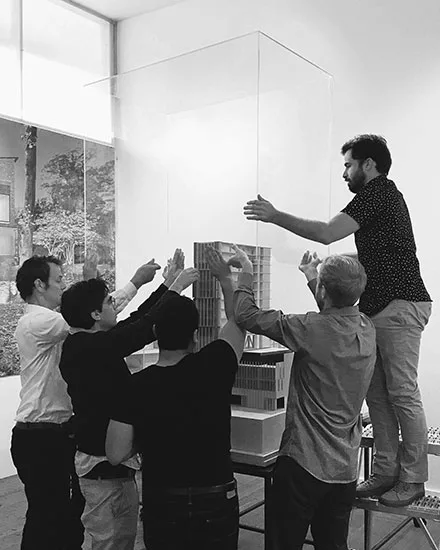
NADAAA team members working with a model.
Photo courtesy NADAAA

Joe Valerio of Valerio Dewalt Train in his Chicago office.
Photo courtesy Valerio Dewalt Train
| Diller Scofidio + Renfro | Michael Maltzan Architecture | NADAAA | Selldorf Architects | Valerio Dewalt Train |
|---|---|---|---|---|
| New York | Los Angeles | Boston | New York | Chicago + Other Locations |
| Founded in 1981 | Founded in 1995 | Founded in 2011 | Founded in 1988 | Founded in 1994 |
| 100 employees | 30 employees | 25 employees | 70 employees | 82 employees |
It’s not always clear when to make a leap. “The hardest period for us was when the office had 25 people,” says Sara Lopergolo, a partner in the now 70-person New York–based firm Selldorf Architects, whose early work on art galleries and residences has led to larger museum projects and apartment towers. “That was the moment we realized we needed to put systems in place to grow, recognizing that we needed to hire for specific roles, upgrade technology, and reorganize the office structure to allow expansion.” Transitioning from a small studio to a midsize firm often entails an exponential increase in overhead—in some cases supporting multiple locations. But it also brings more opportunities, including projects that are larger and more complex, even global.
A midsize firm is like the middle child, competing both with large corporate firms and the wealth of assets available to them, and small offices that can be nimble and may produce the same amount of work on a shoestring budget. In fact, midsize firms are hard to sustain: in recent years, more and more of them have been swallowed up by behemoths like Perkins + Will (which snapped up Texas-based interiors firm lauckgroup and the much larger Danish firm Schmidt Hammer Lassen just since the start of 2018). But despite the challenges, many principals will tell you that their “magic number” falls somewhere in that middle ground between 20 and 100 people, even though less than 10 percent of all American firms are that size. “Seventy feels like a good number for us,” says Annabelle Selldorf, founder of her eponymous firm. “The studio-like environment makes it possible for me to still be involved in all the projects with the four partners. And we can get the whole office together in the conference room. That might seem minor, but it is important in having a good spirit in the office, where people can really get to know one another.”
At 30 people, Los Angeles–based Michael Maltzan Architecture is working on residential, commercial, cultural, and institutional projects at various scales across the globe, but the founding principal feels that midsize crunch. “We compete against a very wide range of firms,” says Maltzan, noting that he’s been on short lists and walk-throughs with large corporate firms. “It’s surprising, because they come with a whole different culture and depth of resources,” he says, “and you’ll also see very small, emerging firms, at times.” That didn’t used to be the case, according to Maltzan, but it shifted significantly during the Great Recession. “You can’t put too bright a line under how much the recession—in sometimes very dramatic and sometimes subtle ways—changed the structure of the profession.”
The AIA’s 2016 Firm Survey Report says that, in terms of revenue, U.S. architecture firms made a nearly full recovery from the recession. But many architects say that fees have not rebounded to their pre-2008 levels and that clients increasingly expect more—and aren’t always willing to pay for it. “We never included designs for RFQs,” says Lopergolo, “but now many of them require it.” Joe Valerio of the 82-person Chicago-based firm Valerio Dewalt Train, which works frequently with the tech industry, points to other changes in the RFQ and interview process. “They not only want to know who on your staff will be working on a project and how many hours they will be spending on it, they want to see those people’s résumés.”
Competitions, on the other hand, have almost always been a losing financial proposition for firms, which can spend as much as 10 times what they receive as a fee (if there is one) for a short-listed competition, with only a small chance of winning. But when it works out, it can make all the difference. To weather the recession, Nader Tehrani took a gamble, entering his firm, then Office dA, in 14 competitions and RFQs in 2008, coming away with three wins—the Melbourne School of Design, the Hinman Building at Georgia Tech, and the Daniels Faculty at the University of Toronto—a trio of architecture schools his 25-person Boston-based firm NADAAA has recently completed.
Similarly, back in late 2009 and early 2010, when most studios were struggling to survive, New York–based Diller Scofidio + Renfro (DS+R)—an interdisciplinary practice that had only completed one major building, the Institute of Contemporary Art in Boston—won six competitions in a row, including the Broad Museum in Los Angeles, the Museum of Image and Sound in Rio de Janeiro, and the Vagelos Center at Columbia University in New York. In one year, the office grew from 40 to 80 people—it is now at about 100 and continues to enter many competitions. “Maybe we were just lucky, but I think there’s a double reason,” says DS+R partner Ben Gilmartin. “We’re a highly specialized practice. Our business model isn’t based on cranking out the same thing over and over again. It’s a model that is very hard to sustain today because so many things can be automated. Contractors can take over a lot of that work without even needing architects to participate. But in many other ways, there’s a shrinking of our market. Being in a space where you have the privilege to do pretty distinct, one-off projects that are highly creative, we’ve been able to increase our agency.” And their visibility.
Underscoring the value architects bring to a project has become ever more important, given tightening purse strings and evolving technologies. “I think the recession made everybody sit up and say, ‘What do we need to do to increase the value that we provide?’ ” says Valerio. “An architect always believes that, whatever the question is, design is the answer. But do we really understand the question?”
Looking for quick answers on architecture and design topics?
Try Ask RECORD, our new smart AI search tool.
Ask RECORD →
To succeed and thrive, architects are expanding their services, responding to the needs of clients to help solve complex problems. “We’re seeing large-scale developers turning toward architecture to help them work through the development business model,” says Maltzan, who from early in his career took up a community-liaison/developer role for many of the low-cost housing projects he’s completed. “Lately we’ve been asked to help developers plan the programming and start to strategize an approach to getting land entitlements. Architects are working more in the space of urban planning and urban design. There’s less of a distinction between architecture and landscape and planning than there might have been years ago.”
When it comes to complicated projects, architects are often the glue. “My biggest power is when I go into a meeting filled with consultants, engineers, planners, this and that, and everybody brings expertise to the table, none of whom can paint a picture that’s larger than the sum of what they know,” says Tehrani, who juggles his practice with his role as dean at the Cooper Union School of Architecture in New York. “As architects, we conceptualize something that is a bridge between them.”
Finding senior architects with that kind of expertise, however, is a common struggle for midsize firms: some left the profession after the recession; others are less willing today to risk a stable position at a large firm for a new, less certain one. “During the height of the last building boom, when people were doing really big projects, firms couldn’t hire fast enough,” explains Katherine Faulkner, a founding principal of NADAAA with Tehrani, who admits to turning down work rather than hiring too quickly. “That became a real problem, because there were very good people that you would bring in, but you just can’t expect them to know all your standards and how you work. Even a very senior person would need time to join in.” Though Faulkner has taken a slow approach to growth, she would eventually like to see the office reach 50.
For a variety of reasons, it can make sense for a small to midsize firm to partner with a larger one on a big project. “If you’re doing a performing-arts center, and there’s a firm that has done many of those, you stand to benefit so much from their intelligence,” says Tehrani. “We’re working with DLR Group right now. That collaboration is something that catapults you into the stratosphere.”
Though Maltzan’s firm will often be the design architect and architect of record, it too collaborates with bigger firms. “If we were doing full service on all the projects that we were doing, the office would probably be twice the size,” he admits. For instance, the firm just finished the Brickyard, a two-building office complex in Los Angeles for Tishman Speyer, and the executive architect was Gensler. “They have a long relationship with Tishman Speyer on commercial buildings, so that made a certain amount of sense.”
With the challenges for midsize firms come advantages, besides the obvious one of maintaining an intimate, or at least informal, office culture. “The office needs to be at this scale to legitimately take on larger, more public institutional projects,” says Maltzan, whose staff size rebounded to its pre-recession level in recent years. Those types of projects tend to be more profitable. Private residential work—the bread and butter of many smaller practices— can sometimes be a drain on resources. “If you’re designing a house, and you’re charging 20 percent, it’s probably not enough, because the clients will ask you for endless handholding, revisions, and oversight that will cost you 30 percent to do,” explains Tehrani. “If you’re doing a tower with repetitive units and relatively little variation, you stand to get a lot of profits just from the bulk, even if the stakes are bigger.”
When asked where they see architecture heading, these architects are both hopeful and cynical at the same time. “I think the future of the profession and the way that we practice is an enormous question mark,” says Maltzan. “But I don’t think the discipline of architecture has ever been more valuable than it is today. What architecture, in its broadest definition, can bring—the type of intelligence, of historical knowledge, of creative ability, and of critical thinking that the discipline has at its core—I think is more powerful than ever.” Despite economic and technological pressures, midsize, design-oriented firms like these believe they are uniquely positioned to translate this expanding influence of architecture into practice.
Looking for a reprint of this article?
From high-res PDFs to custom plaques, order your copy today!