Living in the U.S.: At What Cost?

Home prices in San Francisco rose 14.5 percent in the past year.
Photo © Haizhan Zheng/Getty Images
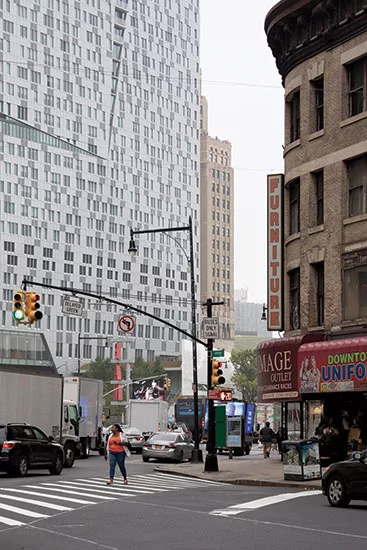
Rents in changing areas like Downtown Brooklyn, NY, are rising with new towers.
Photo © James Ewing
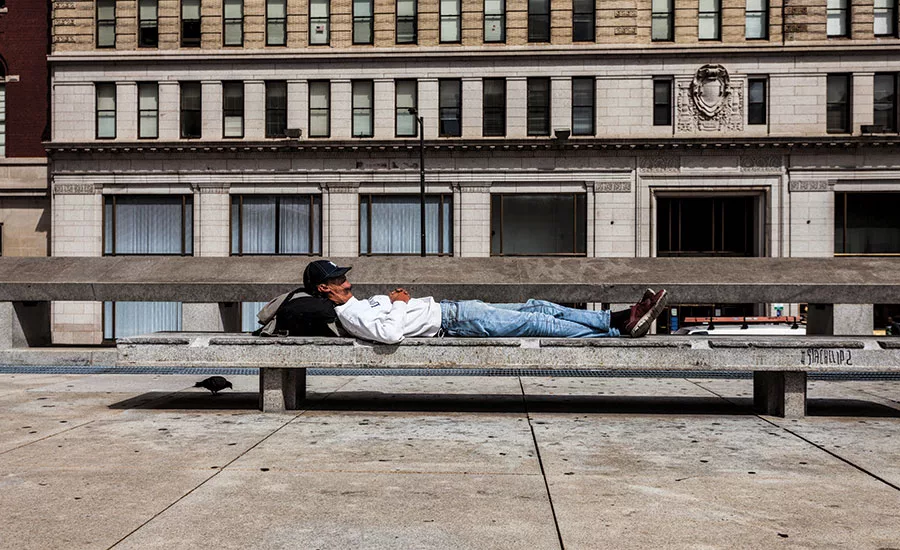
Homeless populations are growing in cities like Philadelphia and Seattle.
Photo © Zooebala/Getty Images
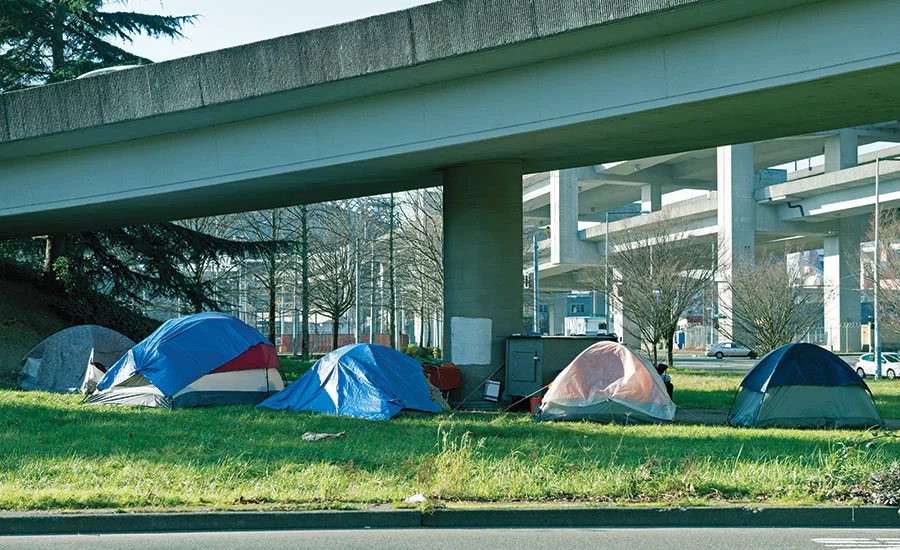
Homeless populations are growing in cities like Philadelphia and Seattle.
Photo © Phil Augustavo/Getty Images
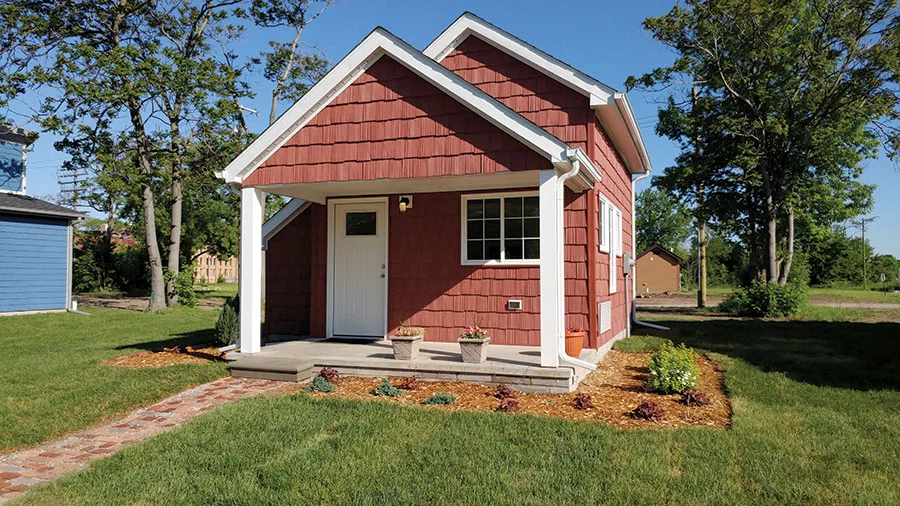
Tiny houses, such as this one in Detroit, are being built to address their needs.
Photo courtesy Cass Community Social Services
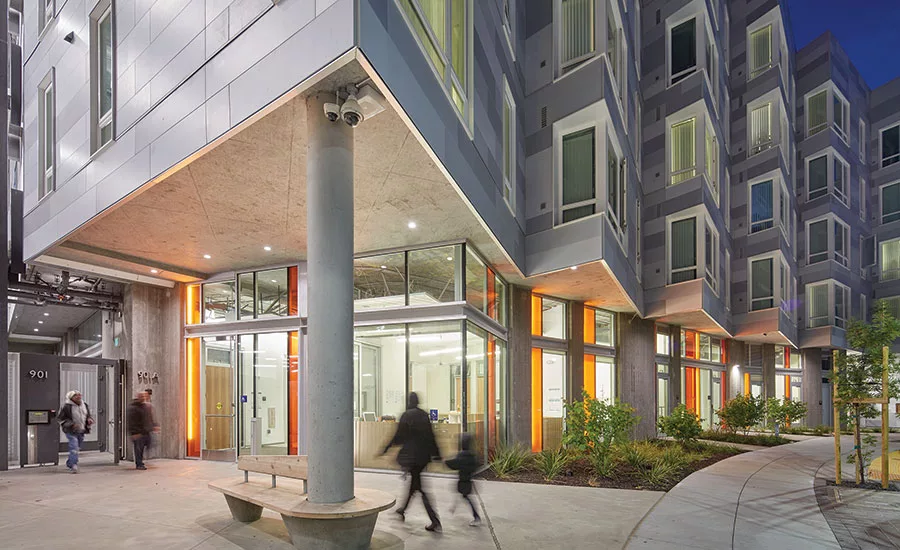
San Francisco’s Hunters View, a joint venture between Paulett Taggart Architects and David Baker Architects, addresses many public-housing issues.
Photo © Bruce Damonte
It’s no longer shocking, but it should be: the average price of a Manhattan apartment hovers around $2 million; in San Francisco, the median price of a home increased by 14.5 percent in the past year, and now coasts above $1.6 million; in some neighborhoods in Seattle, prices have increased 40 percent in a year. Residents of coastal cities—where land costs have soared—have become accustomed to mind-boggling house prices, but now cities like Cincinnati, Philadelphia, and Salt Lake City are witnessing unprecedented price appreciation.
The median home price rose 41 percent faster than overall inflation between 1990 and 2016. Nearly one-third of U.S. households—38.1 million owners and renters—paid more than 30 percent of their incomes for housing in 2016. While the situation has been tough for homeowners, it’s been undoubtedly worse for renters. According to the Harvard Joint Center on Housing Studies, almost half of all renters are paying more than the federal benchmark of affordability of 30 percent of their gross income for housing. Fully 80 percent of renters making less than $30,000 in 2016 were deemed cost-burdened. The National Low Income Housing Coalition (NLIHC) found that to afford the rent for an average one-bedroom apartment, workers would need an hourly wage of $17.90 at a full-time job. (Do the math: a worker at the national minimum wage of $7.25 per hour would need to work 99 hours per week, 52 weeks per year to afford the same rent.) While renters make up 36 percent of households nationwide, they’re the majority in 42 of the country’s 100 largest cities, where the housing crisis is most acute. And there’s little relief in sight.
But unaffordable housing is not just an unfortunate economic situation. Studies show that the high cost of housing is driving the United States’ widening inequality and serving as an obstacle to economic mobility, especially for young people. It also correlates with racial segregation. The home ownership gap between black and white Americans is growing larger. Between 1994 and 2016, black home-ownership rates increased just 0.3 percent while white rates rose 2.2 percent; black and white home-ownership rates now stand at 41.6 percent and 72.9 percent, respectively. And while homeowners get economic benefits such as a mortgage-interest tax deduction (up to $750,000 in the new tax bill) or the ability to leverage home equity for college loans or medical expenses, renters fall further behind.
Homelessness is on the rise too, a stark reality when viewed against cities’ booming economies and low unemployment. While chronic homelessness (a condition defined as homeless for more than one year with a disabling condition) was declining for much of the last decade, it has increased by 12 percent since 2016. One might typically think of the homeless as single men, but 33 percent of all people experiencing homelessness are families and, tragically, another 7.4 percent are unaccompanied youth under 25 years old.
Not surprisingly, the lack of affordable housing can be linked to lower mental and physical well-being. Living in substandard housing increases risks to health such as asthma and exposure to lead, while experiencing a foreclosure—even living near foreclosures—is associated with elevated levels of anxiety, depression, and violent behavior.
There is agreement among many local and state governments that we have a housing crisis on our hands, and therefore, an economic, social, and health crisis. And yet the U.S. Department of Housing and Urban Development (HUD) under Secretary Ben Carson views federal subsidies for housing as a hindrance to self-sufficiency, as evidenced by the proposed Making Affordable Housing Work Act, which would require public-housing authorities to raise the minimum rent on their lowest-income residents from $50 to $150 per month. Carson’s perspective, notes Diane Yentel, president and CEOof the National Low Income Housing Coalition, is that “if people were to just try harder, they wouldn’t be as challenged by housing affordability. Which is just so clearly wrong at a time when the housing-affordability crisis has reached historic heights.” What many officials don’t see is the frustrating and time-consuming effort required to access subsidized housing. According to a recent study by the Urban Institute, actually sponsored by HUD, landlords reject applicants with Section 8 vouchers at rates as high as 78 percent in areas such as Fort Worth; not surprisingly, more denials occur in low-poverty neighborhoods, thwarting the Housing Choice Voucher program’s goal of helping people access high-opportunity neigborhoods.
For decades now, federal investment in affordable housing through HUD’s signature Community Development Block Grants (CDBG) has been declining. Created in 1974, the CDBG program’s budget has remained approximately $3 billion per year and thus has lost 80 percent of its value due to inflation. In the face of the federal government’s stepping back from the severe current problems, cities across the country are racing to find new sources of housing revenue in the form of taxes and bond measures, as well as solutions such as zoning that mandates some affordable housing. But none comes easily, or without controversy.
Looking for quick answers on architecture and design topics?
Try Ask RECORD, our new smart AI search tool.
Ask RECORD →
Seattle made headlines earlier this year for its proposed “head tax” on large businesses, like Amazon, that would have funneled some $47 million toward affordable housing and addressing homelessness; but after corporations protested, the tax was repealed. On the first day of this fall’s legislative session, Philadelphia’s mayor and city council agreed to withdraw a long-debated proposal for a tax on all construction, and instead will secure approximately $71 million for affordable housing over the next five years through the city’s general fund and by collecting fees from developers who pay for density bonuses. Meanwhile, a handful of cities such as Washington, D.C., and Boston have directed that residential construction in some areas include a percentage of affordable housing or that developers pay a fee to a housing building fund. But these inclusionary zoning programs are generating far too few units considering the scale of the problem—some hundreds of units against thousands of people on wait lists. “The evidence on inclusionary zoning is mixed, and I’m not optimistic that it will make a dent in the problem,” says Jenny Schuetz, David M. Rubinstein Fellow at the Brookings Institution. “But an awful lot of places have used it as a Band-Aid and a way to show they care about affordable housing.”
State governments are also getting involved in the creation and preservation of affordable housing. California, which is home to 21 of the 30 most expensive rental markets in the country, will pose two housing-related ballot questions to voters this November. Proposition 1 would allow the state to take out $4 billion in general obligation bonds for housing-related programs, including $1 billion in loans for veterans to purchase housing and $1 billion toward a program to assist people with incomes at 60 percent or below Area Median Income. Proposition 10 would reverse a law that prevented municipalities from imposing rent controls on new multifamily buildings.
“Proposition 1 could be a big boost for California’s efforts to end homelessness and the affordable-housing crisis,” says Yentel.
“While these ballot propositions may provide much needed rent relief,” says Vincent Reina, assistant professor, City and Regional Planning, at the University of Pennsylvania, “they do not address a key driver of the affordability problem, which is the severe shortage of supply in response to the state’s overwhelming demand.” The NLIHC has found that there are 7.2 million affordable-housing units lacking across the country, and 1 million of those are in California alone.
To reduce the time and costs of constructing housing, new companies are touting business models based on technology and prefabrication. Katerra, a Silicon Valley end-to-end building provider now valued at $3 billion is seeking to disrupt the traditional housing industry with factory and jobsite integration that increases productivity and lessens construction waste. Earlier this year, New York’s Department of Housing Development and Preservation issued its first-ever RFP to build a modular, multiuse, mixed-income housing development in Brooklyn’s East New York neighborhood, showing how cities can make building affordable housing, well, more affordable. The nonprofit New Story Charity is exploring 3-D printing and other technologies to create new housing cheaply: the company says it can 3-D-print a 650-square-foot house for just $10,000. Its main applications will be in disaster zones, but one can imagine the eventual use in U.S. communities. Blokable, another Silicon Valley company, offers a 328-square-foot cottage for $58,000. Suddenly, a thoughtfully designed tiny house becomes as affordable as a mobile home. But Schuetz warns that much of the time spent developing housing isn’t for construction. It’s the slowdowns, from land acquisition to zoning to permitting, that can add years—and costs—to preconstruction. And, indeed, such tiny houses aren’t legal in many locales.
One way cities are looking at speeding up the supply of new housing is to legalize outlawed alternatives to the single-family house, such as the tiny houses, accessory dwelling units (ADUs)—aka granny flats—and co-living. After years of fighting ADUs, California now supports them as a way to create density without upzoning. In Detroit and Nashville, tiny houses are adHomeless dressing homelessness. In New Orleans, the city approved a 233-unit co-living development for service-industry workers, so long as the developers pledge to freeze rents at affordable rates. In Philadelphia, the city is considering bringing old-fashioned rooming houses up to code.
Clearly, new thinking is needed to address such an enormous national problem. Two recent proposals for housing relief from Senator Kamala Harris (DCalifornia) and Senator Cory Booker (D-New Jersey) would provide tax rebates to those paying more than 30 percent of their income on rent. The separate proposals attack the inequality in tax policy for homeowners and renters, but there is a potential downside. “The challenge will be if the market then reflects the tax benefit, and landlords then just charge higher rents,” says Reina.
Yentel sees these “big, bold” proposals as a sign that the country is ready for a national conversation about the affordability crisis in the next presidential election, if not as soon as the midterms this November. And it’s not just coastal Democrats making housing an issue: there are a number of bipartisan bills making their way through the political process, including a bill to expand the Low Income Housing Tax Credit, and a bill introduced by Senator Todd Young (R-Indiana) to create a national affordable-housing task force.
But government is only one channel for attacking the housing crisis. When the market is king, developers have to step up, and a younger generation is calling for changes in the market altogether, with easier and faster development processes that both stimulate the production of housing and encourage housing quality and stability. Often strapped with debt and priced out of desirable housing markets, millennials have taken up the mantle of YIMBYism (Yes In My Backyard) to fight for more housing supply. A new generation of urbanites, NUMTOTs (New Urbanist Memes for Transit Oriented Teens) are using social media to fight for better transit options, to ensure access to affordable housing in more outlying urban neighborhoods. Such grassroots approaches have helped encourage high-density construction in urban areas and provide cover for politicians who want to see more development too.
Yet, as Yentel reminds us, “there is no silver bullet for affordable housing.” The fact that there is no easy fix can feel disheartening, but it does mean that no one entity is responsible for addressing the affordable-housing crisis. Policymakers, developers, planners, architects, and advocates of all stripes must play an active role in pushing for creative solutions.
Looking for a reprint of this article?
From high-res PDFs to custom plaques, order your copy today!

-High-Caliber-Captures.webp?height=200&t=1725895765&width=200 "Williams-Crossing-(c)-High-Caliber-Captures.jpg")