Continuing Education: Resilience Rating Systems
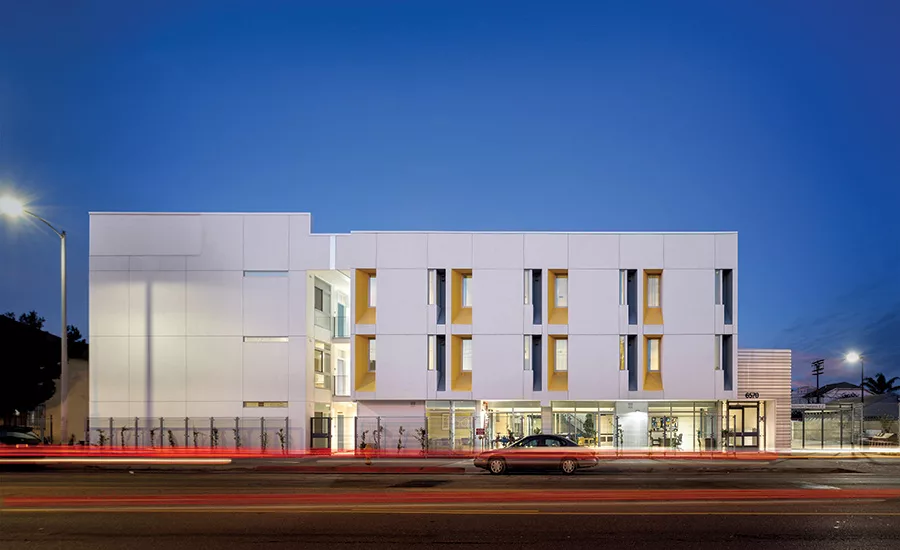
FSY’s Silver Star Apartments, housing for formerly homeless veterans in Los Angeles, incorporates a variety of strategies that should help it weather disruptive events. The measures include orientation-specific window shading, rooftop PVs with battery storage, and a configuration that promotes natural ventilation.
Photo © Natalia Knezevic Photography
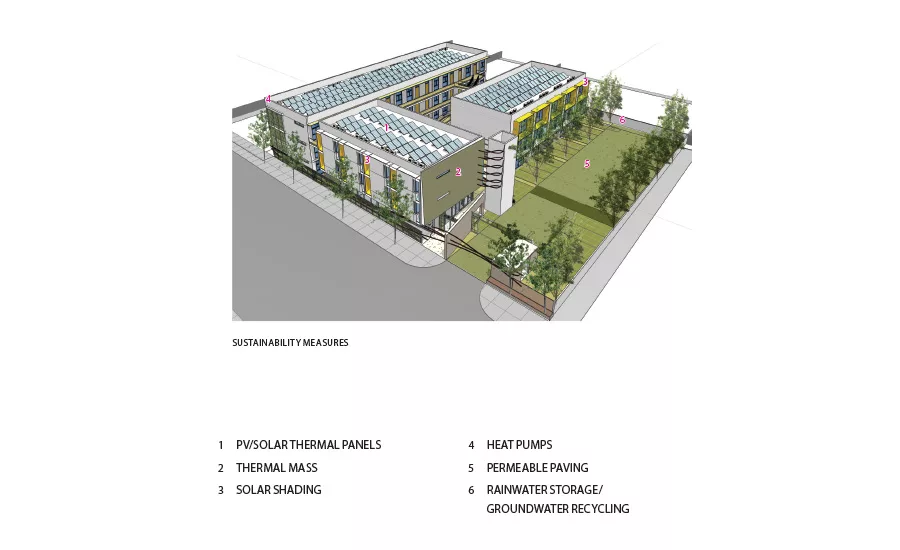
Silver Star Apartments—Sustainability Measures
Image courtesy FSY
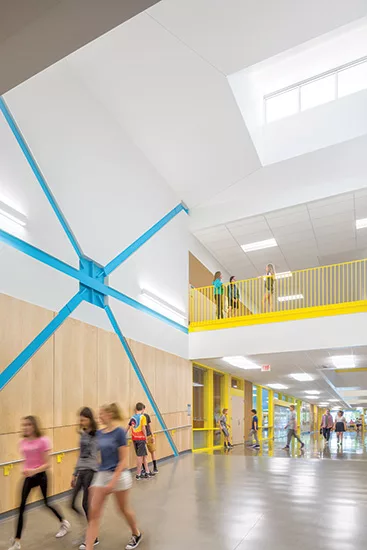
The buckling-restrained braced frame structure at the Mahlum-designed middle school for Oregon’s Beaverton School District should enhance its seismic performance.
Photo © Josh Partee
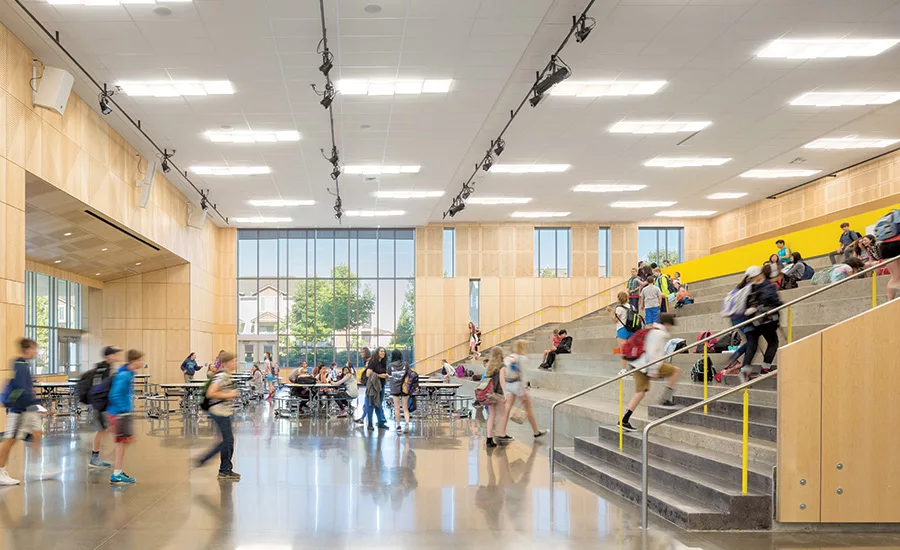
The middle school’s commons has a backup power supply so that it can serve as an emergency shelter for local residents.
Photo © Josh Partee
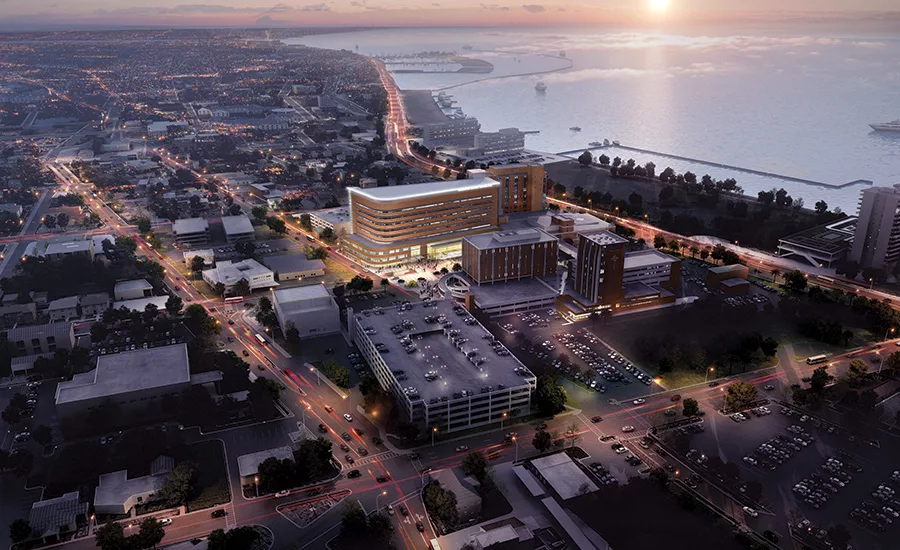
Perkins+Will’s schemes for a pair of hospitals, one in Corpus Christi, Texas (shown), and another in Oklahoma City, respond to threats specific to their locations, including hurricanes and tornadoes.
Photo courtesy Perkins+Will
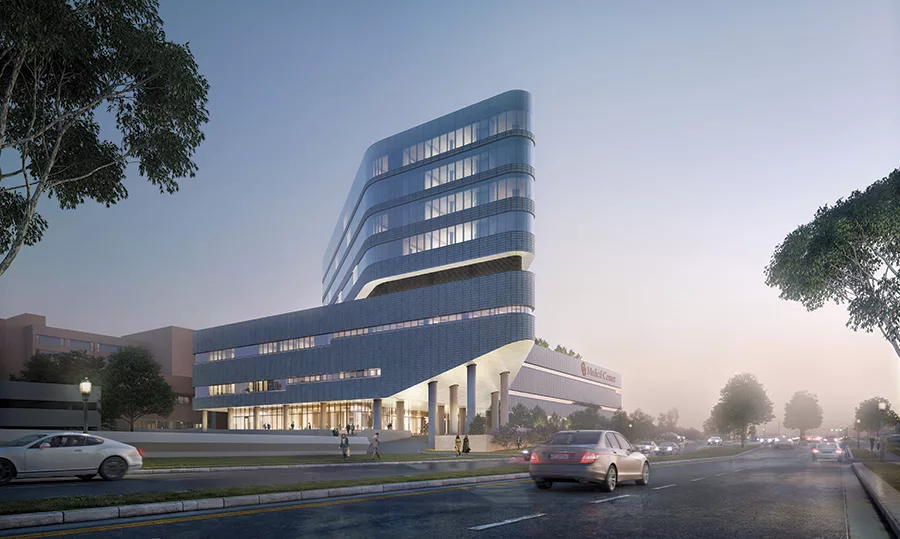
Perkins+Will’s schemes for a pair of hospitals, one in Corpus Christi, Texas, and another in Oklahoma City (shown), respond to threats specific to their locations, including hurricanes and tornadoes.
Photo courtesy Perkins+Will
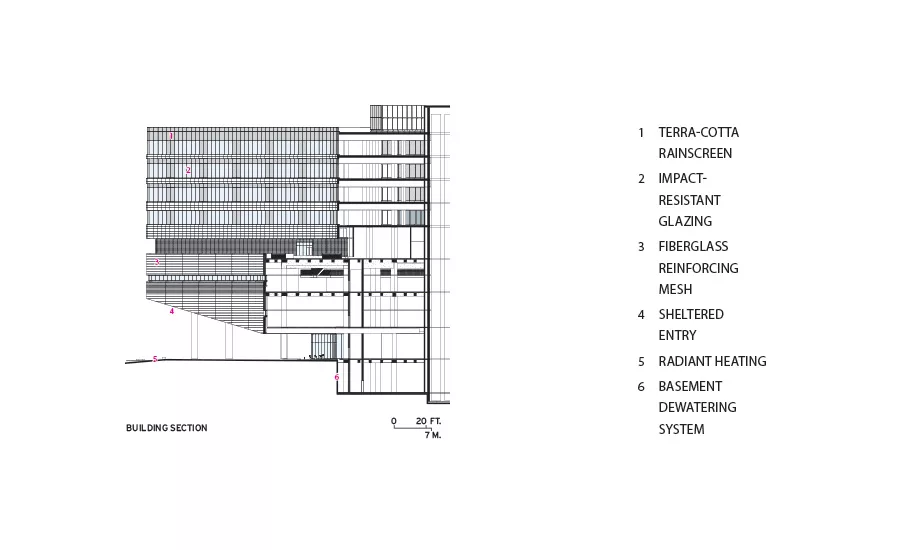
Image courtesy Perkins+Will
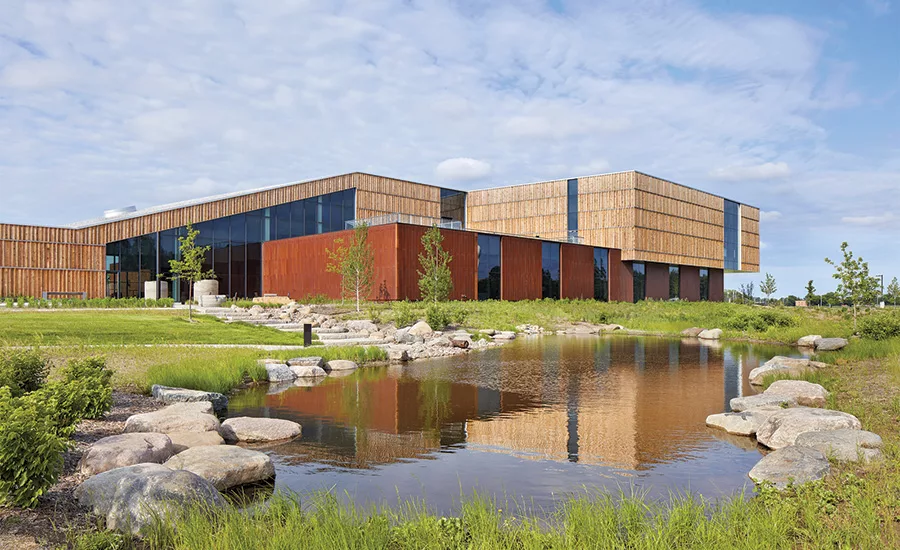
The Bell Museum of Natural History, in St. Paul, Minnesota, by Perkins+Will, has features aimed at preserving biodiversity, including bird-safe glass incorporating a subtle horizontal frit, and a pond that fosters wildlife habitat.
Photo © Corey Gaffer
The Bell Museum of Natural History, in St. Paul, Minnesota, by Perkins+Will, has features aimed at preserving biodiversity, including bird-safe glass incorporating a subtle horizontal frit, and a pond that fosters wildlife habitat.
Photo © Corey Gaffer
Each fresh disaster, whether hurricane, wildfire, flood, or tornado, and each sign of global warming, whether rising seas, recurring drought, melting permafrost, or new disease, makes the urgency of resilient design more emphatic. Resilience is sustainability for an unstable world—the capacity to adapt to changing conditions, to maintain or regain functionality in the face of stress and disturbance, and to continue to thrive. As growing public awareness increasingly prioritizes resilience, a slew of new guidelines and rating systems are emerging to help.
“As with sustainable building, where the LEED rating system—most prominently—provided an easy way for a building owner to specify green, a rating system can do the same for resilience,” says Alex Wilson, president of the Resilient Design Institute. Some frameworks target a single hazard. The Resilience-based Earthquake Design Initiative (REDi) and the U.S. Resiliency Council rating systems, for example, address seismic events—although the latter plans to expand its scope. Others, such as the Insurance Institute for Business and Home Safety’s Fortified programs, focus on weather. But, here, RECORD investigates a handful of systems that are more broadly based, helping users address a gamut of acute shocks and chronic stresses, including RELi, a comprehensive resilience rating system the U.S. Green Building Council (USGBC) is poised to launch.
“Many of the strategies that improve sustainability under LEED inherently improve resilience as well,” says Jennifer Druliner, vice president of governance at the USGBC. A project illustrating her point is Silver Star Apartments, a 49-unit LEED Platinum–certified housing development for formerly homeless veterans, completed in 2017. Designed by Los Angeles–based FSY Architects, Silver Star is the first zero net energy (ZNE) affordable housing project in L.A. and is on track to achieve Living Building Challenge Zero Energy certification from the International Living Future Institute (ILFI).
Beyond being designed to withstand earthquakes in accordance with the city’s strict seismic regulations, the three-story wood structure’s strategies for sustainability will help its tenants to weather a range of disruptions. For instance, in the aftermath of a disaster that results in power outages, Silver Star will be able to draw on solar-generated electricity from its ILFI-mandated battery storage system to power essential functions in a common area. Residents will be able to charge communication devices, for example, and refrigerate medicines and food.
Complementing the emergency power provision are a variety of strategies familiar from LEED and LBC that will help the building remain habitable even without power. These include a courtyard configuration to facilitate cooling and natural ventilation, shading devices appropriate to facade orientations, and daylighting. A less familiar passive strategy is the use of phase change material (PCM), a compound, installed in quilt-like plastic sheets in the building envelope, that hardens as it cools overnight and absorbs heat as it melts during the day. Intended to bring cooling loads within the capacity of the photovoltaics that fit on Silver Star’s roof, the PCM will also help the building to remain habitable even if the air-conditioning stops working.
One significant contributor to the development’s resilience is a design that fosters social connectivity. Besides being essential to the well-being of the veterans who live here, many of whom struggle with mental-health issues, the patterns of social interaction and mutual support encouraged by the building’s plan can help provide a foundation for cooperation after a disruption. So laundry facilities are located to attract people to the building’s courtyard and its central, open-air lounge. Staircases are offset at each level to require a short walk along floors other than a tenant’s own. And a community garden is in the works. “If sustainability is truly done well,” says Anuj Dua, an associate at FSY, “then you only have to do a little bit more so that, in an emergency, people can continue to function.”
Projects certifying under the LEED system for new construction will soon have a framework for thinking explicitly about what that little bit more entails. Three resilience pilot credits, which were available for a period following their launch in late 2015, are now in the process of being refined to harmonize with RELi prior to being rereleased, according to sources on the USGBC’s Resilience Steering Committee. The pilot credits provide practical ways for project teams to begin to integrate resilience into their designs, requiring risk assessment and planning, remedies to mitigate impacts, and provision for passive survivability (the ability to maintain a minimum level of habitability during an extended loss of services such as power, heating fuel, or water).
Looking for quick answers on architecture and design topics?
Try Ask RECORD, our new smart AI search tool.
Ask RECORD →
Whether or not a project is pursuing certification, a growing number of frameworks developed by states and municipalities, such as the Oregon Resilience Plan, New York’s Climate Resiliency Design Guidelines, and Resilient New Orleans, support resilience planning. To varying degrees these guides have done the legwork of identifying the risks pertinent to their region, and offer resources and recommendations to design for them at a range of scales. The Oregon Resilience Plan (ORP), for example, the product of a public-private collaboration, released in 2013, addresses the impacts of earthquakes and tsunamis. It has inspired revisions to the state land-use plan that will restrict development within a tsunami-inundation zone, the development of a Resilient Transportation Plan, and increased funding for the seismic upgrade of schools and essential facilities.
To meet and exceed ORP’s goal for shelters to open almost immediately and schools to reopen within 30 days, the state’s Beaverton School District established three goals for its disaster-resilient new middle school, by the Portland office of Mahlum Architects. The first requires that staff and students are able to shelter in place for 96 hours; the second, that the building and grounds be able to function as a public shelter, distribution center, and campground for 30 days; and the third, that classes have capacity to resume while the school continues to act as a refuge.
In response, the 165,000-square-foot school, completed in 2016, includes several resilience-specific measures as well as providing for overall flexibility of use. The steel buckling-restrained braced frame (BRBF) structure is designed so that the entire building, rather than just designated areas, performs seismically as an essential facility that can be occupied immediately, rather than meeting only the lesser and more common life-safety standard. The school is daylit throughout, including interior stairwells and locker rooms, so that operations can continue without electric light. Provisions for water and waste include piping connections strengthened to resist ruptures, and a bladder (an empty tank) with 96-hour capacity, which can be filled in response to an earthquake-warning system or by an emergency-response water truck afterward. The gymnasium and commons would shelter displaced community members, with a backup generator providing power for emergency needs, such as heating, ventilation, pumping water, and cooking.
During normal operations, a 138-kilowatt photovoltaic array on the school roof generates renewable electricity, with shortfalls taken from the grid and surpluses returned to it. If the grid fails, a switch allows the PV system to be disconnected from it so solar energy can continue to power the building without risk of sending electricity into a system under repair. For now, however, this is only hypothetical; the building code does not permit the PVs to power the building during a utility failure, even if the array is disconnected from the grid. “That’s why it would be better if the ORP became code,” says Rene Berndt, associate principal at Mahlum. Berndt cites the gap between measures that engineering makes possible and measures that jurisdictions will accept as one of the biggest challenges resilience initiatives face. That, and the rising costs of construction.
Ultimately, resilience encompasses more than passive survivability, as RELi, a preexisting rating system adopted by the USGBC for rerelease this year, makes clear. Similar in structure to LEED, with categories, requisites, and a menu of credits leading toward four certification levels, RELi takes a comprehensive approach to resilience across a range of scales. “Besides being a narrow-scope response to weather extremes or the specific elements of climate adaptation, the goal is for it to be more holistic,” says Douglas Pierce, principal investigator for the RELi standard and a senior associate at Perkins+Will. The firm helped develop the rating system with a host of collaborators, including the University of Minnesota School of Architecture. “The aim is to expand the dialogue of what sustainability is,” he says.
RELi’s eight categories provide guidance to a Panoramic Approach (planning, discovery, and systems thinking); Hazard Preparedness; Hazard Adaptation; Community Vitality; Productivity, Health + Diversity; Energy, Water + Food; Materials + Artifacts; and Applied Creativity (innovation). In addition to developing new measures, RELi incorporates the relevant strategies from other standards so as not to reinvent—or to lose sight of—what they already do well.
A handful of Perkins+Will projects that have piloted RELi, or aspects of it, demonstrate its utility. Christus Spohn Shoreline Hospital in Corpus Christi, Texas (a 400,000-square-foot tower supporting the consolidation of two hospitals), and a new 10-story tower at the University of Oklahoma Medical Center in Oklahoma City, both under construction, are the standard’s first two full projects. They share some strategies, including redundancy in the central plant, provision for a shelter-in-place period, and a command and communication center. Yet each facility’s resilience provisions are different, in anticipation of local threats.
Christus Spohn is built above the 500-year flood plain, with hurricane-resistant structure and cladding and oversize roof drains. The area under the ambulance canopy converts into a mass-decontamination facility in case of an oil-rig or other industrial disaster. And in recognition that not all disruption is environmental, its emergency department provides for two flows of traffic, so that patients injured in civil unrest, such as gang-related violence, can wait in a separate area from patients in an opposing faction.
At OUMC, where tornadoes are a central worry, the building’s skin is hardened by steel-stud spacing reduced to 9 inches, a fiberglass reinforcing mesh under the terra-cotta rainscreen, impact-resistant glazing, and a green roof to protect from penetration by wind-driven objects (in addition to that feature’s more familiar advantages). Radiant-heating systems under exterior walkways and driveways reduce the hazards of winter storms. And the building’s foundation and steel frame are designed with moment and braced frames to mitigate seismic risk.
The main challenge in using RELi on these pilots, says Julie Frazier, a Perkins+Will senior medical planner who worked on both projects, was “not so much the technical aspects as the paradigm shift.” Frazier observed signs of rating-system fatigue among members of the project team: “another checklist, more due diligence—it can be overwhelming.” But by the end of the design process, she says, “I think everybody realized the payoff—we’ve done something good and it’s going to perform.”
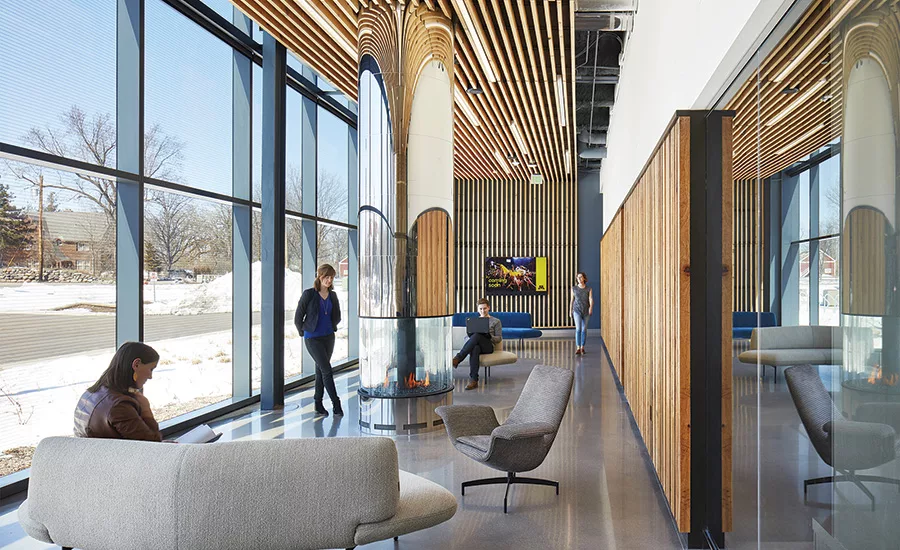
It’s clear why health-care facilities would push the frontiers of resilient design. A museum is a more surprising advocate. But the Bell Museum of Natural History at the University of Minnesota’s Twin Cities campus is very much aware of the United Nations’ finding that the loss of biodiversity poses as great a threat to our society as climate change: only with a diversity of species can ecosystems adapt. For a natural history museum, this issue is a logical fit, so the 90,000-square-foot building, designed by Perkins+Will’s Minneapolis studio and completed in 2017, makes biodiversity a priority, deploying strategies that Pierce expects will inform RELi’s next iteration.
To prevent bird strikes on glass that reflects sky or habitat (a significant factor in bird population decline), all of the museum’s glazing is fritted with tightly spaced narrow gray lines. Surprisingly unobtrusive, the frit has to be pointed out to visitors. The building envelope also engages with the issue of diminished forest diversity, expressed by Forest Stewardship Council–certified thermally modified wood. On the grounds, the landscape design features a hybrid irrigation-bioswale- cum-vertebrate-pond, designed to accommodate a 1,000-year rainfall and at the same time to ensure that water levels never fall below the minimum required for habitat. The project’s low carbon footprint—which meets the 2030 Challenge (a program of phased targets toward a goal of all carbon-neutral building by the year 2030)—also does its bit to mitigate climate-change-caused habitat loss and species migration.
“The revolution here is in seeing the world as a whole system,” says Pierce. “It’s really about systems thinking.” In the five years since work on RELi began, scientists’ understanding of climate change has evolved. While we might all have hoped to avert it with carbon mitigation, says Pierce, the emerging consensus seems to be that abrupt climate change is now under way. As architects are increasingly called on to design for adaptation, resilience rating systems, both familiar and new, can help.
|
Continuing Education
 To earn one AIA learning unit (LU), including one hour of health, safety, and welfare (HSW) credit, read "Continuing Education: Resilience Rating Systems," review the supplemental material listed below, and complete the online test. Upon passing the test, you will receive a certificate of completion, and your credit will be automatically reported to the AIA. Additional information regarding credit-reporting and continuing-education requirements can be found online at continuingeducation.bnpmedia.com. To earn one AIA learning unit (LU), including one hour of health, safety, and welfare (HSW) credit, read "Continuing Education: Resilience Rating Systems," review the supplemental material listed below, and complete the online test. Upon passing the test, you will receive a certificate of completion, and your credit will be automatically reported to the AIA. Additional information regarding credit-reporting and continuing-education requirements can be found online at continuingeducation.bnpmedia.com.Supplemental Material
Iris Tien, Elementa Science of the Anthropocene. 2018; 6(1):18. [Test takers should review all sections through: “Drivers for integrating resilience practices into design of buildings and their linked FEWS: Formal regulations”]Learning Objectives 1 Describe the different types of resilience standards, including those directed at specific threats, those addressing a broad range of disruptive events, and those devised for particular regions. 2 Discuss the relationship between green building measures and resilience strategies. 3 Explain the importance of biodiversity preservation to resilience. 4 Explain concepts and terms relevant to resilient design, such as “passive survivability.”
AIA/CES Course #K1810A
For CEU credit, read "Continuing Education: Resilience Rating Systems" and take the quiz at continuingeducation.bnpmedia.com, or use our Architectural Record Continuing Education app, available in the iTunes store. structure, finishes, and other original fabric when
a building is moved.
significant buildings.
|
Looking for a reprint of this article?
From high-res PDFs to custom plaques, order your copy today!