Tsingpu Yangzhou Retreat by Neri&Hu Design and Research Office
China
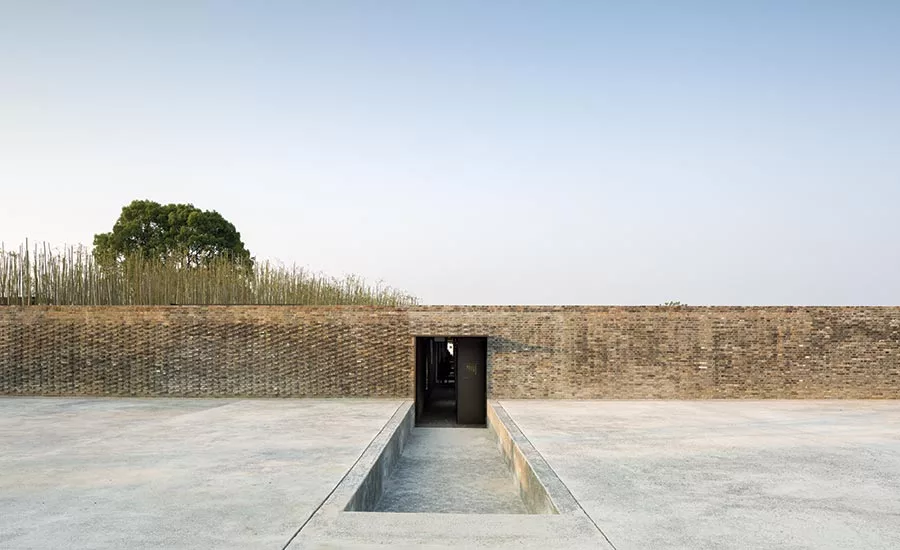
Constructing a wall of salvaged bricks brought order to the retreat's buildings.
Photo © Pedro Pegenaute
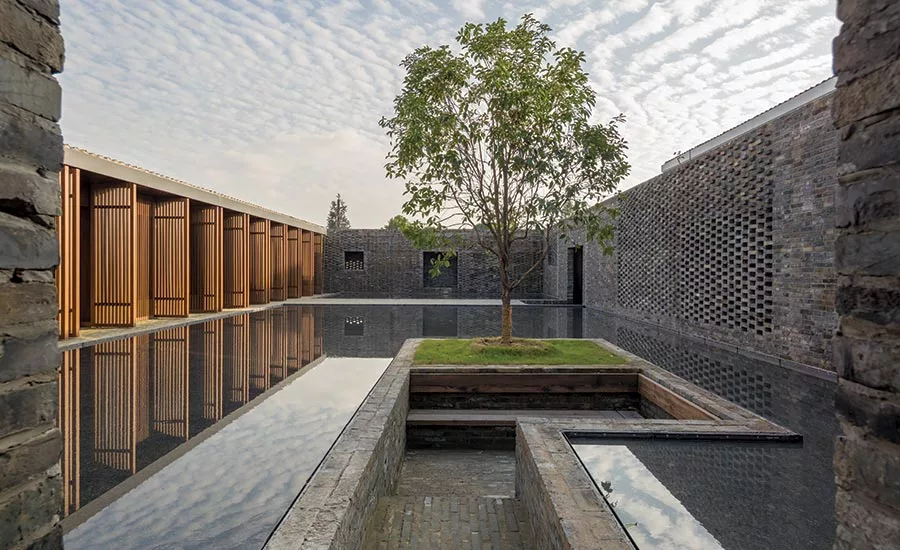
A sunken sitting area in one courtyard holds a tree and reflecting pool like the entrance plaza.
Photo © Pedro Pegenaute
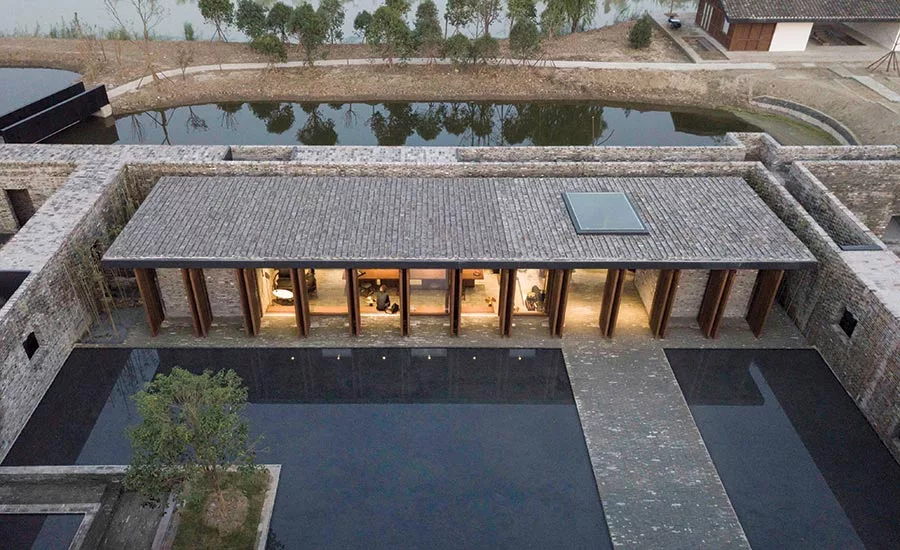
Reception is located in one of several courtyards formed by the site’s maze of walled corridors.
Photo © Pedro Pegenaute
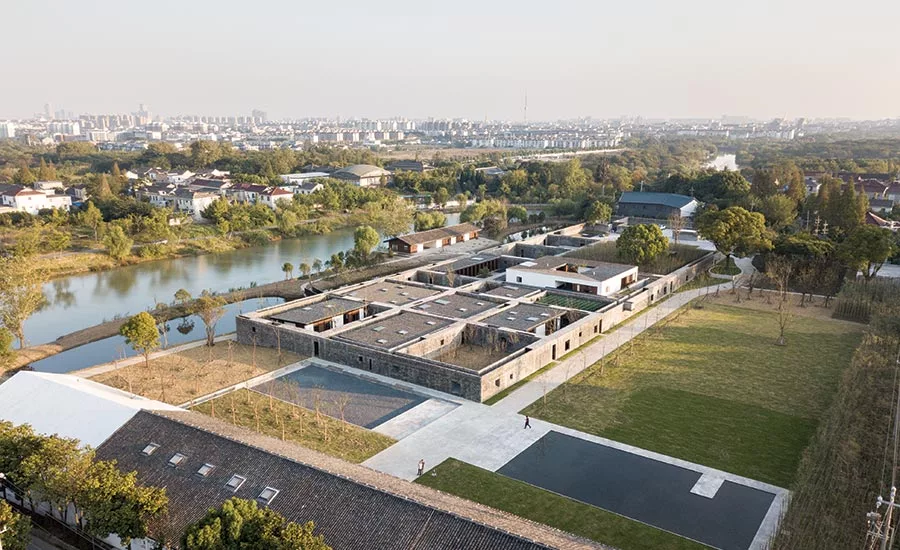
A drone’s-eye view of the retreat shows the rigor its wall imposes.
Photo © Pedro Pegenaute
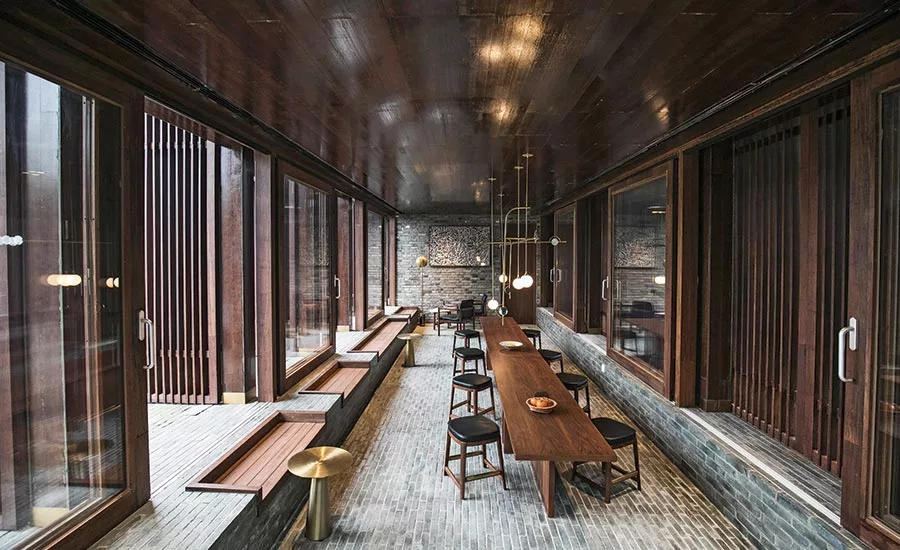
The reception building features a sunken tearoom, one of the several spaces the architects carved out using excavation.
Photo courtesy Neri&Hu Design and Research Office
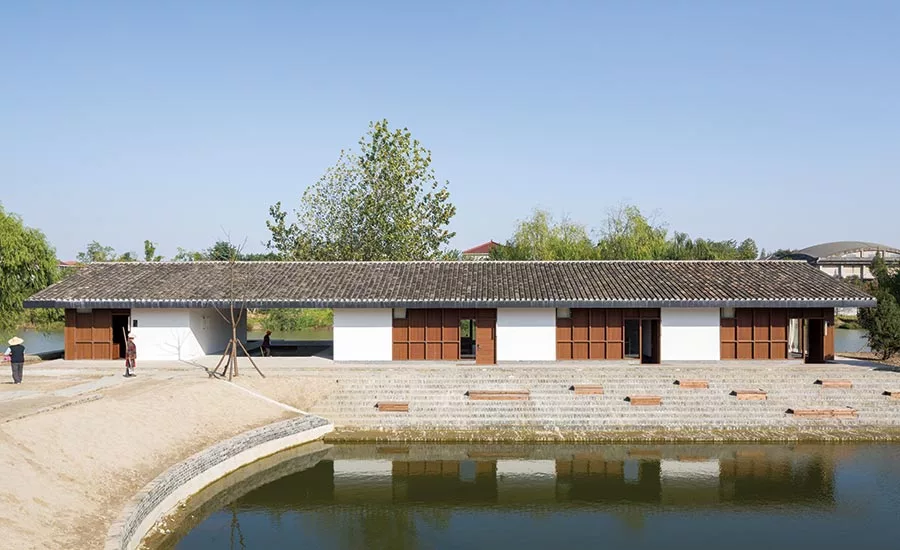
The Lakeview guest rooms and baths open up to fresh air and stepped seating next to a reflecting pool.
Photo © Pedro Pegenaute
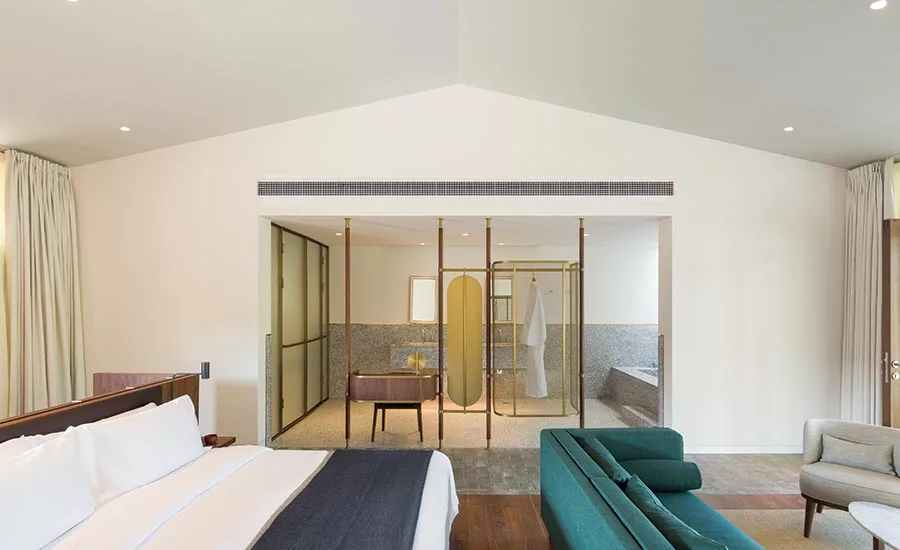
The Lakeview guest rooms feature modern heating and cooling systems.
Photo © Pedro Pegenaute
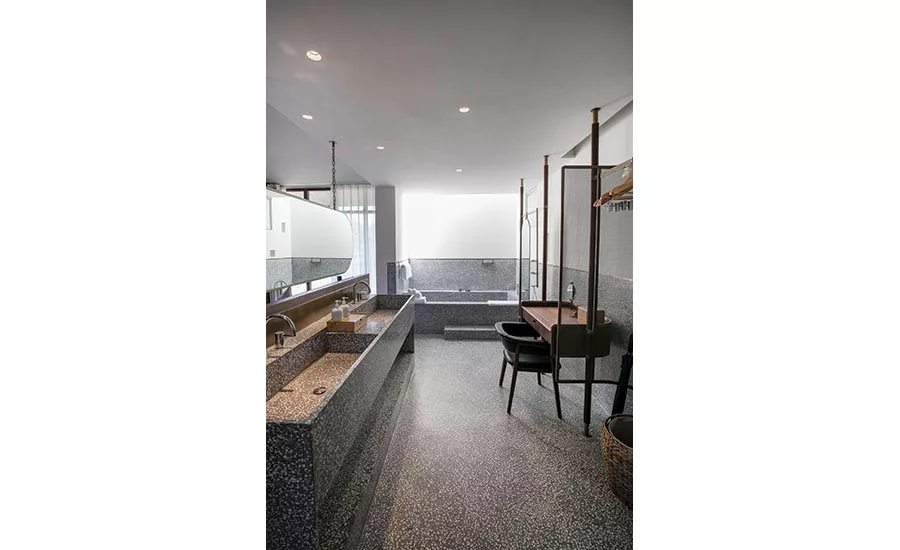
A Lakeview bathroom
Photo courtesy Neri&Hu Design and Research Office
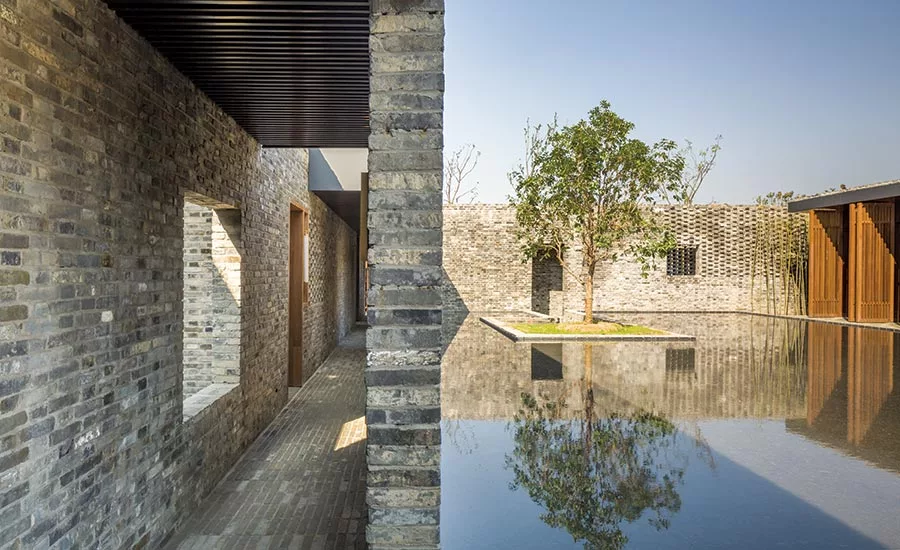
An enclosed corridor leads to reception in one direction and a serene seating area surrounded by water in the other.
Photo © Pedro Pegenaute
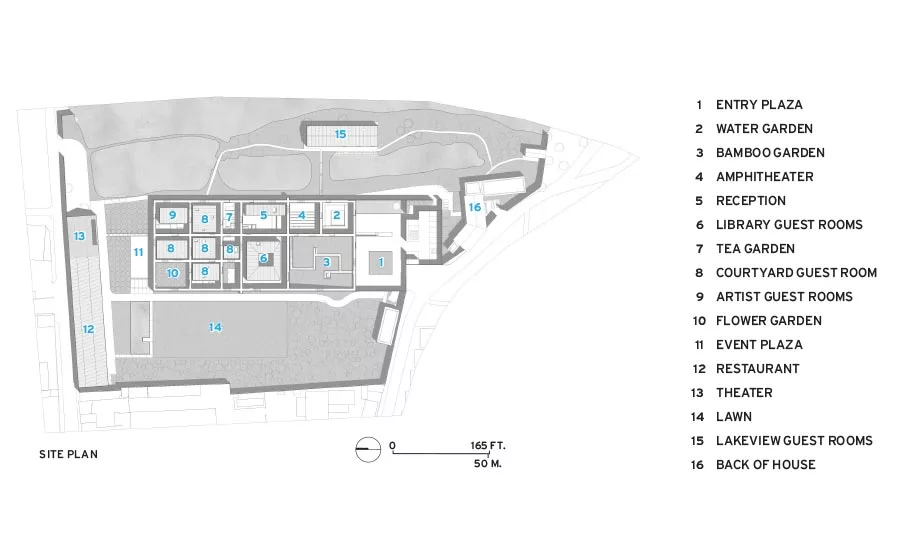
Image courtesy Neri&Hu Design and Research Office
Architects & Firms
On the east side of a vast concrete plaza that welcomes visitors to the Tsingpu Yangzhou Retreat, a rectangular opening cut into a gray brick wall frames a lone tree and reflecting pool—a preview of the landscape that lies beyond the square, within this hotel’s internal grid of brick-walled passageways. In fact, the property features 45,000 square feet of courtyard spaces, with trees, terraces, pools, and 20 spalike guest rooms.
Additional Content:
Jump to credits & specifications
Shanghai architects Lyndon Neri and Rossana Hu, principals of their eponymous firm, conceived this grid of enclosed walkways as an elegant and culturally appropriate way to organize and unify the site’s existing group of scattered structures, which the client, Tsingpu, asked them to transform into guest and event spaces.
Sunken steps lead from the entry plaza down to the front door of the main complex, where visitors enter one of its brick-lined corridors. These open onto and overlook a series of quadrangles that hold buildings for reception and private rooms, as well as bamboo and flower gardens, reflecting pools, and an amphitheater. Two buildings outside the protective wall hold a restaurant, an event space, and additional guest rooms.
All the rooms echo the minimalist aesthetic of the complex’s outdoor areas: private spaces are clad in walnut, with terrazzo floors, and are sparsely furnished with the architects’ own clean-lined modern seating, wood built-ins, and warm brass lighting fixtures—a signature of Neri&Hu projects. The paneled and minimally furnished reception, dining, and workshop areas all open to the outdoors. Although in-room televisions and audio systems are nonexistent, interiors are kept comfortable with a modern HVAC system that is grouped in one courtyard with other mechanicals.
Few individual details are as impressive as the wall that contains the site. With it, the architects turned the assortment of ramshackle buildings on the edge of Yangzhou’s picturesque Slender West Lake into an homage to traditional Chinese courtyard architecture, one that captivates visitors even in a region already famous for its elaborate garden designs.
Although the architects had to work within existing building footprints, each of the 20 guest rooms (ranging in size from 350 square feet to 840 square feet) features a unique configuration, depending on which structure houses it. The bungalow of concrete, brick, and wood at the edge of the lake, for example, has rooms that open up to the water.
Hu says that coming up with the site plan was her favorite part of the project—overlaying the grid of walls and paths to tie the scheme together, creating the many courtyard enclosures. Exploring the walls’ narrow interior passages has become, itself, a popular guest pastime. That’s because the structure “forces a long perspective,” she says, “while light plays off various brick patterns, enticing you to venture ever deeper.”
The Beijing-based Tsingpu Group, which operates four small hotels, has characterized this latest property in Yangzhou as providing a “journey into the inner self” and emphasized that the journey should also feel culturally rich: the walled oasis hosts nearly 100 activities, such as tea appreciation and local crafts workshops, that, along with meals, are included in the price of guests’ stay.
Naturally, the retreat’s architecture also had to project a strong sense of place. Yangzhou is a two-hour drive from Nanjing (the former capital of China) and sits on the northern bank of the historic Yangtze, Asia’s longest river, which is dotted with tourist attractions. Generations of emperors have visited Yangzhou to experience its cuisine and the elaborate gardens of its wealthy scholars and merchants. Those gardens—combinations of pavilions, rocks, and horticulture—were places for contemplation and the enjoyment of food, tea, poetry, painting, and music, just as they are at the Neri&Hu–designed retreat.
In the two years the project took to build, the firm embraced Yangzhou’s history by interviewing locals, studying gardens, and salvaging 1.2 million bricks to construct the wall. Many bricks bear the patina of their previous use. In some parts of the wall, bricks are arranged to completely enclose a corridor, invoking the protective function of traditional walled properties. In others, the brickwork features spaces between each break, resulting in patterns that mimic a perforated screen and provide mysterious glimpses of private plazas and inviting views of bamboo groves or a single tree—the architects’ contemporary riff on the same elements in traditional Chinese gardens.
They also played with elevations, creating communal spaces with amphitheater-style sunken seating in some of the squares, by digging or filling in land. Conversely, some brick stairs lead up out of the passageway to a second story, where a mazelike series of balconies lining the top of the wall invites guests to wander and admire the surrounding landscape.
“We used the idea of a wall as both a landscape and an architectural strategy,” Neri says. “It’s the blurring of both that allowed the project to sit beautifully in the site.”
CreditsArchitect: [Neri&Hu Design and Research Office. Building 31, Jiazhou Road, Shanghai, China. +8621 5286 2900. www.neriandhu.com]
Personnel in architect's firm who should receive special credit: Design Team: Lyndon Neri & Rossana Hu (Founding Partners, Principal in Charge) Federico Saralvo (Senior Associate) Ziyi Cao (Associate) Fong Huang (Senior Project Manager) Sela Lim (Senior Architectural Designer) Zhao Lei (Senior Architectural designer) Callum Holgate Leyue Chen Valentina Brunetti ( Senior Architectural Designer) Sean Shen Xin Liu Bin Zhu Nicolas Fardet (Associate, product design) Yun Wang Jin Zhang
Architect of record: Shanghai Nuclear Engineering Research & Design Institute Co., Ltd. 29 Hongcao Road, Shanghai 200233 +8621 6186 0035
Interior designer: Neri&Hu Design and Research Office
Landscape designer (concept): Neri&Hu Design and Research Office
Engineers: Shanghai Nuclear Engineering Research & Design Institute Co., Ltd.
Consultants: Bamboo Lighting Design +8610 6055 2240 www.bld-bj.com
General contractor: CNTC
Photographer: Pedro Pegenaute |
SpecificationsExterior Cladding Bamboo: Dasso Group Other cladding unique to this project: Locally sourced recycled bricks
Roofing Tile/shingles: Locally sourced recycled roof tiles
Windows Bamboo frames: Dasso Group
Glazing Other: locally sourced glazing
Doors Entrances: custom made by Neri&Hu
Hardware - Hafele Pulls: partly custom made by Neri&Hu
Interior Finishes Cabinetwork and custom woodwork: Walleay
Furnishings Reception furniture: custom made by Neri&Hu Chairs: custom made by Neri&Hu Tables: custom made by Neri&Hu
Lighting Interior ambient lighting: custom made by Neri&Hu
Kohler: toilet Duravit: toilet Zucchetti: faucet PG: bathtub, wash basin |
Looking for a reprint of this article?
From high-res PDFs to custom plaques, order your copy today!