Blique by Nobis by Wingårdhs
Stockholm

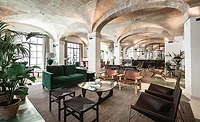
The main lobby is in the central warehouse structure, designed by Sigurd Lewerentz in the 1930s.
Photo © Bruno Ehrs

Spaces within the hotel are spread out over three buildings.
Photo © Bruno Ehrs

An arrangement of light tubes by the street entrance is a nod to the complex’s former use, and to Lewerentz’s own playful design of electrical cabling.
Photo © Bruno Ehrs

Bunker-like rooms within the warehouse structure have low ceilings.
Photo © André Pihl

All rooms include black steel armatures for affixing lights, mirrors, cabinets, and more.
Photo © André Pihl

The bright lower-level dining area opens up to a sunken courtyard in front of the warehouse building.
Photo © Bruno Ehrs

The rooftop restaurant atop the curving building features more sober interiors but expansive views.
Photo © Bruno Ehrs

A round bar animates the main lobby.
Photo © Bruno Ehrs

Image courtesy Wingårdhs

Image courtesy Wingårdhs

Image courtesy Wingårdhs

Image courtesy Wingårdhs
Architects & Firms
A pioneering Modernist, Sigurd Lewerentz was born the same year as Gunnar Asplund (1885) and outlived him by more than three decades, but he never achieved the same level of fame outside Sweden as Asplund did. Though revered by many, the man, and to some extent his work, was an enigma. Now one of Sweden’s best known contemporary architects, Gert Wingårdh (who tied with Lewerentz in the first architectural competition he ever entered, back in the 1970s) has converted an early Lewerentz building, a warehouse for Philips, into a chic but no-nonsense 249-room hotel for repeat client Nobis Hospitality Group.
Additional Content:
Jump to credits & specifications
“This building was designed to store light bulbs,” Wingårdh explained during a visit last month to the new Blique by Nobis in Stockholm. “The structure is much more robust than it needed to be for that purpose. We don’t know why.”
That building, from the 1930s, is characterized on the outside by neat rows of distinctive square windows (Lewerentz left architecture for many years midcareer to fabricate his own windows and other architectural fittings), and 3-foot-wide square concrete columns on the inside. It is the centerpiece of a three-building complex tucked away from the street, in a quiet neighborhood strewn with art galleries. To the south, an L-shaped office building, also by Lewerentz for Philips, now includes event space for the hotel on its ground floor. To the north is a curving 1990s-era Postmodern pile by Alenius-Silfverhielm-Åhlund (architect of the Swedish pavilion at Expo ’92 in Seville, Spain) that contains additional guest rooms and a rooftop restaurant.
As the centerpiece, the former warehouse features the reception area and a large lobby on its ground floor. That ample space—filled with contemporary art from Nobis founder Alessandro Catenacci’s personal collection—was made so by the removal of a floor slab, the scars from which were left visible along the walls. “The biggest challenge with converting this building was the low ceiling heights,” explains Wingårdhs project leader Helena Toresson. The bunker-like guest rooms in the six stories above the lobby are only 7½ feet tall. (Two taller stories, that contain longer-stay studios, were added in a previous renovation when the building was converted to office space. Rooms in the 1990s building have more conventional dimensions.)
Despite the small proportions, the rooms in the warehouse (with the exception of a few windowless rooms for the intrepid traveler) are more desirable. They are organized around a central light well that Wingårdhs enlarged, and feature textured concrete ceilings, chunky columns, and quirky apertures (smaller square windows were added by Alenius- Silfverhielm-Åhlund when its building was erected). “There’s something really beautiful about that ‘as found’ condition,” says Wingårdh. His firm kept as much of that condition as possible intact, forgoing adding soffits in rooms and hallways and instead exposing air-conditioning units and ducts and meticulously organized cables.
Public spaces, on the other hand, are extremely generous. Aside from the main lobby—which includes a lively bar and quieter, skylit areas behind it for work or lounging—a lower-level restaurant, serving as a sprawling breakfast room with an open kitchen, extends into a sunken courtyard. More outdoor seating areas line the walkway from the street, but the most spectacular space is the rooftop bar and restaurant, a popular spot for locals since the hotel opened in late spring.
Blique is located at the northern edge of Stockholm, bordering what used to be the old city gates and railyards. The neighborhood, called Hagastaden, has been a hotbed of construction in recent years—since segments of the highway and the railway were concealed in tunnels—with dense housing developments going up just behind the hotel. A few hundred feet from Blique is the city’s tallest residential tower, completed last year; the first of two designed by OMA, it is said to contain among the most expensive apartments in the metropolitan area. Blique’s rooftop—which includes gardens for herbs used in elaborate cocktails at the hotel’s bars—offers views over this contemporary cacophony of buildings, as well as over the historic rooftops to the south.
Blique, like its surroundings, reflects old and new. In an homage to Lewerentz, who relied heavily on the material expression of his buildings, Wingårdhs pared down its material palette to just raw concrete, black steel, and deep brown woods and upholstery (and brown-speckled terrazzo in the bathrooms). The move was a risky one for a hotel—threatening to produce spartan rather than hospitable spaces—and one that initially left the client, with whom Wingårdhs continues to work on new hotels in Mallorca and elsewhere, a bit skeptical. But the spaces not only feel welcoming but authentic—uniting the early Modern, the Postmodern, and today.
CreditsArchitect: Interior architect´s firm name: Wingårdhs, Kungsgatan
Personnel in architect's firm who should receive special credit: Lead architects: Gert Wingårdh, Helena Toresson Design team: Kajsa Johanson, Disa Reuterswärd Original Architects: Sigurd Lewerentz, Alenius-Silfverhielm-Åhlund Architect of record: Sweco Architects
Consultants: Landscape: Wingårdhs HVAC: POAB Construction: Sweco Structure Electrical engineering: Electro Engineering Lighting: Anker & Co Furnishing: Senab General contractor: (Project management) Forsen AB
Photographer: Bruno Ehrs |
SpecificationsInterior Finishes Acoustical ceilings: Ecophon Suspension grid: XAL Move it lighting system Paints and stains: Wall paint: Jotun Lady, color Washed Linen 10679 (or similar) Paneling: Rooftop restaurant: Ruukki design Venice S10 color RR45 Floor and wall tile: Lobby, restaurants: Concrete floor, modern betong Carpet: Hotel room: Ogeborg Terra Cenere 139 Furnishings Reception furniture: Custom made design by Wingårdhs Fixed seating: Custom made design by Wingårdhs Chairs: Carl Hansen & son: Safari chair, Folding chair, CH47, CH46, CH44 Tables: Friends & Founders: Knock out table
Other furniture: Hotel room storage system: Custom made design by Wingårdhs Lighting Interior ambient lighting: Lobby, restaurant: XAL Move it lighting system Tasklighting: Oluce, Atollo 235/236/237 Exterior: Castellani & Smith, Syphasera |
Looking for a reprint of this article?
From high-res PDFs to custom plaques, order your copy today!