Architectural Record
search
cart
facebook twitter linkedin youtube
  • Sign In
  • Subscribe
  • Sign Out
  • My Account
Architectural Record
  • NEWS
    • Latest News
    • Awards
    • Interviews
    • Obituaries
    • Podcasts
      • Design:Ed Podcast
      • Sponsored Podcasts
  • OPINION
    • Book Reviews / Excerpts
    • Exhibition Reviews
    • Forum
  • EXCLUSIVES
    • Videos
    • Design Vanguard
    • Top 300 Firms
    • Sponsored Content
    • Sponsored eBooks
    • From the Archives
  • CONTINUING ED
    • Editorial Continuing Ed
    • CE Center
    • CE Academies
  • PROJECTS
    • Buildings By Type
    • Reuse & Renovation
    • Museums & Arts Centers
    • Colleges & Universities
    • Multifamily Housing
    • Interiors
    • Lighting
    • Kitchen & Bath
  • HOUSES
    • Record Houses
    • House of the Month
    • Featured Houses
  • PRODUCTS
    • Products by Category
    • Record Products of the Year
    • Latest Products
  • EVENTS
    • Dates & Events
    • Record on the Road
    • Innovation Conference
    • Sustainability in Practice
    • Women In Architecture
    • Webinars
    • Ad Excellence Awards
    • Submit an Event
  • CONNECT
    • Ask RECORD AI
    • Newsletters
    • Contact
    • Advertise
    • Editorial Calendar
    • Store
    • Customer Service
  • SUBMIT
    • Submission Guidelines
    • RECORD Competitions
  • MAGAZINE
    • Subscribe
    • My Account
    • Digital Edition
    • Current Issue
    • Firm Pass
    • Historic Archive
Opinion

Review of 'Ballpark: Baseball in the American City'

by Paul Goldberger
By Jerry Adler
Ballpark: Baseball in the American City

Ballpark: Baseball in the American City, by Paul Goldberger. Knopf, 384 pages, $35.

September 13, 2019

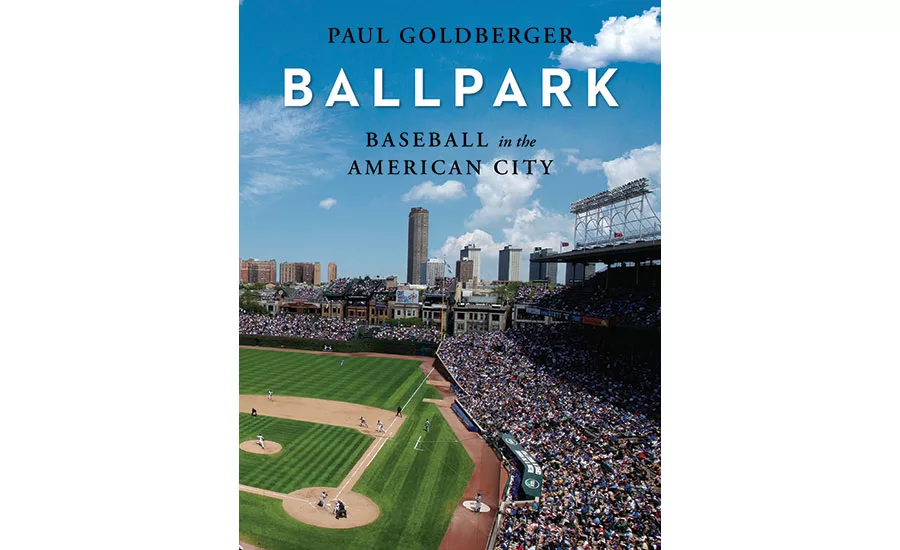
In baseball’s quaint antiquity, teams made money by selling tickets to watch the game, rather than through broadcast rights and branded merchandise. Hence stadiums were situated in population centers, which created the undesirable side effect of allowing people living nearby to watch the games from their windows, free, or even sell tickets themselves. The teams built higher fences; the freeloaders responded by erecting stands on their roofs, finally driving one team, the Chicago Cubs, to buy most of the houses behind Wrigley Field and put their own bleachers atop them, which I might not have believed if I didn’t see it myself on the jacket of the architecture critic Paul Goldberger’s new book.

The much-beloved Wrigley, which dates from 1914, looms large in Goldberger’s account. Its quaint, ivy-covered outfield fence and its near–North Side location make it the perfect illustration of one of the author’s key themes, the baseball “park” (or “field” or “grounds”) as rus in urbe, a small piece of countryside transplanted to downtown. Like nature itself—but unlike, say, football—baseball has no fixed boundaries. Beyond the right angles of the infield, it occupies a theoretically limitless space whose main constraint, in the pre-suburban-stadium era, was the surrounding real estate. This called forth some creative architectural solutions to achieve maximum seating capacity, optimal sight lines, and enough distance to the outfield fence to create a meaningful distinction between a pop fly and a home run.

Mostly, these efforts fell short, in part because the laws of physics do not easily allow for a second tier of grandstands without supporting columns that interfere with the view from the lower deck. Goldberger is good on the ingenuity that was applied to fit Wrigley (and Boston’s Fenway Park, Brooklyn’s Ebbets Field, and Detroit’s Tiger Stadium) into their eccentric lots. He is meticulous about details such as the commodious ramps in the original Yankee Stadium that allowed more than 60,000 attendees at its first opening day to exit the stands in just 11 minutes. He dwells, perhaps a touch more than necessary, on the facades, materials, colors, and decorative touches of what are, for the most part, utilitarian structures that are occupied, for a few hours at a time, 80 or so days a year. Some readers— fans of baseball as well as architecture—might like a little more on how the eccentricities of various parks affected the players and the game, beyond the obligatory reference to Willie Mays’s immortal back-to-the-plate catch in the 1954 World Series of a ball that would have been a home run in almost any park other than Manhattan’s old Polo Grounds. He devotes several pages to the history of the “Green Monster”—the wall enclosing Fenway’s short left field—with no discussion of how it shaped the career of Carl Yastrzemski.

Even Mickey Mantle appears only once in the book, giving his impression of the Houston Astrodome: “It reminds me of what my first ride would be like in a flying saucer.” Goldberger views the Astroturfed indoor ballpark with a jaundiced eye, albeit preferable to Seattle’s Kingdome, “a structure so banal that it made the Astrodome seem vibrant and fresh.” This was the apotheosis of the second wave of baseball parks, the symmetrical concrete ovals plunked down amid an endless plain of parking lots. The third wave, of retro-designed stadiums on downtown sites, was ushered in by Baltimore’s acclaimed Camden Yards stadium, which inspired numerous imitators but also gave rise to what Goldberger considers a less appealing fourth wave, the stadium as the anchor of a larger real-estate venture, a themed faux-urban entertainment/retail district, “a way of withdrawing from the city into an upscale bubble.” Authenticity, he writes, “should mean connection not only to the past, but also the present, not only the rus but also the urbe.”

Looking for quick answers on architecture and design topics?
Try Ask RECORD, our new smart AI search tool.
Ask RECORD →

KEYWORDS: Book Reviews / Excerpts

Share This Story

Looking for a reprint of this article?
From high-res PDFs to custom plaques, order your copy today!

Jerry Adler is a former senior editor of Newsweek who writes about architecture and other subjects.

Post a comment to this article

Report Abusive Comment

Subscription Center
  • Create an Account
  • Start a Subscription
  • Manage My Account
  • Sign Up for Newsletters
  • Visit Customer Service
  • Update Preferences

More Videos

Sponsored Content

Sponsored Content is a special paid section where industry companies provide high quality, objective, non-commercial content around topics of interest to the Architectural Record audience. All Sponsored Content is supplied by the advertising company and any opinions expressed in this article are those of the author and not necessarily reflect the views of Architectural Record or its parent company, BNP Media. Interested in participating in our Sponsored Content section? Contact your local rep!

close
  • TAMLYN XtremeTrim Exterior Trim
    Sponsored byTamlyn

    Designing Cleaner Panel Facades: Why Exterior Trim Details Matter

  • Building with Vapor Barriers
    Sponsored byReef Industries, Inc.

    Vapor Barriers Help Control Moisture in Tighter Building Designs

  • Duct Interior with Prodeq System
    Sponsored byHenry, a Carlisle Company

    Designing Resilient Water Containment Systems

DESIGN:ED Podcast
Listen to Architectural Record’s DESIGN:ED Podcast

Events

June 10, 2026

Rethinking Stormwater – The Power of Porous Paving

Credits: 1 AIA LU/HSW; 1 AIBD P-CE; 0.1 ICC CEU

Learn how porous paving systems support stormwater management, reduce heat island effects, and enhance sustainable site design performance.

June 11, 2026

Very Early Warning Fire Detection for Mission-Critical Facilities

Credits: 1 AIA LU/HSW; 1 AIBD P-CE; 0.1 ICC CEU

Examine advanced fire detection strategies that support uptime and enhance safety in data centers and other mission-critical facilities.

View All Submit An Event

Products

2026 Architect's Square Foot Costbook

2026 Architect's Square Foot Costbook

See More Products

Popular Stories

Coronado Bridge

The Architect’s Guide to San Diego

Practice Matters illustration

What’s in a (Firm’s) Name? Thinking About Succession and Legacy

Practice Matters illustration

By the Numbers: Counting America's Architects

Inward House

Inward House by VeeV Design Studio

Riverdale House by Studio Lau

Riverdale House by Studio Lau

Broader Sustainability of CMU - Free Webinar - May 21, 2026

Related Articles

  • Review of ‘Tall: The American Skyscraper and Louis Sullivan’

    Review of ‘Tall: The American Skyscraper and Louis Sullivan’

    See More
  • The Bike Barn on Marlon Blackwell Architects Thaden School

    Finding a Renewed Sense of Place in the American South

    See More
  • City on the Hill

    Review of 'City on a Hill: Urban Idealism in America from the Puritans to the Present'

    See More

Related Products

See More Products
  • GlobalData_logo_blue_header.png

    Construction in the US - Key Trends and Opportunities to 2023

  • drawingfrommodel.jpg

    Drawing from the Model: Fundamentals of Digital Drawing, 3D Modeling, and Visual Programming in Architectural Design

See More Products
×

The latest news and information

#1 Source for Architectural Design, News and Products

SUBSCRIBE
  • RESOURCES
    • Advertise
    • Contact Us
    • Submit
    • Store
  • ACCOUNT CENTER
    • Create an Account
    • Start a Subscription
    • Manage My Account
    • Sign Up for Newsletters
    • Visit Customer Service
    • Update Preferences
  • PRIVACY
    • PRIVACY POLICY
    • TERMS & CONDITIONS
    • DO NOT SELL MY PERSONAL INFORMATION
    • PRIVACY REQUEST
    • ACCESSIBILITY
  • SERVICES
    • Marketing Services
    • Reprints
    • Market Research
    • List Rental
    • Survey/Respondent Access
  • STAY CONNECTED
    • Linkedin
    • Facebook
    • Instagram
    • YouTube
    • X (Twitter)

Copyright ©2026. All Rights Reserved BNP Media, Inc. and BNP Media II, LLC.

Design, CMS, Hosting & Web Development :: ePublishing