Architectural Record
search
cart
facebook twitter linkedin youtube
  • Sign In
  • Subscribe
  • Sign Out
  • My Account
Architectural Record
  • NEWS
    • Latest News
    • Awards
    • Interviews
    • Obituaries
    • Podcasts
      • Design:Ed Podcast
      • Sponsored Podcasts
  • OPINION
    • Book Reviews / Excerpts
    • Exhibition Reviews
    • Forum
  • EXCLUSIVES
    • Videos
    • Design Vanguard
    • Top 300 Firms
    • Sponsored Content
    • Sponsored eBooks
    • From the Archives
  • CONTINUING ED
    • Editorial Continuing Ed
    • CE Center
    • CE Academies
  • PROJECTS
    • Buildings By Type
    • Reuse & Renovation
    • Museums & Arts Centers
    • Colleges & Universities
    • Multifamily Housing
    • Interiors
    • Lighting
    • Kitchen & Bath
  • HOUSES
    • Record Houses
    • House of the Month
    • Featured Houses
  • PRODUCTS
    • Products by Category
    • Record Products of the Year
    • Latest Products
  • EVENTS
    • Dates & Events
    • Record on the Road
    • Innovation Conference
    • Sustainability in Practice
    • Women In Architecture
    • Webinars
    • Ad Excellence Awards
    • Submit an Event
  • CONNECT
    • Ask RECORD AI
    • Newsletters
    • Contact
    • Advertise
    • Editorial Calendar
    • Store
    • Customer Service
  • SUBMIT
    • Submission Guidelines
    • RECORD Competitions
  • MAGAZINE
    • Subscribe
    • My Account
    • Digital Edition
    • Current Issue
    • Firm Pass
    • Historic Archive
Architecture NewsInterviews

Interview with Ian Weir

The Australian architect and researcher speaks with RECORD about designing for wildfires.
By Miriam Sitz
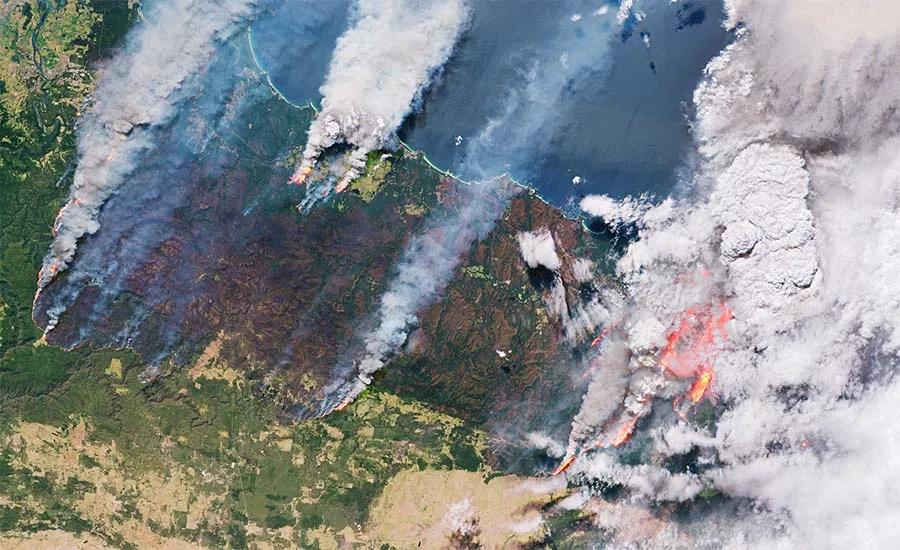
The Copernicus Sentinel-2 satellite captured this image of smoke and flames from bushfires in Australia on December 31, 2019.

The Copernicus Sentinel-2 satellite captured this image of smoke and flames from bushfires in Australia on December 31, 2019.

Image © European Space Agency

January 17, 2020

Since September 2019, catastrophic wildfires have scorched tens of millions of acres across Australia. As of press time, at least 28 people have died, as well as hundreds of millions of animals, and more than 3,000 houses have been destroyed. The combination of unprecedented heat and drought have made this bushfire season one of the most devastating to date; the country experienced its hottest day on record in mid-December, following the driest recorded spring.

RECORD spoke with Ian Weir, Ph.D.—an architect and researcher at Queensland University of Technology in Brisbane, who studies (and structured his practice around) wildfire-adapted architecture—about risks and design strategies.


Ian Weir

Photo © Kylie M Weir

What has made this bushfire season so bad?

It’s really the current drought conditions, and not only have we had very little rainfall where the fires are happening, but the normal winds that run west to east across Australia are picking up really hot, dry air as they traverse the middle of the continent, which has an extra drying effect on the southeast coast, where the fires are the worst.

How do settlement patterns and land clearing affect wildfires?

I grew up on a farm in southern Western Australia that was developed as part of a massive land-clearing scheme in the late 1950s and early 1960s. I have witnessed first-hand how regional-scale clearing creates dry micro­climates, which has subsequently led to decreased rainfall and major droughts. Queens­­land also has well-documented native vegetation clearing to facilitate cattle grazing and agriculture. It’s fair to say that these examples are representative of a nationwide problem, which is desertification. My landscape ecologist colleagues agree that it is primarily desertification that is driving droughts, which, in turn, is the key factor in driving up the fire danger.

The idea behind removing vegetation is to make homes more defensible from fire, right?

Looking for quick answers on architecture and design topics?
Try Ask RECORD, our new smart AI search tool.
Ask RECORD →

That’s the intention, but this is where we have a problem emerging in Australia: the clearing of vegetation is actually driving the resilience of homes down, because the more you clear around a house, the less resilient it has to be. Now, that sounds quite logical, but in a fire event of the magnitudes that we’re seeing in the eastern states, clearing becomes a bit redundant, because embers—the primary danger to houses—can travel from many kilometers away.

Also, the clearing-around-homes regulations are often, unfortunately, misread as wholesale clearing. But there’s no justification for eliminating trees, for instance; that just creates a dry microclimate around the house. We need to make a distinction between trees and the meaningful fuel, which actually contributes to the fire front.

This relates to the profession because, in my view, architecture’s primary role is to engender connection with place. That means protecting the natural assets of the site and celebrating that biota. That simply cannot be done when biophysical assets are removed due to what I consider to be rather draconian, top-down mandates to create so-called “defendable zones.”

How can existing houses and buildings be retrofitted to be more resistant to bushfires?

The first thing I encourage homeowners to do is to think like an ember—to forensically look at all the gaps where embers could become lodged. During a fire, negative pressure inside houses can create a vacuum that effectively sucks embers in through even very small gaps.

Otherwise, sprinklers certainly help; there are many cases where people have effectively protected their houses with a really good water supply—and not just during the emergency, but leading up to it, to get moisture back into all of those combustible materials.

And then, of course, managing the fuels around the house—not just in the vegetation, but other landscape features, by minimizing combustible fences and so on.

You designed the Karri Fire House, completed in 2014. What aspects of that structure make it resistant to fire?

First off, it's completely non-combustible. We used a fire-proof concrete block, which is quite affordable and a fantastic performer in bushfire. Along with a very thick concrete slab, it gives us thermal mass and thermal efficiency, which was a bit of a cost-benefit optimization, because bushfire-prone areas in Australia are all actually quite cold in winter.

Other components are designed integrate with daily life. The veranda has non-combustible decking, and sliding glass doors that open to it are protected by a metal mesh, which acts as an insect screen, ember screen, and radiant heat shield. The owners move in and out all the time, so we know those features are going to be maintained and are going to work in an emergency

Why should fire-adapted design matter to architects?

Over the years, I’ve encouraged many fellow architects to work in this space, and I’ve been surprised at how little people appreciate that this can be a driver for creativity. Many in the profession think this is a hopeless situation, that no house can be built for fire conditions. But the reality is, a lot of people get trapped in circumstances where they can’t escape, by roadblocks or by bushfire, and they have a greater chance of surviving when their house has a greater chance of surviving. I’m hoping these events of late start to get into architects’ headspace.

KEYWORDS: Australia fire resistance

Share This Story

Looking for a reprint of this article?
From high-res PDFs to custom plaques, order your copy today!

Miriam Sitz was a staff writer and editor for Architectural Record from 2015 to 2020, during which time she served as the web editor, then senior news & web editor.

Post a comment to this article

Report Abusive Comment

Subscription Center
  • Create an Account
  • Start a Subscription
  • Manage My Account
  • Sign Up for Newsletters
  • Visit Customer Service
  • Update Preferences

More Videos

Sponsored Content

Sponsored Content is a special paid section where industry companies provide high quality, objective, non-commercial content around topics of interest to the Architectural Record audience. All Sponsored Content is supplied by the advertising company and any opinions expressed in this article are those of the author and not necessarily reflect the views of Architectural Record or its parent company, BNP Media. Interested in participating in our Sponsored Content section? Contact your local rep!

close
  • cold storage facility
    Sponsored byCarlisle SynTec Systems

    How Architects Can Design More Continuous Cold Storage Envelopes

  • TAMLYN XtremeTrim Exterior Trim
    Sponsored byTamlyn

    Designing Cleaner Panel Facades: Why Exterior Trim Details Matter

  • Building with Vapor Barriers
    Sponsored byReef Industries, Inc.

    Vapor Barriers Help Control Moisture in Tighter Building Designs

DESIGN:ED Podcast
Listen to Architectural Record’s DESIGN:ED Podcast

Events

June 23, 2026

Enhancing Fire Resistance with Advanced PVC Solutions

Credits: 1 AIA LU/HSW; 1 AIBD P-CE; 0.1 ICC CEU; 1 IIBEC CEH

Evaluate advanced PVC solutions that improve fire resistance, support WUI compliance, and enhance resilience in residential and commercial building design.

June 25, 2026

Designing Glass Railing Systems that Enhance Aesthetics and Meet Code

Credits: 1 AIA LU/HSW; 1 AIBD P-CE; 0.1 ICC CEU

Upon course completion, participants will possess a deeper understanding of glass railings to help ensure that safety, aesthetic, and performance objectives are achieved.

View All Submit An Event

Products

2026 Architect's Square Foot Costbook

2026 Architect's Square Foot Costbook

See More Products

Popular Stories

Lorcan O' Herilhy

California Architect Lorcan O’Herlihy Has Died, Age 66

Obama Presidential Center, Chicago

The Obama Presidential Center Opens on Chicago’s South Side

Spoonbill Ranch

Johnsen Schmaling Architects Integrates Spoonbill Ranch into a Pristine Landscape

Image of Bruce Springsteen Center for American Music

The CookFox-designed Bruce Springsteen Center for American Music Opens in New Jersey

Three Courtyards House

Design Vanguard 2026: Balsa Crosetto Piazzi

Enhancing Fire Resistance with Advanced PVC Solutions - Free Webinar - June 23, 2026

Related Articles

  • Defaced monument next to a headshot of a woman

    Interview with Page & Turnbull's Ruth Todd

    See More

Related Products

See More Products
  • 047177751X.gif

    Sustainable Urbanism: Urban Design With Nature

See More Products

Events

View AllSubmit An Event
  • January 29, 2026

    Using Advanced Materials to Push Design Boundaries: Solving Complex Building Challenges with Fire-Rated Glazing

    NOW ON DEMANDCredits: 1 AIA LU/HSW; 1 AIBD P-CE; 0.1 ICC CEU; 0.1 IACET CEUThis course will provide a starting point for advanced fire-rated design by leveraging expert knowledge and real-world examples of boundary pushing uses of fire-rated glass.
  • June 23, 2026

    Enhancing Fire Resistance with Advanced PVC Solutions

    Credits: 1 AIA LU/HSW; 1 AIBD P-CE; 0.1 ICC CEU; 1 IIBEC CEHEvaluate advanced PVC solutions that improve fire resistance, support WUI compliance, and enhance resilience in residential and commercial building design.
View AllSubmit An Event
×

The latest news and information

#1 Source for Architectural Design, News and Products

SUBSCRIBE
  • RESOURCES
    • Advertise
    • Contact Us
    • Submit
    • Store
  • ACCOUNT CENTER
    • Create an Account
    • Start a Subscription
    • Manage My Account
    • Sign Up for Newsletters
    • Visit Customer Service
    • Update Preferences
  • PRIVACY
    • PRIVACY POLICY
    • TERMS & CONDITIONS
    • DO NOT SELL MY PERSONAL INFORMATION
    • PRIVACY REQUEST
    • ACCESSIBILITY
  • SERVICES
    • Marketing Services
    • Reprints
    • Market Research
    • List Rental
    • Survey/Respondent Access
  • STAY CONNECTED
    • Linkedin
    • Facebook
    • Instagram
    • YouTube
    • X (Twitter)

Copyright ©2026. All Rights Reserved BNP Media, Inc. and BNP Media II, LLC.

Design, CMS, Hosting & Web Development :: ePublishing