Architectural Record
search
cart
facebook twitter linkedin youtube
  • Sign In
  • Subscribe
  • Sign Out
  • My Account
Architectural Record
  • NEWS
    • Latest News
    • Awards
    • Interviews
    • Obituaries
    • Podcasts
      • Design:Ed Podcast
      • Sponsored Podcasts
  • OPINION
    • Book Reviews / Excerpts
    • Exhibition Reviews
    • Forum
  • EXCLUSIVES
    • Videos
    • Design Vanguard
    • Top 300 Firms
    • Sponsored Content
    • Sponsored eBooks
    • From the Archives
  • CONTINUING ED
    • Editorial Continuing Ed
    • CE Center
    • CE Academies
  • PROJECTS
    • Buildings By Type
    • Reuse & Renovation
    • Museums & Arts Centers
    • Colleges & Universities
    • Multifamily Housing
    • Interiors
    • Lighting
    • Kitchen & Bath
  • HOUSES
    • Record Houses
    • House of the Month
    • Featured Houses
  • PRODUCTS
    • Products by Category
    • Record Products of the Year
    • Latest Products
  • EVENTS
    • Dates & Events
    • Record on the Road
    • Innovation Conference
    • Sustainability in Practice
    • Women In Architecture
    • Webinars
    • Ad Excellence Awards
    • Submit an Event
  • CONNECT
    • Ask RECORD AI
    • Newsletters
    • Contact
    • Advertise
    • Editorial Calendar
    • Store
    • Customer Service
  • SUBMIT
    • Submission Guidelines
    • RECORD Competitions
  • MAGAZINE
    • Subscribe
    • My Account
    • Digital Edition
    • Current Issue
    • Firm Pass
    • Historic Archive
Architecture NewsCoronavirus Coverage

‘Slow Street’ Initiatives in Cities Promote Social Distance During Pandemic
By Joann Gonchar, FAIA
Slow-Streets-NYC-1.jpg

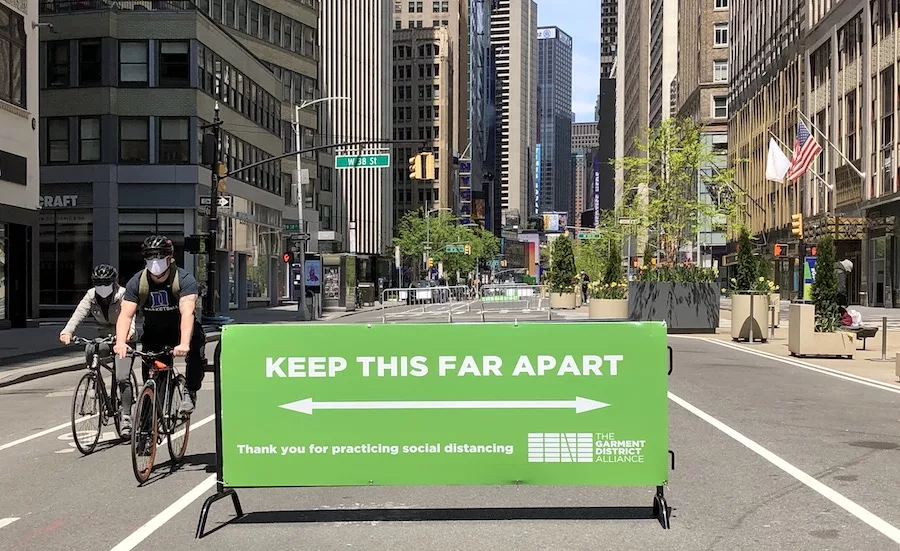
Across New York, officials have closed select streets to cars, including some in the Garment District of Midtown Manhattan.

Photo © Architectural Record

May 26, 2020

As the pandemic emergency drags on, inhabitants of dense urban environments are challenged to effectively maintain physical distancing. Sidewalks are narrow and often obstructed, and much public space has been engineered around parking and the flow of vehicular traffic. “COVID has revealed how little space we give to people in our cities and how much space we give to cars,” says Brent Toderian, a Vancouver-based city planner.

Now, as stay-at-home orders have resulted in largely empty streets, some local governments are temporarily converting roadways into pedestrian zones where people have space to safely accomplish essential trips on foot, to exercise, or to simply enjoy fresh air. Several U.S. cities—including Denver, Minneapolis, San Francisco, and Boston—have implemented programs that restrict vehicle access on select streets, prioritizing cyclists, joggers, and pedestrians. Oakland, California, has an especially ambitious initiative, with a phased plan for designating 74 miles, or 10 percent of its roadways, as “Slow Streets.” 
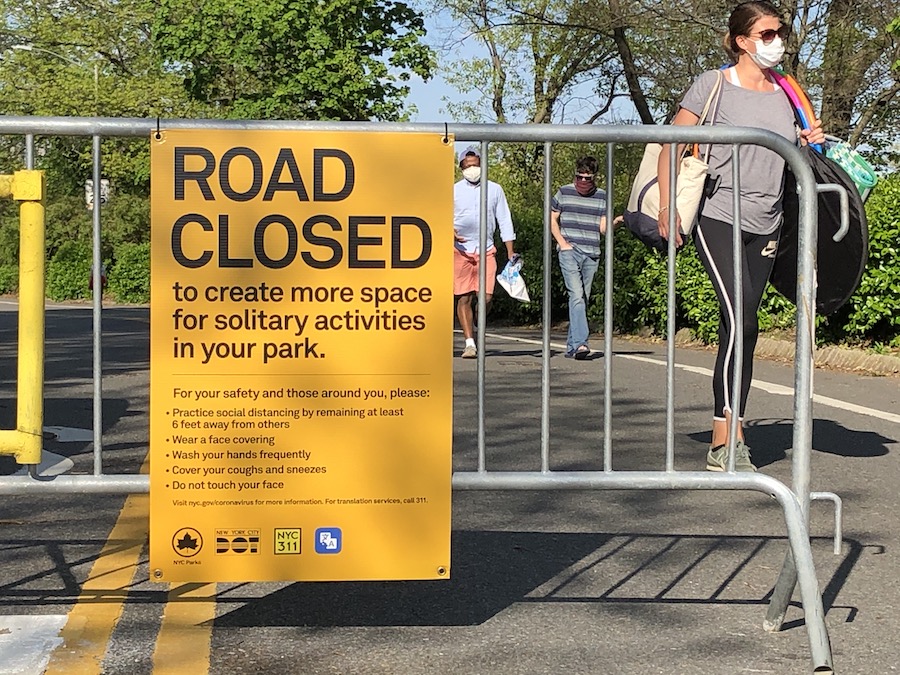
A closed street near Fort Tryon Park in Uptown Manhattan, photo © Architectural Record

America’s most populous metropolis, New York, is also implementing an “Open Streets” program that officials say will eventually encompass 100 miles, or about 2 percent of the city’s total street area. The first seven miles of the program, opened in early May, were primarily in and around public parks—a strategy that some observers criticized. “They should be in neighborhoods that are open-space deserts,” says New York–based transportation economist Charles Komanoff. But right before the start of Memorial Day weekend, the city announced its third group of Open Streets, bringing the total to more than 44 miles across the five boroughs, with a smaller portion directly adjacent to or through parks. The designated roadways include nine miles of temporary protected bike corridors intended to connect existing bike lanes.

Urbanists have advice for New York and other cities aiming to provide residents with more breathing room. Toderian has a “Top 10” list of recommendations that include making such spaces plentiful and “hyper­local,” so the greatest number of people can have access; making them “ordinary” and “non-sexy,” rather than a “destination or a scene,” in order to avoid crowds; and to network streets into systems that serve both essential workers and local residents.
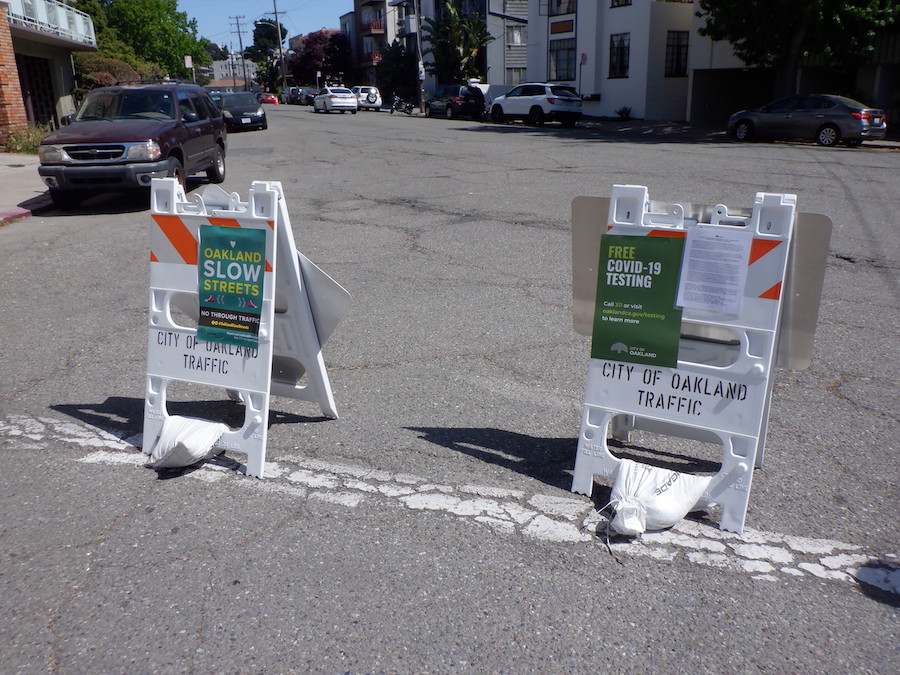
A closed street in Oakland, California, photo © Kenny Caldwell

What New York’s Open Streets program might look like as it expands, or how much of it will persist post-COVID, is unclear. “We want to see which aspects are applicable moving forward,” says Eric Beaton, a deputy commissioner with the Department of Transpor­tation. Activists suggest the initiative could help the city recover once restrictions are eased, providing people with transportation options other than cars—and their associated problems of congestion, carbon emissions, and poor air quality—especially as public confidence in mass transit has taken a devastating hit. Danny Harris, executive director of  Trans­­portation Alternatives, a New York–based advocacy group, points to cities around the globe as examples of what could be. Paris, for instance, is fast-tracking pre-pandemic plans for reducing on-street parking, widening sidewalks, and creating an extensive network of bike lanes, while Milan will revamp streets at the city’s core for cyclists and pedestrians. And in Vilnius, Lithuania, streets are being closed to cars, allowing restaurants to create open-air dining areas that meet physical-distancing requirements. 

Framed as part of a long-term vision for public space and transportation policy, rather than just a pandemic accommodation, the Open Streets plan could help ensure the future livability of New York—even, suggests Harris, helping to address environmental sustainability, fight economic inequality, and improve public health. “If we don’t reimagine our city now for the next century,” he says, “it would be a missed opportunity.”

Looking for quick answers on architecture and design topics?
Try Ask RECORD, our new smart AI search tool.
Ask RECORD →

KEYWORDS: cities urban planning

Share This Story

Looking for a reprint of this article?
From high-res PDFs to custom plaques, order your copy today!


Joann gonchar

Joann Gonchar, FAIA, LEED AP, is deputy editor at Architectural Record. She joined RECORD in 2006, after working for eight years at its sister publication, Engineering News-Record. Before starting her career as a journalist, Joann worked for several architecture firms and spent three years in Kobe, Japan, with the firm Team Zoo, Atelier Iruka. She earned a Master of Architecture degree from the University of Pennsylvania and a Bachelor of Arts from Brown University. She is licensed to practice architecture in New York State.

Post a comment to this article

Report Abusive Comment

Subscription Center
  • Create an Account
  • Start a Subscription
  • Manage My Account
  • Sign Up for Newsletters
  • Visit Customer Service
  • Update Preferences

More Videos

Sponsored Content

Sponsored Content is a special paid section where industry companies provide high quality, objective, non-commercial content around topics of interest to the Architectural Record audience. All Sponsored Content is supplied by the advertising company and any opinions expressed in this article are those of the author and not necessarily reflect the views of Architectural Record or its parent company, BNP Media. Interested in participating in our Sponsored Content section? Contact your local rep!

close
  • cold storage facility
    Sponsored byCarlisle SynTec Systems

    How Architects Can Design More Continuous Cold Storage Envelopes

  • TAMLYN XtremeTrim Exterior Trim
    Sponsored byTamlyn

    Designing Cleaner Panel Facades: Why Exterior Trim Details Matter

  • Building with Vapor Barriers
    Sponsored byReef Industries, Inc.

    Vapor Barriers Help Control Moisture in Tighter Building Designs

DESIGN:ED Podcast
Listen to Architectural Record’s DESIGN:ED Podcast

Events

June 23, 2026

Enhancing Fire Resistance with Advanced PVC Solutions

Credits: 1 AIA LU/HSW; 1 AIBD P-CE; 0.1 ICC CEU; 1 IIBEC CEH

Evaluate advanced PVC solutions that improve fire resistance, support WUI compliance, and enhance resilience in residential and commercial building design.

June 25, 2026

Designing Glass Railing Systems that Enhance Aesthetics and Meet Code

Credits: 1 AIA LU/HSW; 1 AIBD P-CE; 0.1 ICC CEU

Upon course completion, participants will possess a deeper understanding of glass railings to help ensure that safety, aesthetic, and performance objectives are achieved.

View All Submit An Event

Products

2026 Architect's Square Foot Costbook

2026 Architect's Square Foot Costbook

See More Products

Popular Stories

Lorcan O' Herilhy

California Architect Lorcan O’Herlihy Has Died, Age 66

Obama Presidential Center, Chicago

The Obama Presidential Center Opens on Chicago’s South Side

Spoonbill Ranch

Johnsen Schmaling Architects Integrates Spoonbill Ranch into a Pristine Landscape

CCA, Studio Gang

The Winners of the AIA’s 2026 Architecture Award Range from Collegiate Rowing Hubs to Housing for the Homeless

West Village Penthouse

Design Vanguard 2026: Brent Buck Architects

Enhancing Fire Resistance with Advanced PVC Solutions - Free Webinar - June 23, 2026

Related Articles

  • Mediamatic-Amsterdam-Willem-Velthoven-FT.jpg

    Architects Envision Ways to Make Restaurants Safe During a Pandemic

    See More
  • Oslo-Library-3.jpg

    Oslo’s New Central Library, Opened During the Pandemic, Does a Subtle Dance with Snøhetta’s Opera House

    See More
  • Design Contest Seeks to Promote Rebuilding in Twin Cities

    See More

Related Products

See More Products
  • superlux.jpg

    SuperLux: Smart Light Art, Design & Architecture for Cities

See More Products
×

The latest news and information

#1 Source for Architectural Design, News and Products

SUBSCRIBE
  • RESOURCES
    • Advertise
    • Contact Us
    • Submit
    • Store
  • ACCOUNT CENTER
    • Create an Account
    • Start a Subscription
    • Manage My Account
    • Sign Up for Newsletters
    • Visit Customer Service
    • Update Preferences
  • PRIVACY
    • PRIVACY POLICY
    • TERMS & CONDITIONS
    • DO NOT SELL MY PERSONAL INFORMATION
    • PRIVACY REQUEST
    • ACCESSIBILITY
  • SERVICES
    • Marketing Services
    • Reprints
    • Market Research
    • List Rental
    • Survey/Respondent Access
  • STAY CONNECTED
    • Linkedin
    • Facebook
    • Instagram
    • YouTube
    • X (Twitter)

Copyright ©2026. All Rights Reserved BNP Media, Inc. and BNP Media II, LLC.

Design, CMS, Hosting & Web Development :: ePublishing