What Biden’s $2 Trillion Infrastructure Proposal Could Mean for Architects
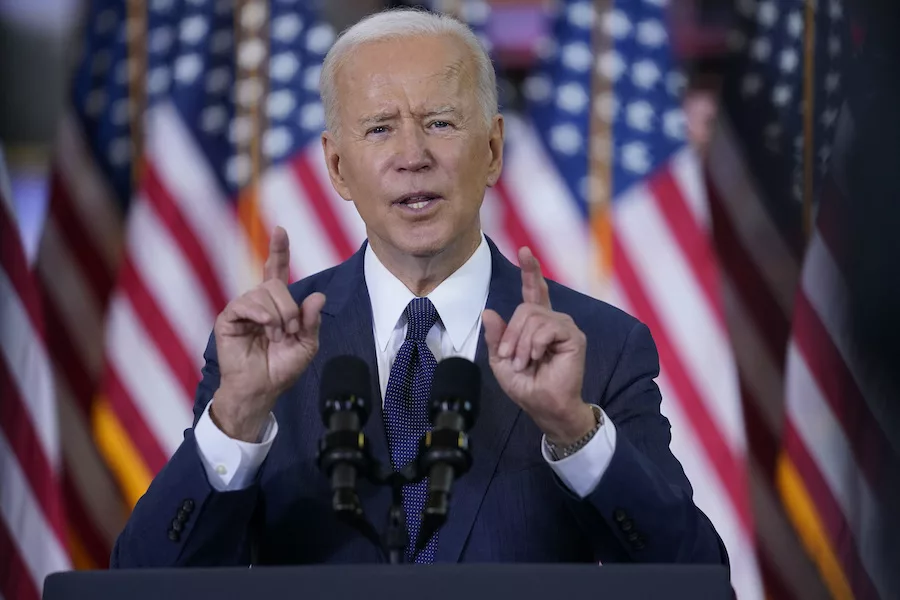
President Biden’s ambitious plan includes repairing infrastructure and expanding affordable housing.
Photo © Evan Vucci/Associated Press
President Biden laid out the framework for the American Jobs Plan, a $2.25 trillion infrastructure proposal, at the end of March. Whatever else can be said about it, the plan is breathtakingly expansive and expensive—yet represents, as the president put it, “a once-in-a generation investment in America.” The proposal put forth an almost incomprehensible scale of spending— it has already been decried as too large by conservatives and too small by Green New Deal proponents— but is envisioned as igniting the American economy, not only by financing conventional infrastructure such as bridges and tunnels, but also in renewing and expanding affordable-housing stock and public education facilities, and funding green technology. Biden, acknowledging it is big and bold, said, “We can get it done.”
How it gets done, when it gets done, and at what ultimate price tag, remain the trillion dollar questions. The biggest slice of the proposal’s pie goes to infrastructure repair, with $621 billion (roughly 28 percent of the plan) allocated to transportation-related projects. While that may seem like a lot of roadwork—and $25 billion of that is set aside for airports—the plan also includes equitable remediation strategies, such as $20 billion to “reconnect neighborhoods cut off by historic investments [read urban renewal and highways that cut through cities] and ensure new projects increase opportunity, advance racial equity and environmental justice, and promote affordable access.”
Related to such infrastructural proposals are numerous parts of the plan that address the concerns of architects and will require their expertise. Even before Biden unveiled his program, a team from the American Institute of Architects (AIA) urged Congress in February to include $300 billion to fund green infrastructure. The Biden-Harris plan gets close, with $100 billion dedicated to achieving carbon-pollution-free power by 2035, and another $180 billion allocated for research, development, and deployment of climate-science solutions. Another $50 billion targets long-term resilience of the country’s entire infrastructure, to mitigate flooding, effects of extreme weather and climate change, and sea-level rise.
Kara Kempski, director of federal relations at the AIA, points to the importance of the plan’s sustainable initiatives, which could help reduce the “roughly 40 percent of greenhouse gas emissions that come from our building stock.” In addition, she notes, buildings are a “significant part of this proposal: there are investments in affordable housing, VA hospitals, airports, schools, and federal facilities. That investment is great to see, along with the language about [being] carbon-smart, resilient, and equitable.” The AIA is advocating that all new buildings be carbon zero by 2030 and all buildings achieve that by 2040. To reach those targets calls for “some investment from all levels of government,” she says.
For the architecture profession, the biggest impact of Biden’s plan would be the $213 billion investment in affordable housing “to produce, preserve, and retrofit more than 2 million affordable and sustainable places to live.” That includes $20 billion for the Neighborhood Homes Investment Act, which would build or rehabilitate roughly half a million low- to middle-income homes. The plan further apportions $100 billion for upgrades to public schools, $25 billion for childcare centers, and $12 billion for community colleges. “There’s only about 36 percent available affordable-housing units for every family that would qualify nationwide,” says Kempski. “So, clearly, we need significant investment to make up the difference there.”
The proposal, as it currently stands, has already been called a nonstarter by Senate minority leader Mitch McConnell, based on both its cost and its content. Myriad details would have to be ironed out in House and Senate committees before anything gets passed. Just for comparison, the recent Covid-19 relief bill cost $1.9 trillion, the 2009 American Recovery and Reinvestment act was $840 billion, and the New Deal passed, in various bills from 1933 to 1937, allocations of roughly $41.7 billion—or approximately $841 billion in 2021 dollars. The American Jobs Plan’s $2.25 trillion proposes spreading this cost over the next 10 years— with an estimated investment of 1 percent of GDP over the next eight years—an amount overall that is less than half of the $5 trillion climate policy that then-candidate Biden offered in June 2019. His administration seeks to pay for this plan by eliminating fossil-fuel producers’ tax incentives, while raising corporate income taxes from 21 percent to 28 percent.
That corporate-tax increase alone may be enough to scuttle this infrastructure plan as currently envisioned: as Politico reported, despite early White House outreach, McConnell has indicated that the tax hikes make the infrastructure bill impossible for Republican senators to support, meaning all the Democratic senators would have to vote in its favor for it to pass. And some on the left feel it does not go far enough, relative to the $10 billion, 10-year Green New Deal introduced in 2019 by representative Alexandria Ocasio-Cortez of New York and senator Edward J. Markey of Massachusetts. Given the expansiveness of the infrastructure proposal, it may take the rest of the term to reach agreement, postponing the start of the country’s rebuilding until consensus on its scope can somehow be reached.
Looking for quick answers on architecture and design topics?
Try Ask RECORD, our new smart AI search tool.
Ask RECORD →
Looking for a reprint of this article?
From high-res PDFs to custom plaques, order your copy today!