Architectural Record
search
cart
facebook twitter linkedin youtube
  • Sign In
  • Subscribe
  • Sign Out
  • My Account
Architectural Record
  • NEWS
    • Latest News
    • Awards
    • Interviews
    • Obituaries
    • Podcasts
      • Design:Ed Podcast
      • Sponsored Podcasts
  • OPINION
    • Book Reviews / Excerpts
    • Exhibition Reviews
    • Forum
  • EXCLUSIVES
    • Videos
    • Design Vanguard
    • Top 300 Firms
    • Sponsored Content
    • Sponsored eBooks
    • From the Archives
  • CONTINUING ED
    • Editorial Continuing Ed
    • CE Center
    • CE Academies
  • PROJECTS
    • Buildings By Type
    • Reuse & Renovation
    • Museums & Arts Centers
    • Colleges & Universities
    • Multifamily Housing
    • Interiors
    • Lighting
    • Kitchen & Bath
  • HOUSES
    • Record Houses
    • House of the Month
    • Featured Houses
  • PRODUCTS
    • Products by Category
    • Record Products of the Year
    • Latest Products
  • EVENTS
    • Dates & Events
    • Record on the Road
    • Innovation Conference
    • Sustainability in Practice
    • Women In Architecture
    • Webinars
    • Ad Excellence Awards
    • Submit an Event
  • CONNECT
    • Ask RECORD AI
    • Newsletters
    • Contact
    • Advertise
    • Editorial Calendar
    • Store
    • Customer Service
  • SUBMIT
    • Submission Guidelines
    • RECORD Competitions
  • MAGAZINE
    • Subscribe
    • My Account
    • Digital Edition
    • Current Issue
    • Firm Pass
    • Historic Archive
Architecture NewsOpinion

Review of 'Unless: The Seagram Building Construction Ecology'

By Kiel Moe
By Eric Höweler, FAIA
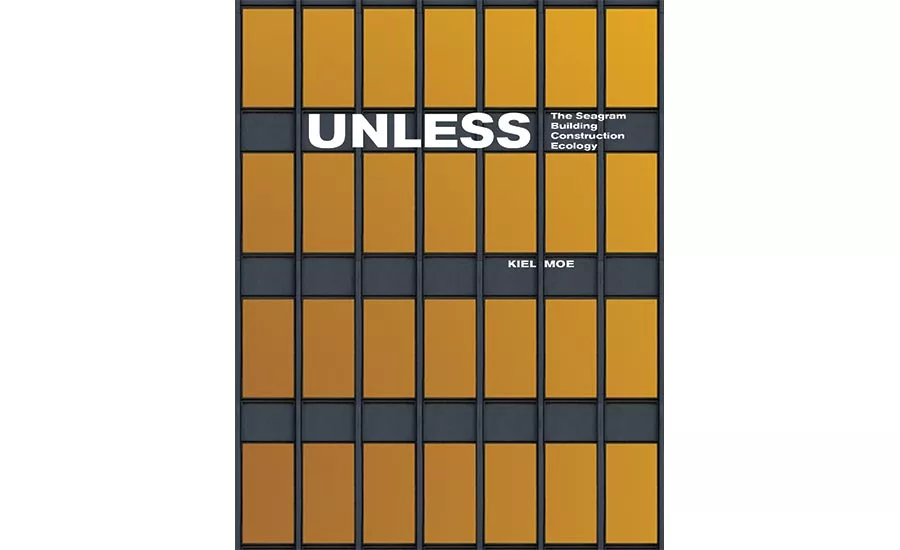
Unless The Seagram Building Construction Ecology

Unless: The Seagram Building Construction Ecology, by Kiel Moe. Actar, 316 pages, $34.95.

May 6, 2021

Architects & Firms

Mies van der Rohe

Some of the most pervasive myths of modern architecture surround the Seagram Building, the emblem of standardization—manifested by the extruded shaft of the tower, the applied bronze I-beams that are stand-ins for the structural steel frame encased in concrete within, and the urban stance of the building, an autonomous prismatic object set back on a spare granite plaza. Every aspect of Mies van der Rohe’s building has been extensively documented, illustrated, and imitated. Kiel Moe’s critical assessment of this Modernist icon reads it through the lenses of material ecologies and environmental load. In the process, he demolishes so much of its mythology.

The book’s title implies a dire warning: “Unless architects begin to describe buildings as terrestrial events, processes, and artifacts, architects will—to professional and collective peril—continue to operate outside the key environmental and political dynamics of this century.” Moe assesses architecture as a material, geological, and ecological artifact—essentially the substance of which it is made, and the embodied energy and labor that it represents. To do so, he performs a painstaking material audit of the Seagram Building, modeling and measuring the quantities of steel, concrete, and glass that make up the tower’s 38 stories.

Elaborating on a method he developed in his previous book, Empire, State & Building, Moe tracks the building components back to the fabricators that produced them, to the quarries and mines where the raw materials were extracted, and ultimately back to the ground. He sees the Seagram Building as an “exquisite pile of technomass, attached to perhaps less exquisite inequities in its world.”

Moe derives the term “terrestrial,” for his investigation, from French sociologist Bruno Latour, as pertaining to “all the human and nonhuman, organic and inorganic, ‘natural’ and ‘unnatural’ dynamics of entities on the surface of the planet.” The shifting of materials in the making of a building creates “environmental loads,’’ which Moe argues are being asymmetrically displaced from centers of power and wealth onto the peripheries where these materials come from. Only by understanding the expanded web of materials, their sources, waste, by-products, and toxicological impacts can we gain a true accounting of the real environmental footprint of architecture.

The Seagram Building’s “bronze” I-beams are actually brass—a combination of copper and zinc. Probably the copper was a mix of recycled and new copper, likely to have come from the Chuquicamata mine in Chile’s Atacama Desert. Here Moe finds a mining town crushed, literally, by the tailings from the open pit mine, and a history of illnesses among the workers. In tracing the production of the famous I-beams, we learn about the custom die operation, and the meticulous process of straightening and hand-polishing the extrusions to achieve the perfect “machine-age” look. In Butler, Pennsylvania, the source of the pink-tinted glass Mies specified, he details the history of the Franklin Glass factory, the pouring and casting of the glass, and the labor of polishing the unique lites. The story of the company is one of growth, obsolescence, bankruptcy, and factory closure.

Mies’s masterpiece is not emblamatic of modern standardization but is a bespoke artifact, and that comes at a high cost: it was the most expensive office building ever constructed at the time, and now Moe is calculating the environmental and social costs.

But he is not interested in vilifying or valorizing the building or its creators. He wants to completely reevaluate the way we think about architecture, the way we describe it, and the way we value it. Architecture has tremendous agency and responsibility. This book demands that we rethink the very substance of architecture and its expanded footprint so we can understand its larger impact in a “terrestrial” world.

Looking for quick answers on architecture and design topics?
Try Ask RECORD, our new smart AI search tool.
Ask RECORD →

KEYWORDS: Book Reviews / Excerpts

Share This Story

Looking for a reprint of this article?
From high-res PDFs to custom plaques, order your copy today!

Eric Höweler, FAIA, is a founding principal of Höweler + Yoon, and an associate professor at the Harvard Graduate School of Design.

Post a comment to this article

Report Abusive Comment

Subscription Center
  • Create an Account
  • Start a Subscription
  • Manage My Account
  • Sign Up for Newsletters
  • Visit Customer Service
  • Update Preferences

More Videos

Sponsored Content

Sponsored Content is a special paid section where industry companies provide high quality, objective, non-commercial content around topics of interest to the Architectural Record audience. All Sponsored Content is supplied by the advertising company and any opinions expressed in this article are those of the author and not necessarily reflect the views of Architectural Record or its parent company, BNP Media. Interested in participating in our Sponsored Content section? Contact your local rep!

close
  • cold storage facility
    Sponsored byCarlisle SynTec Systems

    How Architects Can Design More Continuous Cold Storage Envelopes

  • TAMLYN XtremeTrim Exterior Trim
    Sponsored byTamlyn

    Designing Cleaner Panel Facades: Why Exterior Trim Details Matter

  • Building with Vapor Barriers
    Sponsored byReef Industries, Inc.

    Vapor Barriers Help Control Moisture in Tighter Building Designs

DESIGN:ED Podcast
Listen to Architectural Record’s DESIGN:ED Podcast

Events

June 18, 2026

Rebooting the Aging Office Building

Credits: 1 AIA LU/HSW; 1 AIBD P-CE; 0.1 ICC CEU; 1 PDH

Explore façade retrofit strategies and award-winning design concepts that can transform aging office buildings into healthier, higher-performing workplaces for today’s hybrid workforce.

June 23, 2026

Enhancing Fire Resistance with Advanced PVC Solutions

Credits: 1 AIA LU/HSW; 1 AIBD P-CE; 0.1 ICC CEU; 1 IIBEC CEH

Evaluate advanced PVC solutions that improve fire resistance, support WUI compliance, and enhance resilience in residential and commercial building design.

View All Submit An Event

Products

2026 Architect's Square Foot Costbook

2026 Architect's Square Foot Costbook

See More Products

Popular Stories

SanDiegoAirport

Top 300 Architecture Firms of 2026

Lorcan O' Herilhy

California Architect Lorcan O’Herlihy Has Died, Age 66

Coronado Bridge

The Architect’s Guide to San Diego

CCA, Studio Gang

The Winners of the AIA’s 2026 Architecture Award Range from Collegiate Rowing Hubs to Housing for the Homeless

Dusk House

Design Vanguard 2026: ONO

Rebooting the Aging Office Building - Free Webinar - June 18, 2026

Related Articles

  • Goodbye to All That

    Goodbye to All That: The Four Seasons Restaurant Leaves the Seagram Building

    See More
  • Four Season Restaurant

    More Elegance at the House of Seagram: The Four Seasons Restaurant

    See More
  • The Evolution of a Building Complex: Louis I. Kahn's Salk Institute for Biological Studies

    Review of 'The Evolution of a Building Complex: Louis I. Kahn's Salk Institute for Biological Studies'

    See More

Related Products

See More Products
  • GlobalData_logo_blue_header.png

    Construction in the US - Key Trends and Opportunities to 2023

See More Products
×

The latest news and information

#1 Source for Architectural Design, News and Products

SUBSCRIBE
  • RESOURCES
    • Advertise
    • Contact Us
    • Submit
    • Store
  • ACCOUNT CENTER
    • Create an Account
    • Start a Subscription
    • Manage My Account
    • Sign Up for Newsletters
    • Visit Customer Service
    • Update Preferences
  • PRIVACY
    • PRIVACY POLICY
    • TERMS & CONDITIONS
    • DO NOT SELL MY PERSONAL INFORMATION
    • PRIVACY REQUEST
    • ACCESSIBILITY
  • SERVICES
    • Marketing Services
    • Reprints
    • Market Research
    • List Rental
    • Survey/Respondent Access
  • STAY CONNECTED
    • Linkedin
    • Facebook
    • Instagram
    • YouTube
    • X (Twitter)

Copyright ©2026. All Rights Reserved BNP Media, Inc. and BNP Media II, LLC.

Design, CMS, Hosting & Web Development :: ePublishing