Los Angeles by Christopher Hawthorne
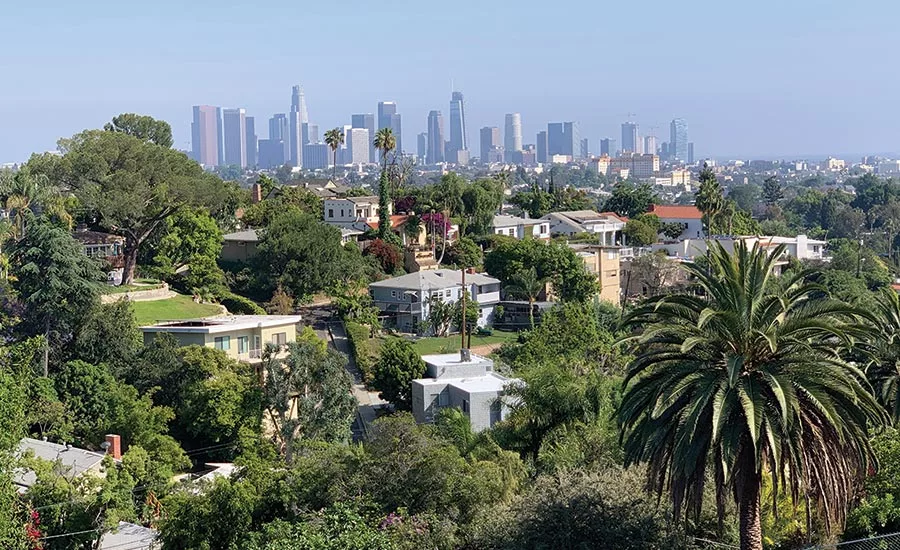
Photo © Yoav Getzler/Eyeem via Getty Images
Christopher Hawthorne, former architecture critic of the Los Angeles Times, is the first Chief Design Officer of the City of Los Angeles, appointed by Mayor Eric Garcetti in 2018. Hawthorne has led design initiatives aimed at some of the city’s most critical issues, which he discussed with RECORD contributing editor Sarah Amelar.
What do you consider the three greatest challenges to Los Angeles today? And what are some of the specific ways the city is tackling those problems?
There are two ways to answer that question. One is: housing, housing, and housing. The other is: housing, mobility, and equity—which is how I’d really answer. Housing is the No. 1 issue—affordability, access to options, and the ways we can rethink zoning and land use.
There’s a stereotype of Los Angeles as a city of single-family houses. We do have almost 500,000 single-family parcels—but we’re also a city of renters, with about two-thirds of households renting. Los Angeles has a great legacy of low-rise residential architecture that preceded the dominance of the single-family house. The idea that the city is defined by it is limited—and has a “before” and an “after.”
Our housing deficit goes back nearly four decades, with systematic under-building. Now, like many cities, we face a housing crisis, with homelessness and lack of affordability. That’s challenge No. 1.
Mobility is the second big issue. No other city has understood its connection to mobility the way Los Angeles has. There’s a longstanding view that the city is most legible—in some ways, only legible—through motion. You read it by moving through it.
But the stereotype we’re challenging is whether it has to be “auto-mobility,” meaning by car. Other ways of navigating L.A. are just as revelatory. Like the single-family stereotype, the idea that this is a city of cars, freeways, and parking lots is also limited. In the mid-20th century, Los Angeles remade itself in that image. But that view has its own before and after. In the early 20th century, our streetcar system was the most extensive transit network in the country, if not the world. And now we’re building out a modern replacement of it.
Looking for quick answers on architecture and design topics?
Try Ask RECORD, our new smart AI search tool.
Ask RECORD →
We’re finally investing in a mature, modern transit system with bus lines, light rail, and subways. We’re not there yet, but the voters have consistently supported that vision. By the end of this decade, we’ll be close.
Some of it’s been made possible by using surviving rights of way from the older, defunct network—what Reyner Banham called L.A.’s “transportation palimpsest.” It’s all layered: the cart paths among the original ranchos, the oldest streets, the streetcar network, the major boulevards, the freeways, and now this new countywide Metro system, which began in the 1980s under Mayor Tom Bradley.
There’s a grain of truth to the cliché—the city did radically remake itself in the image of the car. We saw Los Angeles as a metropolis of the future, we wanted to be modern, and, as in many other cities, saw cars and then freeways as central to that vision. But now we need patience. After 75 years of remaking the city in the service of “motordom,” it’s going to take decades to build a new paradigm.
That may mean some form of congestion pricing and free transit—both ideas are now on the table. Metro’s recently launched pilot is making buses and trains free for students, and it will extend to low-income riders in January. That could dramatically build a constituency: a newly empowered generation of Angelenos, who learn to navigate the city by Metro.
What will be in place by the end of the decade?
The major breakthroughs include the 5-year-old fully completed Expo Line (E Line), connecting downtown to the beach in Santa Monica. Among the three new lines now under construction, the Wilshire Boulevard subway is fundamental to rethinking our urban geography, bringing the new Academy Museum and LACMA onto the transit grid. By the Olympics in 2028, it will extend to UCLA, to the west. The second breakthrough, also underground, will be the Regional Connector, linking existing Metro lines and adding downtown stations, such as one behind Disney Hall.
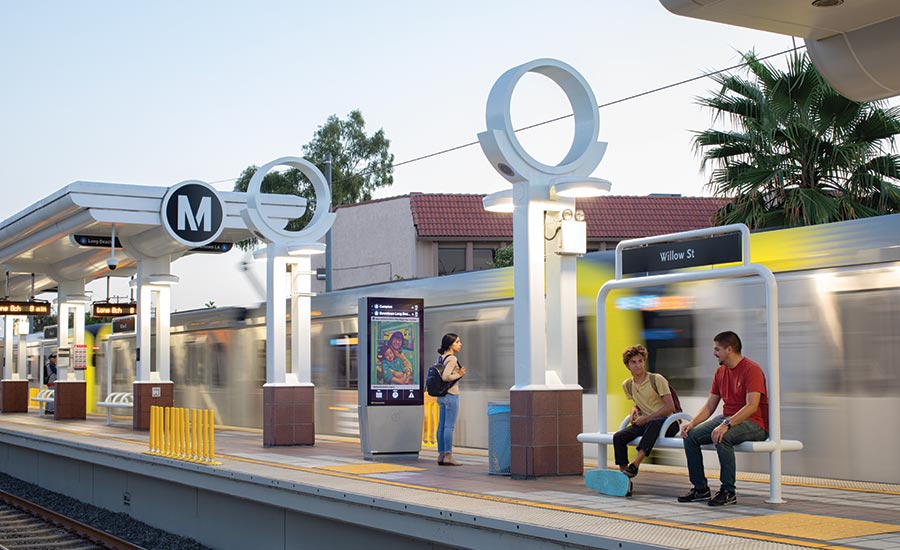
LA Metro. Image courtesy Los Angeles County Metropolitan Transportation Authority/LA Metro, click to enlarge.
Subways are expensive, and we waited too long to build them along major spines like Wilshire, but they’ll make a huge difference. The Expo Line, as transformative as it’s been, still runs at grade, with traffic crossings and resulting delays. The new subway and Regional Connector will be enormously important in increasing the system’s efficiency and coverage of L.A.’s vast territory.
The third project, the Crenshaw Line (see “Public Space Portfolio”), will connect the city to the airport—finally. A big transit gateway station by Grimshaw will link it to the new airport people-mover. Within 10 to 15 years, we’ll reclaim a pretty close approximation of the geography originally covered by streetcar routes.
What about the equity challenges?
One response has been our Civic Memory project, a reckoning with this city’s darker past and tendency to whitewash it. Los Angeles’s modern identity was largely based on mythmaking and boosterism, virtually erasing strands of our past: the indigenous, Spanish Colonial, Mexican, and multiracial legacy that preceded the early 20th-century Anglo elite here.
A city commission is under way to address reparations for Black Angelenos. Los Angeles has long been segregated by class and access to wealth. And the housing crisis has exacerbated it.
How might the civic-memory initiatives play out?
When our Civic Memory Working Group first convened, in November of 2019, the national conversation was already under way about monuments and memorials, particularly Confederate ones. Soon after my job began, Mayor Garcetti mentioned the 1871 anti-Chinese massacre, perhaps the second-deadliest lynching in American history. Nineteen Chinese and Chinese-American Angelenos, then about 10 percent of that entire population, were mobbed and killed one afternoon. Beyond a small plaque in front of the Chinese-American Museum, we’d never grappled with it.
The mayor’s comment stuck with me. We decided to take on not just monuments and memorials, but broader questions of civic memory and the city’s relationship to history. While learning from the national conversation, we wanted to ground our efforts in Los Angeles. The idea that we’re a city of the future has given us a peculiar relationship with the past.
We brought together historians, along with indigenous leaders, architects, designers, and artists, to help think through these issues. In partnership with the Getty Foundation and Huntington-USC Institute on California and the West, we produced a book with 18 key recommendations. It’s called Past Due: Report and Recommendations of the Los Angeles Mayor’s Office Civic Memory Working Group.
It has spun off initiatives, including a memorial for the 1871 massacre, which marks its 150th anniversary in October. We hope to announce some progress then.
Also moving forward is reparative work with indigenous communities, which we hope will include not just a land-acknowledgement policy, but also a formal apology and, potentially, “cultural easements,” opening land to co-management or access by Tongva-Gabrielino and other tribes. One complexity is that no Southern California tribes are federally recognized.
The Tongva language already appears in place names, like Cahuenga Pass, but few people realize it. There hasn’t been an effort to educate the public and officially formalize those markers. Prominent in our report is a round-table re-examination of the legacy of priest Junipero Serra—father of the California mission, in the 1760s and ’70s. Though canonized by the Catholic church, he symbolizes pain and dislocation for indigenous people.
What about overlooked African-American contributions to L.A.?
We explored that in the report, working with Gail Kennard, a member of our Cultural Heritage Commission, president of Kennard Design Group, and daughter of Robert Kennard, a leading 20th-century African-American architect. While Paul R. Williams’s work has drawn welcome revived interest, other deserving, contemporary Black architects—and the stylistic, programmatic, and political range of Black architecture in L.A.—have been overlooked. Uncovering, documenting, and mapping that history, figuring out how to bring attention to it, has been important.
Let’s circle back to “housing, housing, and housing”—from the equity perspective. Didn’t single-family enclaves throughout L.A., and across America, help create segregation in neighborhoods where opposition to multiunit housing became a dog whistle for racism?
That’s the key issue. And we won’t meet our housing needs and affordability goals without opening up more single-family neighborhoods to new housing options. That doesn’t mean blanket up-zoning, but a more pinpointed approach to adding new options in some neighborhoods. Roughly 75 percent of Los Angeles’ residential land is zoned for single-family housing. Meeting our goals will demand a reckoning with our history of discrimination, which, as in other cities, included redlining and other exclusionary lending, zoning, and land-use practices. That was fundamentally responsible for the wealth gap between white and Black households—traceable to the inability among Black families, for much of the 20th century, to buy into neighborhoods where houses would appreciate over generations, enabling their equity to grow.
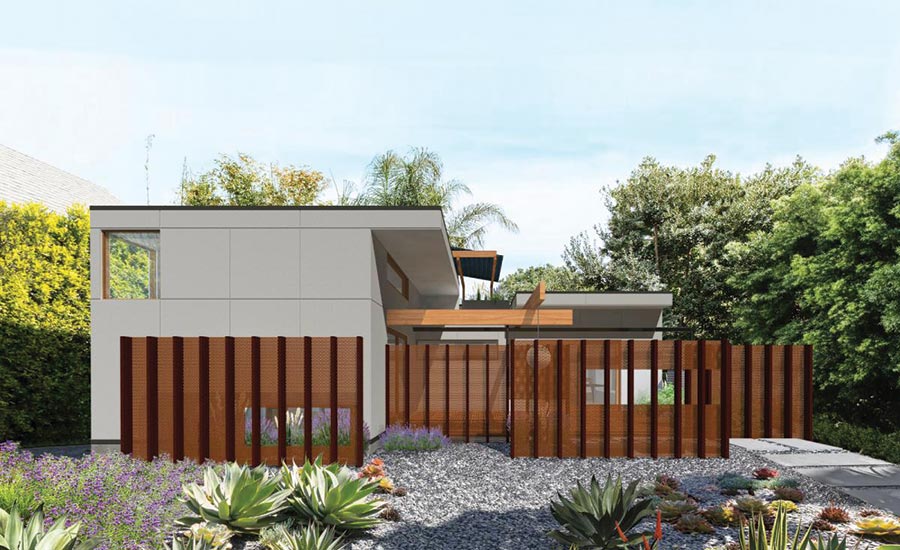
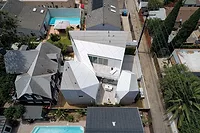
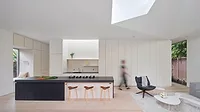
ADU Design by Fung+Blatt. Image courtesy Fung+Blatt Architects
Meanwhile, climate change, wildfires in particular, has clarified the need to locate housing more intelligently, near jobs and transit instead of along ex-urban fringes.
Most Angelenos seem willing to acknowledge that our land-use patterns are no longer sustainable. The question is, how do you build public and political support for careful, effective zoning and land-use reform? Even where there’s interest in aggressively tackling our history of exclusion and racism, it’s tricky to build support for that kind of change. This is a hearts-and-minds effort.
Has recent Accessory Dwelling Unit (ADU) legislation changed the picture?
Yes. In 2017, California passed legislation making it easier to build and legalize ADUs in single-family neighborhoods. Our mayor and other Los Angeles officials supported it by streamlining the city’s permitting process—with great results. ADUs now constitute 20 percent of new housing units each year. The predicted backlash didn’t happen, and ADUs continue to generate some of the most affordable housing to build: single-story, wood-frame construction with no parking requirements.
The next step is to determine how else to increase housing options without radically changing scale. So, our Low-Rise initiative challenged architects and landscape architects to propose designs for small multiunit dwellings to advance the conversation within single-family residential communities. We looked for ways that modifying land use and zoning could provide opportunities—for example, for older residents to age in place or for younger buyers to gain footholds in the now-unaffordable neighborhoods where they grew up.
The initiative engaged communities from the start, asking how people wanted their neighborhoods to evolve, what they lacked and wanted to protect. We were also interested in ways of welcoming new residents who’d been priced out of areas with good school and jobs access.
In the winning designs, I think most Angelenos see a scale and inside-outside architecture that resembles their own neighborhoods. One lesson is the city’s legacy of low-rise multifamily residential architecture from the first half of the 20th century—including bungalow courts, with single- or two-unit structures around a communal garden—is beloved.
Are the Low-Rise proposals you received legal in L.A.?
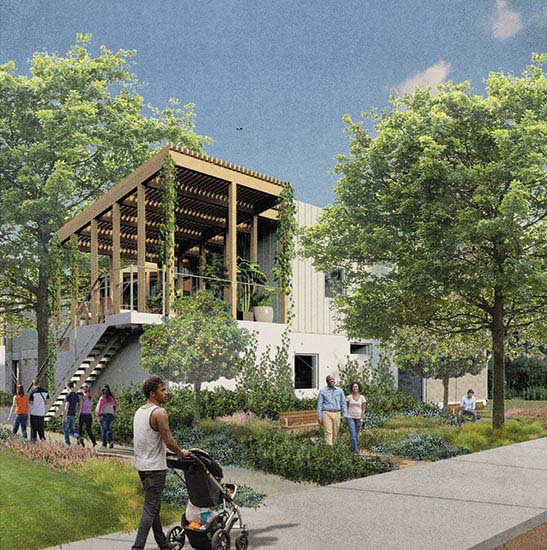
Low-rise prototype by Studio-MLA and omgivning. Image courtesy Omgivning + Studio-MLA
Not yet. This was an ideas competition to clarify the changes needed. Making the winning designs legal would, in most cases, take relatively modest adjustments to setbacks, parking requirements, and a few other things.
Let’s talk about homelessness, a problem for L.A. and everywhere.
There are two key issues: One is, we’ve underbuilt all kinds of housing for decades. According to one recent estimate, L.A. County’s overall housing supply has a deficit of about a million units.
Then there’s the fact that the City of Los Angeles doesn’t officially build and operate public housing. There’s a long history of L.A.’s civic elite being suspicious of public housing and blocking it.
The city has cobbled together various subsidies and measures to promote largely nonprofit affordable-housing development. But the complex “capital stack”—the multiplicity of financing sources—plus integral supportive services for the formerly homeless, combined with the challenges of publicly owned sites (difficult grading or locations along freeways, for example) can result in units’ costing half a million dollars or more each.
By contrast, the estimated cost for a one- or two-story wood-frame fourplex without attached parking is less than $200,000 per unit, according to the McKinsey report that informed some of our Low-Rise work. Even modest-scale changes to single-family neighborhoods could significantly increase relatively inexpensive housing. We won’t solve this problem at the macro level without a targeted approach, informed by our history, and extended over the next couple of decades.
 No other city has understood its connection to mobility the way Los Angeles has. There’s a longstanding view that the city is most legible through motion. You read it by moving through it.
Looking for a reprint of this article?
From high-res PDFs to custom plaques, order your copy today!