Supreme Court Justice Stephen G. Breyer on Judging Architecture
Breyer, the longest-serving member of the current Pritzker Prize jury, will stay on in that role, after he steps down from the High Court
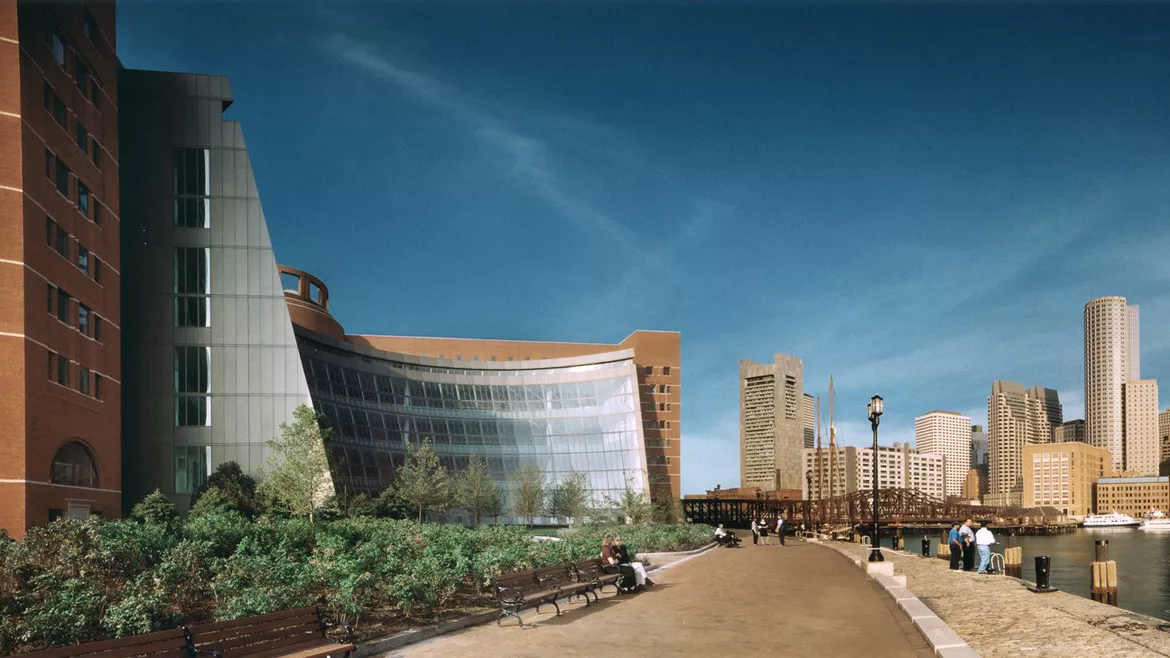
Moakley U.S. Courthouse & Harborpark by Pei Cobb Freed & Partners, Boston (1998). Photo by Steve Rosenthal © Historic New England, from the Steve Rosenthal Collection of Commissioned Work at Historic New England.
Stephen G. Breyer is retiring from the highest court in the land but won’t leave his role as a judge of the world’s best-known architecture prize. The spokeswoman for the Pritzker Prize confirmed that Breyer, 83, who announced last week that he would step down from the U.S. Supreme Court, will continue on the Pritzker jury. Breyer joined the jury in 2011 and is currently the longest serving among its eight members. (The 2022 Pritzker laureate is expected to be named in March.)
His interest in architecture first came to light with his role in the design of the John Joseph Moakley federal courthouse in Boston, which opened in 1999. As the Chief Judge of the First Circuit Court of Appeals, Breyer was instrumental in the selection of the late Henry Cobb of Pei, Cobb, Freed, as architect of the new courthouse, and the judge later wrote a foreword to the book, “Celebrating the Courthouse: A Guide for Architects, Their Clients and the Public.” Critic Martin C. Pedersen spoke to Breyer in July 2018 about his special connection to architecture. In the interview, just re-posted on Common Edge and published below, it is clear that Breyer’s belief that “law requires both a head and a heart” applies, as well, to his ideas about design.

This piece first appeared in Common Edge.
Martin C. Pedersen We can’t talk about your current involvement on the Pritzker jury, but I do want to talk about architecture in more general terms. You have a long engagement. When did it start?
Stephen Breyer: It began back in the early 1990s. Doug Woodlock was the judge in the federal district court for Massachusetts (in Boston), and I was was chief judge of the First Circuit Court of Appeals,, and we needed a new courthouse. We wanted an attractive courthouse, but we also wanted one that would work. It was important that good architects applied, so Bill Lacy [then executive director of the Pritzker Prize] helped us with that. Eventually we found a very good architect, Harry Cobb [with Ian Bader].
But it took quite a while. Anyone who has worked with the General Services Administration knows that it’s not necessarily a smooth, flowing process. It took Doug and me a day a week for about two years—not to get the building built, but to figure out what we wanted, to travel around and look at buildings by Cesar Pelli and Moshe Safdie and Robert Venturi, and other very good architects, to get the plans for the building approved and drawn.
Harry taught us a lot. He spent time sitting in courtrooms, seeing what judges do, and tried to make a building that the public would be able to use and consider their own. It was not a private building. It was a government building. For me, just looking and listening, trying to deal with both the architects and the GSA, and the judges and the others, I learned a lot. I don’t consider myself an architectural expert, but I may be an expert in the choices you have to make if you want to design an effective courthouse.
Looking for quick answers on architecture and design topics?
Try Ask RECORD, our new smart AI search tool.
Ask RECORD →
I came out of that with a belief that, for major government buildings, there always has to be someone who takes an interest—who’s not the architect, who’s not the director of security. It has to be a fairly high level person, in whatever organization is planning the building, who is willing to devote the time. Not to giving total free rein. But sitting there and trying to bring people together, so that the architect has the ability to contribute what he or she has the skill to do. That remains a necessary part of the process to produce good public buildings.
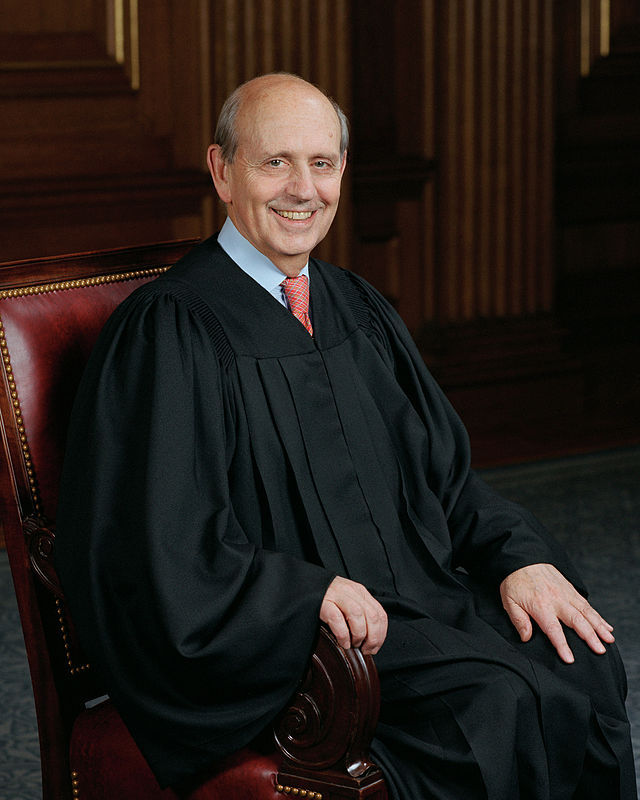
Justice Stephen Breyer.Photo by Steve Petteway, Courtesy of the Supreme Court of the United States
MCP: You get back to the Moakley courthouse every year.
SB: More than that, because my wife has always kept her job at Dana Farber, the cancer hospital in Boston, and we’ve kept our house up there. We’re back and forth quite a lot.
MCP: How has the building held up?
SB: It’s held up beautifully. It still looks good and works well as a courthouse. The courtrooms are attractive and people visit and hold public events there. The local bar association sponsors tours for thousands of school children every year, to observe how our legal system works. The jurors come, learn about their role, and serve as jurors, if selected. The courthouse is both a learning device and a building that the people of Boston feel they can use. Ellsworth Kelly produced a series of paintings for the building that are worth far more than the amount he was paid. And those paintings work perfectly. It’s a testament to what two talented people, Ellsworth Kelly and Harry Cobb, can do when they put their minds to it, and they’re allowed to do it. That doesn’t mean non-interference. It doesn’t mean, “Just do what you want.” It means work with them, be helpful to the process. In the end the only way to understand a building is not to describe it, or even to take a picture of it, but to go there, open your eyes, and look.
MCP: The process of moving through a building and experiencing it, that’s what separates banal, or even good building, from great ones.
SB: Yes. I agree with you. I think that building in Boston has been successful. And now what you have is a new generation of courthouses, all over the world, that are not fortresses or palaces. They’re public buildings. There is one that Richard Rogers designed in Bordeaux. There’s another in Tel Aviv, another in Johannesburg, South Africa. In a sense, they’re all alike, in that they’re immediately seen and experienced as public buildings. They’re beautiful and serious and part of the democratic process. Can architects do that? Yes. They’ve done it.
MCP: Have you seen some of the new embassies that have recently been completed?
SB: I know about the one in Santiago, Chile, which is not a new one. But I have a great fear of it, because it looks like Fort Knox. And if you build a building that looks like Fort Knox, that’s what people will think it is. And that’s what they’ll think of their government, too.
MCP: As someone at least peripherally involved in architecture, I have a question that I ask a lot of architects. Architecture is the ubiquitous art form. It’s all around us, and yet the public’s perception of it is often weak. What do you think accounts for this disconnect?
SB: Part of it is, look, we breathe everyday, right? But you do not understand the need for clean air until it’s not there. People are surrounded by color, light, noise. Now that color, light, and noise, can be a cacophony, it can be garbage cans banging, or it can be Louis Armstrong or Duke Ellington. Buildings are part of that human dynamic. They can bring joy and harmony into the lives of people who encounter them. And those same people might not be able to speak in articulate terms that a great architecture critic would appreciate, but they’ll know when they miss it. They’ll know when it isn’t there. It seems to me that’s why it’s essential part of our lives.
MCP: In the past five years there’s been a cultural shift in architecture away from the celebration of the lone genius architect. What do you make of that shift?
SB: I don’t know. But I do know that one of the most interesting talks that I’ve heard recently was by Alejandro Aravena, the Chilean architect. He cited a statistic. By 2050, there will be as many as five billion people living in cities. And the number of those people who cannot afford ten thousand dollars for a home is huge. So we’re going to have billions more people needing buildings, for work, for living. Whether we like it or not, this is undeniably true. It seems inevitable. And when it happens, those buildings can, conceivably, promote harmony. They can work, they can be coherent, and provide a kind of beauty. That’s the challenge. How do you accomplish that? You can label it genius or you can just call it quality. I’d be satisfied with quality. Now how do we get there? The most I could do, as one client, was to help get a building built. The most I can do as a member of the Pritzker jury is to sit on the sidelines and say, “Keep going! This is important.”
MCP: We’re living in polarized times. Does architecture have a “political” role?
SB: Well, the political role is to try to create physical places where people’s natural needs for harmony, beauty and functionality are met. I would say that’s the job. Just like my job in law is to resolve legal disputes. Therefore, we have a legal system. Everything around us—particularly in the communications area—wants to shout, “It’s all political!” I say, “That isn’t what it feels like to me.” I’m a judge and I try to do my job. And I imagine that architects feel somewhat similarly.
MCP: There’s a phrase going around in architecture circles right now: democratic design. As someone who deals primarily in democratic ideals, and who deals a little bit in design, I wonder what that phrase means to you?
SB: I would prefer to use a legal phrase that was very popular at one time. It’s an Oliver Wendell Holmes term, called Jobsmanship. If you were to translate that into architecture terms, it would mean that every part of the building was designed well. The stairs, the handrails, the restaurants, how it looks from the outside, how it looks on the inside. There are no dead areas. The direction is clear. The signage is clear. Whatever the point of view, there is an attractive perspective. When we were looking around, for architects, we asked a series of questions to the people who worked in their earlier buildings and who used them: What do you think? Do you like it? Does it lift your spirits? Are you happy to be here? How does it still function ten or fifteen years after opening? Does it fit within the neighborhood? Does it add something to the community around it? These are all fair questions to ask of our buildings.
MCP: What’s the most inspiring project you’ve seen in the last handful of years?
SB: Most inspiring? We went on a tour and I loved the Le Corbusier monastery near Lyon. That was one of the things that was a surprise. But I can tell you a city I loved: Barcelona, not just because of the art Nouveau part, the Gaudi buildings, but because of the old city, which they’d redone, in a way that was not gentrified. There were all kinds of neighborhoods, and lots of different kinds of people. You’d go to look at a library, at night, and they’d be a cafe next door and there’d be a lot of young people sitting at the cafe, and you’d look through the windows of the library and see children reading books, younger people reading books, and old people reading books. Great. There they were, using that building. An attractive building, in an attractive neighborhood, so when I saw that I thought of that corny old political slogan, “Yes, we can do it.”
MCP: It is possible.
SB: It’s possible! Of course.
Looking for a reprint of this article?
From high-res PDFs to custom plaques, order your copy today!