Tenant Rights and Sustainability Retrofits: A Tough Balancing Act
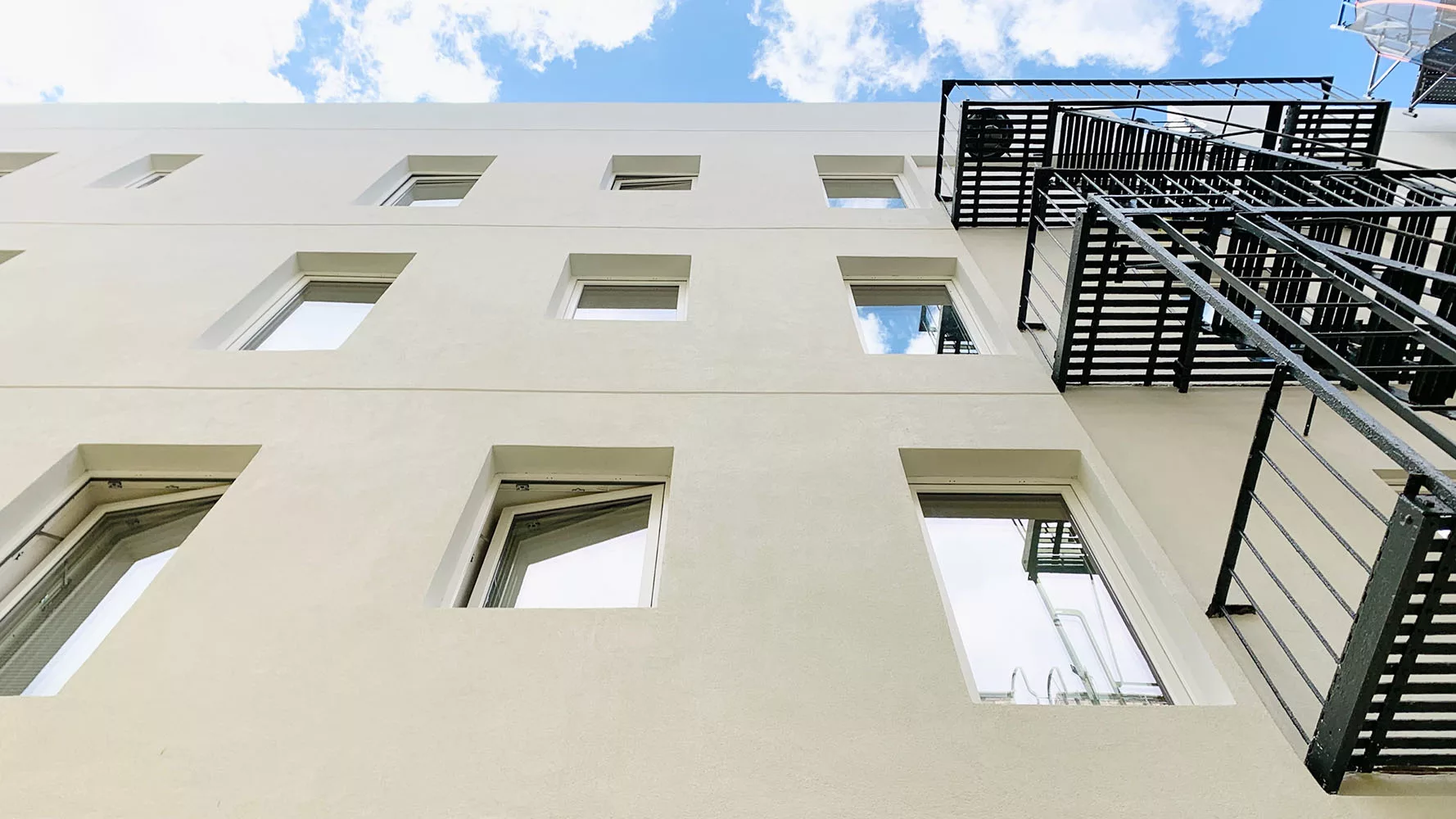
The Grove Street building of RiseBoro's Casa Pasiva project. Photo courtesy RiseBoro
In 2019, RiseBoro Community Partnership, a New York City-based nonprofit developer that owns a portfolio of affordable housing, set out to renovate nine century-old apartment buildings in the city’s rapidly gentrifying Bushwick neighborhood. Not coincidentally, construction began the same year that the city enacted Local Law 97—the landmark legislation establishing strict caps on greenhouse gas emissions for large buildings, setting the stage for mandated mass retrofits.
RiseBoro’s project, titled Casa Pasiva, is novel in more ways than one: not only did RiseBoro complete it to Passive House energy use standards, but it did so largely without disrupting the lives of longtime residents. Leveraging financing from city and state sources, and utilizing the expertise of architect Chris Benedict, the project added new insulative cladding, replaced windows, and installed electric HVAC systems within the exterior walls—eliminating the need for invasive in-unit construction that would have severely inconvenienced residents.
Residents of the Casa Pasiva buildings are among the 2.1 million tenant households in New York City, where seven out of ten households occupy rental units. For many tenants, renting is not a transient or temporary state—especially in affordable and rent-regulated housing, where residents often stay in their homes for decades and sometimes across generations.
The success of the retrofit project sets a precedent that is relevant as well outside of New York, where mandates and disclosure requirements for energy efficiency have become increasingly common—at a time when there are more renter households nationwide than at any point in the last 50 years.
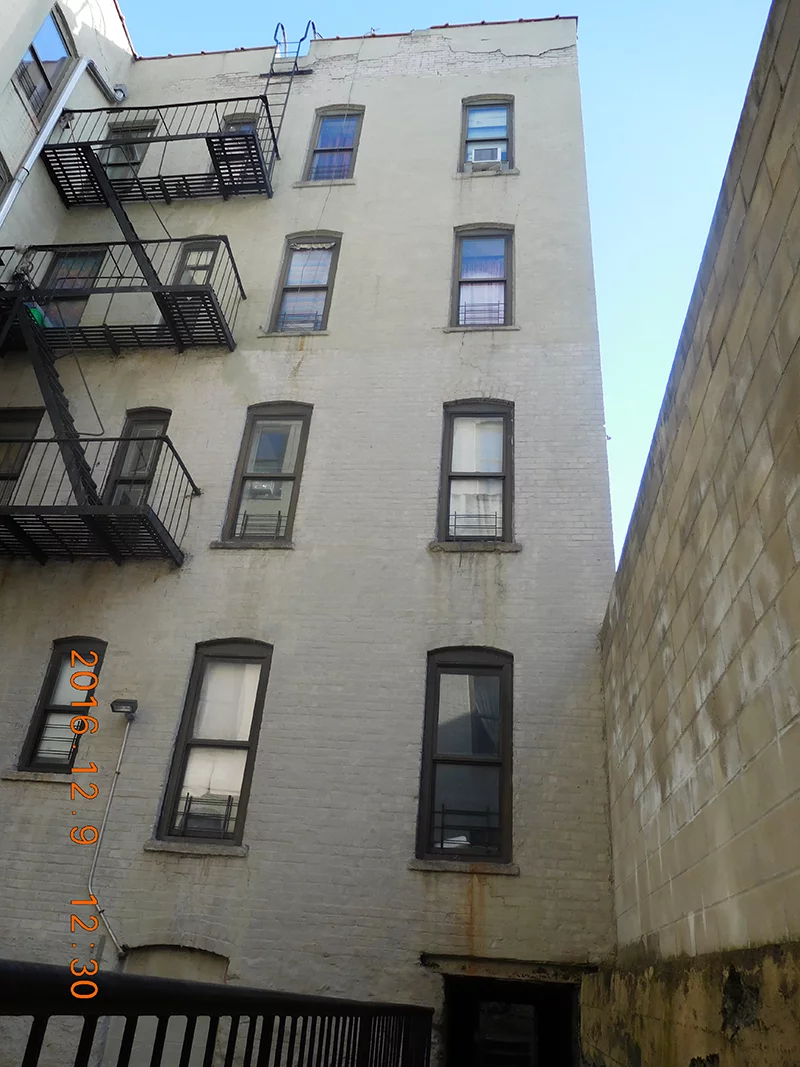
One of the Brooklyn buildings that RiseBoro retrofitted in its Casa Pasiva project. Photo courtesy RiseBoro
Ryan Cassidy, RiseBoro’s director of sustainability and construction, describes the years following Local Law 97’s passage as a kind of “feasibility study” for large-scale retrofits. But all too often, the effects of major capital improvements, including retrofits, have left tenants out of the conversation. And those effects go beyond minor disturbances: tenant relocation, excessive noise, and hazardous structural conditions can occur when major rehabilitation work is undertaken.
Mission-based affordable housing developers like RiseBoro have become de facto leaders in emphasizing tenant welfare during retrofits—both because of their concern for their tenants, and because of their ability to leverage subsidies to fund often-expensive projects. For example, another developer, the Boston-based WinnCompanies, relied on a longstanding relationship with a tenant association when undertaking a retrofit of its Castle Square Apartments in the city’s South End over a decade ago—one of the first such projects in the country.
For tenants living in buildings owned by for-profit landlords, a lack of agency often means that sustainability takes a backseat to more immediate concerns. “Tenants have very little say over what’s happening physically in their buildings, even though it’s their home,” says Emily Goldstein, director of advocacy and organizing at the non-profit Association for Neighborhood and Housing Development and a longtime tenant organizer in New York. Some degree of disruption is to be expected for critical construction and rehabilitation projects, Goldstein says, but she has observed scenarios where the health and safety of tenants was placed at risk by landlords acting negligently or in bad faith when undertaking building upgrades.
Looking for quick answers on architecture and design topics?
Try Ask RECORD, our new smart AI search tool.
Ask RECORD →
A recent study by Stand for Tenant Safety (STS), a coalition of tenant advocacy groups, followed the experiences of tenants in rent-regulated buildings that recently underwent construction. STS found a high percentage of tenants experiencing severe disruptions to services, while understaffed city agencies charged with tenant rights enforcement were slower to respond to residents’ concerns than required by law. Harassment, repeated offers to buy tenants out of rent-regulated apartments, and poor communication are also commonplace, according to the study.
Some landlords have a “long history of mistreating their tenants and not addressing repair issues,” as Goldstein puts it, and the result is “a situation in which tenants are rightly worried that the construction will not be done responsibly—that the effects will be more severe than they ought to be.”
In New York, uncertainty persists around Local Law 97, which faces opposition from some members of the city’s real estate industry. Owners of both regulated and unregulated buildings have been slow to make required improvements. Retrofits are expensive endeavors. While there are incentives and resources for building owners, these do not come close to covering the full cost of many retrofits, according to WinnCompanies director of energy and sustainability Christina McPike. Instead, landlords of unregulated buildings have incentive to pass the costs of a retrofit onto tenants—even with any resulting return on investment from energy savings. Landlords of rent-regulated buildings, by contrast, are limited in their capacity to raise rents to cover the cost of retrofits, and, as a result, the city created a carve-out for delayed compliance for buildings with regulated units. While this is a temporary solution, the result could be “a class divide in terms of who is getting healthier housing and who is living in less ideal physical conditions,” says Goldstein.
Today, there is institutional interest in supporting tenant-in-place major retrofits—the New York State Energy Research and Development Authority’s RetrofitNY program, for example, helped fund Casa Pasiva as well as other New York-based pilots and continues to support the development of design innovation in this space, including building component prefabrication and creating demand for retrofit technologies, modeled after the Dutch EnergieSprong initiative. And the federal Department of Energy recently announced $32 million in funding for affordable housing retrofit pilot projects around the country. To McPike of WinnCompanies, the question of financing for these projects is “the challenge of the next decade,” and critical to get right in addition to innovation in technology and construction methods. Beyond energy efficiency, upgrades to the nation’s aging building stock are required to meet the challenges of extreme weather and climate resiliency.
But more attention to the issue is needed, and architects have an important role to play in developing design solutions that reduce the impact of upgrades on tenants—just as Benedict did at Casa Pasiva. “We’re still in the new or early stages of passive house retrofits, so the design community has not really ramped up,” says Cassidy. “It’s a great opportunity to think through our means and methods and to get creative with solutions.”
Design professionals who undertake these projects can also learn from the experiences of tenants, whose deep knowledge of their buildings is invaluable. Goldstein notes that tenants must be seen as “partners in the process of figuring out the best solutions and needs of each building.” While solutions run the gamut from design decisions, to careful construction phasing, to updated and better enforcement of regulations, to expanded financial support, ensuring tenant welfare as decarbonization mandates are implemented across the country is crucial—and cannot be achieved without giving tenants themselves a voice in how their buildings are retrofitted.
Looking for a reprint of this article?
From high-res PDFs to custom plaques, order your copy today!