Developer Anyeley Hallová Tackles Equity and Wealth-Building
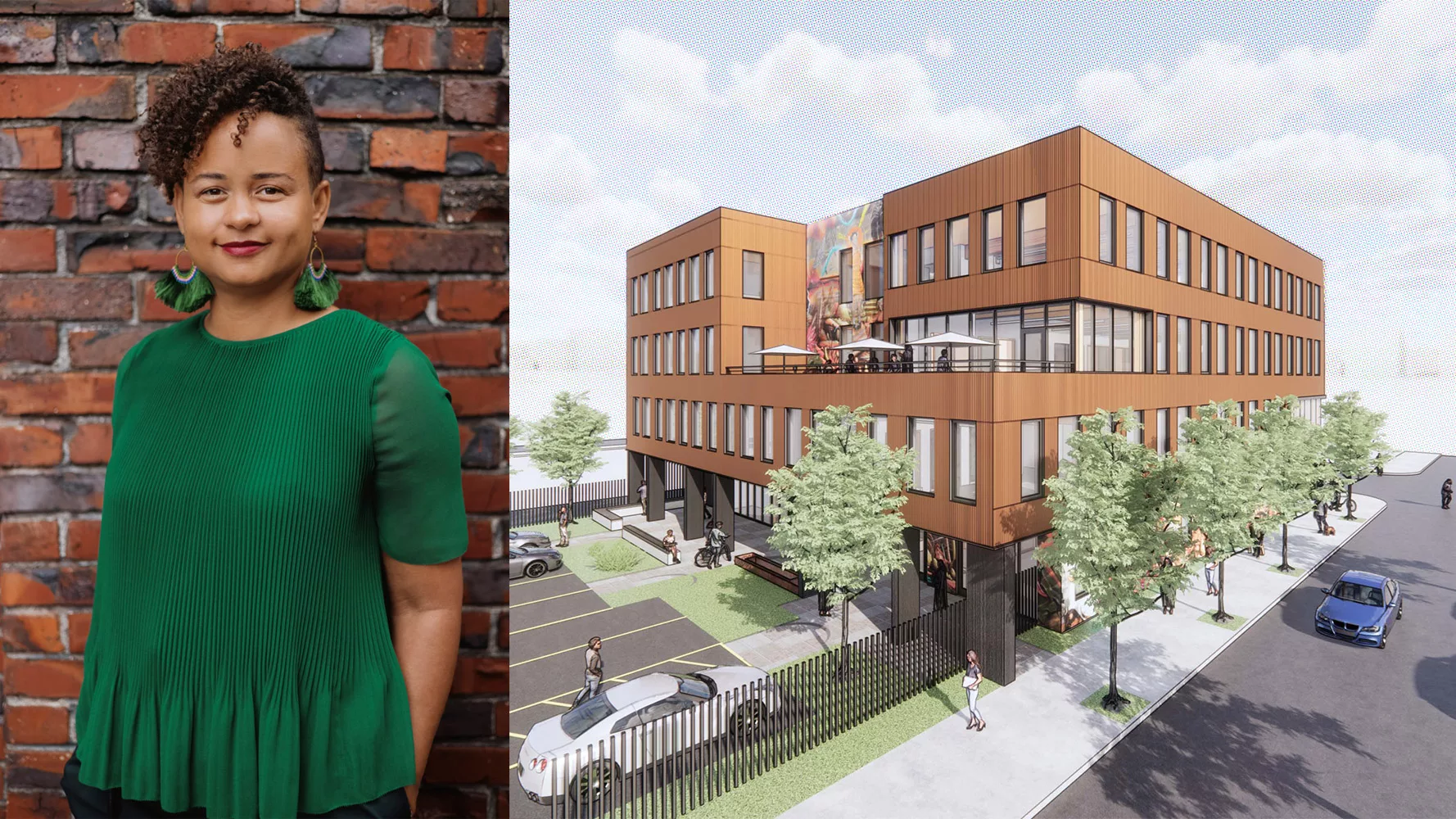
Anyeley Hallová (left) and her company Adre are developing the Building United Futures Complex (right), in Portland, Oregon, designed by Mahlum Architects and Colloqate. It will house a consortium of BIPOC organizations and businesses. Headshot © Sam Gehrke, rendering courtesy Adre/Mahlum
Architects & Firms
With degrees in environmental systems, city planning, and landscape architecture, Portland, Oregon-based Anyeley Hallová didn’t travel a conventional path to real-estate development. But, during her nearly two decades in the field, she has used her education in design thinking to advance sustainability, mass-timber construction, and architectural ambition. With the development firm project^, she worked on Framework, an office building in Portland. Though never built, it was, in 2017, the first wood high-rise to be permitted in the U.S. and opened the door to future tall wood buildings. Also at project^, she developed the Meyer Memorial Trust Headquarters in Portland’s Lower Albina neighborhood. The mass-timber LEED Platinum building was constructed with 47 percent minority- or women-owned business participation (both Framework and Meyer were designed by LEVER Architecture). In 2016, Hallová was named one of Urban Land Institute’s “40 under 40” and, earlier this year, honored as a 2022 Grist 50 “Fixer.” Hallová sits on the U.S. Green Building Council’s board, consults with Amazon’s Puget Sound housing-equity accelerator, and chairs Oregon’s Land Conservation and Development Commission (LCDC), the powerful overseer for the statewide land-use system.
Hallová, 46, recently started her own development firm, Adre, to advance equity and wealth-building for BIPOC communities. She spoke with RECORD about her new venture.
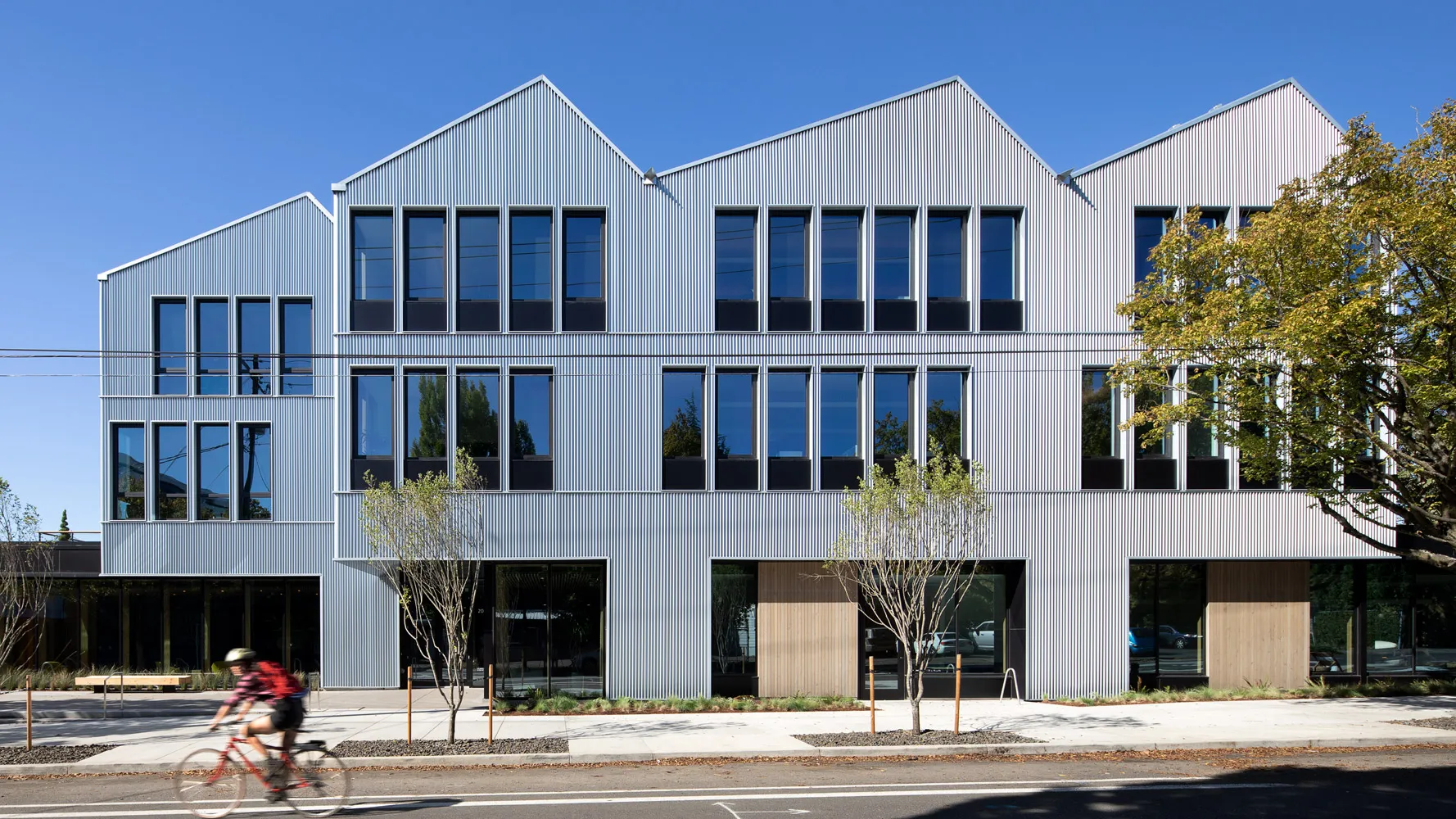
While a partner at project^, Hallová oversaw the development of the Meyer Memorial Trust Headquarters in Portland’s Lower Albina neighborhood. Designed by LEVER Architecture, it was built with 47 percent minority- or women-owned business participation. Photo © Jeremy Bittermann
You’ve worked with a couple of the most sustainable developers in the country, Gerding Edlen and project^. Why was 2020 the right time to start Adre?
Obviously, there was COVID, which kept me home more. You think a lot when you’re in your home space. Two was Black Lives Matter, a critical moment similar—I hope—to the civil rights movement: a realization that change needs to happen. Three, I was finishing up Meyer Memorial Trust, the most mission-oriented project I’ve done, not just for design and sustainability, but also equity. Four, on the LCDC, we were developing policies for housing production and asking cities to answer new questions: “What are you doing for homelessness or affordable homeownership for BIPOC communities?” I was on the Portland Housing Center Board, working on homeownership for BIPOC folks. And, then, people began asking my advice on how to get more developers of color in the field. I’ve been asked to increase this, there, and that, and I’m like, “Wait a minute, what about me?” If there are so few developers of color who own a majority of their own business, I thought, if I don’t do this, then who is expected to?
How does architecture help further your equity and sustainability goals?
Buildings are for people. They live, work, play, and shop in buildings, and the fabric of our cities is filled with buildings. It shows people their self-worth. If we’re going to change trajectories of the lives of people of different economic and racial backgrounds architecture has to play a role. Architecture is completely linked to equity.
As a developer trying to push the needle in sustainability and equity, what are the most frustrating systemic barriers you encounter? What would you change?
Looking for quick answers on architecture and design topics?
Try Ask RECORD, our new smart AI search tool.
Ask RECORD →
The most frustrating part—well, there’s a lot, actually—but one is how projects are financed and owned. The typical real-estate development project requires accredited investors, meaning a certain net worth. Essentially, that allows people who have a lot of money to continue to make money, but it doesn’t really allow regular folks to participate. Our whole system of ownership and development perpetuates wealth inequality. It’s not something I’m going to solve with my company in the first couple of projects. But our work is inspirational and catalytic. I want to tackle a different issue with each project to inspire those who have more assets and capital to change the system.
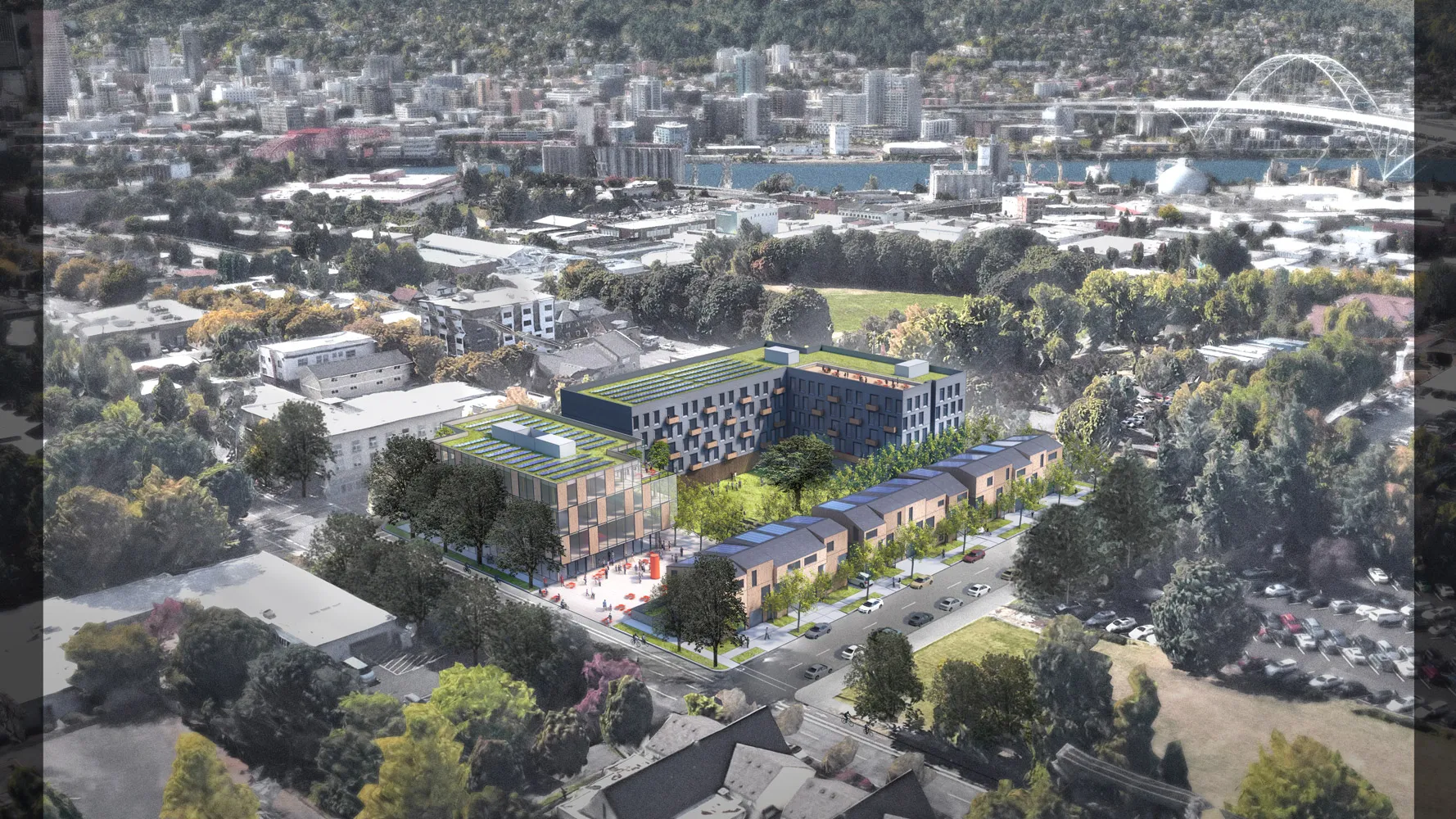
The Williams & Russell project, designed by LEVER Architecture, will rise on a Portland site where urban renewal displaced Black families in the 1970s. The development will include office space and affordable housing. Image courtesy Adre/LEVER Architecture
Two of your projects are benefiting from the Portland Clean Energy Fund (PCEF) generated from a local surcharge on large retailers. The program has been somewhat controversial. How is PCEF money benefiting your work?
We’ll be using the money for design of energy efficiency and production that go beyond code: better performing facades, mass timber for less embodied energy, 60-75-kilowatt solar arrays. Both buildings will be owned by organizations that will serve Black or BIPOC people. These are nonprofits that are receiving these funds, not my company. This fund is huge for the city of Portland and for the United States, saying, hey, we have some money set aside to help communities that don’t get access to big capital for sustainability. I hope it is a model in the United States.
Your mixed-use Williams & Russell complex, designed by LEVER, will rise on a 1.7-acre lot in Portland where urban renewal forcibly displaced 120 Black families in the 1970s. Do you think of this as a healing and reconciliation project?
I definitely do, though you cannot repair all that has been lost—on that site or any site, for that matter—through a development project. It has three parts: office, apartments, and affordable homes for sale. Adre is working on the office and affordable homes. Our goal is to maximize ownership within the Black community. So, wealth creation and healing. Design will play a role in how we tell these stories about what has been successful, but also about what has been lost.
Looking for a reprint of this article?
From high-res PDFs to custom plaques, order your copy today!