Architectural Record
search
cart
facebook twitter linkedin youtube
  • Sign In
  • Subscribe
  • Sign Out
  • My Account
Architectural Record
  • NEWS
    • Latest News
    • Awards
    • Interviews
    • Obituaries
    • Podcasts
      • Design:Ed Podcast
      • Sponsored Podcasts
  • OPINION
    • Book Reviews / Excerpts
    • Exhibition Reviews
    • Forum
  • EXCLUSIVES
    • Videos
    • Design Vanguard
    • Top 300 Firms
    • Sponsored Content
    • Sponsored eBooks
    • From the Archives
  • CONTINUING ED
    • Editorial Continuing Ed
    • CE Center
    • CE Academies
  • PROJECTS
    • Buildings By Type
    • Reuse & Renovation
    • Museums & Arts Centers
    • Colleges & Universities
    • Multifamily Housing
    • Interiors
    • Lighting
    • Kitchen & Bath
  • HOUSES
    • Record Houses
    • House of the Month
    • Featured Houses
  • PRODUCTS
    • Products by Category
    • Record Products of the Year
    • Latest Products
  • EVENTS
    • Dates & Events
    • Record on the Road
    • Innovation Conference
    • Sustainability in Practice
    • Women In Architecture
    • Webinars
    • Ad Excellence Awards
    • Submit an Event
  • CONNECT
    • Ask RECORD AI
    • Newsletters
    • Contact
    • Advertise
    • Editorial Calendar
    • Store
    • Customer Service
  • SUBMIT
    • Submission Guidelines
    • RECORD Competitions
  • MAGAZINE
    • Subscribe
    • My Account
    • Digital Edition
    • Current Issue
    • Firm Pass
    • Historic Archive
Architecture NewsClimate Change & Sustainability

Lessons in Teaching the Complex Reality of Carbon

By Fred A. Bernstein
Princeton-Campus-2022.jpg

Nassau Hall at Princeton University, which is trying to make embodied energy a criterion when evaluating designs for new buildings. Photo by Geoff Livingston via Flickr

September 22, 2022
✕
Image in modal.

A mere 44 years after graduating from Princeton’s School of Architecture, I was back. Dean Monica Ponce de Leon had invited me to give a lecture on embodied energy. I would focus on how architects’ determination to reduce operational energy was, in some cases, making the embodied energy problem worse, and how touting the former while ignoring the latter made buildings seem much “greener” than they really are.

I gave the lecture in the fall of 2021. A few days later, the dean asked me to expand it into a graduate seminar, which would give me a chance to guide students’ research on aspects of the embodied energy problem, while also working on my own.

It turns out that Princeton students have many chances to explore the topic. Professor Paul Lewis offers a graduate seminar focused on “the tectonics of plant-based building materials.” Professor V. Mitch McEwen teaches a seminar in which students create products like bioplastic brise soleils and new kinds of low-carbon insulation. At the same time, Forrest Meggers, a polymath who divides his time between Princeton’s architecture and engineering schools, has been providing an introduction to embodied carbon in his undergraduate level course “Designing Sustainable Systems,” and to life cycle assessments (LCAs) in his graduate level “Elemental Building Function.”

So how would I make my seminar different? Over the last few years, I’ve come to realize that one of the biggest impediments to reducing embodied energy is a lack of consensus on how to measure it. That's no surprise. Imagine a window with components from three different countries, which were shipped to a fourth for assembly and then to a fifth for installation. Calculating the amount of energy in that window involves making assumption after assumption, educated guess after educated guess, which is why experts may come up with very different answers. Unfortunately, the absence of consensus gives anyone inclined to ignore the problem an excuse for doing so. (By contrast, measuring operational energy, at least after a building opens, is about as difficult as reading a utility bill.)

Princeton Architecture class.

Professor Paul Lewis watches as one of his students presents work at Princeton's Laboratory for Embodied Computation. Photo by Danial Mahfoud

So I focused my course on the ways we measure embodied energy, those methods’ limitations, and how we might do better. The class began with examinations of some of the most common embodied energy apps for architects: Tally, One Click LCA, Edge and EC3. The goal wasn’t for students to become adept at using these tools but rather to understand the assumptions behind them—after all, the feedback these apps provide may affect the design of new buildings well into the future.  Then we looked at various LCA methodologies, which tend toward mind-numbing complexity. The LCA of Harvard’s experimental HouseZero, for example, resulted in a spreadsheet with 83 columns and 114 rows: that’s over 9,400 cells, some containing numbers computed to 15 decimal points (quadrillionths!). But with so many items—from plumbing to appliances—excluded from the LCA, the result overlooks much of the house’s real impact.

What to do? We turned to guest speakers for insights. Among them were Stacy Smedley, the executive director of Building Transparency, the creator of EC3; architect Chris Hellstern of Miller Hull in Seattle, who has performed many LCAs; and Steve Raciti, a scientist who was able to explain the mechanics of carbon sequestration in soil. Ron McCoy, Princeton’s University architect, gave us a candid look at the institution’s efforts to make embodied energy one of its criteria when evaluating designs for new buildings.

Themes emerged from our research. One was the importance of geography. Translating embodied energy into embodied carbon (which is what we really care about) requires knowledge of the carbon intensity of electricity production in the relevant location. Among the 50 states, that number varies about 1 pound of CO2 per kwh in Vermont, to about 1900 pounds of CO2 per kwh in West Virginia. The question of what measures to take to minimize a building’s total lifetime carbon emissions has very different answers in different places.

Looking for quick answers on architecture and design topics?
Try Ask RECORD, our new smart AI search tool.
Ask RECORD →

The students did great original research. One wrote about the embodied energy of solar arrays versus that of wind farms, a crucial question as we decarbonize the grid. Another wrote about the carbon emitted into the atmosphere when soil is disturbed, or covered with asphalt or concrete, an important topic because in some active ecosystems there can be as much carbon below ground as above it. (And it’s timely, given the push by the federal government to build new highways under the rubric of infrastructure improvement.)
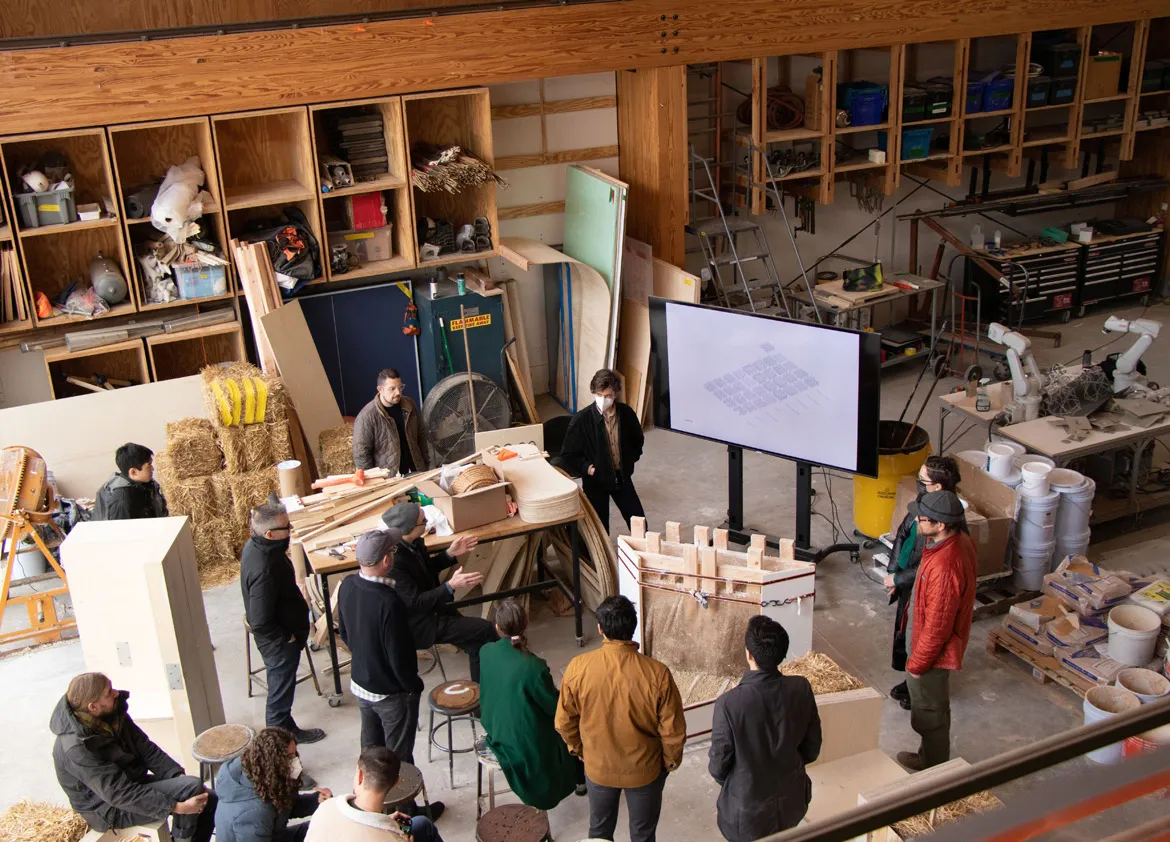
Princeton Architecture class.

Professor Lewis's students present at Princeton's Laboratory for Embodied Computation. Photo by Danial Mahfoud

My own research involves ways property owners can determine which energy-saving retrofits will actually reduce total carbon emissions. The recently passed Inflation Reduction Act provides about $10 billion to subsidize the costs of installing rooftop solar panels, electric (instead of gas) appliances and efficient heating and cooling systems. But how long will it take for the energy those systems save to outweigh their embodied energy? Until there’s an easy way to do those “carbon payback” calculations, billions of dollars may be spent on improvements that, from a climate change perspective, make things worse, not better. I can’t think of a more important subject to address.

As Dean Ponce de Leon wrote when she asked me to teach the course, “Implications and Complications of Embodied Energy Analysis,” again next spring, students are “really thirsty for the topic.”

Read about embodied carbon and education
KEYWORDS: architecture education

Share This Story

Looking for a reprint of this article?
From high-res PDFs to custom plaques, order your copy today!

Fred Bernstein studied architecture at Princeton and law at NYU and writes about both subjects.

Post a comment to this article

Report Abusive Comment

Subscription Center
  • Create an Account
  • Start a Subscription
  • Manage My Account
  • Sign Up for Newsletters
  • Visit Customer Service
  • Update Preferences

More Videos

Sponsored Content

Sponsored Content is a special paid section where industry companies provide high quality, objective, non-commercial content around topics of interest to the Architectural Record audience. All Sponsored Content is supplied by the advertising company and any opinions expressed in this article are those of the author and not necessarily reflect the views of Architectural Record or its parent company, BNP Media. Interested in participating in our Sponsored Content section? Contact your local rep!

close
  • cold storage facility
    Sponsored byCarlisle SynTec Systems

    How Architects Can Design More Continuous Cold Storage Envelopes

  • TAMLYN XtremeTrim Exterior Trim
    Sponsored byTamlyn

    Designing Cleaner Panel Facades: Why Exterior Trim Details Matter

  • Building with Vapor Barriers
    Sponsored byReef Industries, Inc.

    Vapor Barriers Help Control Moisture in Tighter Building Designs

DESIGN:ED Podcast
Listen to Architectural Record’s DESIGN:ED Podcast

Events

June 18, 2026

Rebooting the Aging Office Building

Credits: 1 AIA LU/HSW; 1 AIBD P-CE; 0.1 ICC CEU; 1 PDH

Explore façade retrofit strategies and award-winning design concepts that can transform aging office buildings into healthier, higher-performing workplaces for today’s hybrid workforce.

June 23, 2026

Enhancing Fire Resistance with Advanced PVC Solutions

Credits: 1 AIA LU/HSW; 1 AIBD P-CE; 0.1 ICC CEU; 1 IIBEC CEH

Evaluate advanced PVC solutions that improve fire resistance, support WUI compliance, and enhance resilience in residential and commercial building design.

View All Submit An Event

Products

2026 Architect's Square Foot Costbook

2026 Architect's Square Foot Costbook

See More Products

Popular Stories

SanDiegoAirport

Top 300 Architecture Firms of 2026

Lorcan O' Herilhy

California Architect Lorcan O’Herlihy Has Died, Age 66

Coronado Bridge

The Architect’s Guide to San Diego

CCA, Studio Gang

The Winners of the AIA’s 2026 Architecture Award Range from Collegiate Rowing Hubs to Housing for the Homeless

Dusk House

Design Vanguard 2026: ONO

Enhancing Fire Resistance with Advanced PVC Solutions - Free Webinar - June 23, 2026

Related Articles

  • NOMA 2019 Conference

    NOMA’s 2019 Conference Offers Lessons in Design Justice and Recruiting the Next Wave of Licensed Architects

    See More
  • Radical Pedagogies.

    Radical Pedagogies Explores Teaching Lessons from the Past

    See More
  • Manual of Biogenic House Sections

    LTL Architects' Newest Book Cuts Through Houses Constructed of Low-Carbon Materials

    See More

Related Products

See More Products
  • drawingfrommodel.jpg

    Drawing from the Model: Fundamentals of Digital Drawing, 3D Modeling, and Visual Programming in Architectural Design

See More Products

Events

View AllSubmit An Event
  • March 25, 2026

    Rewards and Challenges of Design-Assist: Lessons for Students in Collaborative Project Delivery

    NOW ON DEMANDCredits: 1 AIA LU/HSW; 1 AIBD P-CE;  0.1 ICC CEU; 0.1 IACET CEULearn how design-assist collaboration among architects, engineers, and contractors improves efficiency and constructability through real-world case studies and expert insights.
  • April 22, 2026

    One Foot In, One Foot Out—The Balancing Act of Teaching and Practicing Architecture

    NOW ON DEMANDCredits: 1 AIA LU/Elective; 1 AIBD P-CE;  0.1 ICC CEU; 0.1 IACET CEUJoin Architectural Record for a discussion with three leading firms on the future of the academic–practice hybrid model and its impact on the next generation of architects.
View AllSubmit An Event
×

The latest news and information

#1 Source for Architectural Design, News and Products

SUBSCRIBE
  • RESOURCES
    • Advertise
    • Contact Us
    • Submit
    • Store
  • ACCOUNT CENTER
    • Create an Account
    • Start a Subscription
    • Manage My Account
    • Sign Up for Newsletters
    • Visit Customer Service
    • Update Preferences
  • PRIVACY
    • PRIVACY POLICY
    • TERMS & CONDITIONS
    • DO NOT SELL MY PERSONAL INFORMATION
    • PRIVACY REQUEST
    • ACCESSIBILITY
  • SERVICES
    • Marketing Services
    • Reprints
    • Market Research
    • List Rental
    • Survey/Respondent Access
  • STAY CONNECTED
    • Linkedin
    • Facebook
    • Instagram
    • YouTube
    • X (Twitter)

Copyright ©2026. All Rights Reserved BNP Media, Inc. and BNP Media II, LLC.

Design, CMS, Hosting & Web Development :: ePublishing