Architectural Record
search
cart
facebook twitter linkedin youtube
  • Sign In
  • Subscribe
  • Sign Out
  • My Account
Architectural Record
  • NEWS
    • Latest News
    • Awards
    • Interviews
    • Obituaries
    • Podcasts
      • Design:Ed Podcast
      • Sponsored Podcasts
  • OPINION
    • Book Reviews / Excerpts
    • Exhibition Reviews
    • Forum
  • EXCLUSIVES
    • Videos
    • Design Vanguard
    • Top 300 Firms
    • Sponsored Content
    • Sponsored eBooks
    • From the Archives
  • CONTINUING ED
    • Editorial Continuing Ed
    • CE Center
    • CE Academies
  • PROJECTS
    • Buildings By Type
    • Reuse & Renovation
    • Museums & Arts Centers
    • Colleges & Universities
    • Multifamily Housing
    • Interiors
    • Lighting
    • Kitchen & Bath
  • HOUSES
    • Record Houses
    • House of the Month
    • Featured Houses
  • PRODUCTS
    • Products by Category
    • Record Products of the Year
    • Latest Products
  • EVENTS
    • Dates & Events
    • Record on the Road
    • Innovation Conference
    • Sustainability in Practice
    • Women In Architecture
    • Webinars
    • Ad Excellence Awards
    • Submit an Event
  • CONNECT
    • Ask RECORD AI
    • Newsletters
    • Contact
    • Advertise
    • Editorial Calendar
    • Store
    • Customer Service
  • SUBMIT
    • Submission Guidelines
    • RECORD Competitions
  • MAGAZINE
    • Subscribe
    • My Account
    • Digital Edition
    • Current Issue
    • Firm Pass
    • Historic Archive
Architecture News

Tribute: Robert Geddes (1923–2023)

By Inga Saffron
portrait of robert geddes
Architect Robert Geddes during a November 1979 lecture to students at Miami-Dade Community College Mitchell Wolfson New World Center. Courtesy State Archives of Florida/Florida Memory, Creative Commons/Public Domain
February 14, 2023
           
✕
            Image in modal.


Among the architects and engineers associated with the influential, midcentury group known as the Philadelphia School, Louis Kahn and Robert Venturi are easily the most famous. But Robert Geddes, who died Monday at 99, was the group’s heart and soul, the architect who most exemplified the Philadelphia School’s ideals, and the one most committed to reconciling modernist design principles with traditional urban values. His work was proof that you could insert bold buildings into cities without dismantling the things around them.

Like Venturi and Kahn, Geddes grew up in Philadelphia at a time when the city was an industrial powerhouse. Although his family, who used the name Goldberg, would later move to Atlantic City, Philadelphia retained its pull for Geddes. After studying at Harvard’s Graduate School of Design under Walter Gropius, he returned to the city in 1951 to take up a teaching position at the University of Pennsylvania. 

By then, Philadelphia was a much changed place. Jobs and people were leaving for the suburbs, and a new, progressive administration was struggling to modernize the city’s neglected infrastructure. At Penn, the design faculty was undertaking their own reckoning, as they reflected on modernism’s harsh treatment of older architecture. Geddes joined Kahn, Venturi, Romaldo Giurgola, Denise Scott Brown and others in formulating a more sympathetic approach, which led them to being lumped together as the Philadelphia School. The group’s “architecture was different,” Geddes explained in a history of the period written by Pratt Institute professor John Lobell. “Our buildings were neighbors of buildings that were there before, and that would come after.”
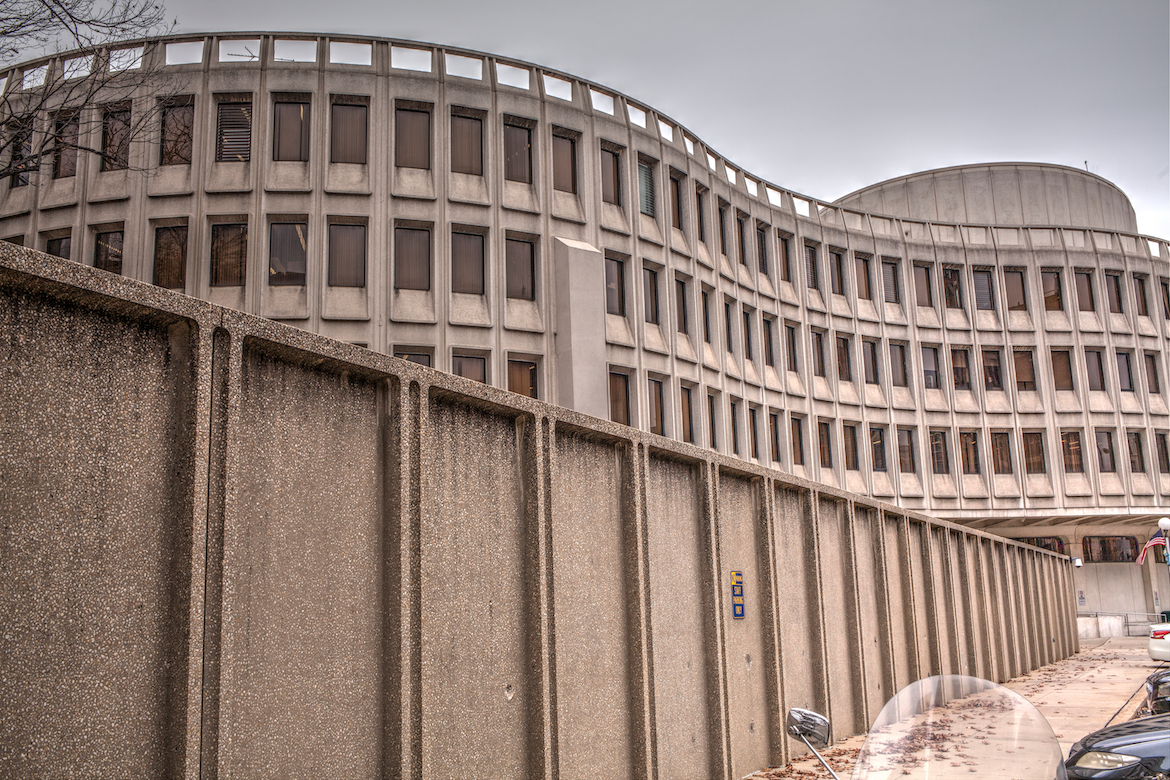
a curving brutalist police building in philadelphia.

Philadelphia Police headquarters. Photo by Fernando Garcia Esteban, Shutterstock

Geddes’ first project, Pender Labs, was a perfect demonstration of that ethos. Designed for Penn’s engineering school in 1958, the four-story cube was squeezed into a small space between two early 20th-century structures. While Pender’s rigorously gridded facade was stylistically distinct, Geddes' use of materials and scale made the trio feel like natural companions. Sadly, Pender was torn down in 2003 to make way for a much larger infill building.

Geddes’ respect for connectivity and city streets didn’t prevent his firm, Geddes, Brecher Qualls Cunningham, from occasionally departing from the grid. In Philadelphia, he is best known for his 1963 police headquarters, a sinuous, double-barrelled, concrete structure with a facade of taut, washboard-ab windows. Geddes, who was deeply committed to collaborations with engineers and planners, tapped August Komendant, who pioneered the use of prestressed concrete (and later worked with Kahn on the Kimbell Art Museum) to develop the structural system. Every window frame had to be individually designed—no mean feat in an era before computer-assisted design. Although the building, nicknamed the ”Roundhouse,” was part of a city effort to professionalize the department, it became linked in the minds of many Philadelphians with the police abuses that took place inside. Since the department moved to new quarters last year, the Roundhouse’s fate has been uncertain.
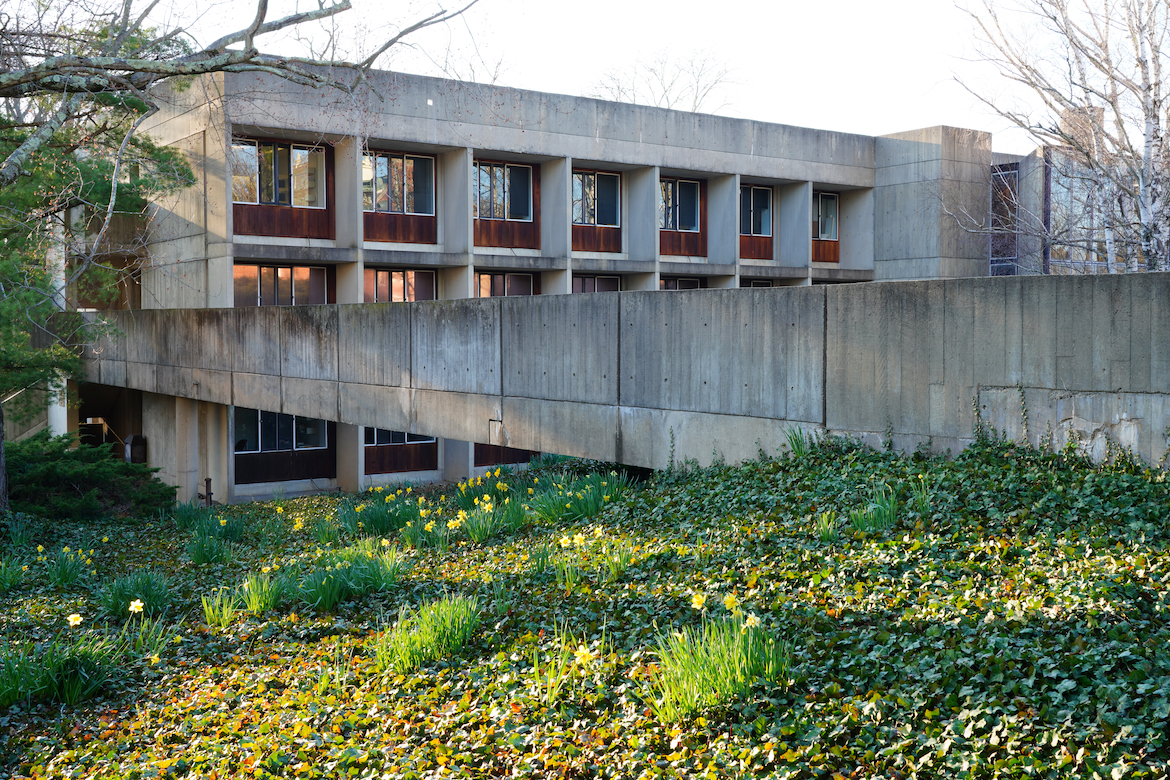
a brutalist campus building at princeton.

Institute for Advanced Study, Princeton, New Jersey. Photo by EQRoy, Shutterstock

Geddes, who spent countless hours in conversation with Kahn and other Penn faculty, was as much a teacher as a practitioner. By the mid-’60s, the Philadelphia School was breaking up, as its members achieved success. Geddes left his beloved Philadelphia in 1965 to become dean of Princeton’s School of Architecture, and would spend the next 17 years building up the department. The position gave him the opportunity to design the serene dining hall and Birch Garden Quad at the Institute for Advanced Study, also in Princeton.

While it’s easy to focus on Geddes’ memorable building designs, he also left an important legacy of downtown plans. His work on Philadelphia’s 1988 plan for Center City, and a redevelopment proposal in Princeton, reinforced the value of retaining the existing street plan and creating lively blocks with buildings from many periods. Geddes continued to teach and lecture well into his 90s. In 2013, he finally published a manifesto calling for architecture that was sympathetic to cities. It was titled, appropriately enough, Fit.

Looking for quick answers on architecture and design topics?
Try Ask RECORD, our new smart AI search tool.
Ask RECORD →

KEYWORDS: obituary Philadelphia Princeton

Share This Story

Looking for a reprint of this article?
From high-res PDFs to custom plaques, order your copy today!

Inga Saffron is architecture critic at the Philadelphia Inquirer. 

Post a comment to this article

Report Abusive Comment

Subscription Center
  • Create an Account
  • Start a Subscription
  • Manage My Account
  • Sign Up for Newsletters
  • Visit Customer Service
  • Update Preferences

More Videos

Sponsored Content

Sponsored Content is a special paid section where industry companies provide high quality, objective, non-commercial content around topics of interest to the Architectural Record audience. All Sponsored Content is supplied by the advertising company and any opinions expressed in this article are those of the author and not necessarily reflect the views of Architectural Record or its parent company, BNP Media. Interested in participating in our Sponsored Content section? Contact your local rep!

close
  • cold storage facility
    Sponsored byCarlisle SynTec Systems

    How Architects Can Design More Continuous Cold Storage Envelopes

  • TAMLYN XtremeTrim Exterior Trim
    Sponsored byTamlyn

    Designing Cleaner Panel Facades: Why Exterior Trim Details Matter

  • Building with Vapor Barriers
    Sponsored byReef Industries, Inc.

    Vapor Barriers Help Control Moisture in Tighter Building Designs

DESIGN:ED Podcast
Listen to Architectural Record’s DESIGN:ED Podcast

Events

June 25, 2026

Designing Glass Railing Systems that Enhance Aesthetics and Meet Code

Credits: 1 AIA LU/HSW; 1 AIBD P-CE; 0.1 ICC CEU

Upon course completion, participants will possess a deeper understanding of glass railings to help ensure that safety, aesthetic, and performance objectives are achieved.

June 30, 2026

Generator Selection and Sizing for Outage-Ready Homes

Credits: 1 AIA LU/HSW; 1 AIBD P-CE; 0.1 ICC CEU

Explore how propane-powered systems and whole-home generators can improve energy resilience, reduce electrical loads, and lower long-term residential costs.

View All Submit An Event

Products

2026 Architect's Square Foot Costbook

2026 Architect's Square Foot Costbook

See More Products

Popular Stories

Lorcan O' Herilhy

California Architect Lorcan O’Herlihy Has Died, Age 66

Obama Presidential Center, Chicago

The Obama Presidential Center Opens on Chicago’s South Side

Spoonbill Ranch

Johnsen Schmaling Architects Integrates Spoonbill Ranch into a Pristine Landscape

Image of Bruce Springsteen Center for American Music

The CookFox-designed Bruce Springsteen Center for American Music Opens in New Jersey

Three Courtyards House

Design Vanguard 2026: Balsa Crosetto Piazzi

Designing Glass Railing Systems that Enhance Aesthetics and Meet Code - Free Webinar - June 25, 2026

Related Articles

  • Robert Mangurian

    Tribute: Robert Mangurian (1941–2023)

    See More
  • LundyLead_jpg..jpg

    Tribute: Victor Lundy (1923–2024)

    See More
  • Gyo-Obata-Obit-1.jpg

    Tribute: Gyo Obata (1923-2022)

    See More
×

The latest news and information

#1 Source for Architectural Design, News and Products

SUBSCRIBE
  • RESOURCES
    • Advertise
    • Contact Us
    • Submit
    • Store
  • ACCOUNT CENTER
    • Create an Account
    • Start a Subscription
    • Manage My Account
    • Sign Up for Newsletters
    • Visit Customer Service
    • Update Preferences
  • PRIVACY
    • PRIVACY POLICY
    • TERMS & CONDITIONS
    • DO NOT SELL MY PERSONAL INFORMATION
    • PRIVACY REQUEST
    • ACCESSIBILITY
  • SERVICES
    • Marketing Services
    • Reprints
    • Market Research
    • List Rental
    • Survey/Respondent Access
  • STAY CONNECTED
    • Linkedin
    • Facebook
    • Instagram
    • YouTube
    • X (Twitter)

Copyright ©2026. All Rights Reserved BNP Media, Inc. and BNP Media II, LLC.

Design, CMS, Hosting & Web Development :: ePublishing