Rising from the Ashes: Mass Timber Helps Resurrect a Fire-Torn Town in Rural California
Greenville, California

The Dixie Wildfire—one of the largest in California history—began in July 2021, blazing through nearly a million acres of forest and, in the rural town of Greenville alone, destroying nearly 600 homes and most of the village center. While residents were still reeling from the devastation, Steve Marshall, an expert on mass timber, and Jonathan Kusel, executive director of the Sierra Institute, a local nonprofit focused on community revitalization and the environment, came up with an idea: what if the institute facilitated the use of cross-laminated timber (CLT), an engineered-wood product, to fast-track the creation of high-quality, fire-hardened replacement homes in Greenville—demonstrating the material’s potential while permanently rehousing people and boosting the local economy?
Marshall—a 42-year veteran of the U.S. Forest Service—had just been working with Kusel and others on a Sierra Institute report for the State of California with recommendations for future uses and possible manufacture of mass timber, including CLT—a material that took off in Europe in the 1990s, but is relatively recent in the U.S. Its panels—engineered from kiln-dried lumber, layered with the grain in alternating perpendicular directions and pressure-bonded with adhesives—can produce buildings that are lighter in weight and more carbon efficient than those of concrete or steel, yet structurally strong, seismically resilient, and fire resistant. When exposed to flames, CLT’s outer layer forms a seal-like char, which protects the dense, unburnt core from damage or even significant temperature rise. Since the panels—which perform well for roofs, floors, and structural shells—are typically factory precut, the work on-site (once land preparation and foundations are done) is more assemblage than traditional construction. Doubling as a structural system and basic enclosure, CLT tends to require smaller crews and less site time than, for example, stick framing.
Soon after discussing ideas for rebuilding, Marshall made a match between the Sierra Institute and the Seattle-based architectural firm atelierjones, one of the few practices with extensive experience designing houses primarily with CLT. Its founding principal, Susan Jones, had not merely used it for houses, including her own—but also, between 2016 and 2019, had helped develop the International Building Code for mass-timber buildings up to 18-stories tall. Her projects with such materials have ranged from religious structures to multifamily high-rises. Meanwhile, the Sierra Institute also had experience with mass timber, having used it in 2018 to construct a modest biomass-fueled power plant, California’s first almost entirely CLT building. But this would be the organization’s initial foray into CLT in the residential realm.
“The majority of Greenville’s pre-fire population, of just under 1,200, had lost their homes—it was disastrous,” recalls Kusel. “Even though we couldn’t rebuild everything instantly, we could give the community hope, confidence, and a path forward by demonstrating and offering ways of creating well-designed houses quickly—and with dramatically improved fire-hardening.”
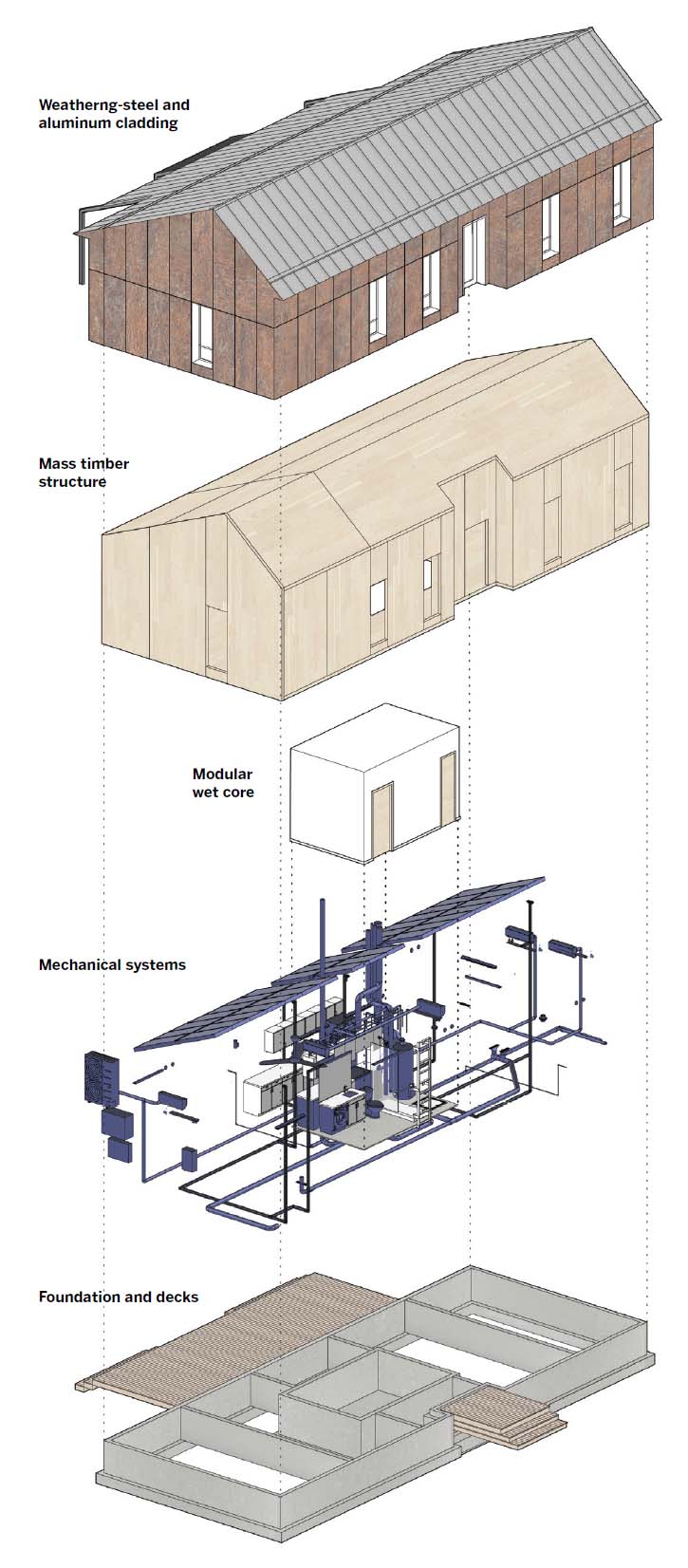
Fortunately, atelierjones had a head start, having already produced modular houses elsewhere, with designs it could adapt or borrow from. In 2022, the Sierra Institute commissioned the firm to produce three prototypical schemes—for one-, two-, and three-bedroom houses—with some add-on and accessory dwelling unit options for future growth. The organization then offered the designs free of charge to residents of Plumas County, where Greenville is located and the Dixie Fire had been particularly destructive. Further expediting the process, the plans were pre-permitted—leaving homeowners simply to complete their own permitting to cover site-specific matters and deviations from the master plans. To speed construction, the initial houses will have prefabricated kitchen-bathroom wet cores, although other methods will be tried in later iterations.
The total construction cost (expected to range from $250,000 to $400,000, depending on house type/size) was tailored to fit within anticipated available funds. About 56 residents from this median-low-income community agreed to immediate presettlement payouts from Pacific Gas & Electric (PG&E), the utility company that took responsibility for sparking the Dixie Fire with its outdated power lines, while other homeowners are still hashing out more individualized PG&E settlements.
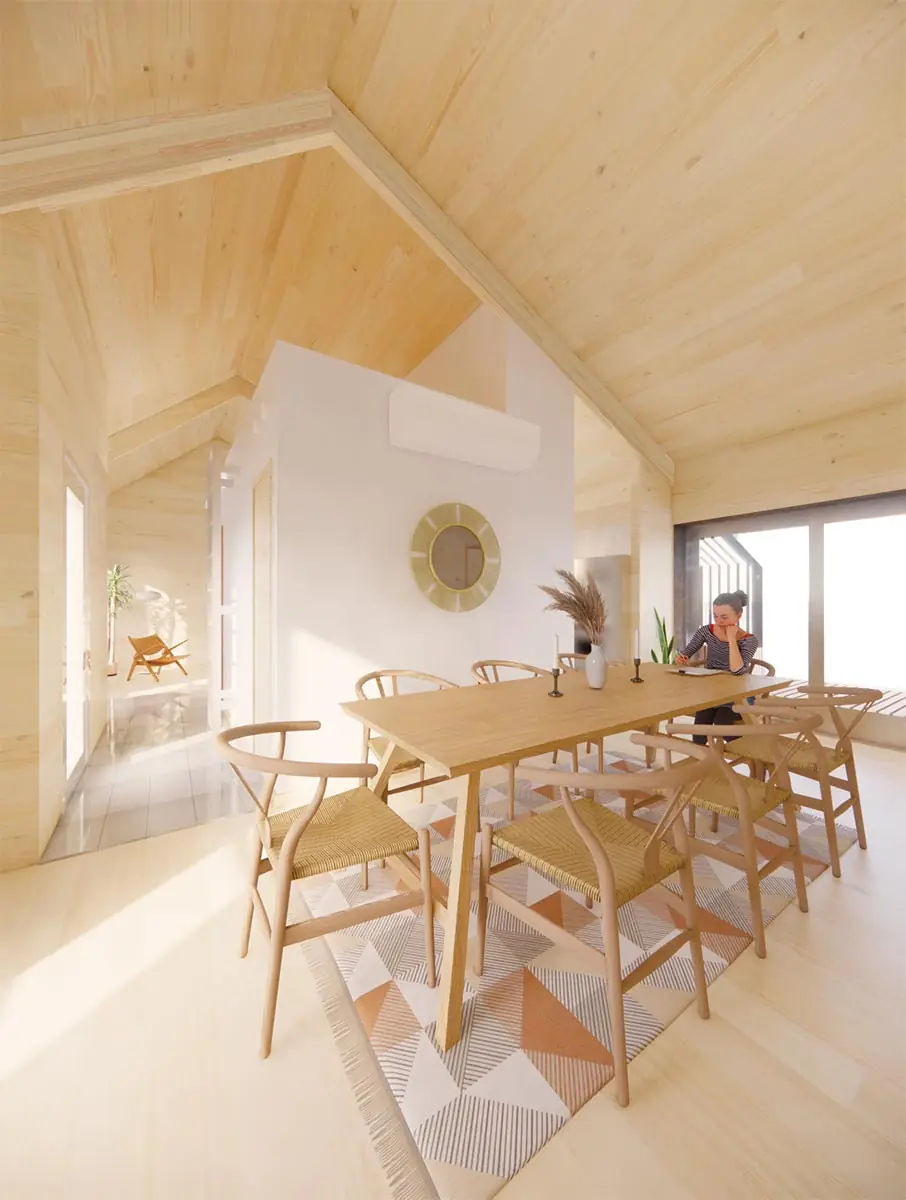
The CLT structural shell doubles as exposed interior wood surfaces. Photo © atelierjones, click to enlarge.
To keep within the expected budgets, Jones designed houses—at 600, 700, and 960 square feet each—that are smaller than many pre-fire versions, but with great versatility and such architectural features as double-height living spaces, in addition to the enhanced resiliency and durability. Although CLT, at this stage in its U.S. production, can still be more expensive than “legacy” materials such as concrete and sometimes even steel, the savings come in the construction efficiencies and, environmentally, in captured carbon. Furthermore, CLT walls, exposed on the interior, eliminate any need for additional finishes, while offering the warmth, beauty (and, early on, the fragrance) of fresh-hewn wood. But for extra fire and moisture protection, as well as perceptual reassurance, in an area vulnerable to both wildfires and heavy winter snowfalls, these houses will be clad in weathering steel. The buildings will meet the strictest state codes for fire-hazard-severity zones, as well as stringent new Wildlands Urban Interface guidelines.
Looking for quick answers on architecture and design topics?
Try Ask RECORD, our new smart AI search tool.
Ask RECORD →
In an ideal recovery scenario, the CLT would be manufactured nearby, using wood from the surrounding fire-ravaged forests, as it’s well established that burnt, still-standing trees are often salvageable for lumber for a significant period after wildfires. How long depends on such factors as tree size and species, weather, climate or microclimate, and the characteristics of the fire itself. Large-diameter trunks typically emerge with only the outer layer charred (like CLT), leaving the underlying wood unharmed. Though some trees, under exceptional conditions, have been salvageable longer, generally, the average time before rot sets in is about two years. A phoenix rising from ashes via locally sourced CLT would clearly be optimal for Greenville—but it’s not entirely feasible immediately. “We’re making strides in that direction,” says Marshall, noting that the whole rebuilding process could take years, allowing it to benefit from interim measures as well as later achievements.
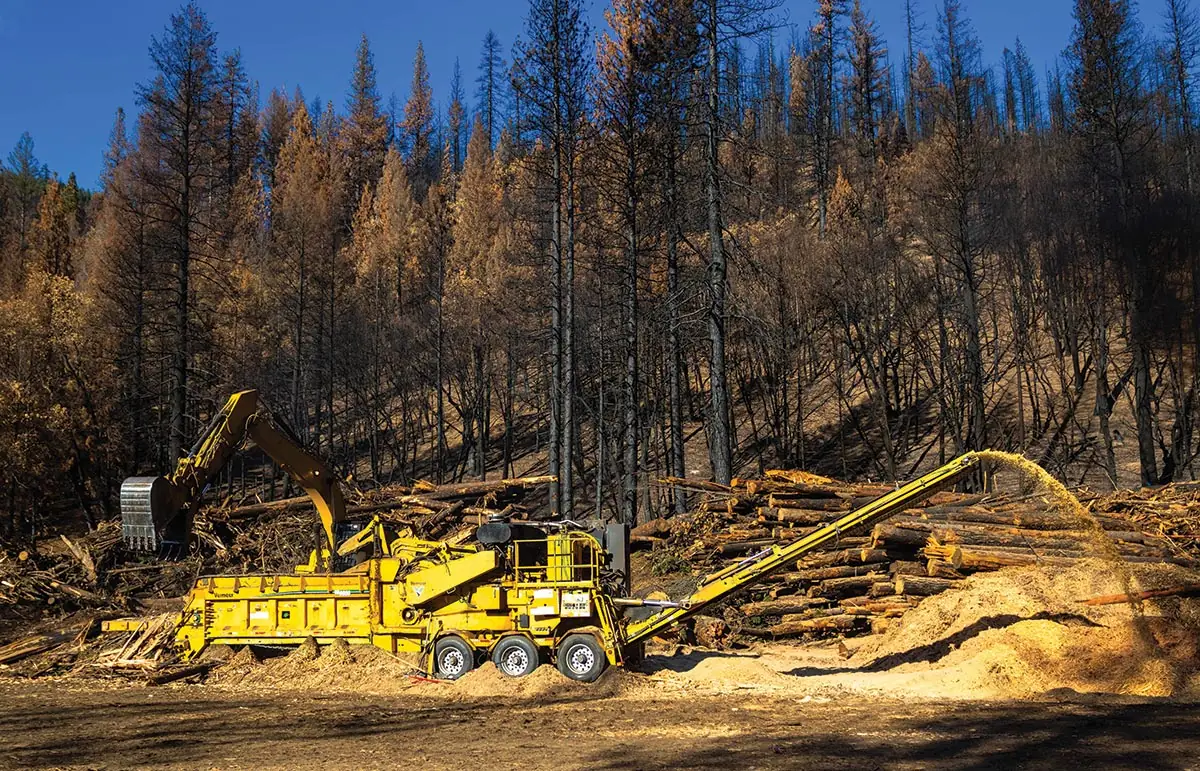
Some scorched trees are chipped; others are salvageable for lumber. Photo © Ty O’Neil/SOPA
One of the biggest challenges is manufacturing CLT locally. Even though California, according to Marshall, now builds with mass timber more than any other state, it doesn’t yet produce the materials itself. And, given the Greenville area’s modest population and remoteness from interstate highways, only a small CLT plant—one of the first of that size in the United States—would make sense. The Sierra Institute is working toward creating such a facility here, but the funding is not yet in place, and there are both technical and economic hurdles in scaling down.
With the clock ticking on Dixie-charred trees, the Sierra Institute has come up with alternative uses. It has already retooled and revived a long-dormant mill site, just outside Greenville, which is now churning out 2-by-4s and 2-by-6s, mostly of Ponderosa pine, the predominant species here, for sale across the region. Previously, California’s Department of Transportation (Caltrans), whose oversight includes highways, was removing and then chipping massive burnt trees that were at risk of falling onto roads bordering the woodland. The Sierra Institute successfully petitioned to have those enormous logs (some upward of 3 feet in diameter) rerouted to the refurbished mill.
Click graphic to enlarge
The modular wet cores were craned into place, and the structural shells’ flat-packed precut CLT panels were assembled on-site. Image © atelierjones
“The big-picture, long-term goal,” says Jones, “is to support a small-scale local industry that would produce CLT for future home construction, here and in neighboring communities.” There’s already been significant interest from surrounding areas. And even after the scorched trees are no longer usable, the forests here, which include private and federal lands, will still require enough ongoing fire-protection maintenance, including thinning, to continue feeding local mills and CLT production. Although pine is not yet certified for such mass timber, groups elsewhere in the U.S. are progressing on that front.
For now, the rebuild will rely on Oregon-manufactured Douglas-fir CLT for the houses, as well as a new community center, at the heart of Greenville, for the local Maidu Indian tribe. That atelierjones-designed structure will rise on the site where the Dixie Fire destroyed a building full of irreplaceable tribal artifacts. Construction will begin this summer, with completion expected in the fall.
Meanwhile, the first three houses—each commissioned by an individual homeowner—are almost done. “Response to the designs has been very positive—and we expect more commissions once more settlements are reached,” says Kusel. Among those who’ve already taken the leap, longtime Greenville resident and developer Ken Donell is not merely gearing up to move into his own new CLT house—he’s also planning to build more of them, plus a low-rise multi-family building by atelierjones, as affordable rental properties. “CLT is amazing in so many respects,” says Donell. “On top of that, its warm wood surfaces and remarkable properties are particularly well suited to Greenville, where we’re surrounded by magnificent forests—but also, of course, the potential for wildfire.”
Credits
Architect:
atelierjones — Susan Jones, Meghan Doring, Eleanor Lewis, Lenore Wan, project team
Engineers:
Hariott Valentine Engineers (structural); Sugarpine Engineering (m/e/p)
Consultant:
Method Homes (modular wet-core fabricator)
General Contractor:
Lights Creek Construction
Client:
Sierra Institute for Community and Environment
Size:
600–960 square feet per house
Cost:
$400 per square foot, estimated
Completion Date:
Late spring 2023 (first three houses)
Sources
Mass Timber:
DR Johnson Wood Innovations (CLT and glulam)
Windows:
Alpen
Interior Paints/Stains:
Sansin; Bellingham Professional Finishes
Insulation:
Rockwool
Tile:
Florida Tile
Looking for a reprint of this article?
From high-res PDFs to custom plaques, order your copy today!