Sports & Recreation 2024
A Multiuse Recreation Complex in Sweden Pushes the Envelope (Literally) with Mass Timber
Gothenburg, Sweden

Architects & Firms
“Rules are meant to be broken,” or so goes the contrarian adage. But in cases of code and zoning, bending is sometimes the best an architect can do. When commissioned with the design of a multiuse recreational facility on a constraint-laden parcel in Kviberg, a suburb of Gothenburg, Sweden, local practice Wahlström & Steijner found clever ways to make the most with the least. Here, the municipal government has been busy redeveloping a former military barracks into a community athletic campus—with the Kvibergs Parks Is och Sporthall as its centerpiece.
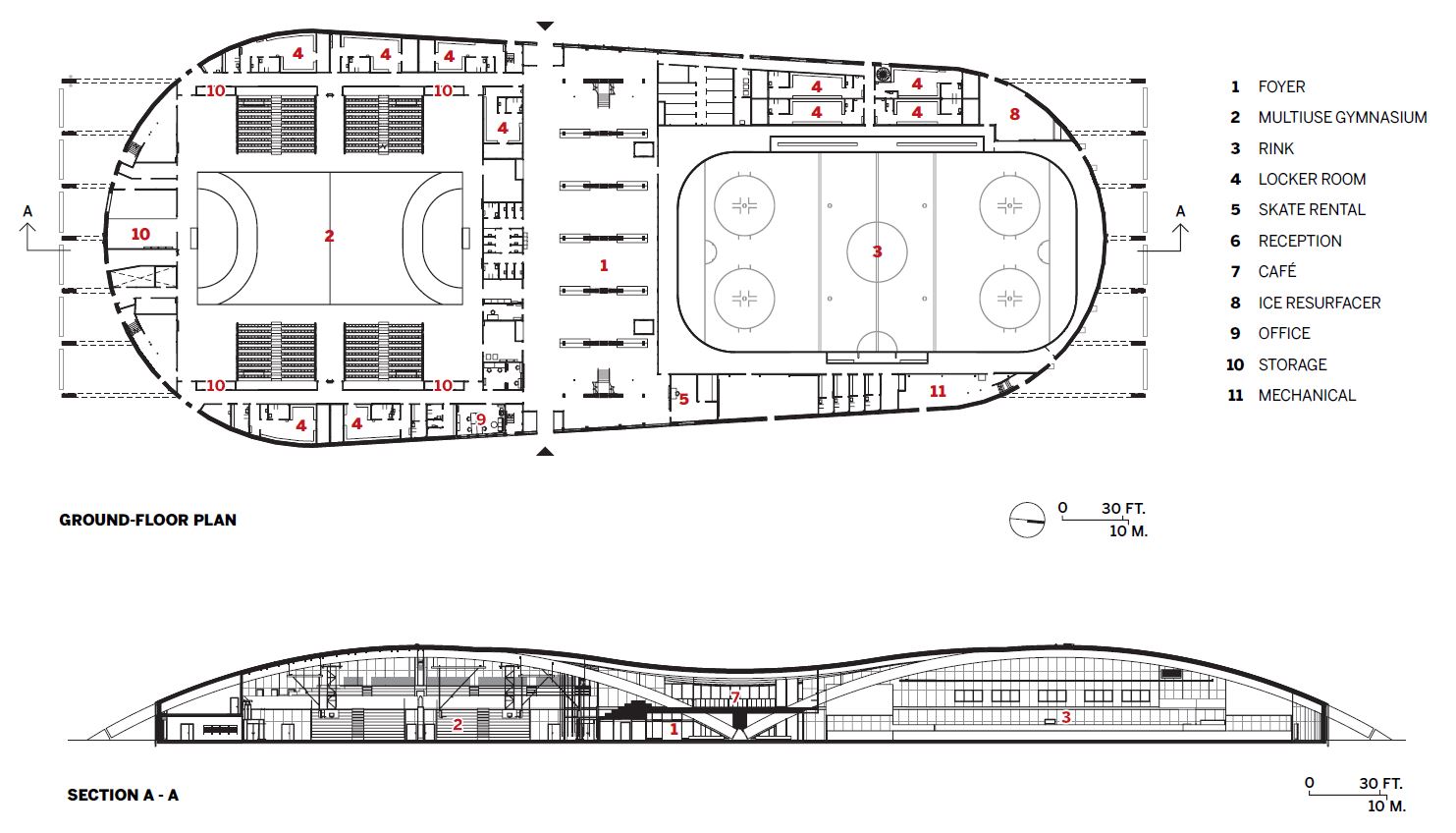
For starters, “the footprint couldn’t exceed 8,000 square meters,” or about 86,110 square feet, explains firm principal and cofounder Jürgen Wahlström. Accordingly, the plan he and his team devised includes an envelope that is tightly wrapped around spectator seating and a subdividable gymnasium (large enough to fit two handball courts) on one end and, on the other, a smaller ice rink, resulting in the venue’s tapered oblong shape. “We came in at 7,999,” he adds with a smile.
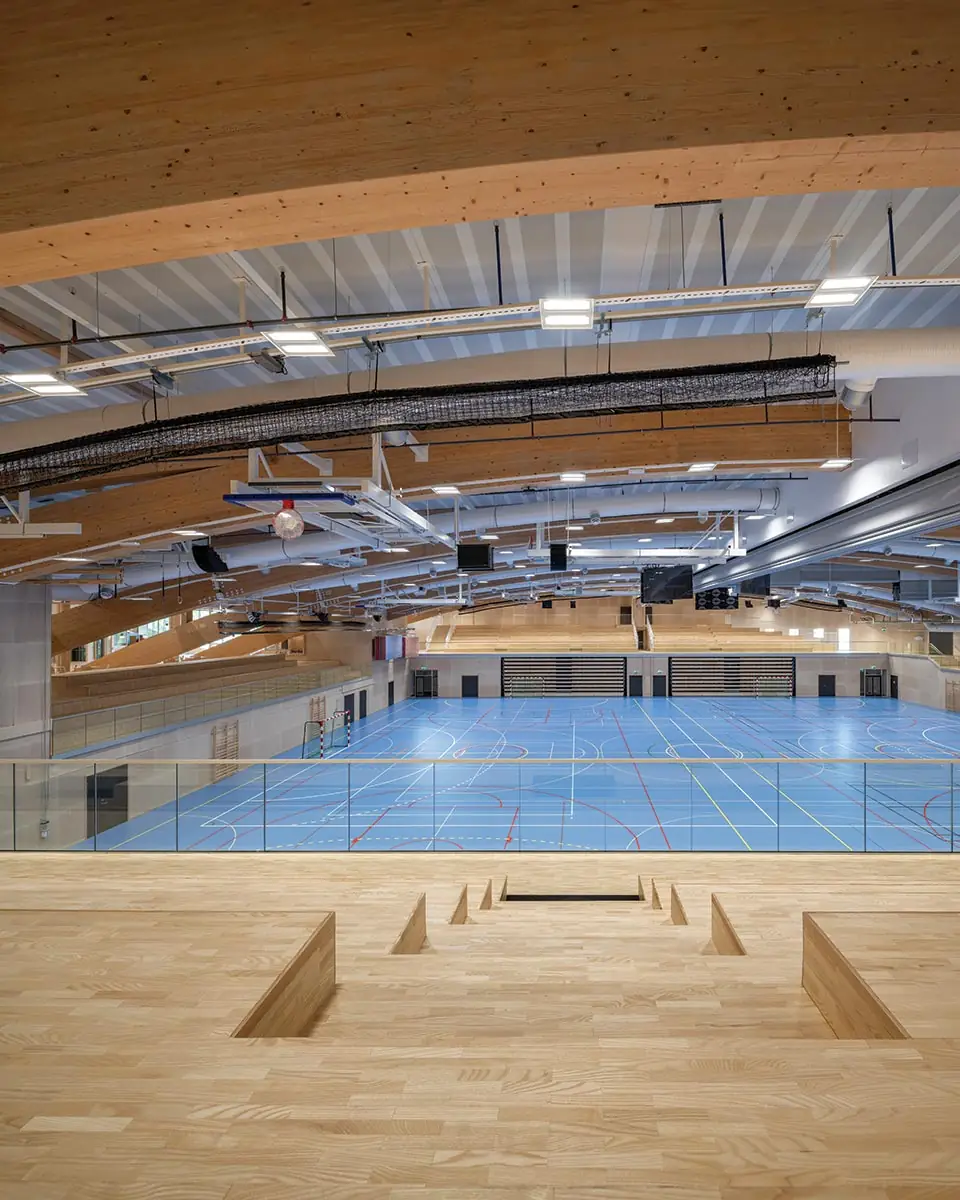
In addition to column-free expanses, gymnasiums require generous clearances overhead—ensuring players’ occasional lobs, near-miraculous saves, and long-range three-pointers remain free of incidental collisions with beams or other architectural elements. However, straight trusses that could both provide the necessary headroom as well as span the complex’s two “arenas” would have, due to their depth, eclipsed the site’s 40-foot height cap. The solution came in the form of glue-laminated arches—14 to be exact, arranged into two groups of seven. They pierce floor plates, bridge rooms, and help to stabilize other structural elements. But to achieve optimal clearances, Wahlström and team extended the arches beyond the building’s footprint, skirting the interior square-footage restrictions. Although some may see this strategy as an imperfect answer to the problem at hand, the project’s authors appreciate this bit of structural expression, which they further emphasize with a gently undulant roofline created by adding seven inverted arches at the building’s center.
1
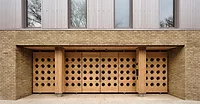
Glue-laminated arches, which span interior spaces (1 & 2), extend beyond the building’s footprint (top of page). Photos © James Silverman, click to enlarge.
2
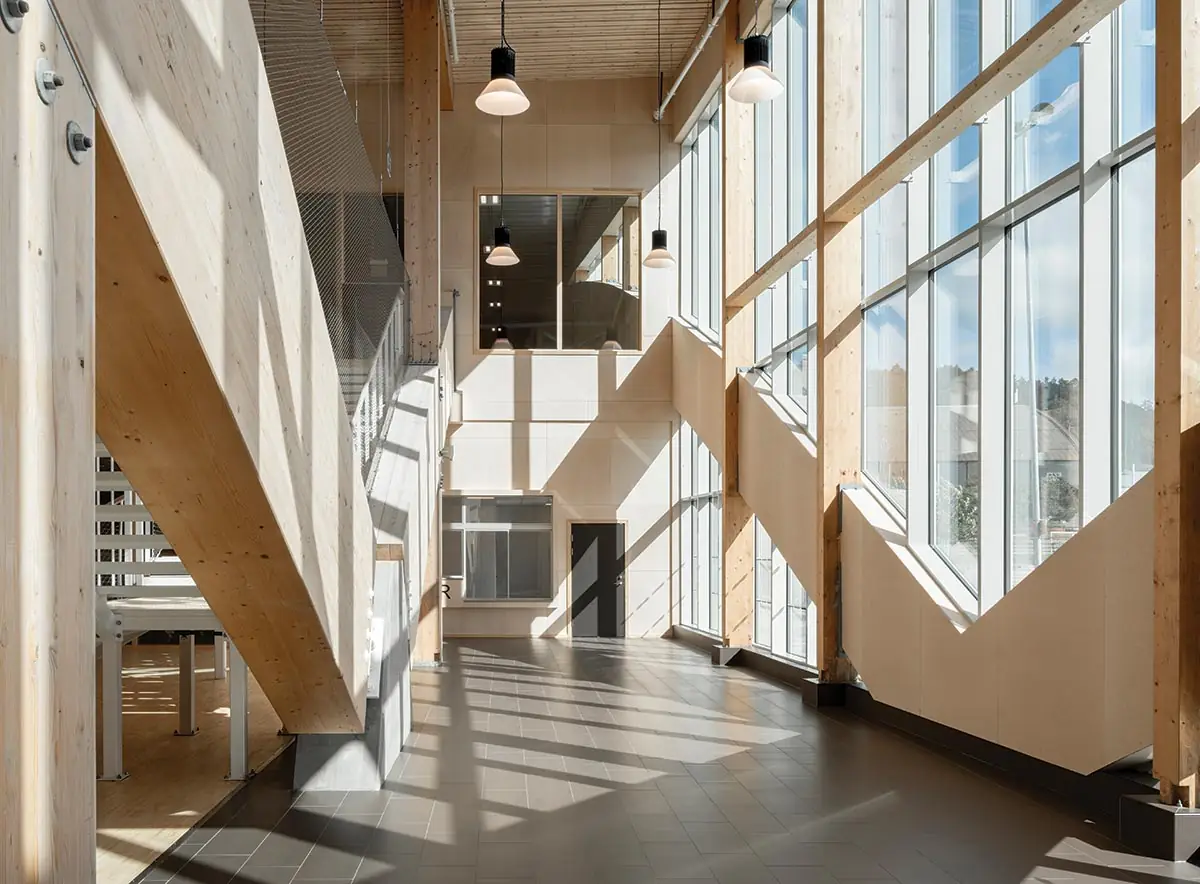
In addition to handball, the multiuse arena at the southern end can host badminton, basketball, fencing, floorball (a type of hockey popular in Sweden), and gymnastics, with space for up to 2,500 spectators when retractable bleachers are fully extended. A ceiling-mounted curtain system allows staff to divide the space into three smaller courts for tournaments. The smaller rink, on the other hand, accommodates 300 people and is mostly used for hockey practice and ice-skating. “Professional associations use it, as can the public, but the building is very much for youngsters,” adds Wahlström, to the din of squeaking sneakers and bouncing balls. A full complement of offices, storage, and locker rooms for staff, players, and referees lines the perimeter. Between the two arenas, in a light-filled communal foyer where the structural ribs dramatically converge at a linear series of trapezoidal anchorages, a café and ample seating offer parents a place to chat and cheer.
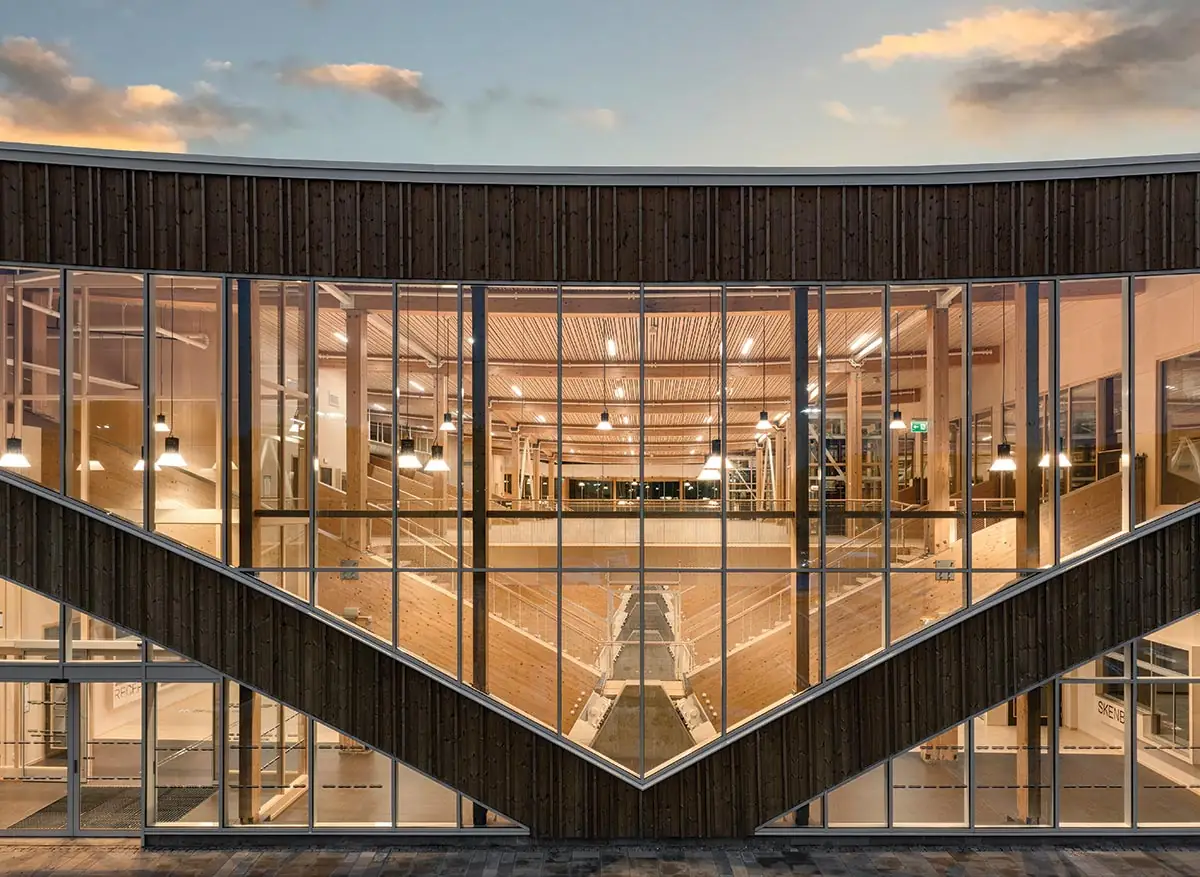
The mass-timber arches converge inside an entry foyer. Photo © James Silverman
The omnipresent glulam arches may be colossal—5 feet in depth, 1½ feet in width, and each spanning over 262 feet—but they are not monolithic. “One” arch comprises four curved segments (making the journey from Austria more manageable), connected on-site with a pinned joint at the center and two knife plates on either side. Two additional pinned joints tie the arches into the foundation. Assembly took about three weeks.
Despite the stabilization offered by the adhesive, glulam arches of such great lengths still expand and contract with changing weather. During the warm, humid months, they swell, while Sweden’s dry wintry air shrinks them. The pinned joints help redirect the movement, which could be likened to a single deep breath over the course of a year—one that results in a 4-inch shift of the roof plane, along with the planted sedum and photovoltaic array above it. Telescopic joints, hidden in the ceiling, accommodate this architectural respiration.
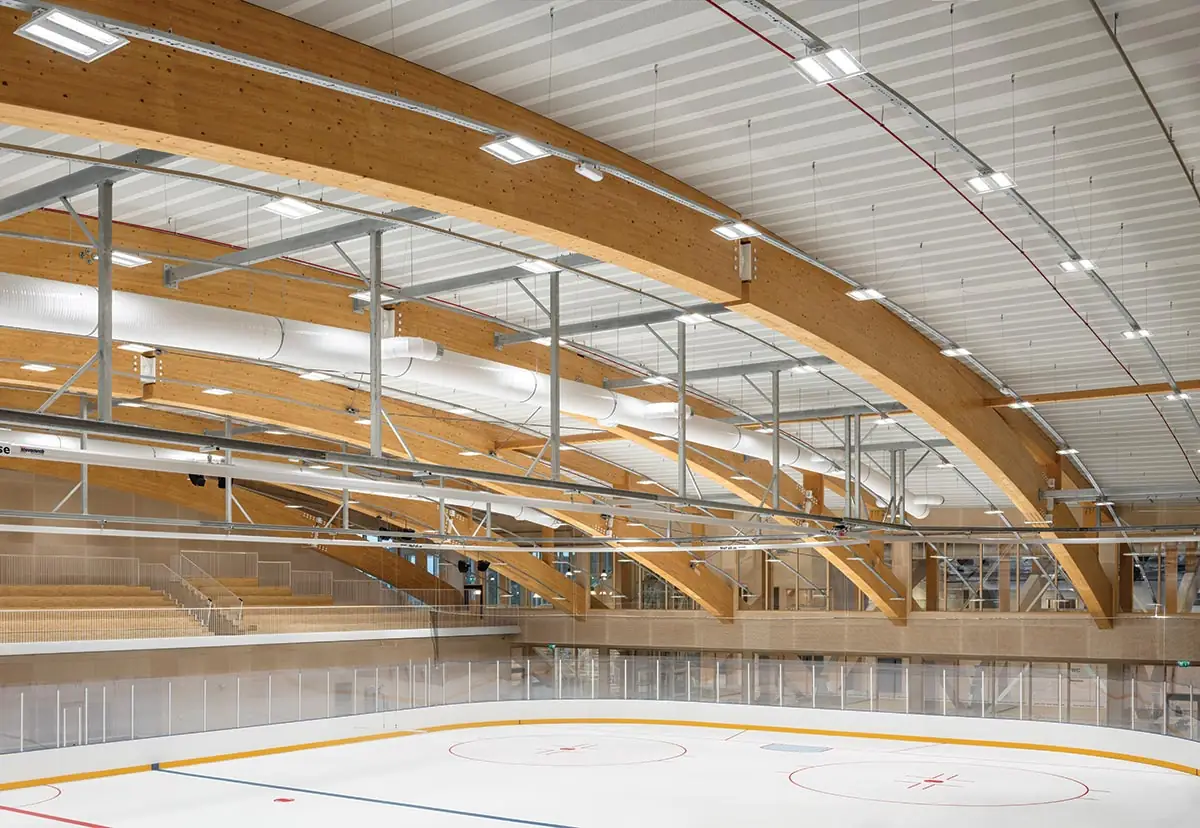
An enclosed rink provides space for hockey and skating. Photo © James Silverman
If there was a building sport for timber use, the facility would surely finish in first place. “Everything is wood,” says Wahlström. Spruce forms the structural elements. Vertical battens of silvery heat-treated pine give the exterior facade depth; seemingly placed at random intervals, closer inspection reveals them to be, in fact, a long but repeating pattern. The floors are made of sturdy ash, while birch plywood lines the inner walls (the once-coveted Russian variety has been replaced by a Finnish substitute due to economic sanctions).
On the strength of their portfolio of schools with integrated athletic facilities, the town of Gothenburg commissioned Wahlström & Steijner with the design of the Kvibergs Parks Is och Sporthall. Now the studio aims to continue its winning streak with a ground-up hockey arena in the nearby town of Alingsås, which will be sheathed, head to toe, in a skin of slate shingles. Inside, glue-laminated arches will once again span staggering distances—offering another opportunity for the firm to flex their mass-timber muscle.
Click drawings to enlarge
Credits
Architect:
Wahlström & Steijner Architects — Jürgen Wahlström, principal; Albin Coric, Armin Khazrai, Fabian Ericson, project team
Engineers:
COWI (construction); SWECO (plumbing); Tribus (electrical)
Consultants:
WSP Sweden (landscape)
General Contractor:
Flodén Byggnads
Client:
Gothenburg Town
Size:
127,010 square feet
Cost:
$28.4 million
Completion:
September 2023
Sources
Mass-Timber:
Wiehag
Cladding:
Moelven (wood)
Curtain Wall:
Ferm & Persson
Roofing:
Vegtech (roofing)
Doors:
Daloc, Swedoor
Looking for quick answers on architecture and design topics?
Try Ask RECORD, our new smart AI search tool.
Ask RECORD →
Looking for a reprint of this article?
From high-res PDFs to custom plaques, order your copy today!