Architectural Record
search
cart
facebook twitter linkedin youtube
  • Sign In
  • Subscribe
  • Sign Out
  • My Account
Architectural Record
  • NEWS
    • Latest News
    • Awards
    • Interviews
    • Obituaries
    • Podcasts
      • Design:Ed Podcast
      • Sponsored Podcasts
  • OPINION
    • Book Reviews / Excerpts
    • Exhibition Reviews
    • Forum
  • EXCLUSIVES
    • Videos
    • Design Vanguard
    • Top 300 Firms
    • Sponsored Content
    • Sponsored eBooks
    • From the Archives
  • CONTINUING ED
    • Editorial Continuing Ed
    • CE Center
    • CE Academies
  • PROJECTS
    • Buildings By Type
    • Reuse & Renovation
    • Museums & Arts Centers
    • Colleges & Universities
    • Multifamily Housing
    • Interiors
    • Lighting
    • Kitchen & Bath
  • HOUSES
    • Record Houses
    • House of the Month
    • Featured Houses
  • PRODUCTS
    • Products by Category
    • Record Products of the Year
    • Latest Products
  • EVENTS
    • Dates & Events
    • Record on the Road
    • Innovation Conference
    • Sustainability in Practice
    • Women In Architecture
    • Webinars
    • Ad Excellence Awards
    • Submit an Event
  • CONNECT
    • Ask RECORD AI
    • Newsletters
    • Contact
    • Advertise
    • Editorial Calendar
    • Store
    • Customer Service
  • SUBMIT
    • Submission Guidelines
    • RECORD Competitions
  • MAGAZINE
    • Subscribe
    • My Account
    • Digital Edition
    • Current Issue
    • Firm Pass
    • Historic Archive
Architecture NewsOpinion

‘Tropical Modernism’ Surveys Climate-Responsive Architecture in Post-Colonial West Africa and India

By Catherine Slessor
Unity Hall, Accra
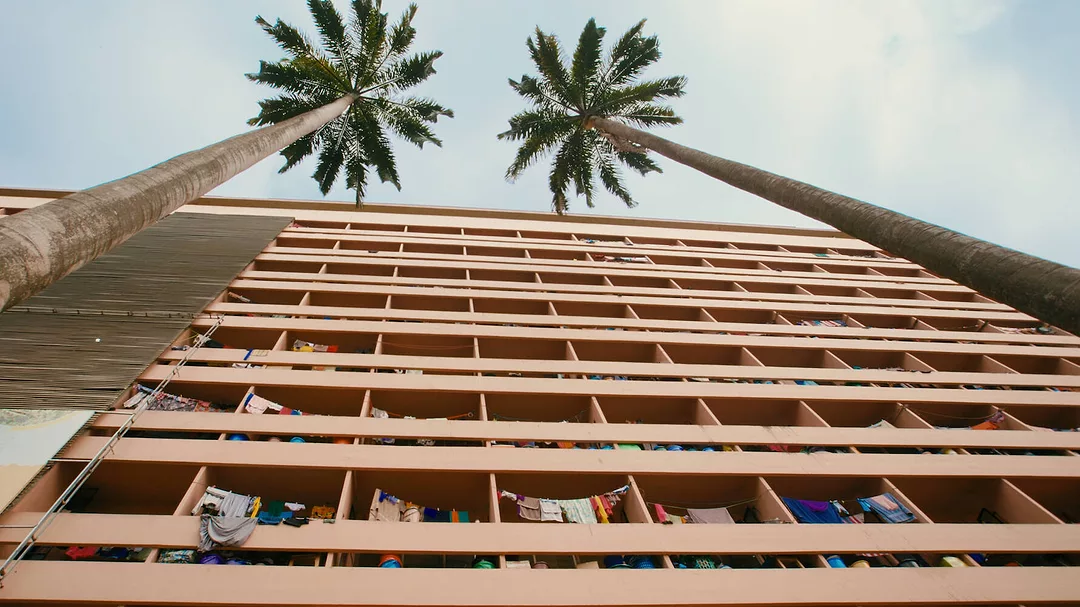
Film still of Unity Hall, KNUST, Kumasi, Ghana, by John Owuso Addo and Miro Marasović for Tropical Modernism: Architecture and Independence. Image © Victoria and Albert Museum, London
Installation shot of Tropical Modernism - Architecture and Independence at the V&A South Kensington (c) Victoria and Albert Museum, London (5).webp
Installation view of Tropical Modernism: Architecture and Independence at the V&A Kensington's Porter Gallery. Photo © Victoria & Albert Museum, London
Installation shot of Tropical Modernism - Architecture and Independence at the V&A South Kensington (c) Victoria and Albert Museum, London (22).webp

Installation view of Tropical Modernism: Architecture and Independence at the V&A Kensington's Porter Gallery. Photo © Victoria & Albert Museum, London

Installation shot of Tropical Modernism - Architecture and Independence at the V&A South Kensington (c) Victoria and Albert Museum, London (18).webp

Installation view of Tropical Modernism: Architecture and Independence at the V&A Kensington's Porter Gallery. Photo © Victoria & Albert Museum, London
Installation shot of Tropical Modernism - Architecture and Independence at the V&A South Kensington (c) Victoria and Albert Museum, London (16).webp

Installation view of Tropical Modernism: Architecture and Independence at the V&A Kensington's Porter Gallery. Photo © Victoria & Albert Museum, London

Unity Hall, Accra
Installation shot of Tropical Modernism - Architecture and Independence at the V&A South Kensington (c) Victoria and Albert Museum, London (5).webp
Installation shot of Tropical Modernism - Architecture and Independence at the V&A South Kensington (c) Victoria and Albert Museum, London (22).webp
Installation shot of Tropical Modernism - Architecture and Independence at the V&A South Kensington (c) Victoria and Albert Museum, London (18).webp
Installation shot of Tropical Modernism - Architecture and Independence at the V&A South Kensington (c) Victoria and Albert Museum, London (16).webp
March 26, 2024
✕
Image in modal.

ALT TEXT.

Illustration from The Architectural Review, 1953. Image courtesy RIBA Collections © Gordon Cullen Estate

“The wind of change is blowing through this continent,” declared British Prime Minister Harold Macmillan in the Ghanaian capital Accra in 1960. “Whether we like it or not, this growth of national consciousness is a political fact.” Formerly the Gold Coast, its shoreline dotted with the relics of forts from the transatlantic slave trade, Ghana was the first sub-Saharan African nation to gain its sovereignty in 1957.

Led by the charismatic Kwame Nkrumah, Ghana embarked on a vigorous program of nation-building, employing Modernist architecture to express political and cultural ambitions and concretize Nkrumah’s vision of a Pan-African future. A decade earlier, India had finally achieved independence and its first Prime Minister, Jawaharlal Nehru, was equally eager to modernize, commissioning Le Corbusier to design the new city of Chandigarh.
mfantsipim school.

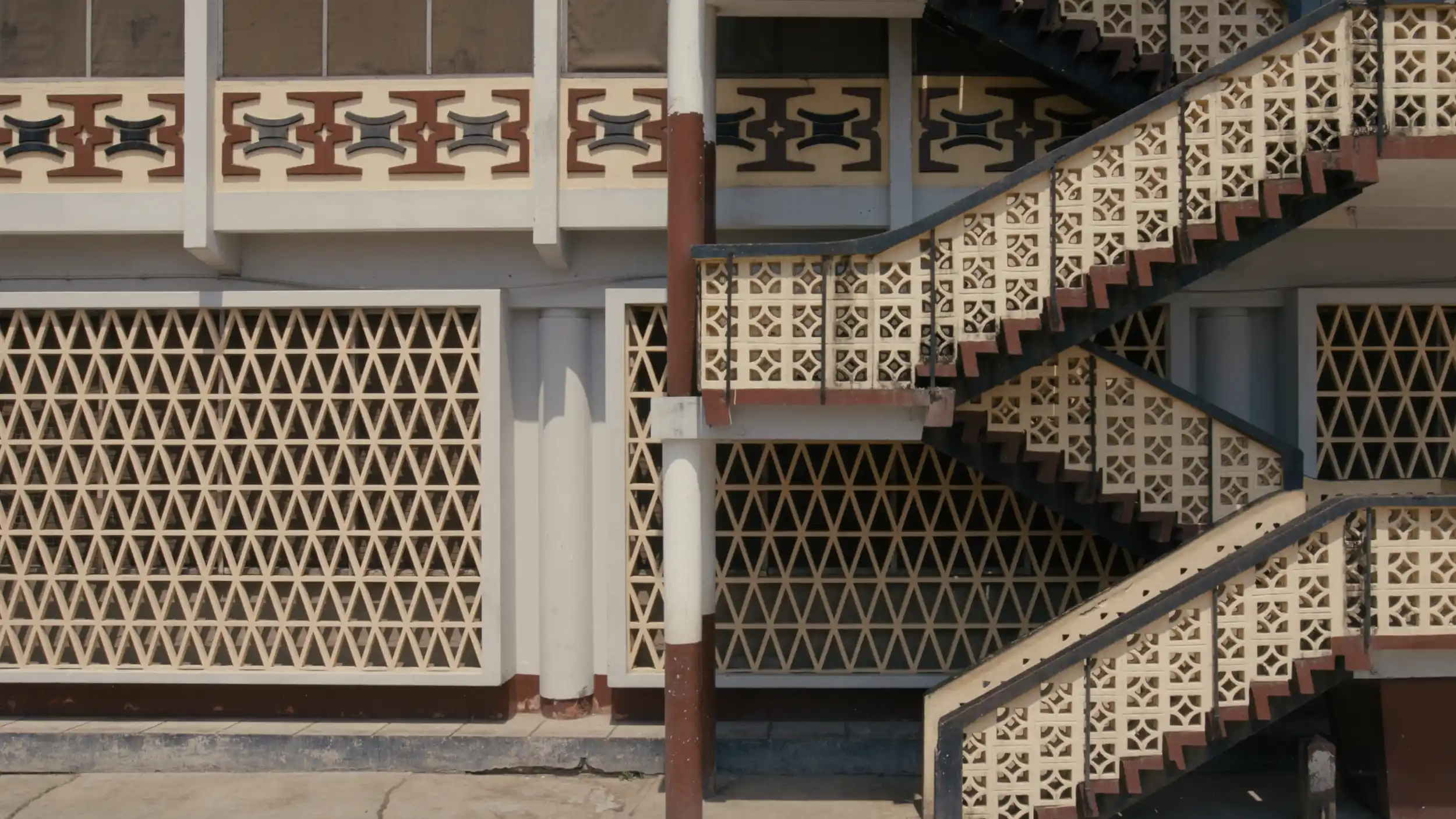
Film still of Mfantsipim School, Cape Coast, by Fry, Drew Partners for Tropical Modernism: Architecture and Independence. Image © Victoria and Albert Museum, London.

Developed from an exhibition first shown at the 2023 Venice Biennale, Tropical Modernism—on view at the Victoria & Albert Museum (V&A) in South Kensington, London—deftly unpicks the threads and experiences of the postwar era to show how Modernism took root in Ghana and India following independence from Britain. Through a compelling array of drawings, models, photographs, films, and ephemera, it examines how Western ideas were reimagined as a form of post-colonial nationhood that combined European practice with indigenous traditions of making and design, while valorizing the contributions of historically neglected figures.

Black Star Square.

Black Star Square, Accra, by Ghana Public Works Department. Film Still from Tropical Modernism: Architecture and Independence. Image © Victoria & Albert Museum, London

Among them are the Sikh draughtsman and model maker Giani Rattan Singh, who worked closely with Le Corbusier, and Ghanaian architects John Owusu Addo and Victor Adegbite. Adegbite became the country’s chief architect, designing Black Star Square in Accra, the civic centerpiece of Ghana’s independence celebrations. The scheme encompassed a dramatic, double-arched gate framing the sea, conceived as an “arch of return” as opposed to the “door of no return” in colonial forts through which Africans were forced during the slave trade.
jane dry and maxwell fry

1

archival photos university college ibadan

2

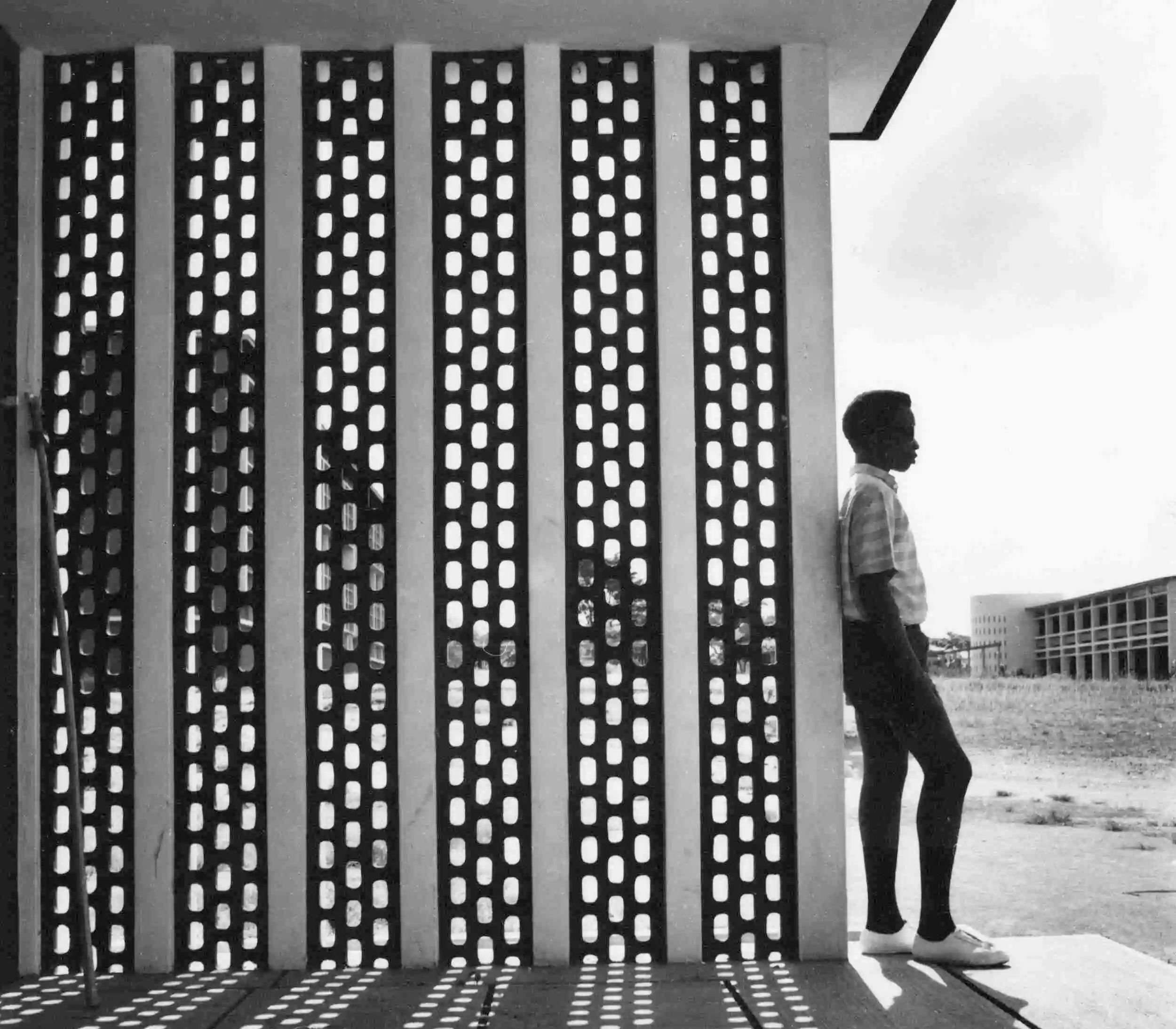
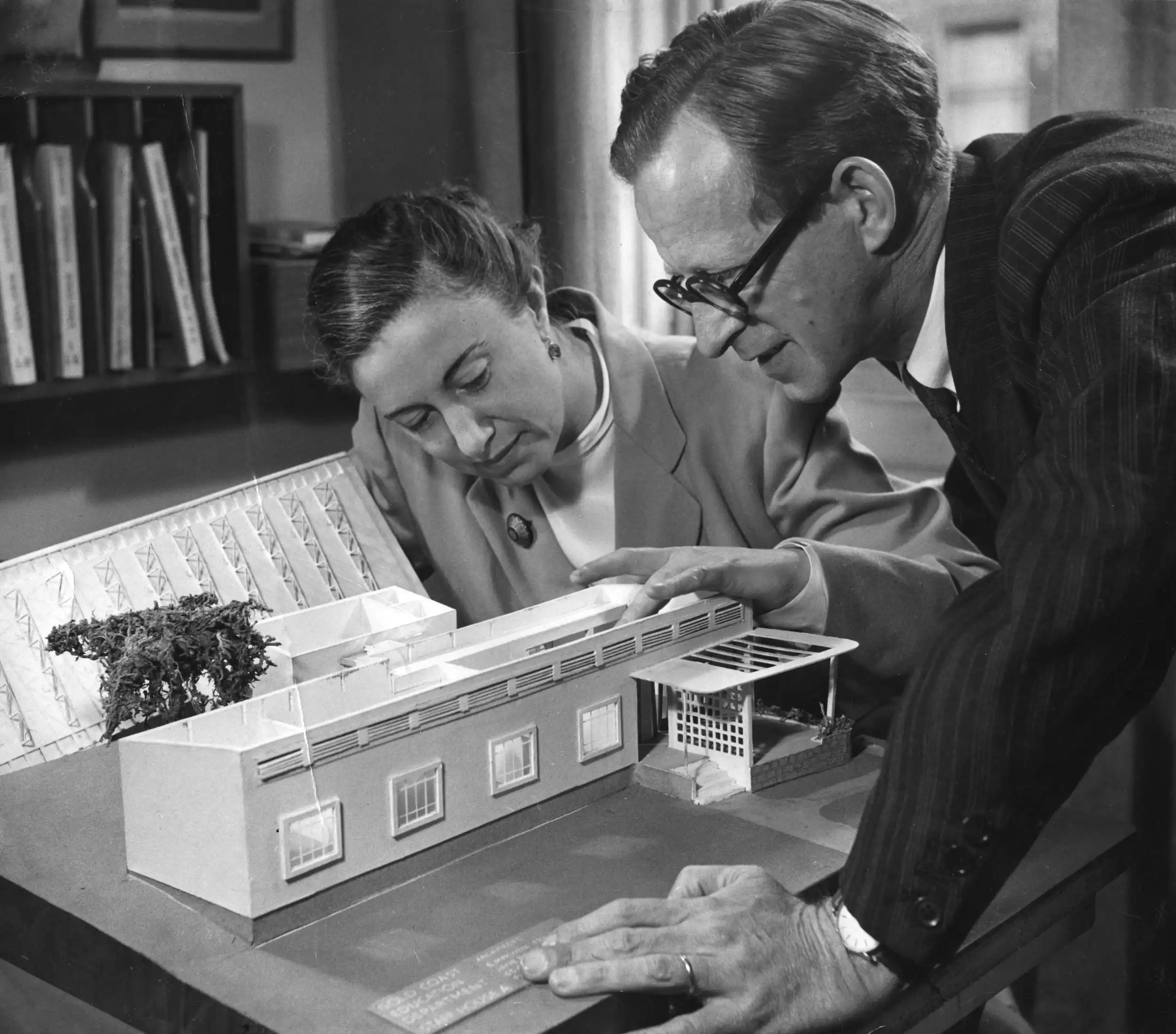
Jane Drew and Maxwell Fry with a model of one of their many buildings for the Gold Coast, 1945 (1); boy and concrete screen at University College Ibadan, Nigeria, 1962 (2). Photos courtesy RIBA

Underpinning the narrative is the influence of more familiar characters, notably English architects Maxwell Fry and Jane Drew. In the late 1940s, their research into generic forms of climate-tempered modern architecture suitable for the “humid zone,” featuring perforated screens, deep shading, and natural ventilation, impelled a lavishly funded postwar pacification program of schools, hospitals, and infrastructure in British West Africa (latter day Ghana, Nigeria, Sierra Leone, and Gambia). A Tropical School was established at London’s Architectural Association to train architects for practice in the colonies; John Owusu Addo was one of its alumni.

le corbusier in india.

Le Corbusier in Chandigarh with the plan of the city and a model of the Modular Man, his universal system of proportion, 1951. Photo © FDL, ADAGP 2014

Fry and Drew were also instrumental in the realization of Chandigarh, suggesting that Le Corbusier design the modern state capital of Punjab, which had lost Lahore to Pakistan under partition in 1947. Chandigarh’s gridded layout and heroic concrete forms were the antithesis of Edwin Lutyens’ ponderous New Delhi, once described as “the tombstone of the British Raj.” But a film in the exhibition by Swiss director Alain Tanner brings home the backbreaking reality of Chandigarh’s unmechanized construction, with squads of male and female laborers hefting bowls of concrete up spindly ladders in the sweltering sun.

Subsequent generations of Indian architects absorbed the radical tenets of Chandigarh, but also sought out India’s vernacular heritage, transforming it through abstraction and technical advances in response to changing social realities. Post-independence Ghana pursued a similar path, with the establishment of the first architecture school south of the Sahara, known as the “Bauhaus of the tropics” in Kumasi.

Looking for quick answers on architecture and design topics?
Try Ask RECORD, our new smart AI search tool.
Ask RECORD →

But with economic difficulties mounting, Nkrumah’s regime became increasingly authoritarian and he was abruptly deposed in 1966. Modernism fell out of favor and with the advent of air conditioning, there was less need to rely on passive means of cooling. Yet as the climate emergency intensifies, the ideas behind Tropical Modernism, which represented clarion moments of opportunity in post-colonial history, have renewed relevance for developing new and more sustainable, less energy-intensive forms of architecture.
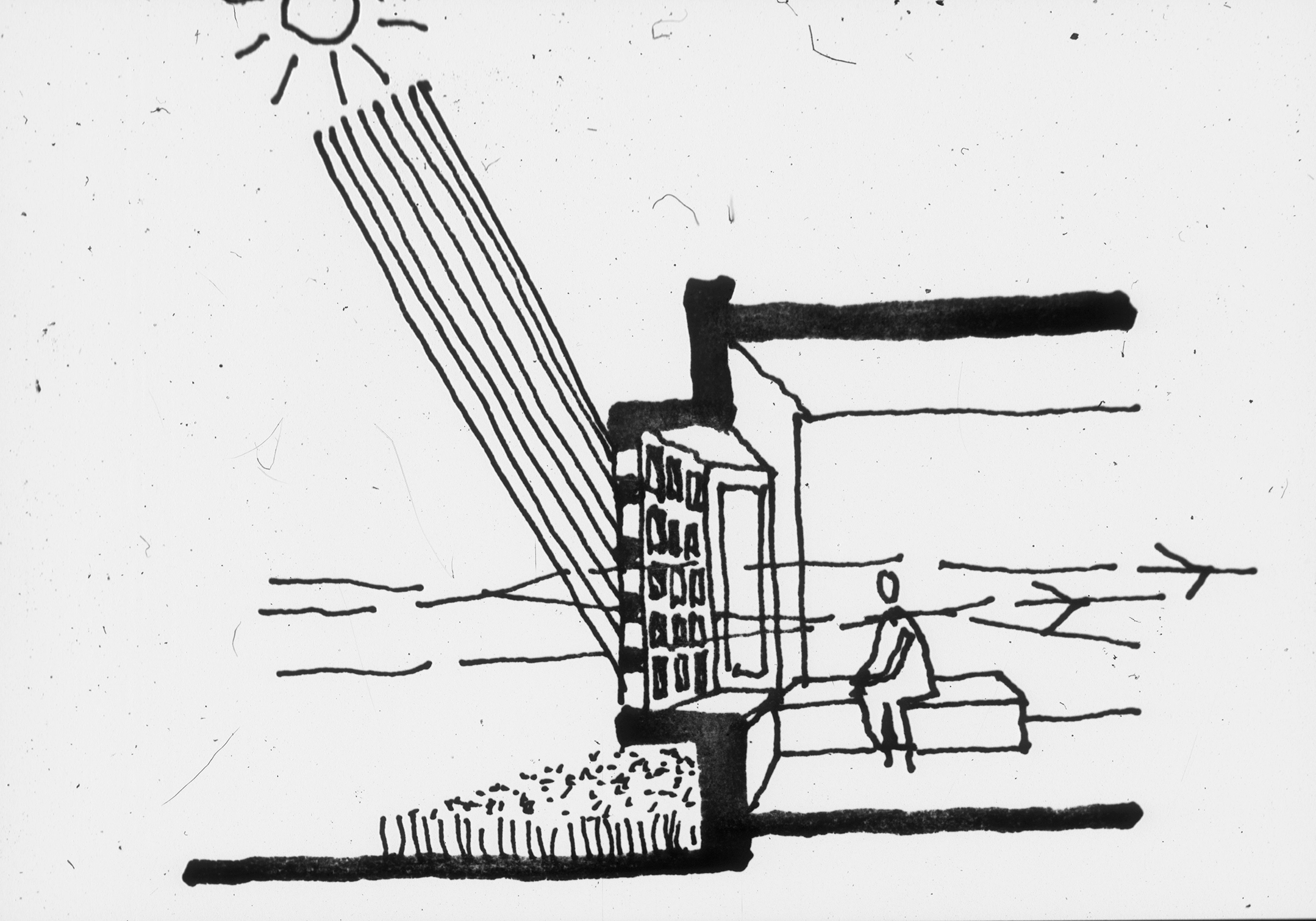
archival drawing.

Diagram of a brise soleil at Aburi Girl’s School, Ghana, from Tropical Architecture in the Humid Zone, 1956, publisher B.T Batsford. Image courtsey RIBA

Tropical Modernism: Architecture and Independence
The Porter Gallery at V&A South Kensington, London
On view now through September 22

KEYWORDS: Africa Exhibitions Ghana India Le Corbusier modernism

Share This Story

Looking for a reprint of this article?
From high-res PDFs to custom plaques, order your copy today!
Catherine Slessor is a London-based architectural critic and writer. She is a former editor of the Architectural Review and continues to contribute to various architecture and design publications. She is also President of the 20th Century Society, a leading UK heritage organization, which advocates for the preservation and reuse of buildings from the modern era.

Post a comment to this article

Report Abusive Comment

Subscription Center
  • Create an Account
  • Start a Subscription
  • Manage My Account
  • Sign Up for Newsletters
  • Visit Customer Service
  • Update Preferences

More Videos

Sponsored Content

Sponsored Content is a special paid section where industry companies provide high quality, objective, non-commercial content around topics of interest to the Architectural Record audience. All Sponsored Content is supplied by the advertising company and any opinions expressed in this article are those of the author and not necessarily reflect the views of Architectural Record or its parent company, BNP Media. Interested in participating in our Sponsored Content section? Contact your local rep!

close
  • TAMLYN XtremeTrim Exterior Trim
    Sponsored byTamlyn

    Designing Cleaner Panel Facades: Why Exterior Trim Details Matter

  • Building with Vapor Barriers
    Sponsored byReef Industries, Inc.

    Vapor Barriers Help Control Moisture in Tighter Building Designs

  • Duct Interior with Prodeq System
    Sponsored byHenry, a Carlisle Company

    Designing Resilient Water Containment Systems

DESIGN:ED Podcast
Listen to Architectural Record’s DESIGN:ED Podcast

Events

June 11, 2026

Very Early Warning Fire Detection for Mission-Critical Facilities

Credits: 1 AIA LU/HSW; 1 AIBD P-CE; 0.1 ICC CEU

Examine advanced fire detection strategies that support uptime and enhance safety in data centers and other mission-critical facilities.

June 16, 2026

Focus on the Façade: Exploring Steel, Timber & Fire-Rated Curtain Walls and Channel Glass Systems

Credits: 1 AIA LU/HSW; 1 AIBD P-CE; 0.1 ICC CEU

Explore modern façade and glazing systems that enhance daylighting, fire safety, and thermal performance while expanding architectural design possibilities.

View All Submit An Event

Products

2026 Architect's Square Foot Costbook

2026 Architect's Square Foot Costbook

See More Products

Popular Stories

Practice Matters illustration

What’s in a (Firm’s) Name? Thinking About Succession and Legacy

Coronado Bridge

The Architect’s Guide to San Diego

Practice Matters illustration

By the Numbers: Counting America's Architects

SanDiegoAirport

Top 300 Architecture Firms of 2026

Crane Cove, ONO

Design Vanguard 2026 Winners

Broader Sustainability of CMU - Free Webinar - May 21, 2026

Related Articles

  • African Modernism Book Cover

    Back in Print, Second Edition of 'African Modernism' Surveys Architecture Across the Continent

    See More
  • Vernacular Architecture of West Africa: A World in Dwelling

    See More
  • Midland Metropolitan University Hospital

    A Vast Hospital Complex in Central England Foregrounds Human-Centered Design

    See More

Related Products

See More Products
  • image7.jpg

    Contemporary Architecture in China Towards A Critical Pragmatism

See More Products
×

The latest news and information

#1 Source for Architectural Design, News and Products

SUBSCRIBE
  • RESOURCES
    • Advertise
    • Contact Us
    • Submit
    • Store
  • ACCOUNT CENTER
    • Create an Account
    • Start a Subscription
    • Manage My Account
    • Sign Up for Newsletters
    • Visit Customer Service
    • Update Preferences
  • PRIVACY
    • PRIVACY POLICY
    • TERMS & CONDITIONS
    • DO NOT SELL MY PERSONAL INFORMATION
    • PRIVACY REQUEST
    • ACCESSIBILITY
  • SERVICES
    • Marketing Services
    • Reprints
    • Market Research
    • List Rental
    • Survey/Respondent Access
  • STAY CONNECTED
    • Linkedin
    • Facebook
    • Instagram
    • YouTube
    • X (Twitter)

Copyright ©2026. All Rights Reserved BNP Media, Inc. and BNP Media II, LLC.

Design, CMS, Hosting & Web Development :: ePublishing