A Vast Hospital Complex in Central England Foregrounds Human-Centered Design
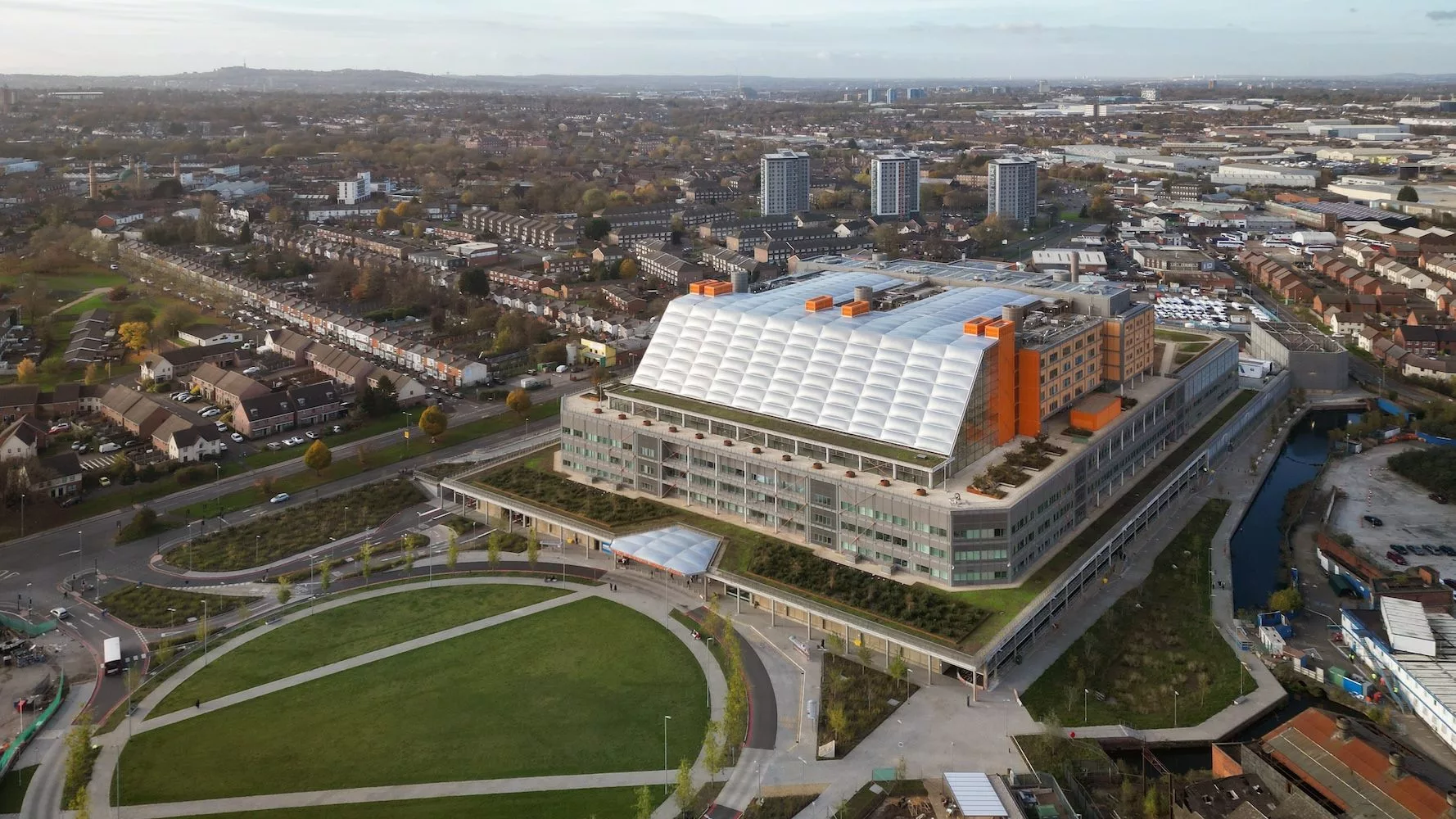
Looming like a beached battleship over rows of terraced housing and the carious remnants of long-gone industry, the new Midland Metropolitan University Hospital (MMUH) is hard to miss. Tasked with delivering state-of-the-art healthcare to half a million people in Birmingham, Britain’s second-largest city, it combines an expressively functional rigor with generous public spaces and landscaping, including a cricket pitch-sized “village green” designed to embed the new 736-bed megastructure into its surroundings.

Photos © Jack Hobhouse
Beset by poverty and social deprivation, Sandwell, on the western edge of Birmingham, is sorely in need of regenerative impetus. In 2023, it was ranked second-lowest out of 333 English boroughs on a cost-of-living vulnerability index. In once-thriving industrial locales, it’s a depressingly familiar narrative, but Sandwell’s languishing tracts of disused factories and workshops yielded a roughly 16-acre brownfield site for MMUH. Replacing two existing hospitals, the new facility provides commensurate operational efficiencies and the potential to establish a new neighborhood focus.
A key move was to vertically stack the assorted elements of the hospital, which include an emergency department, 13 operating theaters, and outpatient and maternity services. The outcome is a compact layer cake, rather than sprawling campus, its 11-story volume visible for miles around as a tangible indicator of uplift. Though the battleship grey carapace suggests a combativeness against disease and disorder, it is counterpointed by vivid flashes of orange in the ward block cladding, stair towers, and cross bracing; all a sophisticated, contemporary play on High Tech. “We decided against yellow,” explains Laura Carrara-Cagni of Cagni Williams, the project’s architectural design lead, “and we couldn't have red, for obvious reasons, so we alighted on orange.”

Photos © Jack Hobhouse


The organization of the tripartite layer cake is logical and legible. Clinical adjacencies dictated the arrangement of so-called “hot spaces” (emergency department, critical care, operating rooms) on the lower floors, anchored by two levels of parking. Less heavily serviced ward blocks are stacked above to take advantage of light and views. Throughout, wayfinding is clear and intuitive, underscored by the need to make navigable what is still a huge and potentially disorientating warren of spaces (the building covers just over 900,000 square feet) dominated by the processes and equipment involved with medical care.

Photo © Jack Hobhouse
Prior to setting up their practice in 2011, Carrara-Cagni and partner Edward Williams both worked at Michael Hopkins Architects. In a memorable rethinking of what a hospital should look like, Hopkins designed London’s Evelina Children’s Hospital and its influence on MMUH is palpable, in how to humanize a challenging building type driven by stringent technical requirements. MMUH also involved HKS as architectural project lead and Sonnemann Toon as architectural clinical lead.
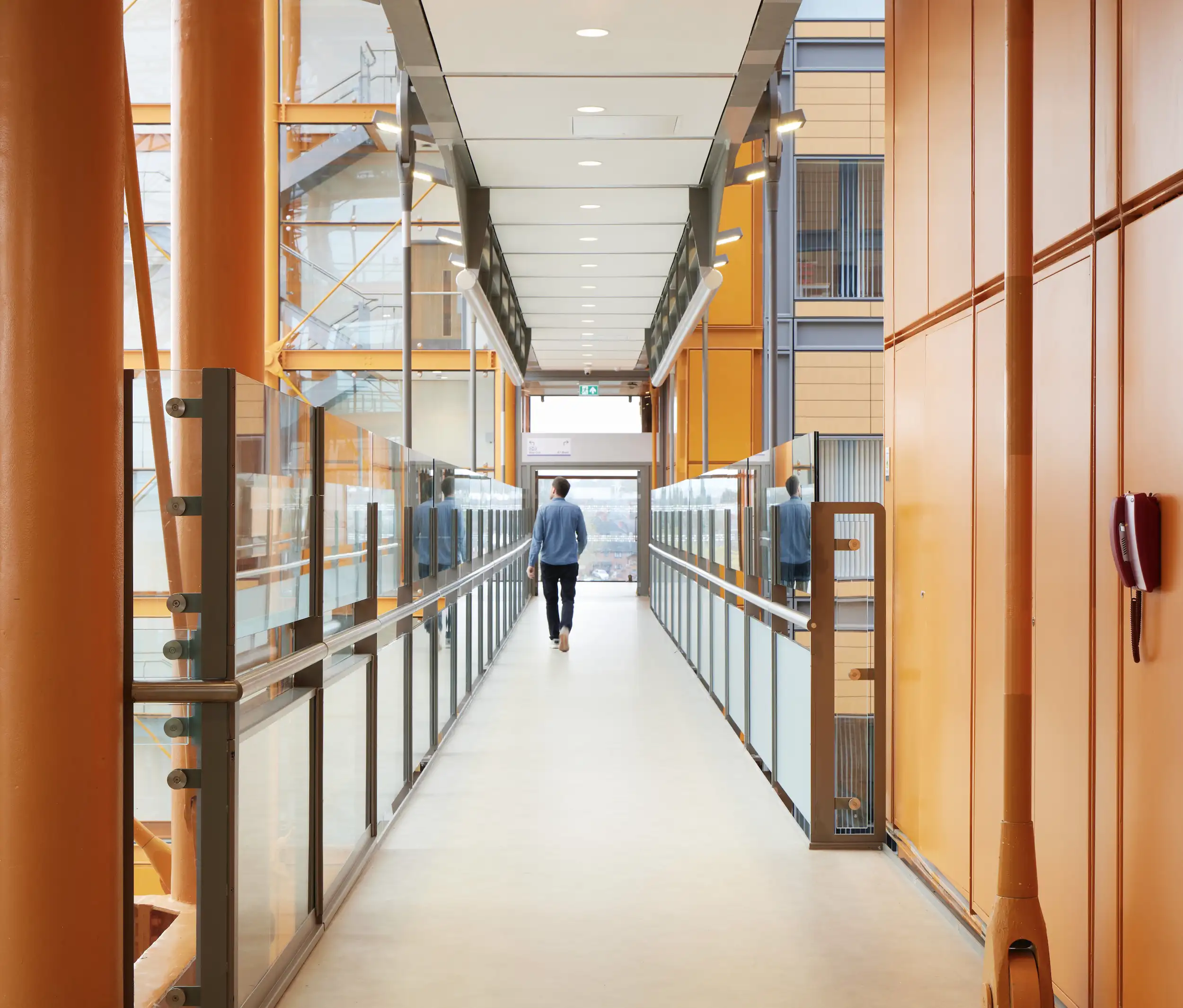
A six-story high winter garden proved spatially and socially transformative. “From the earliest sketches and models, the idea of the winter garden was always to create a central heart for the hospital,” says Williams. Bisected by glass walkways and with vertiginous views down into internal planted courtyards, the soaring space has a compelling, Piranesian drama, amplified by a sloping roof of transparent ETFE pillows, like a giant inflatable car windshield. At a quarter of the cost of conventional glazing, the billowing, angular plane of ETFE gives the building a futuristic allure. More prosaically, it is self-cleaning, which reduces maintenance costs, and can be recycled.
Photos © Paul Raferty

Accessed from elevators that shuttle up from a ground floor entrance concourse, the winter garden is a kind of social condenser. It has many possible uses, from art exhibitions, markets and talks, to a place where patients, staff, visitors, and the wider public can simply sit and have coffee or lunch, savoring the ballet mécanique of the glazed circulation towers and the exultant panoramas of the surrounding cityscape. What Carrara-Cagni describes as a “non-briefed communal area,” the winter garden was made possible by the efficiencies achieved by the building’s 25-foot grid, an optimal structural solution that could accommodate parking bays, ward blocks, and bulky medical equipment, so avoiding the use of more costly transfer structures.
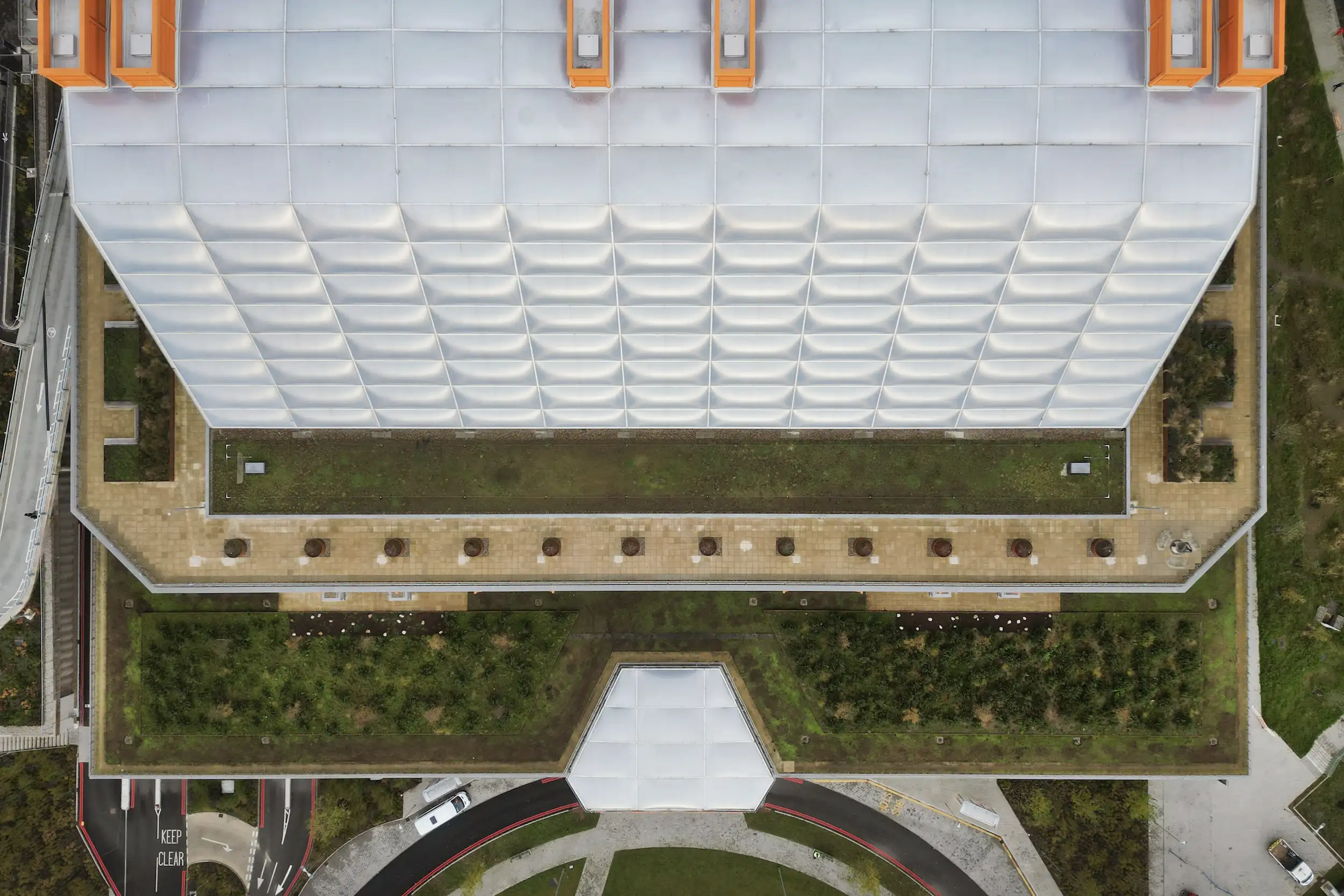
Photo © Jack Hobhouse
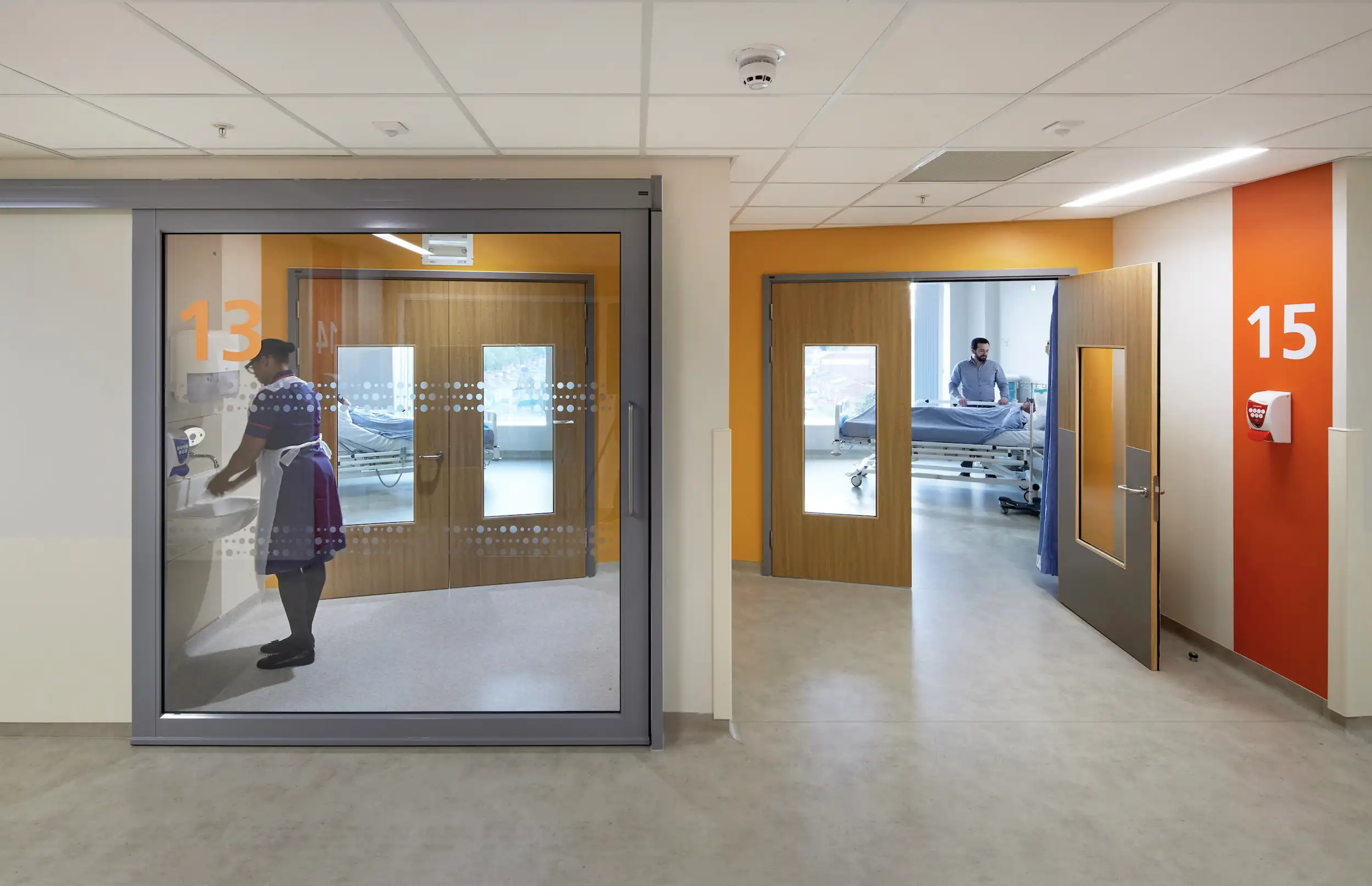
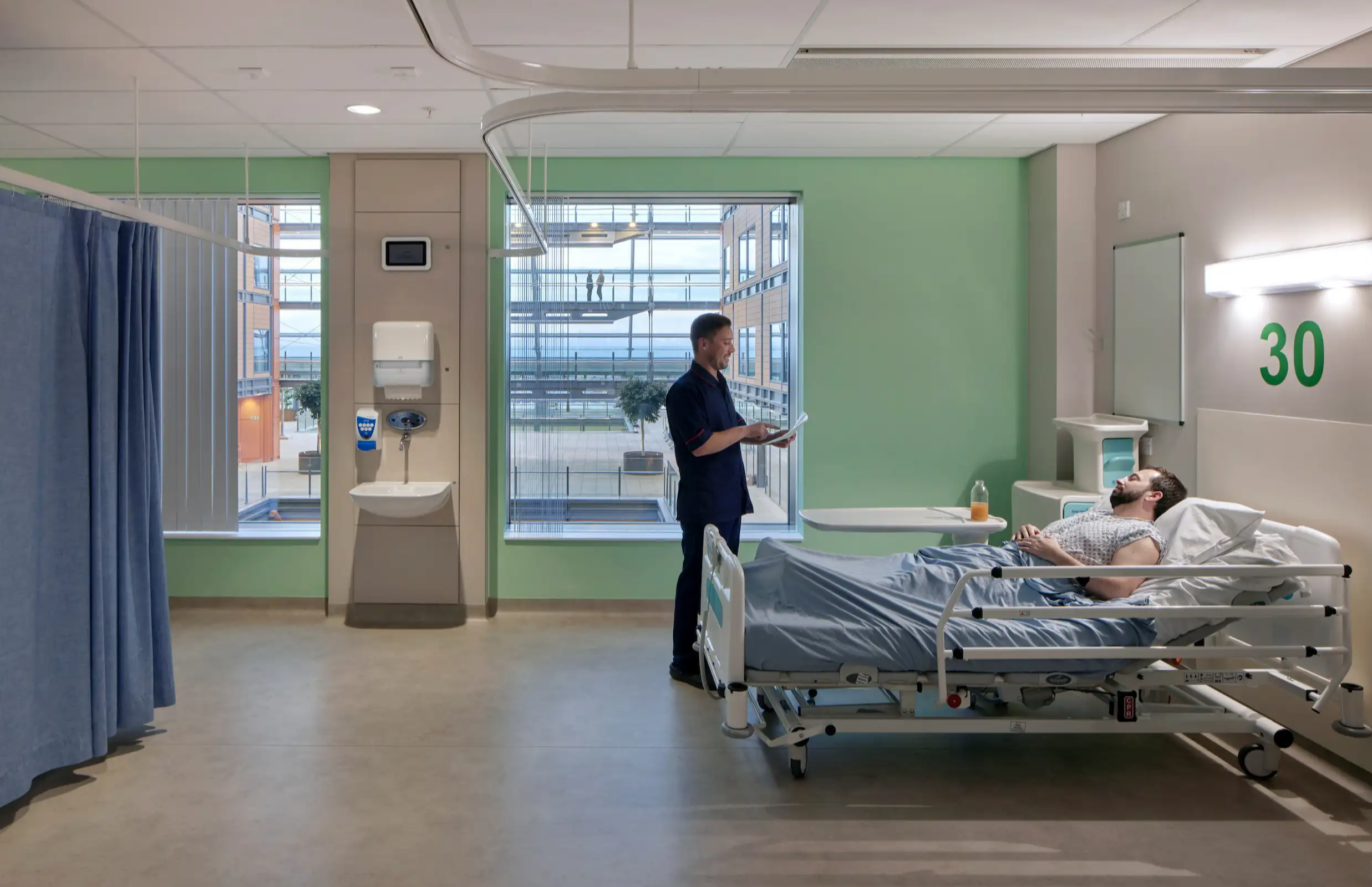
It’s now established that the quality of surroundings impacts overall well-being, with architecture subtly contriving to assist and speed recovery. Half of all inpatients will be cared for in single rooms with ensuite bathrooms, while in all wards, large windows maximize natural daylight and views, creating an environment conducive to support patient recuperation. Augmenting the set piece of the winter garden, smaller, more intimate enclaves are woven into the hospital labyrinth offering moments of calm and respite. Across all scales, there is a thoughtful sense of how spaces will work, connect, and be experienced, and how the day-to-day operation of such an immense building can be made more responsive to the human condition.
Looking for quick answers on architecture and design topics?
Try Ask RECORD, our new smart AI search tool.
Ask RECORD →
Looking for a reprint of this article?
From high-res PDFs to custom plaques, order your copy today!