In Focus
New Standards Shape a Series of New Embassies and Consulates Representing the U.S. Abroad

For the United States of America’s first 150 years, its ambassadors and their staffs typically lived and worked in rented houses and apartments. In 1926, to foster less ad hoc diplomatic facilities better suited to an emerging world power, Congress established the Foreign Service Buildings Commission, an agency within the Department of State. Known today as the Bureau of Overseas Building Operations (OBO), it manages the planning, acquisition, design, construction, operation, and maintenance of U.S. properties abroad.
Architectural commissions prior to World War II reflected the patrician tastes of President Franklin Delano Roosevelt and included a Neoclassical chancery by Delano & Aldrich in Paris and a Neo-Georgian legation by Harrie T. Lindeberg in Helsinki. During the Cold War, the bureau championed Modernism as a symbol of democracy, building embassies by Eero Saarinen in London and Oslo, Edward Durell Stone in New Delhi, and Walter Gropius in Athens, to mention just a few.
U.S. EMBASSY MAPUTO, MOZAMBIQUE
Allied Works Architecture, Design Architect
Yost Grube Hall Architecture, Architect of Record

Photos © Jeremy Bittermann, click to enlarge.

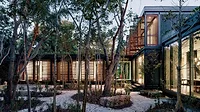
Completed in 2021, this 180,000-square-foot project on a 10-acre campus overlooks the Madagascar Strait off the east coast of Africa. To resist corrosion in the harsh coastal environment, the exterior is clad in vertical precast ribs of ultra-high-performance concrete. Their sculptural shapes recall the wood carvings of the Makonde tribe, one of Mozambique’s indigenous groups. The facade’s parametric design considered the sun’s angle throughout the year to limit direct sun and minimize glare, while framing dramatic views of the ocean.
The landscape represents the three major biomes of Mozambique—dunes, savanna, and forest—and provides outdoor meeting and event spaces. Extensive infrastructure protects the site from flooding, while stormwater runoff is diverted to culverts that direct water to the sea.
Terrorist attacks, beginning in 1983, shifted the focus from symbolism to security, with requirements codified in a one-size-fits-all Standard Embassy Design (SED) in 2002. Widespread dissatisfaction with the monotonous, fortress-like results led to the Design Excellence initiative in 2012. Growing awareness that climate change poses a threat at least as serious as terrorism or banal buildings led to a rebranding in 2017 as Security + Resilience + Stewardship (SRS). Just last year, to emphasize performance-based buildings, the name was changed again to Effective Facilities Solutions (EFS). Nonetheless, says OBO design manager Minh Le, “We still approach each project in pursuit of design excellence.”
All OBO projects must meet stringent security standards, including 100-foot setbacks from streets and adjacent properties, construction that resists blasts and ballistics, physical security barriers, and rigorous access controls. Also required is co-location, which means that, wherever possible, all staff and facilities, including housing for Marine guards, must be combined in one secure compound. Despite all that, new embassies and consulates are expected to provide a welcoming diplomatic presence. It’s a tough balancing act. “It’s really hard,” says Christy Foushee, OBO’s former director of external affairs. “That’s why we hire smart people.”
U.S. CONSULATE GENERAL MILAN, ITALY
SHoP Architects, Design Architect
Caddell Construction Company, LLC, Design/Build Contractor

Images Courtesy Bureau of Overseas Building Operations

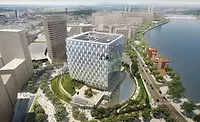
Currently under construction on a 10-acre site just beyond the ring road that encircles Milan’s core, this project of approximately 130,000 square feet includes a historic pavilion, plaza, and parade ground. These have been restored and repurposed to frame a new chancery and serve as both campus gateway and public gathering space.
SHoP positioned its consular office building to respect an existing axial composition and organized it as a block of five stories asymmetrically flanked by two lower bars. The facades are an intricate framework of digitally fabricated stone panels in a warm cream color, a reference to the architecture of Milan’s historic center. The design is distinctly Modern, but its sensitive siting, massing, and articulation make it a sympathetic presence amid its classical neighbors.
To offset the hard-edged security features, OBO engages in soft design diplomacy. “We’ve developed a process,” explains Le, “that AE firms working for us must follow in the conceptual phase, to ensure they understand the host nation’s climate, environment, history, culture, vernacular, and context.”
The requirements of 100-foot setbacks and co-location are forcing moves from city centers, where embassies and consulates had traditionally been situated, to more remote settings where larger sites—ideally at least 10 acres, if possible—are available. This has already happened in London, Oslo, The Hague, and Guatemala City. Six current projects, including an embassy in Doha and a consulate in Milan, are following the same pattern. Predictably, there has been some pushback from diplomats and their staff about the isolation and inconvenience. “Nobody likes to commute,” says Le.
U.S. EMBASSY DOHA, QATAR
Richärd Kennedy Architects, Design Architect
KCCT, Architect of Record

Images Courtesy Bureau of Overseas Building Operations

Currently under construction on a 12.3-acre site in a new diplomatic zone, this 236,000-square-foot project evokes the rich history of the Persian Gulf. Large shade structures, inspired by traditional Bedouin tent forms, mark entry plazas, recreational areas, and residential terraces. A plinth of stone-clad arcades, reminiscent of historic souks, unifies the campus with sheltered pathways that define courts and gardens. At the center is the cubical chancery, organized around a courtyard and sheathed in a brise soleil of tensioned fabric screens whose sizes vary to maximize views while diffusing daylight.
The landscape responds to the harsh desert climate with sustainable materials and systems, including water features that utilize stormwater before storing it for future irrigation.
Factors other than security standards, such as geopolitical events and the evolution of government policies, priorities, and procedures, also drive the creation of new diplomatic facilities. For example, shifting immigration patterns and changing visa requirements to enter the U.S. from Mexico have resulted in nine new consulates in that country since 2008.
Looking for quick answers on architecture and design topics?
Try Ask RECORD, our new smart AI search tool.
Ask RECORD →
Snagging OBO as an architectural client is not easy. Approximately 100 AE firms applied to be on the current list of those approved to provide design services. Only 16, all high-profile, made the cut, including Miller Hull, Diller Scofidio + Renfro, Robert A.M. Stern Architects, Morphosis, and KieranTimberlake. But an established reputation and design chops are not enough—equally important is the ability of an applicant’s staff and facilities to withstand tough, time-consuming vetting for security clearances. (Note to young architects and students: be very careful what you post on social media.)
U.S. EMBASSY COLOMBO, SRI LANKA
ZGF Architects, Design Architect
Integrus Architecture, Architect of Record

Photos © Waruna Gomis

Completed in 2022 on a 5.6-acre site next to the Laccadive Sea, the architecture and landscape of this 207,000-square-foot complex are informed by Sri Lanka’s tropical climate. Verdant courtyards and gardens, along with deep roof overhangs and sunscreens, are consistent with vernacular traditions. Domestically sourced stone and wood draw from the region’s rich materials palette. The embassy’s interior incorporates textures and patterns inspired by local craft, art, and foliage.
A model of environmental stewardship, the new embassy uses rigorous climate-protection elements such as native materials that can withstand sun and corrosion, a climate-responsive shell to protect the interior from solar-heat gain, and an advanced stormwater-management system to cope with heavy rainfall.
Firms on the list are given one-year contracts, which can be renewed for at least four additional years. This comes before any actual hiring for projects. When OBO needs design services for a new embassy compound, major rehabilitation, or security upgrades, pre-approved architects receive a request for a letter of interest, which kick-starts another application-and-selection process. Once a commission has been awarded, security measures for the winner’s office spaces and network systems must be implemented and inspected before work can begin.
Since 2017, OBO has completed 30 major architectural projects, and 29 more are under construction.
Looking for a reprint of this article?
From high-res PDFs to custom plaques, order your copy today!