RECORD Forum
Safe Space: A Pair of New Holocaust Museums Illustrate a Shift in the Architecture of Atrocity
This March, the Netherlands’ King Willem-Alexander inaugurated the country’s National Holocaust Museum in Amsterdam—a long-planned institution that excavates a dark chapter of Dutch history during which roughly three-quarters of the country’s Jews were killed. But because of Israeli president Isaac Herzog’s attendance at the ceremony, it was met with protest. Demonstrators, a number of them Jewish, gathered to decry the killings of thousands of Palestinians in Israel’s military campaign in Gaza.
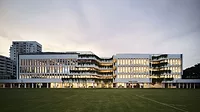
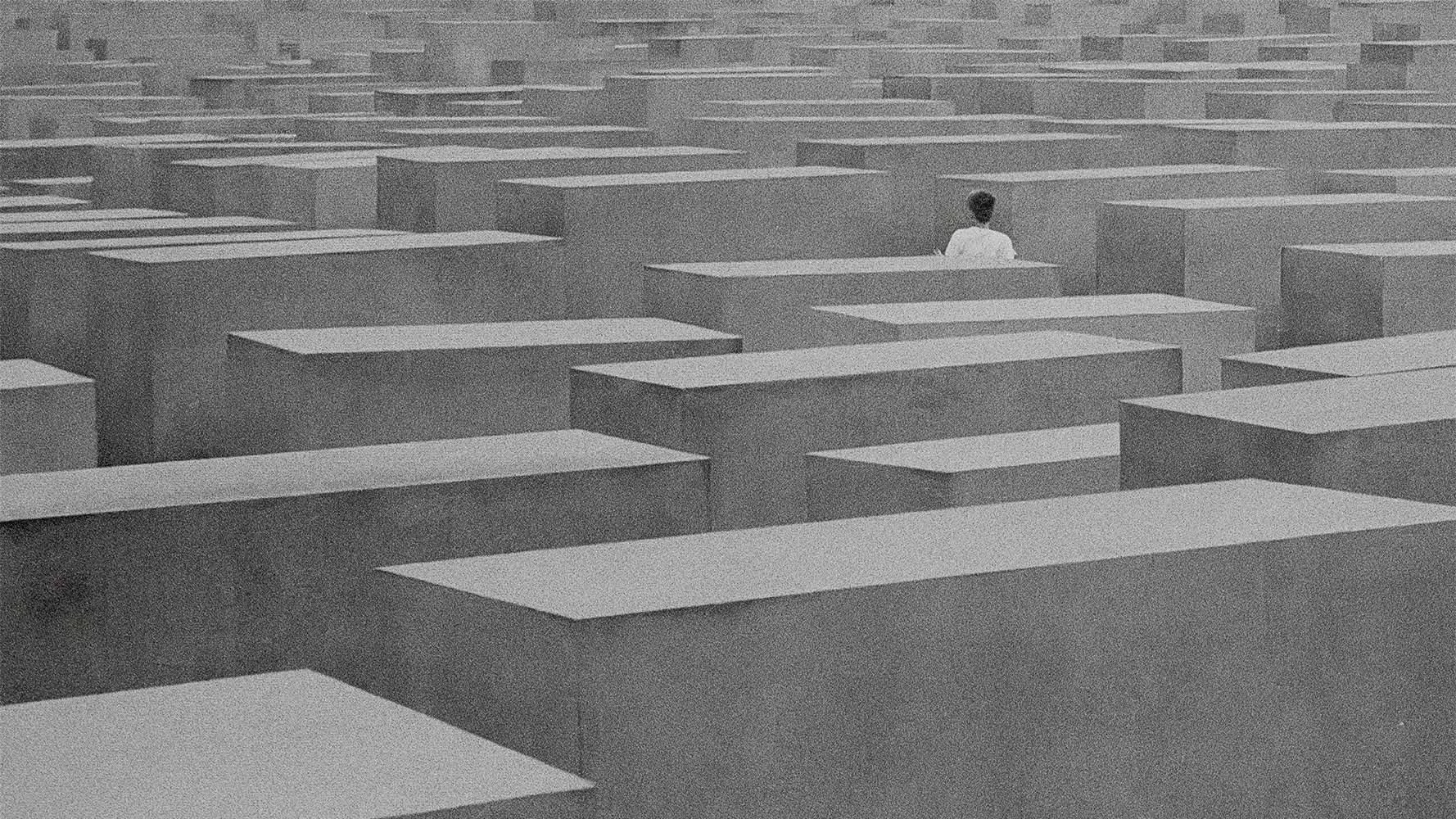
Architecturally, the museum marks a sharp contrast with such earlier projects commemorating the Holocaust as Daniel Libeskind’s Jewish Museum (2001) and Peter Eisenman’s Memorial to the Murdered Jews of Europe (2005), both in Berlin. In those projects, compositions of abstract, irregular forms create discomfiting spatial experiences that reject interpretation. The Amsterdam Museum, which incorporates a former teachers’ college and was designed by Office Winhov, is more calming than unsettling; a latticed brick facade allowing in filtered sunlight, wood-appointed interiors, and placid courtyards give it a distinctly therapeutic feel. And this is not the only recent museum of the genre to adopt what might be termed an architecture of healing. At the Kerstin Thompson–designed Melbourne Holocaust Museum, a similar facade of brick and glass block brings dappled light into warm, muted interiors. The museum’s architecture “was not the right medium to encounter discomfort,” Thompson told RECORD’s Joann Gonchar; the building is instead a “safe space,” in the phrase of former CEO Jayne Josem, to grapple collectively with a traumatic past.
We are witnessing a shift, and it is one that can also be noted across a variety of recent memorial projects. SOM’s 2021 proposal for the LGBTQ2+ National Monument in Canada takes the form of a field of reflective stainless-steel posts around a heated stone table, suggesting an infinite number of pathways all leading toward “community, dialogue, and healing,” in the firm’s words. Höweler + Yoon’s acclaimed memorial honoring enslaved laborers at the University of Virginia, designed with the historian Mabel O. Wilson and others, similarly responds to past atrocity by creating a clearing for communal gathering—a “healing space,” as the New York Times put it in the headline of its review. What is notable about all this is not its novelty but just how accepted it has become: these aims and techniques seem now to be widely accepted as logical and beneficial for architecture that addresses past violence.
Future historians will have important questions to answer. How did we, people of 2024, come to see memorials and museums dealing with such grave subjects as the Holocaust, state persecution of LGBTQ people, and slavery as safe spaces for communal gathering? How did we move from the triumphalist statues of the early 20th century to such searing confrontations with horror as Libeskind and Eisenman’s Berlin projects and Maya Lin’s Vietnam Veterans Memorial in Washington, D.C. (1982), and then to wood-paneled seating areas and heated tables where trauma is expected to be relieved? Even granting that the language with which architects describe their work is highly calculated, the question remains of why these particular words—healing, community, safety—now have such appeal.
All memorials stand in relation to past events. Statues of war heroes suggest that in sacrificing oneself for one’s country, the suffering and death is redeemed—made worthwhile—by its essential contribution to a common cause. Eisenman’s Berlin memorial, by refusing to offer a narrative of heroic resistance and instead taking the form of a dark grid of concrete stelae in the heart of Berlin, remembers the Holocaust as catastrophe without redemption.
While the Holocaust museums in Amsterdam and Melbourne follow Eisenman’s in casting light on atrocity, part of what is different is the attitude these projects adopt toward their audiences in the present. Eisenman’s memorial draws visitors into a space that breaks decisively with the fabric of the city around it. As you walk among the 2,711 stelae, the scale of the space around you becomes increasingly suffocating and you begin to lose your place in what feels like an endless field of solids and voids. How should one react to the murder of millions? The memorial does not leave one feeling affirmed, uplifted, on the right side of history: it refuses to offer an interpretation by which atrocity could be categorized, sorted, filed safely away on a list of past mistakes that ought not to be repeated. Instead it presents the past as seething, alive, unknowable and yet exerting a force of great potency. As such it offers a glimpse of what the philosopher Michel Foucault called a “history of the present,” in contrast to the competing mode, a “history of the past in terms of the present”—that is, a framing of past events in which the assumptions of the present are left undisturbed.
This latter model is what the new memorials and museums tend to offer. Their chronological retellings of past events—a feature not just of the Holocaust museums but also of Höweler + Yoon’s memorial at UVA—lend them a sense of familiarity and predictability. They make the past comprehensible from within carefully curated safe spaces of the present. You learn about unspeakable atrocities but paradoxically feel affirmed in your own revulsion: your disgust, which the tranquil architecture both anticipates and seeks to relieve, tells you that you stand on the right side of history. Here architecture moves from a position of confrontation to one of comfort. It takes on something of a parental attitude, imagining its audience as fragile and in need of affirmation.
It would be premature to make a blanket judgment on this phenomenon. This shift in how architecture’s audience is conceived has not occurred without reason, and, in many cases, these new museums and memorials serve as much-needed correctives to countless years of historical whitewashing. But there is something unsettling about the new pairing of horror with comfort, of atrocity with healing. The purpose of these spaces is often described as enabling audiences to learn from the past in order to shape a more just future, to “turn grief for the past into change for the present,” as the Times’s Holland Cotter put it. This seems like a good thing, and no doubt these sites of affirmation are meaningful and important for many people. Yet one should be careful not to overstate the capacity of such spaces to eradicate evil. After all, the most crucial and difficult work of fighting injustice has in recent history taken place not inside museums but in parks and plazas, at public buildings, on expressways and streets, and often in direct opposition to such rituals as the visit of a head of state. It occurs in those civic spaces where the possibility of contesting and resisting existing structures and meanings becomes possible, if only for the briefest of moments.
Looking for quick answers on architecture and design topics?
Try Ask RECORD, our new smart AI search tool.
Ask RECORD →
Looking for a reprint of this article?
From high-res PDFs to custom plaques, order your copy today!