RECORD Forum
Under One Roof: The Case for Indoor Public Spaces
Between 1917 and 1919, Bruno Taut wrote two books in which he proposed visionary projects, The City Crown and Alpine Architecture, where architecture and technology would be put in service of the spirit. In The City Crown, Taut established the basis of a new communal center, a secular space between the Gothic cathedral and the Buddhist temple, devoted to beauty and to hosting an array of nonspecific activities. After publishing that book, Taut developed similar ideas in Alpine Architecture, a series of 30 drawings with minimal text. In these uncanny blueprints, he depicted secular temples where the newly developed technology of the time, glass and steel, enclosed overwhelming spaces for thinking. Modern materials were employed not for their own sake but rather as part of a broader revolution against rationalism and bourgeois society. As Taut put it, the “ultimate task” of the project was “to be quiet and absolutely turned away from all daily rituals for all time.”
Taut’s utopian projects, which reflect an ideology of openness, democracy, and purity, prompt us to reconsider large and public interior spaces that transcend the programmatic framework of their time. Following Taut’s approach, we might ask: what should the term “civic” represent now, and what are the programmatic and economic frameworks that limit us in our own day, much as religion did in Taut’s? One such framework is consumerism. Nowadays, cities feel increasingly like a series of enclosed places and of events made accessible only on the precondition of membership or credit card payment—from coffee shops and restaurants to museums, concert venues, gyms, and event-filled public parks. Almost everything is commercialized. Wandering in the city with a spirit of the flâneur becomes a complicated—and expensive—task. Our time and space for relationships have been fragmented into profitable activities.
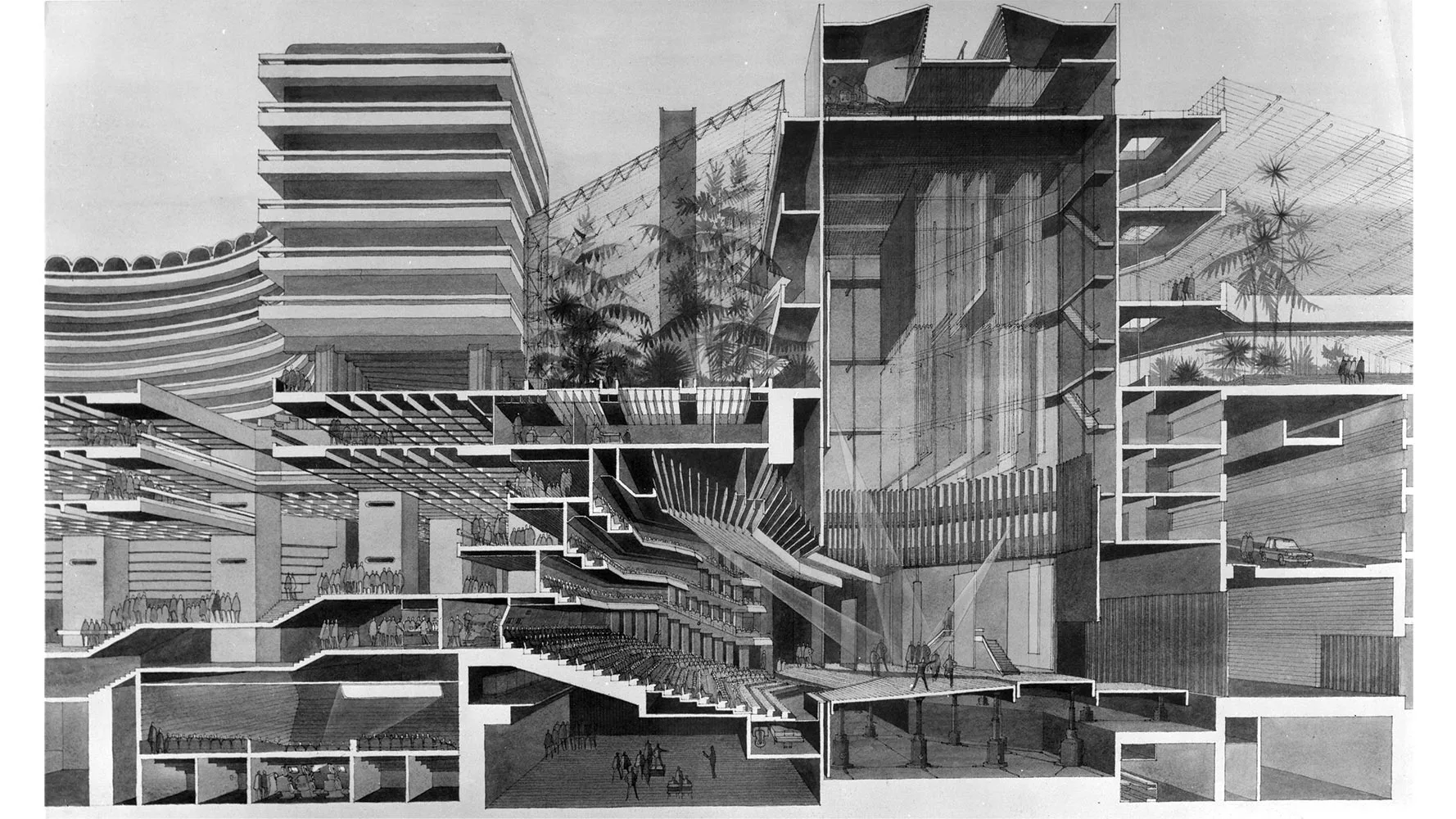
Civic architecture can, and sometimes does, still advocate for a process of liberation from consumerism and spaces that direct users to economically productive activities. Libraries, schools, and free public museums respond to the first hypothesis, but they have programmatic limitations. Architects today need to find precedents for a more expansive kind of enclosed civic space—buildings that accommodate their inhabitants without restrictions. One potent example is the Barbican Centre in London, designed by the British firm Chamberlin, Powell and Bon in the 1950s and fully opened in 1982. The Barbican consists of a large public podium divided into a variety of spaces, with gardens, lakes, pathways, and bridges, surrounded by 2,000 apartment units distributed among three concrete towers and several mid-rise slab buildings. Additional buildings on the podium house a library, a museum, restaurants, coffee shops and bars, a cinema, an art center, and a school of music and drama, among other things.
But the strength of the Barbican Centre is not these multiple programs but rather what happens in between. Almost as a coincidence or afterthought, its large atrium and enclosed corridors have been opened to the public and become seating areas and spaces to gather people together informally. Chairs, tables, and sofas have been arranged for those who want to stay indoors. And these spaces are more than just connective tissue: high ceilings and well-articulated rooms give them a sense of architectural gravitas. The materiality of these interiors—in pale brown and orange tones, large textured-concrete columns, and wood and carpeted floors—creates a cozy and intimate atmosphere, despite their generous dimensions. Light is dimmed in many areas, and threshold galleries divide interior from outdoor spaces. One can find a small, quiet spot to focus on reading, or stay in large areas, next to the garden doors, to engage with others. Within these atria, corridors, and gardens, students do their homework with their friends, people work on their laptops, wanderers read the newspaper in the mornings, and friends gather outside on the brick benches next to the pools.
The success of the Barbican depends not on its free Wi-Fi or the chairs and sofas, but on the architecture that accommodates them. The public spaces of the Barbican, reflective as they are of the welfare-state policies of postwar Britain, can serve as a precedent for similar environments today. They disprove the oft-repeated notion that enclosed public spaces will fall prey to vandalism and become unsafe. Except for a security guard in the primary entries and a small security office on the main level, the Barbican’s atriums, which are accessible for more than 12 hours daily, are not patrolled. They are cleaned regularly, and the bathrooms are open to everyone without restrictions. An attitude of caring for these spaces, used in different scenarios and by people of all walks of life, prevails over any destruction that wanderers might cause. Their popularity helps keep them safe and comfortable.
Even if the approach to this type of enclosed public space has its limitations in other contexts, particularly in American cities, where the concentration of poverty, management of mental illness, and prevalence of security concerns differ greatly from London, the Barbican can still be an inspiration to reimagine what qualifies as civic. The complex shows that citizens are eager to use enclosed public spaces, and that these, if well-designed, can become a success. Further, it prompts the question of whether such public interiors might be reconceived not as a luxury but as a right that cities guarantee to their residents. Just as parks, with their unprogrammed outdoor spaces, widely used on warm days, are considered basic in urban environments, so public interiors should be the norm, not the exception. Spaces that can bring people from different backgrounds together under a single inspiring roof can even help break down growing social divisions.
Making this a creative group endeavor can be challenging. Constructing new forms of cohabitation by putting leisure at the center of the spatial experience requires a new attitude toward design, and a combined effort involving policymakers, architects, and users alike. Each needs to provide incentives and imagine new activities, with the architect envisioning the envelope that will enhance the experience. In the end, this is the goal of architecture: making more meaningful, democratic, and enjoyable spaces.
Looking for quick answers on architecture and design topics?
Try Ask RECORD, our new smart AI search tool.
Ask RECORD →
Looking for a reprint of this article?
From high-res PDFs to custom plaques, order your copy today!