From the RECORD Archives: ‘Bell Labs’ Mirrored Superblock’
The Holmdel, New Jersey, office of Bell Labs—one of the most successful research and development enterprises in the world—could not have been a better setting for Lumon Industries, the fictional biotechnology company at the center of the critically acclaimed television thriller Severance. Designed by Eero Saarinen, the hulking monolith, clad in mirrored glass and surrounded by parking lots on a bucolic countryside campus, epitomizes midcentury corporate modernism. In the show, the building serves as the point of entry to the “severed floor,” a below-grade labyrinth of sterile hallways and remote offices where some of Lumon’s workers mysteriously toil over “macrodata refinement.” With season two now over, readers may be curious to learn more about the complex, which was published as the cover story in the October 1962 edition of RECORD with quotes from Saarinen, who unexpectedly died before the project was finished. Following the sale of the building and a subsequent seven-year transformation master planned by Alexander Gorlin Architects, Bell Labs again appeared on the magazine’s cover in February 2020.
Editor’s note: This article has been condensed for ease of online reading but reflects the original text.

1

2
Bell Labs, now Bell Works, appearing on the cover of Architectural Record in October 1962 (1) and February 2020 (2), following a comprehensive renovation. © Architectural Record, click to enlarge
“Bell Labs’ Mirrored Superblock”
No author attributed
Architectural Record, October 1962
Saarinen’s design for an engineering lab in New Jersey features a six-story reflecting wall 700 feet long and a balconied reception court five stories high
In many locations a wall of mirrored glass five stories high and 700 feet long would be an architectural disaster. But in the gently rolling openness of the South Jersey terrain—tree-dotted, but not densely wooded as is New England—the new Bell Telephone Laboratories Engineering Development Center, when finally glazed with reflecting glass, will have just the right amount of glitter to give it great style and elegance. Its precise, hard, shiny surfaces—and its rectilinearity—will make effective contrast with the soft curves and dips and rises of the countryside. Its character—akin to the machine-perfect products its users will develop—will be peculiarly appropriate.

© Architectural Record, October 1962, photo by Joseph W. Molitor
As is the case in producing many new products, manufacturing difficulties were encountered here in pioneering with a low-brightness reflective glass. As a result, one wall was glazed with an experimental product and the remainder with gray heat-resisting glass, so the building could be used. It appears a satisfactory laminated mirror glass will soon be available to replace the substitute gray glass, and the building will then assume the look the architect intended.
Of the spirit of the design, architect Eero Saarinen said, “Its material and its structure should be appropriate to the advanced technology of our time. The building should appear as a giant pavilion on the central axis of a parklike garden, comprising the driveways and a reflecting lagoon.”

© Architectural Record, October 1962, photo by Joseph W. Molitor
Of the plan, Saarinen said, “After much study, we arrived at a radically new plan, based on the idea of putting all labs and offices in interior space on short, cross-block corridors, with the entire glass periphery free for main corridors.”
“In its final stage, the building will consist of four long-span blocks, separated by a cross-shaped space with interior garden courts, all under one roof. The plan of each of the four units can be thought of as the gridiron of a football field, with corridors running around the outside of the rectangle.”

© Architectural Record, October 1962, photo by Joseph W. Molitor
“The advantages of this plan are many. Flexibility is at a maximum. Each of the cross-building cores is the width of seven 6-foot modules. The entire core can be used as an open area—such as drafting or typing pool—or split in 18-, 24-, or 12-foot-wide areas. Services supplied to the lab blocks are kept to a minimum in office areas, but they can be quickly converted to lab use by adding services through the vertical risers from the source.”
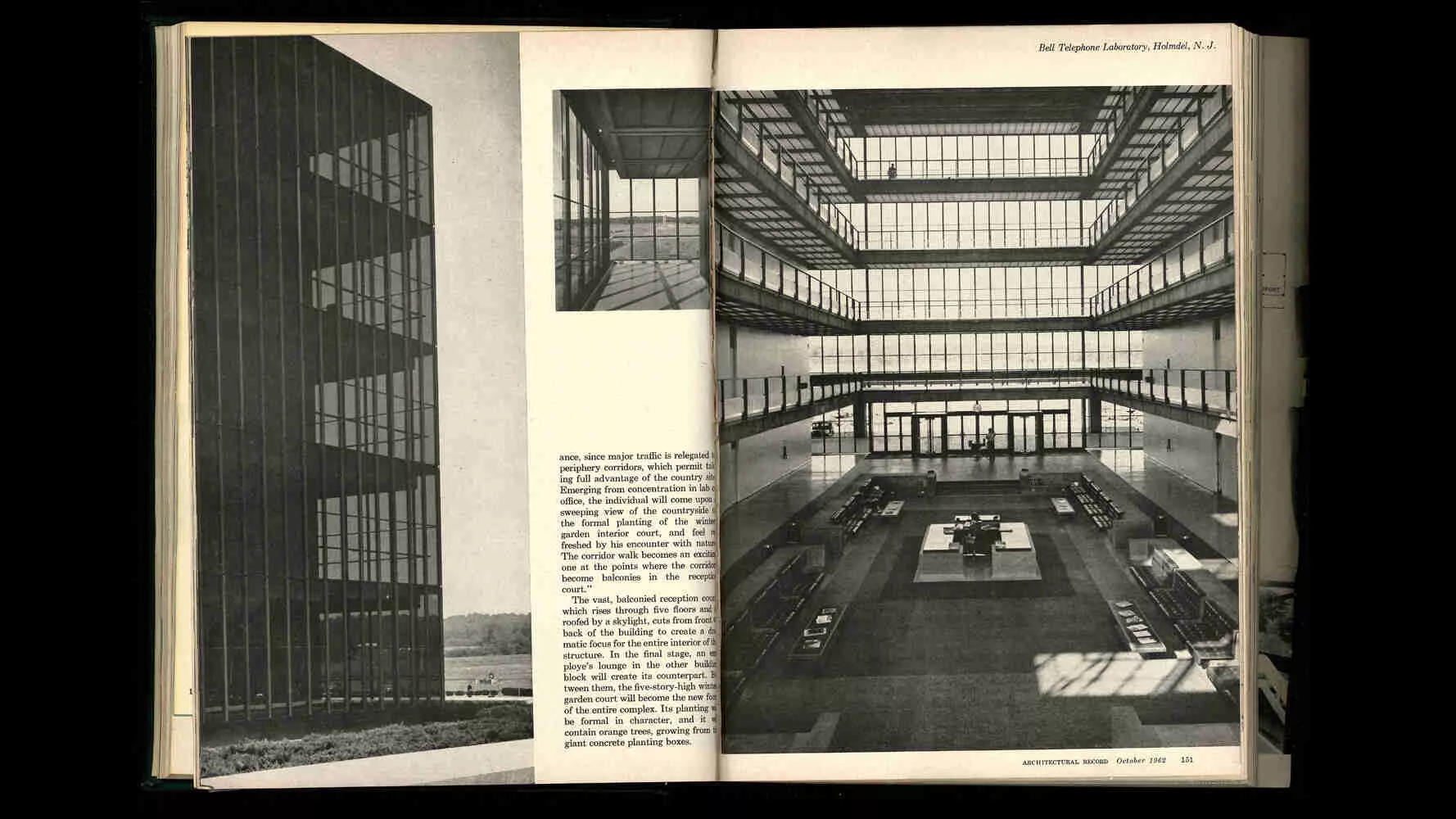
“The scheme also assures short, private corridors with minimum disturbance, since major traffic is relegated to periphery corridors, which permit taking full advantage of the country site. Emerging from concentration in lab or office, the individual will come upon a sweeping view of the countryside on the formal planning of the winter garden interior court, and feel refreshed by his encounter with nature. The corridor walk becomes an exciting one at the points where the corridors become balconies in the reception court.”

© Architectural Record, October 1962, photo by Joseph W. Molitor
The bast, balconied reception court which rises through five floors and is roofed by a skylight, cuts from front to back of the building to create a dramatic focus for the entire interior of the structure. In the final stage, an employe’s lounge in the other building block will create its counterpart. Between them, the five-story-high winter garden court will become the new focus of the entire complex. Its planting will be formal in character, and it will contain orange trees, growing from the giant concrete planting boxes.
At the highway entrance and on axis with the building, a graceful water tower, holding 300,000 gallons, rises 127 feet above grade. Saarinen says of the design, “A water tower should not be hidden away; it is a necessary functional thing, but can also be a proud and beautiful vertical accent, like a piece of sculpture.” The tank, 72 feet in diameter, is illuminated by projected light from the center of its base, which provides a graded wash on the bowl-shaped upper element.

© Architectural Record, October 1962, photo by Joseph W. Molitor
One of the building’s facilities—in addition to auditorium, transcription service, restaurant, medical department, computer center, etc.—is a technical library with a present capacity of 14,000 volumes and 500 periodicals. It and the other common service elements will serve a working population of 4,500 employes.
Looking for quick answers on architecture and design topics?
Try Ask RECORD, our new smart AI search tool.
Ask RECORD →
Looking for a reprint of this article?
From high-res PDFs to custom plaques, order your copy today!