A 100-foot-tall Vertical Mausoleum Rises at L.A.’s Landmark Hollywood Forever Cemetery
From the La Brea Tar Pitts to the Watts Towers to a venue that both cremates the deceased and offers outdoor screenings of Shrek 2, Los Angeles is not short on idiosyncratic cultural attractions.
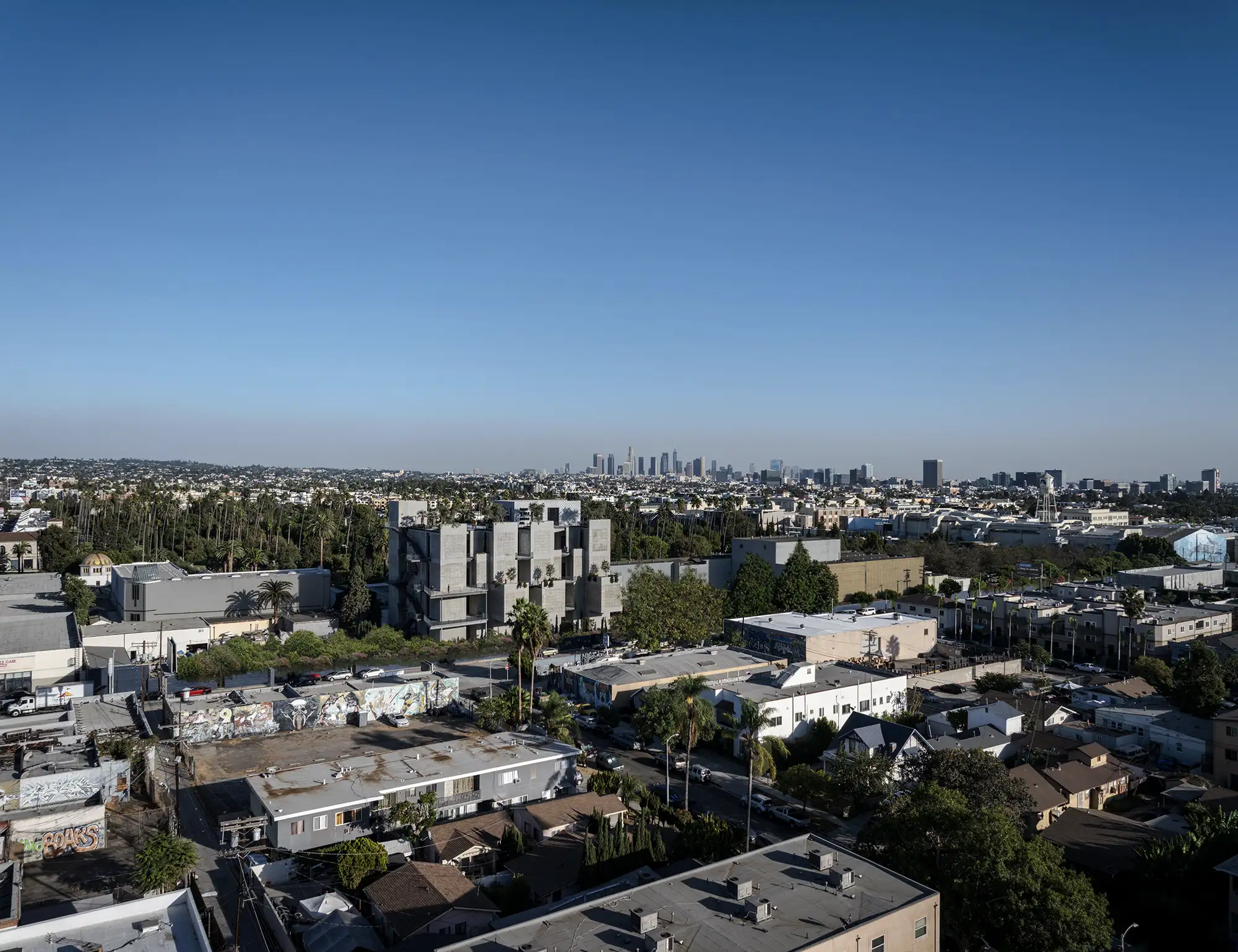
That last spot, Hollywood Forever, is a cemetery, mortuary, and cremation services provider first established in 1899. Designed by noted 19th-century landscape architect Joseph Earnshaw, the 100-acre property originally known as Hollywood Cemetery shrunk to nearly half its size when a non-interred portion of the tract was sold in 1920 to neighboring Paramount Pictures, whose sprawling studio shares the southern half of a mega-block bounded by Santa Monica Boulevard and Melrose Avenue, to the north and south respectively, with the cemetery. In 1998, the flailing memorial park was resuscitated by new ownership after suffering decades of vandalism, neglect, and scandal. Renamed Hollywood Forever, the property was cleaned up, added to the National Register of Historic Places the following year, and refashioned as a full-service cemetery and cultural center. Today, its programming rivals that of a major contemporary arts center—there’s a wildly popular outdoor summer movie series hosted on the Fairbanks Lawn and regular concerts and other performances held in the Masonic Lodge near the main gate. The cemetery is also the site of the largest annual Dia de Los Muertos celebration outside of Mexico. The fact that Hollywood Forever is home to a wealth of starry interments—Valentino, Garland, DeMille, Rooney, and multiple Ramones among them—adds to its allure.
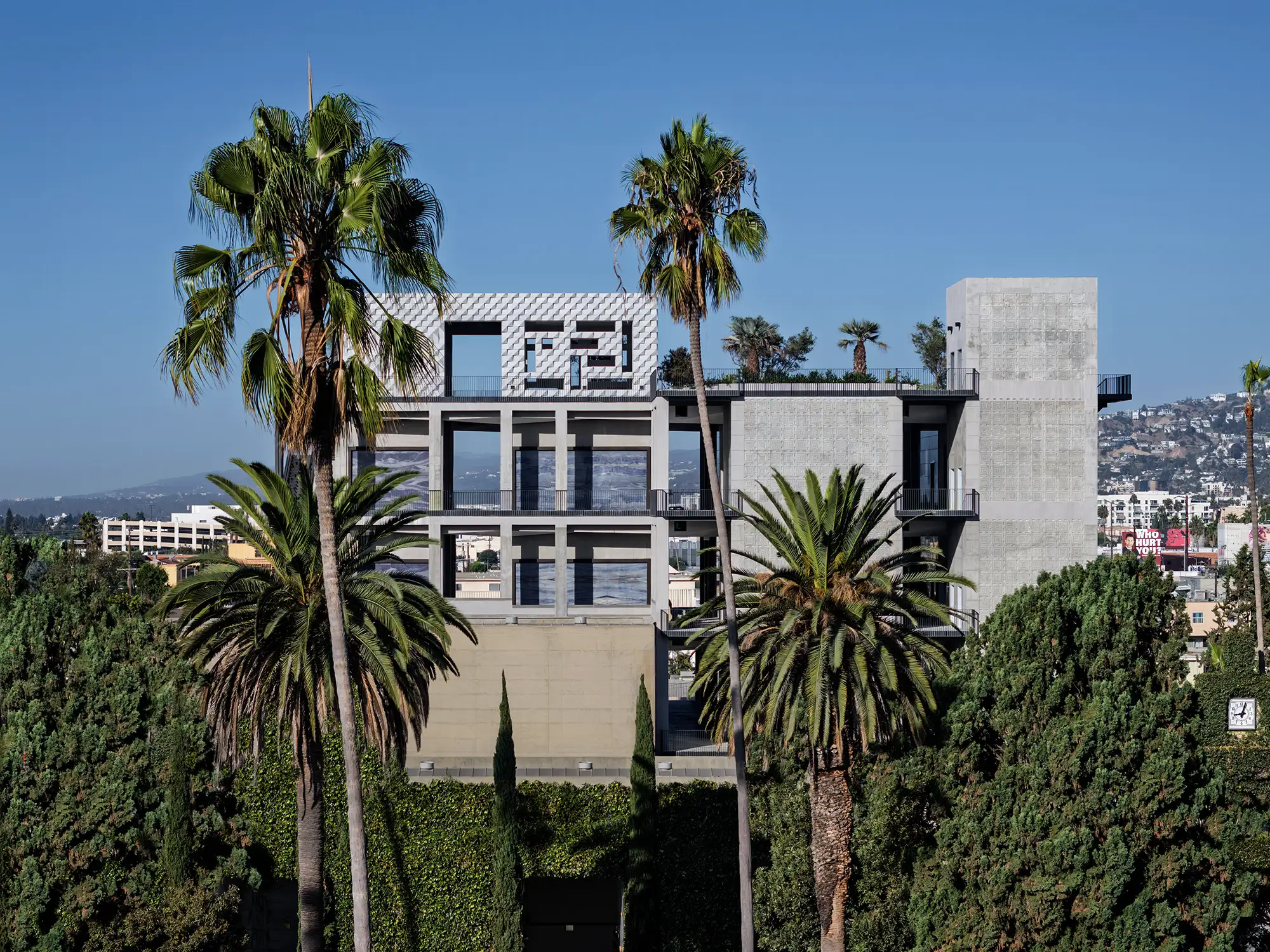
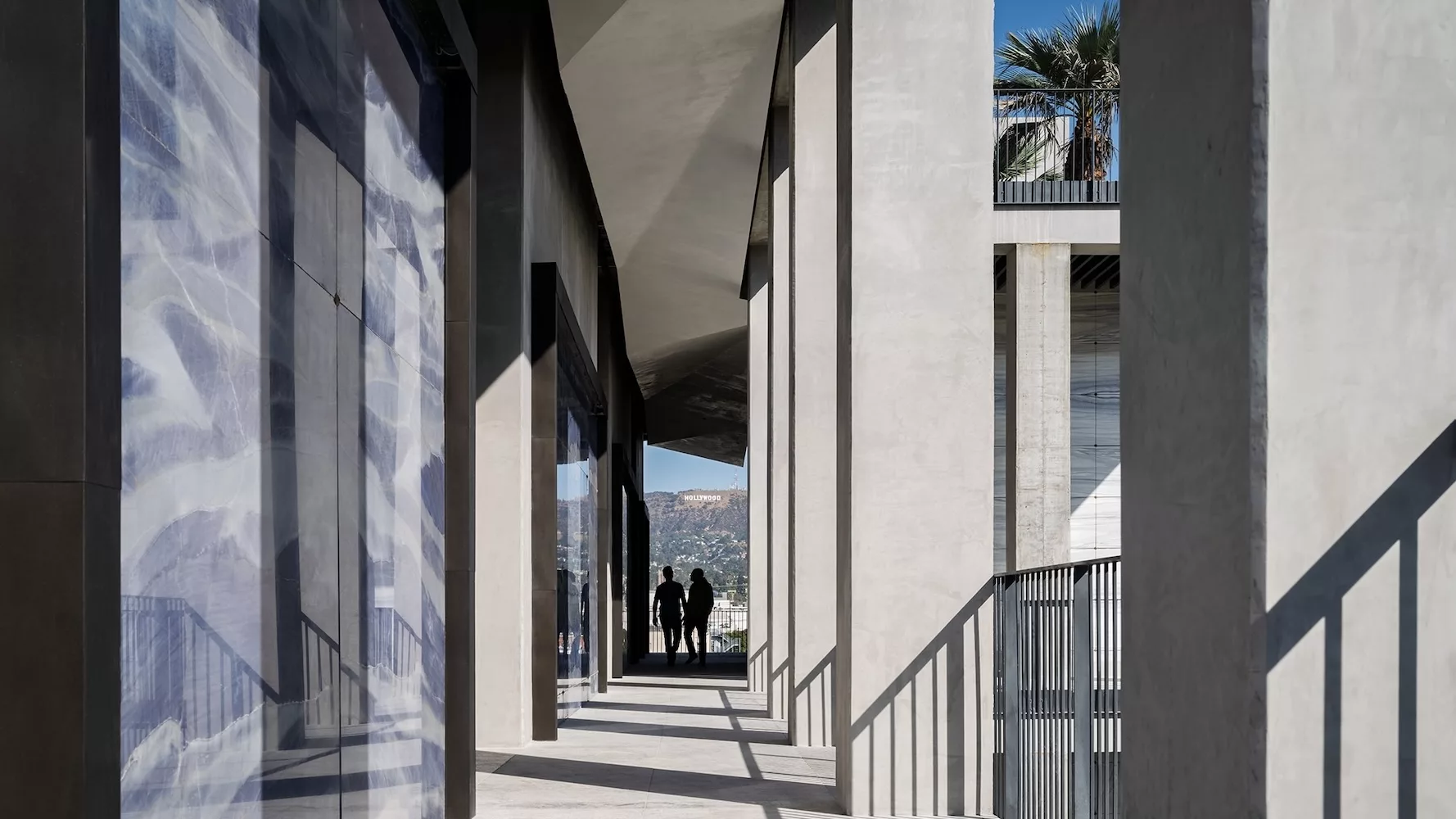
The tall, open-air structure balances monumentality and transparency. Photo © Tim Griffith
With all these goings-on, it’s easy to forget that Hollywood Forever is an active burial ground confined to a compact swath of land in a dense urban area. There’s nowhere to grow but up. The recently completed first phase of the Sunset Mausoleum project is enabling the cemetery to do just that.
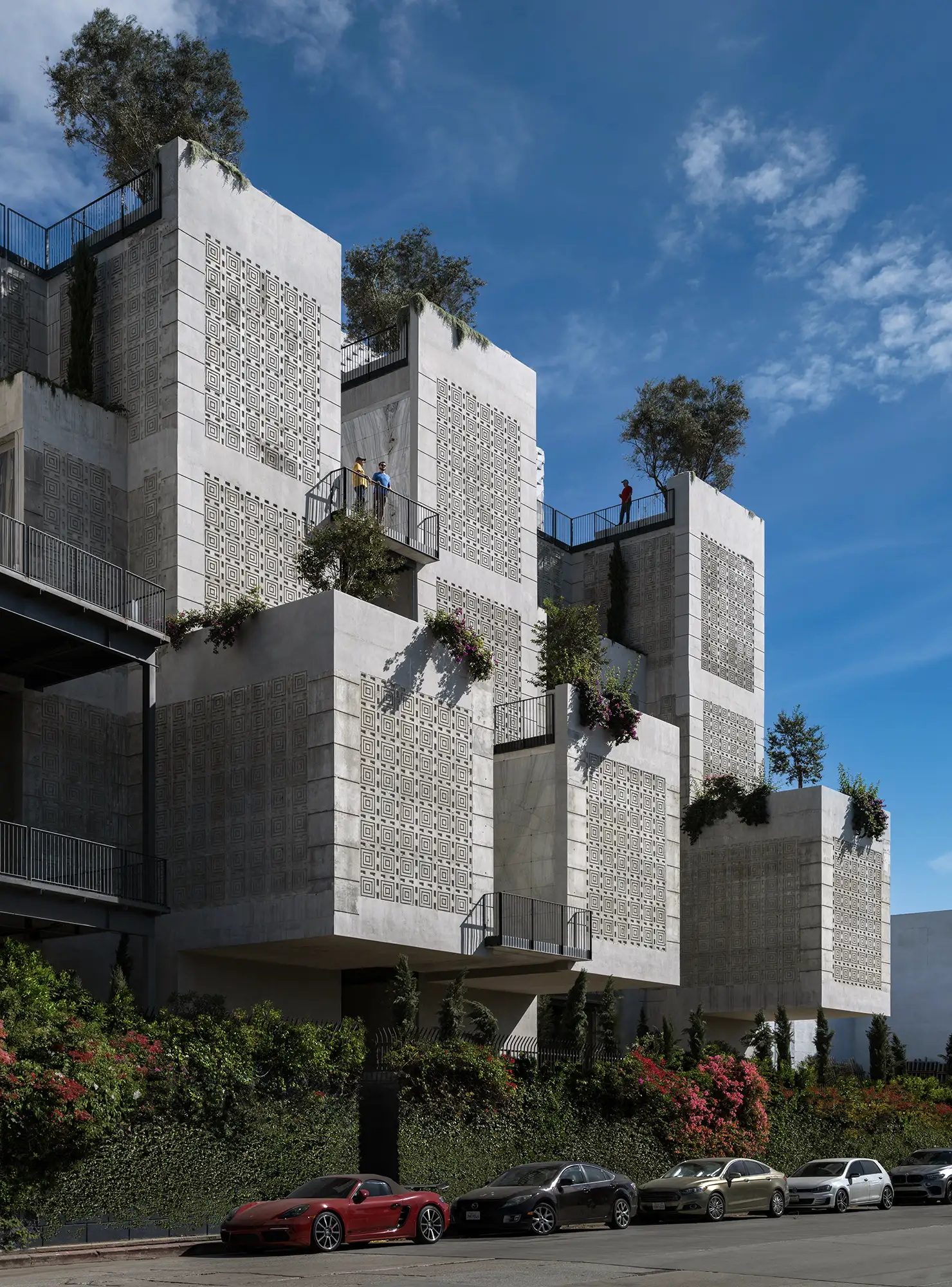
Large cantilevered volumes, which will eventually covered with vines and house the mausoleum's private family estates, extend over Gower Street. Photo © Tim Griffith
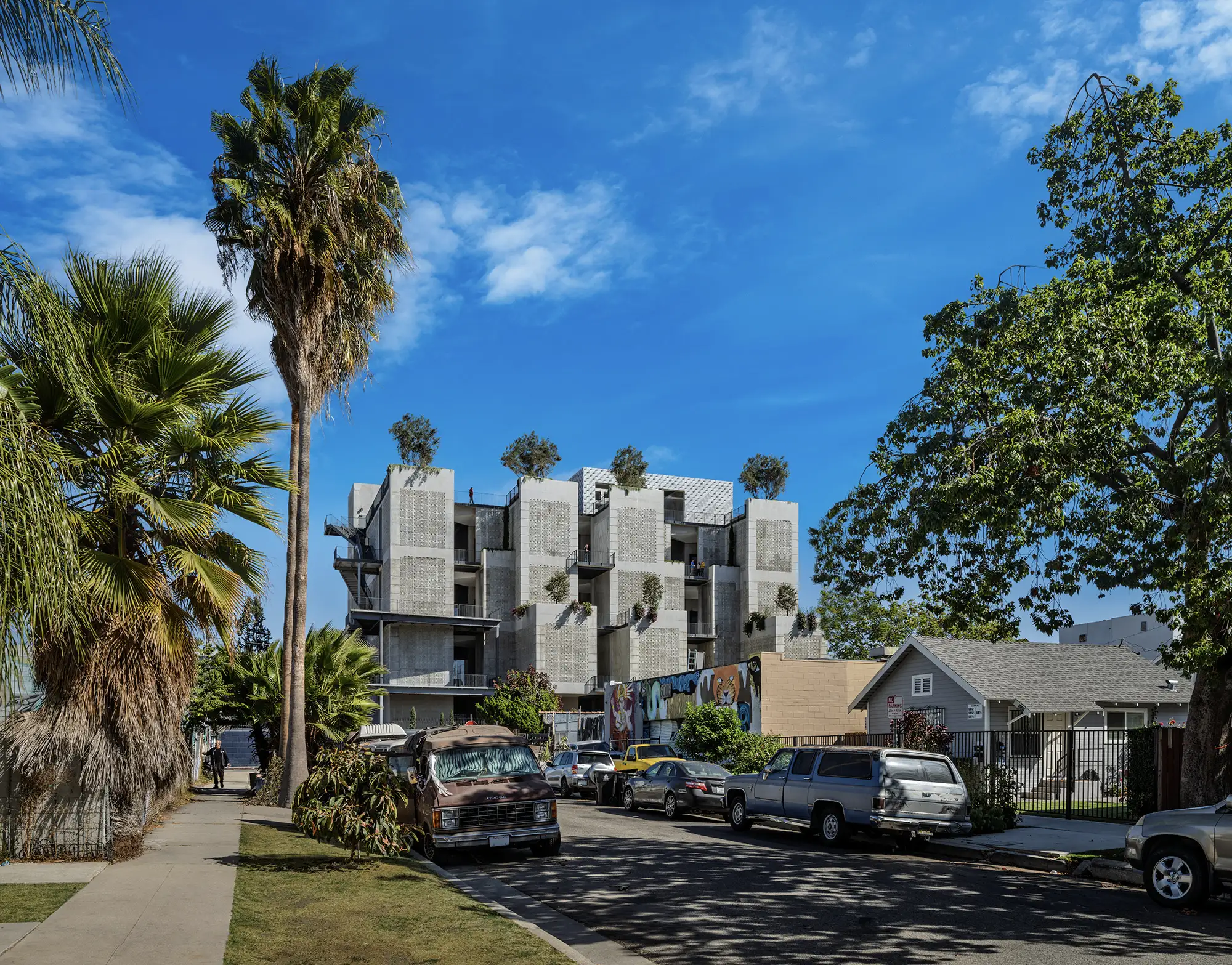
Rising above the eastern perimeter of the grounds is a 100-foot-tall vertical mausoleum constructed from poured-in-place concrete. Featuring large, cantilevered volumes suspended over Gower Street and a rooftop garden, the tremendously heavy but thin building—a “topographical landscape” as architects Michael Lehrer and Roberto Sheinberg call it—will ultimately be flanked by two similar structures to the north and south that will be completed during later phases. (Construction of phase two begins next spring.)
“In our mind’s eye, the mausoleum is very much a cultural project considering its relationship to the cemetery and being in the heart of Hollywood,” explains Lehrer. “As it’s completed, it will be a significant visual, architectural entity.”
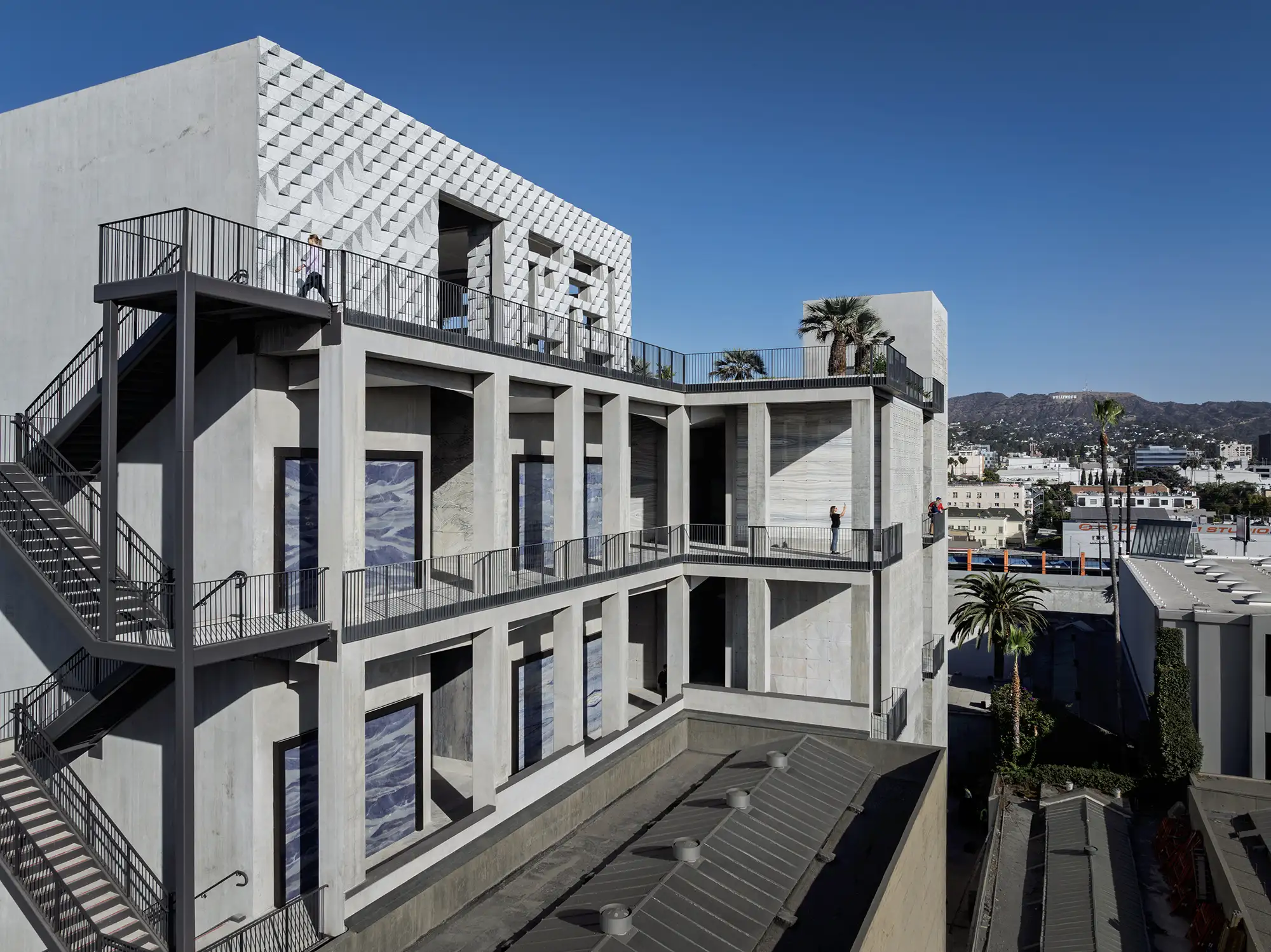
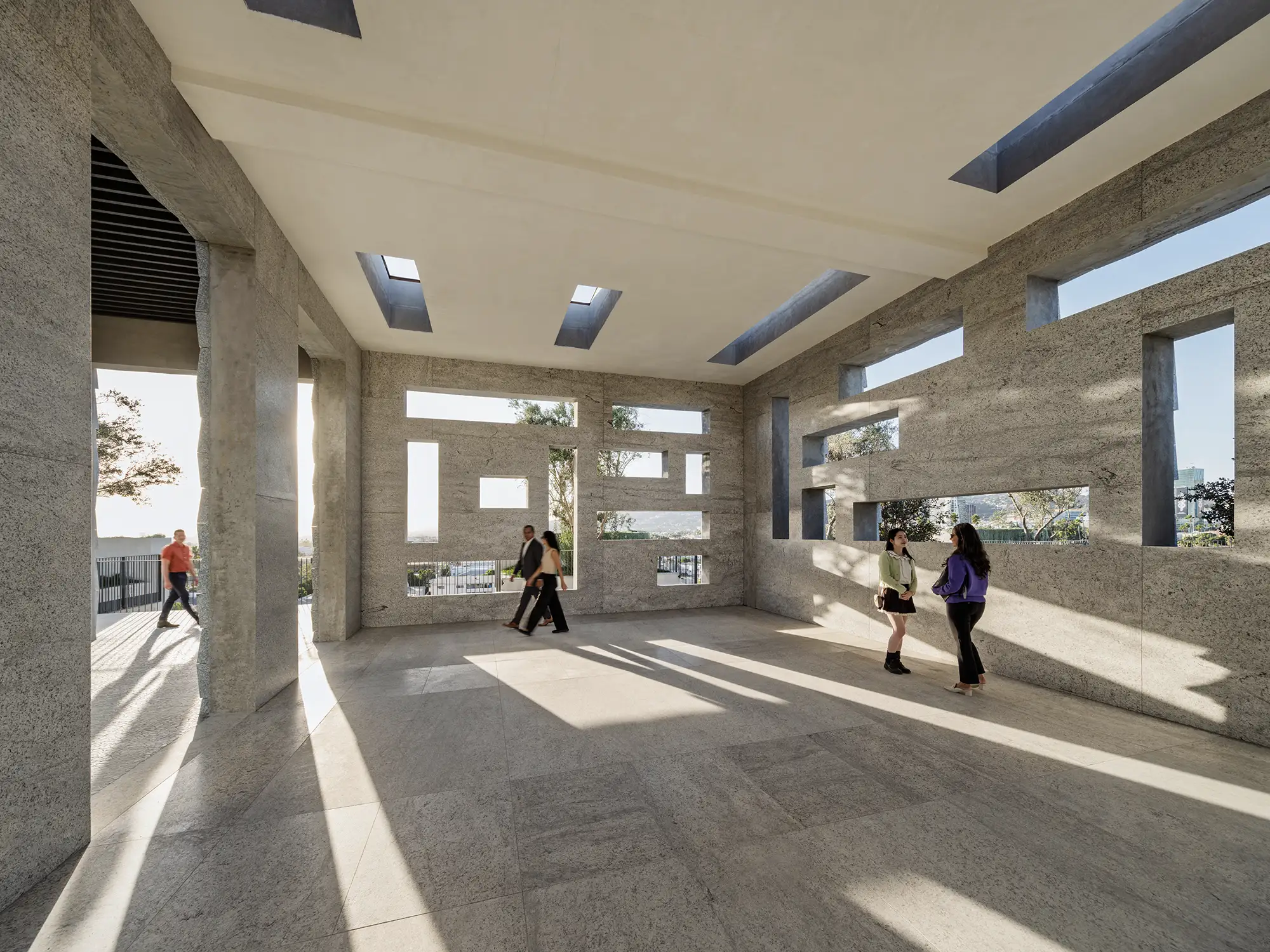
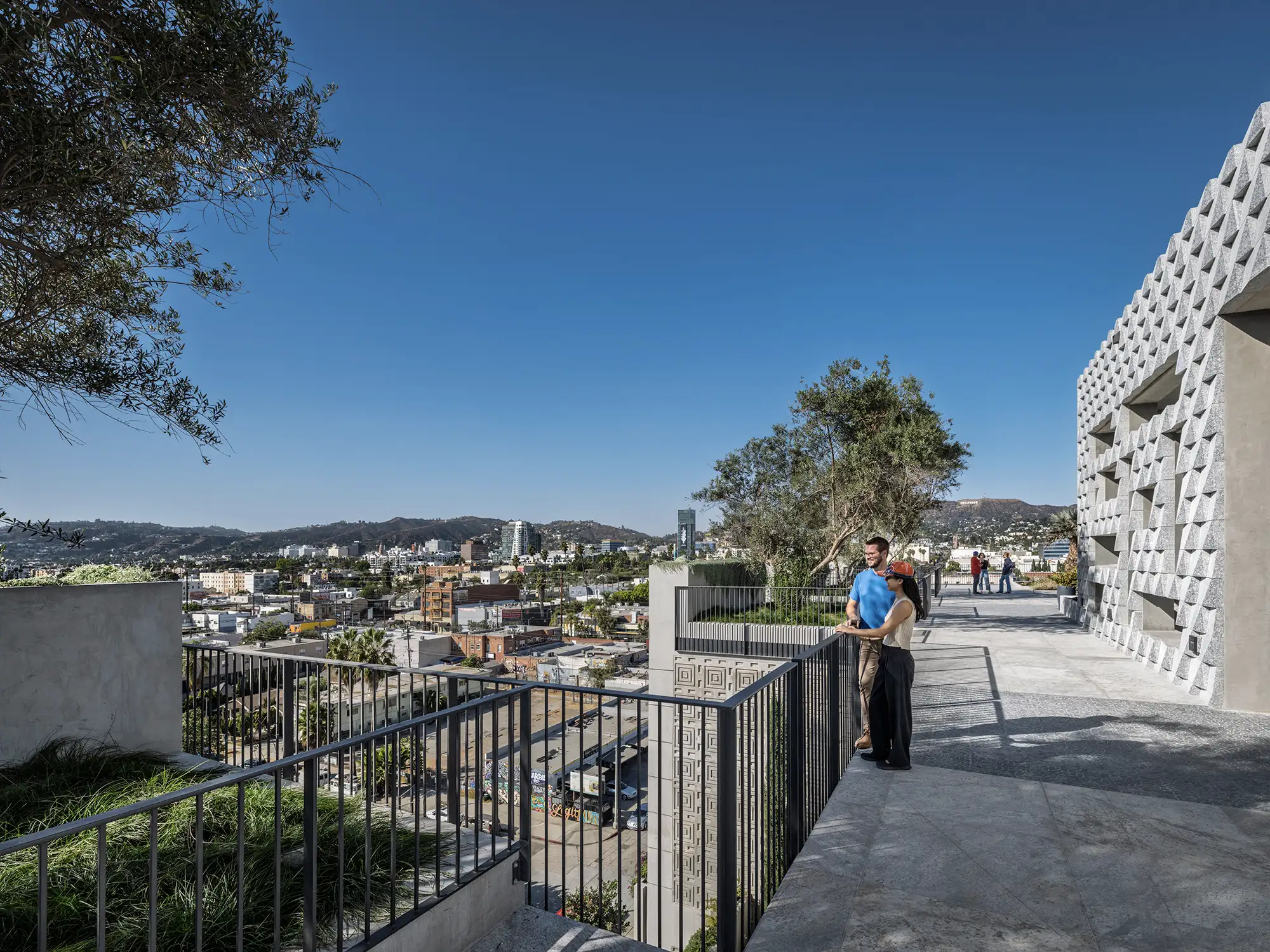
Five stories tall including the granite-block columbarium–topped roof level, the first realized mausoleum is both monumental and markedly porous, eschewing cavernous, enclosed spaces in favor of wide terraces and intimate balconies that edge the crypt-lined open corridors. Glimpses of L.A.—including panoramic city views from a palm- and olive tree–studded roof garden—can be enjoyed every which way one moves through the building. (The building, which pulls double duty as a observation tower, is on axis with the Hollywood Sign.) The same qualities of the cemetery’s flat, park-like landscape—abundant sunlight, ample greenery, and Pacific breezes—can be enjoyed by visitors on the new mausoleum’s upper floors. Describing Hollywood Forever as a tree-dense “giant green patch” that can be seen from far and wide, Sheinberg says that the design team didn’t want to “build a giant wall and block those views, taking that away from the city. Instead, the building extends the park out to the neighborhood.”
1
2
3
The upper floors of the mausoleum, with its open circulation plan, facing east into the cemetery (1); the cemetery is in the heart of Hollywood, adjacent to Paramount Studios (2); Gower Street view (3). Photos © Tim Griffith
When completed in its entirety, the 160,000-square-foot Sunset Mausoleum will occupy the whole Gower Street frontage on what is the last undeveloped parcel at Hollywood Forever. The project effectively extends the life of the cemetery by another 50 years, serving as the final home for more 50,000 Angelenos across 22,500 crypt spaces and 30,000 cremation niches. Four-and-a-half years in the making, the now-open phase-one structure has 5,000 crypts and 8,000 niches. The crypts, formed with 3-inch vertical and horizontal reinforced concrete slabs (as mandated by California health and safety code), create a honeycomb effect throughout the building and are fronted with a variety of Brazilian quartzites; these smooth stone surfaces subtly differ in each corridor to aid in wayfinding. Supported by the rigid concrete construction, heavy coffins housed within the mausoleum are stacked eight high per 20-foot floor-to-floor height, with the total number of coffins varying from level to level.
Looking for quick answers on architecture and design topics?
Try Ask RECORD, our new smart AI search tool.
Ask RECORD →
With Lehrer in the role as design principal-in-charge and Sheinberg as design director, L.A.-based Lehrer Architects first began design work on the mausoleum in 2013. “What preceded us were some schemes which were very high, solid buildings that could have just as well been garages, and not very nice ones either,” says Lehrer. “They didn’t enhance a thing.”
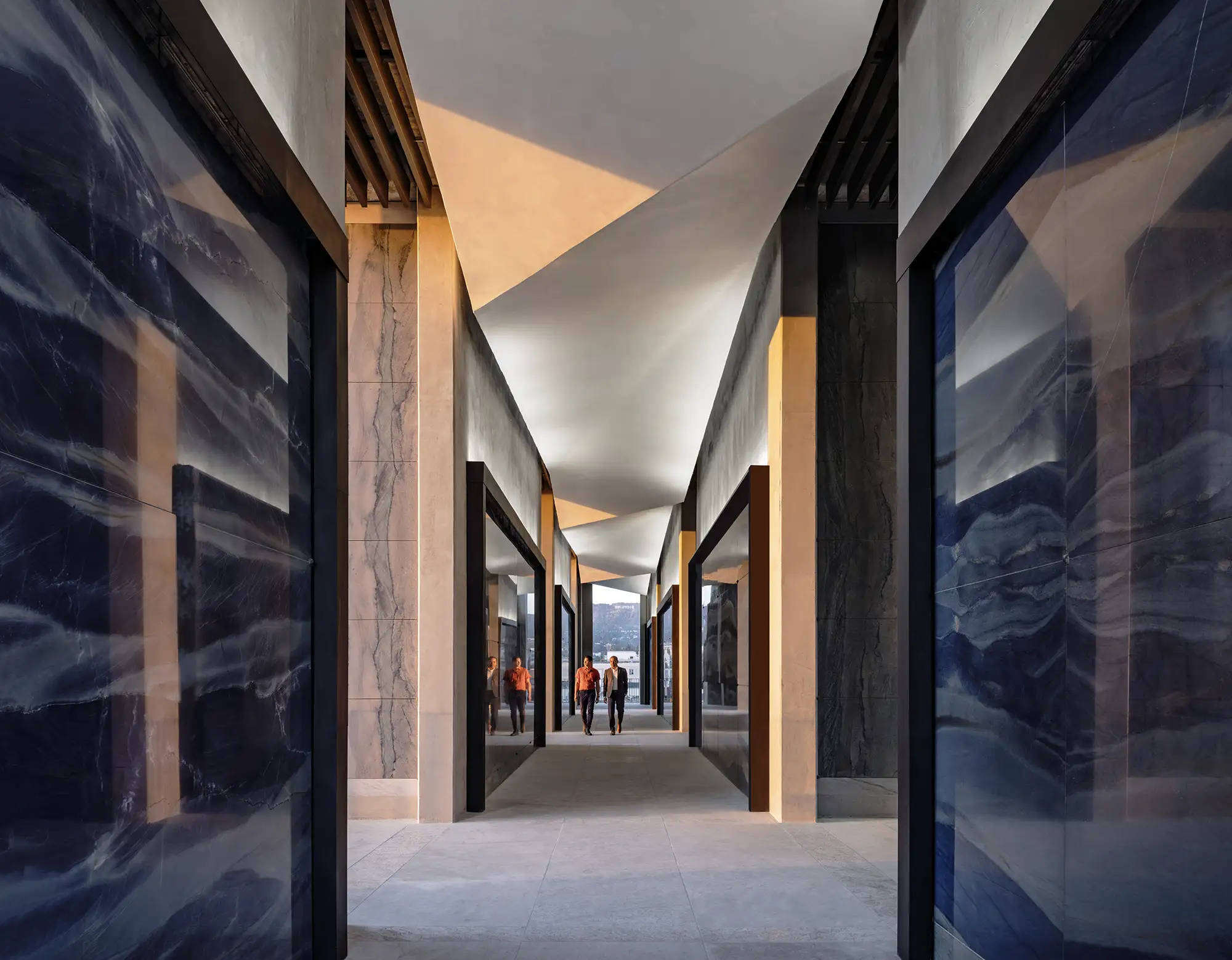
A variety of quartzite finishes lining the crypts help visitors to navigate the building. Photo © Tim Griffith
In 2021, Sheinberg departed Lehrer Architects to establish his own studio, Arquitectura y Diseño, which ushered phase one of the project through construction and is leading design detailing of two future phases. The design process between the two architects, which drew in disparate inspirations ranging from Sumerian mastabas to the work of Louis Kahn, was a collaborative one. The lush landscape surrounding the new mausoleum at street-level and on the stepped gardens above were designed by Studio-MLA, a busy practice led by Michael Lehrer’s wife, the landscape architect Mia Lehrer.
4
5
The rooftop columbarium (4) and terrace (5). Photos © Tim Griffith
One critical player, engineering firm Brandow & Johnston, didn’t come to the project quite as easily. It was the project’s fifth structural engineer to be brought in after its predecessors simply failed to execute the work without dramatically altering the original design, including the hulking cantilevers.
“Short of having a solid concrete building, there aren’t buildings that are much heavier than this one,” says Lehrer, whose firm is known for its colorful public commissions. “The structural challenge was that, given its height and its heaviness, the building isn’t all that deep.”
“They just couldn’t do it,” adds Sheinberg of the early engineering teams. “It’s such a unique building that I think they just didn’t know how to approach it.”
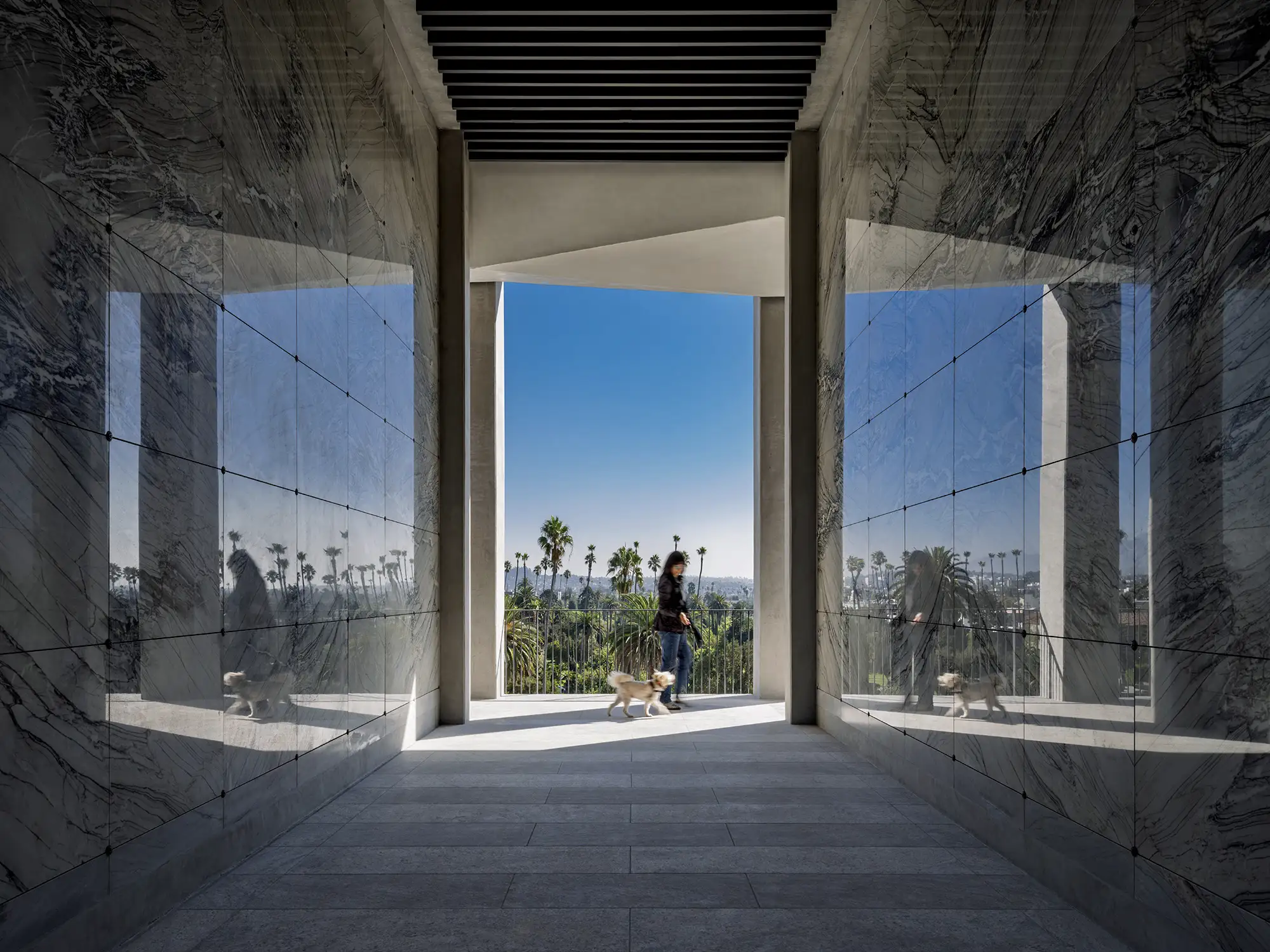
Photo © Tim Griffith
Sunset Mausoleum, the architects hope, will reverse a trend in which loved ones of the deceased stop regularly visiting interment sites after just a few years. “One of the monikers of our practice is to make destinations of desire,” says Lehrer. “Our goal was to create a place of consequence and joy for the living—somewhere you want to keep coming back to even if you don’t know that much about great-grandpa.”
Between the cultural programming, celebrity-driven tombstone tourism, and, now, the partial completion of a landmark vertical mausoleum, Hollywood Forever has further secured its reputation as a singular L.A. destination for those who have yet to pass on to the other side—as well as those who have.
Looking for a reprint of this article?
From high-res PDFs to custom plaques, order your copy today!


-Rafael-Gamo_2.webp?height=200&t=1776801260&width=200 "The Green-House at Green-Wood Cemetery, Brooklyn")