Architectural Record
search
cart
facebook twitter linkedin youtube
  • Sign In
  • Subscribe
  • Sign Out
  • My Account
Architectural Record
  • NEWS
    • Latest News
    • Awards
    • Interviews
    • Obituaries
    • Podcasts
      • Design:Ed Podcast
      • Sponsored Podcasts
  • OPINION
    • Book Reviews / Excerpts
    • Exhibition Reviews
    • Forum
  • EXCLUSIVES
    • Videos
    • Design Vanguard
    • Top 300 Firms
    • Sponsored Content
    • Sponsored eBooks
    • From the Archives
  • CONTINUING ED
    • Editorial Continuing Ed
    • CE Center
    • CE Academies
  • PROJECTS
    • Buildings By Type
    • Reuse & Renovation
    • Museums & Arts Centers
    • Colleges & Universities
    • Multifamily Housing
    • Interiors
    • Lighting
    • Kitchen & Bath
  • HOUSES
    • Record Houses
    • House of the Month
    • Featured Houses
  • PRODUCTS
    • Products by Category
    • Record Products of the Year
    • Latest Products
  • EVENTS
    • Dates & Events
    • Record on the Road
    • Innovation Conference
    • Sustainability in Practice
    • Women In Architecture
    • Webinars
    • Ad Excellence Awards
    • Submit an Event
  • CONNECT
    • Ask RECORD AI
    • Newsletters
    • Contact
    • Advertise
    • Editorial Calendar
    • Store
    • Customer Service
  • SUBMIT
    • Submission Guidelines
    • RECORD Competitions
  • MAGAZINE
    • Subscribe
    • My Account
    • Digital Edition
    • Current Issue
    • Firm Pass
    • Historic Archive
Architectural TechnologyArchitect Continuing EducationInfrastructure & Industrial ProjectsTransportation Architecture

Continuing Education: Prefabrication

Prefab Takes Flight at U.S. Airports

By Joann Gonchar, FAIA
LAX Expansion
The new concourse at LAX will open late this year. Image courtesy Woods Bagot
January 9, 2025
✕
Image in modal.

Expansions and modernizations at airports can be logistically tricky. They often involve shutdowns and delays, adding to travel headaches and causing a loss of revenue. But prefabrication and modular construction are emerging trends for airports, promising benefits that include fewer disruptions, shorter project timelines, and safer work sites, according to advocates of the methodology.

Current projects at Los Angeles International Airport (LAX) and Hartsfield-Jackson Atlanta International Airport (ATL), while not the first in the country to use remote construction, nevertheless illustrate the potential of different variations on the approach. LAX is extending its Midfield Satellite Concourse to the south, adding 146,000 square feet and eight gates for narrow-body aircraft in a process that design architect Woods Bagot calls off-site construction and relocation (OCR). In Atlanta, architects Corgan and Goode Van Slyke are relying on a hybrid of modular and traditional construction to expand ATL’s 44-year-old Concourse D by 75 percent to accommodate larger airplanes and more travelers.

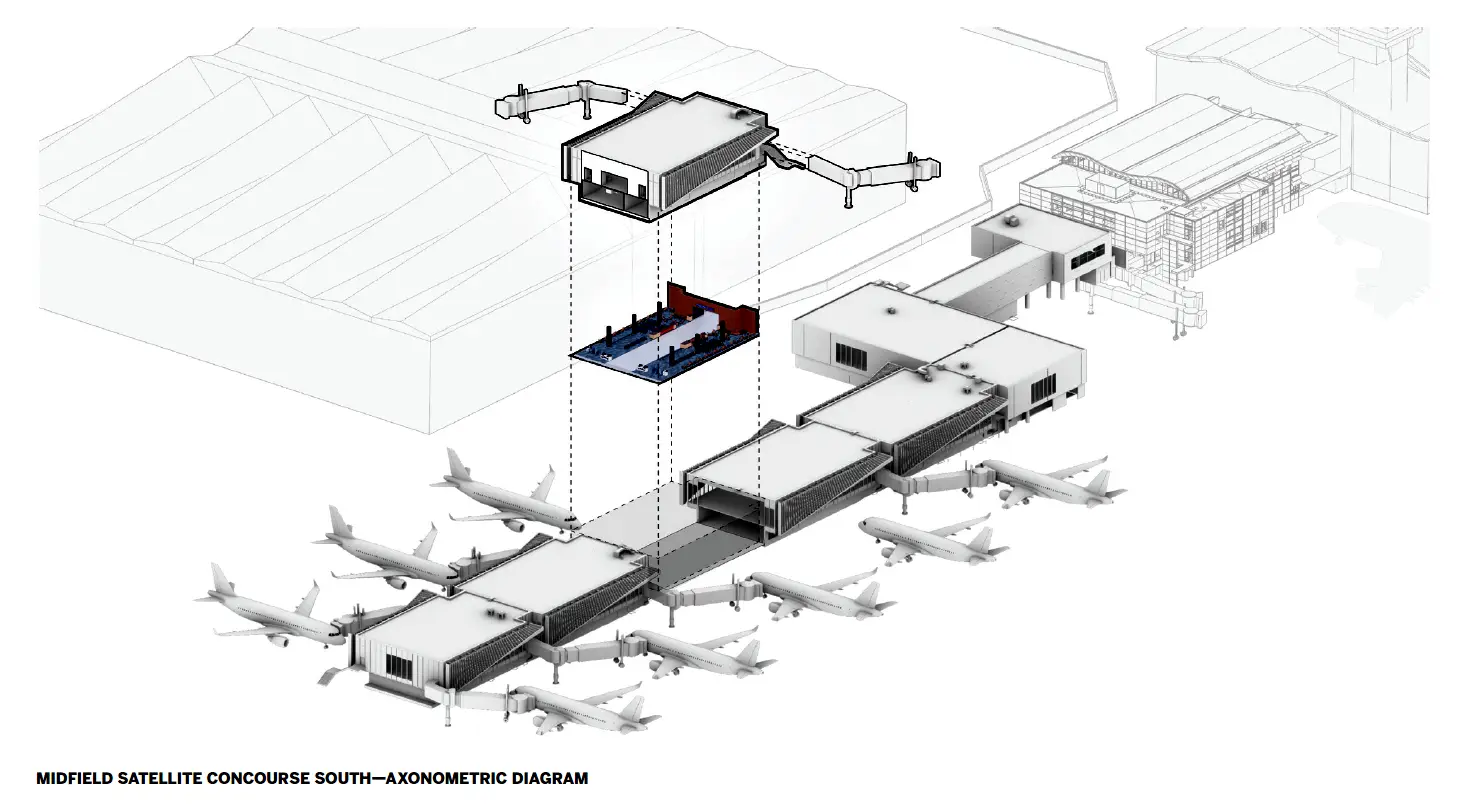
In the case of LAX, workers built nine aluminum-clad, steel-framed segments, with a typical one measuring 63 by 138 feet, in an assembly yard just outside the airfield operations area. Then, over nine nights this past October, with runways temporarily closed, crews from heavy-lifting company Mammoet transported the roughly 1,000-ton modules the 1¾ miles to the building site on specialized multiwheeled vehicles known as self-propelled modular transporters (SPMTs).

LAX Expansion.

Segments of the new concourse at LAX were moved into place in October. Photo © Los Angeles World Airports, click to enlarge.

Ian Lomas, the chair of Woods Bagot’s Los Angeles studio, says that the architecture of the new concourse is intentionally straightforward, but with proportions and geometry inspired by California Modernism. The modules do, however, have a feature that deviates from that era’s mostly rectilinear forms: an angled and subtly curving brise soleil. The shading device allows for daylighting and views without the need for other measures to mitigate heat gain and glare, such as coatings or electrochromic glazing. And “it creates a simple ripple across the facade,” says Lomas.

Click graphic to enlarge
LAX Expansion.

Structurally, each segment is its own building, laterally supported by a pair of moment-resisting frames in one direction and buckling-restrained braced frames in the other, explains Stuart Brumpton, project manager for Buro Happold, the expansion’s structural engineer, as well as its sustainability, lighting, and acoustical consultant. The design takes into account the potential for intense seismic activity in the earthquake-prone region, but it also prevented damage of nonstructural components during the modules’ transport, since their cladding, glazing, m/e/p services, partitions, and many interior finishes had already been installed. “We had to be more careful about deformation than we would for a typical building,” says Derrick Roorda, Buro Happold’s U.S. technical director.

Although the segments will probably stay put for several decades, they have been designed with circularity in mind. One day they could be decoupled and moved to another part of the airport, and possibly be converted to a different use, such as office space, points out Lomas. And, because the connections are bolted (except where the modules are tied to their foundations), the segments could even be easily disassembled and the steel members readily reused.

With all nine modules now in place, workers are building the concourse’s apron level, completing interior finishes, and installing the boarding bridges, among other tasks. Following a systems-commissioning process slated to start in March, the concourse will open in late 2025. According to Los Angeles World Airports, LAX’s owner and operator, the OCR approach shortened the construction timeline by six months and saved $30 million. Many of these economies can be attributed to avoiding the security screening required for building on an active airfield—and the associated time and expense. In a traditionally constructed airport project, “not only personnel, but every bolt needs to go through the TSA,” points out Roorda.

Looking for quick answers on architecture and design topics?
Try Ask RECORD, our new smart AI search tool.
Ask RECORD →

Click graphics to enlarge. Images courtesy Corgan / Goode Van Slyke
LAX Expansion.

LAX Expansion.

LAX Expansion.

LAX Expansion.

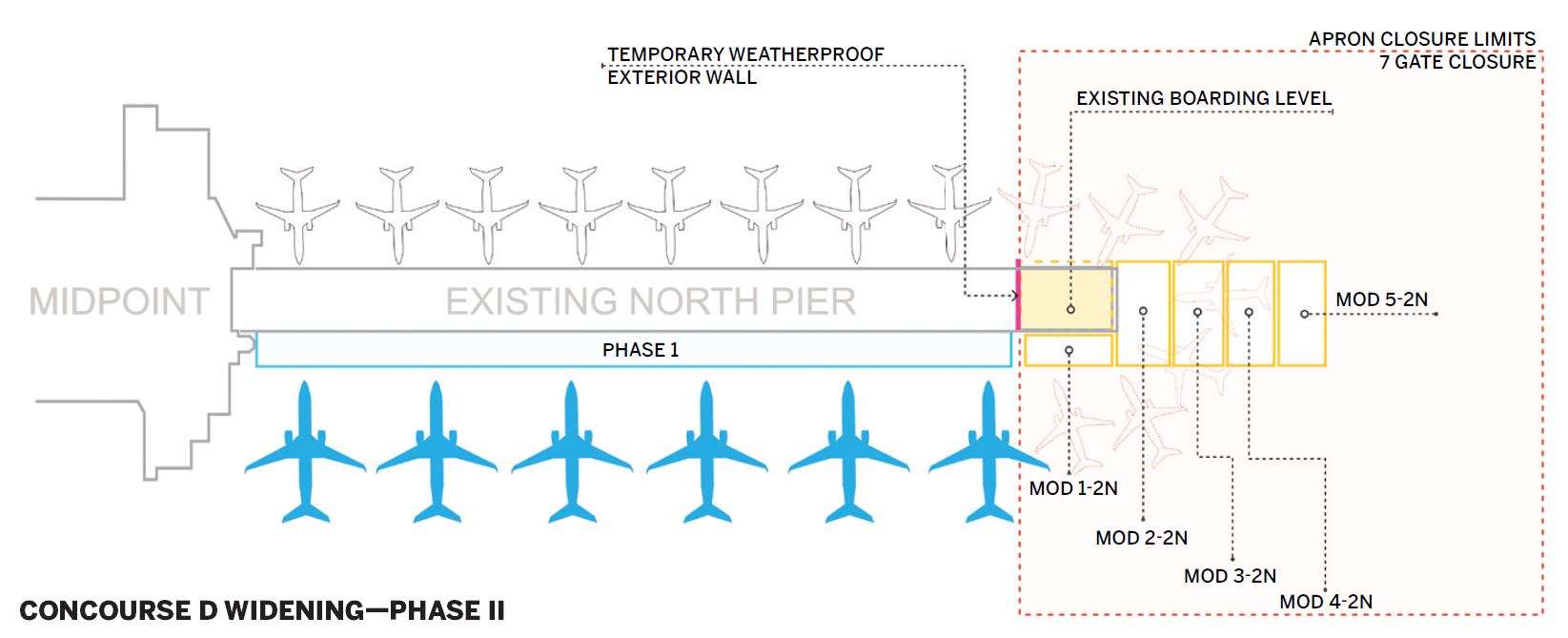
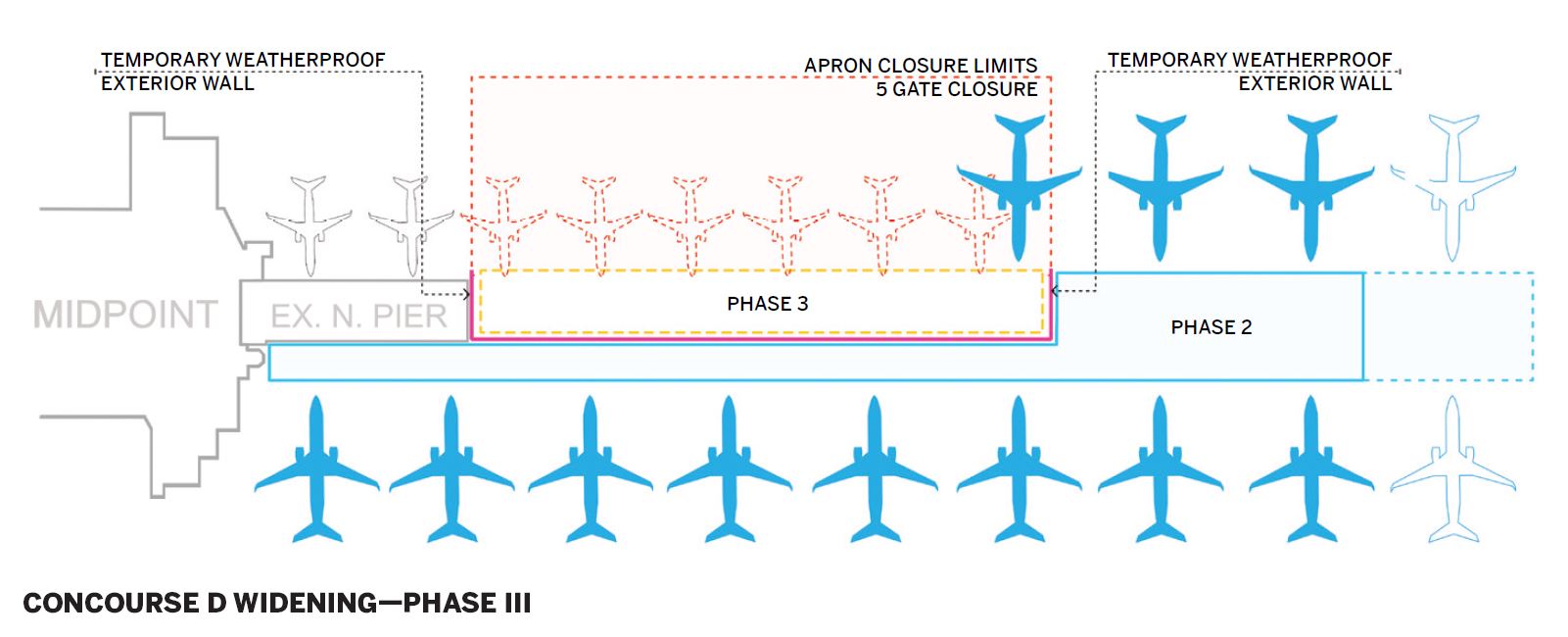
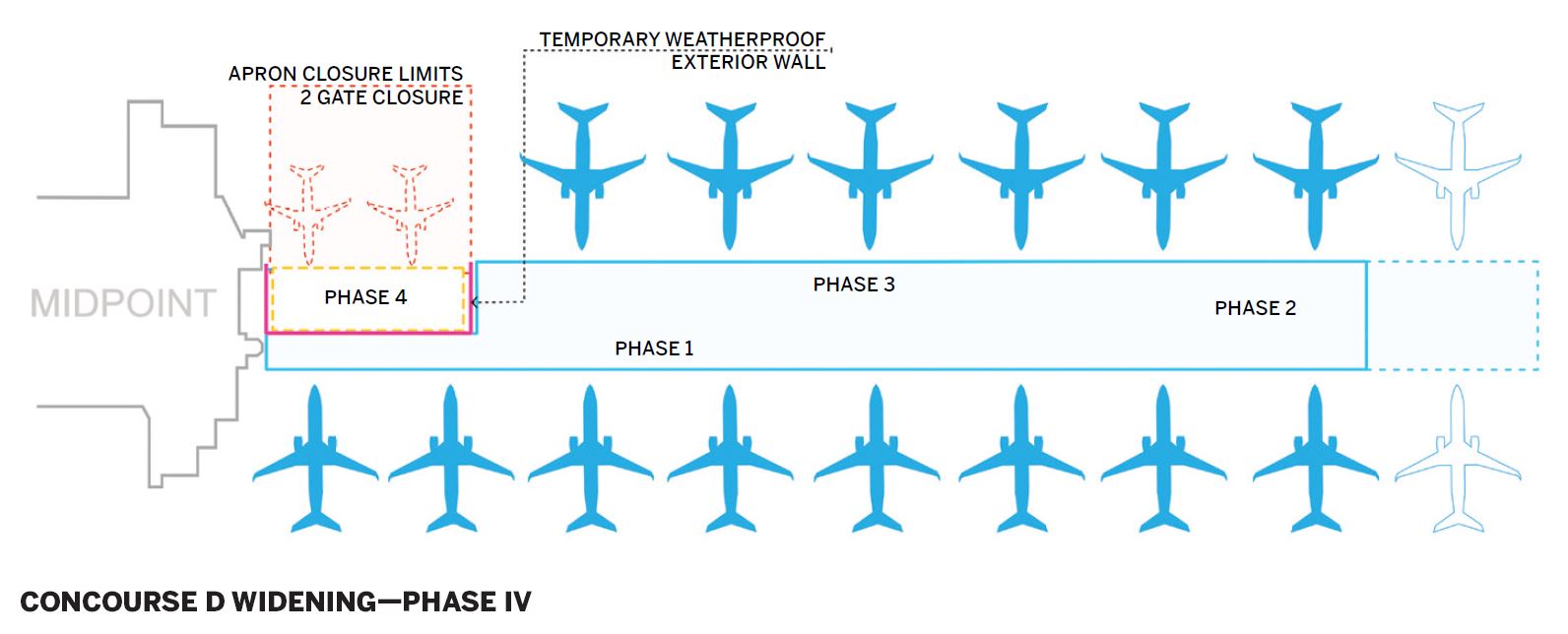
The team behind the expansion of Concourse D at ATL—the world’s busiest airport, with more than 100 million travelers in 2023 alone—is taking a slightly different tack, combining prefabrication with stick-built construction. The $1.4 billion project will widen the structure from 65 feet to 99 feet and extend its overall length by 288 feet. Ross Payton, aviation-sector leader at Corgan, says the revamped concourse will be more comfortable for travelers. It will have a taller interior volume, with 18-foot ceilings; larger hold rooms, with 20 percent more seating; roomier circulation spaces; more food options; and larger restrooms. When both north and south wings are complete, Concourse D will have 34 gates for next-generation aircraft.
ATL Expansion.

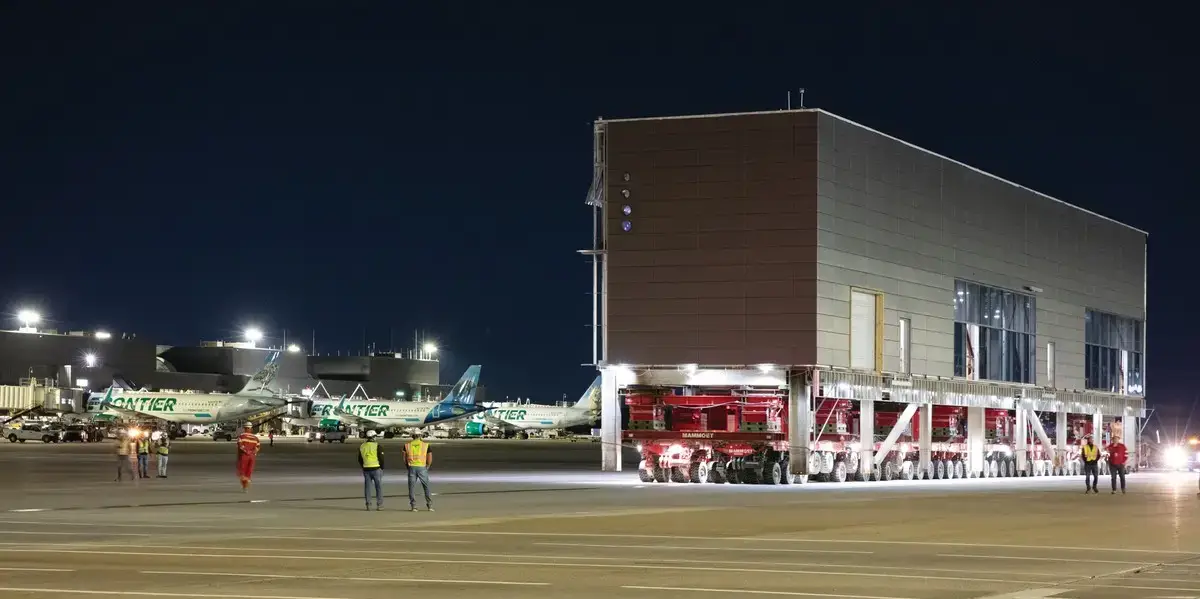
In Atlanta, workers are moving the segments into place with specialized multi-wheeled vehicles, as they did at LAX. Photo © Corgan

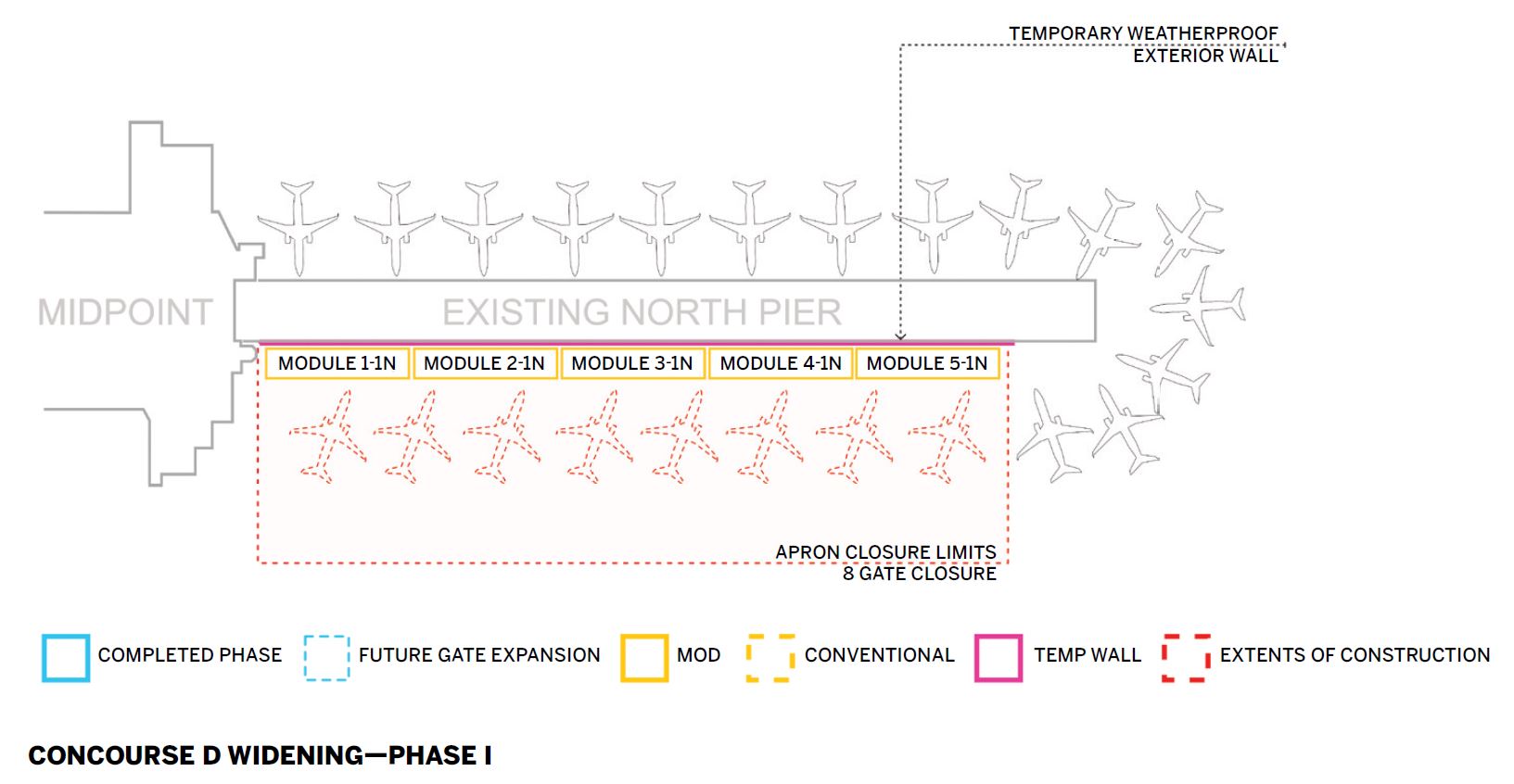
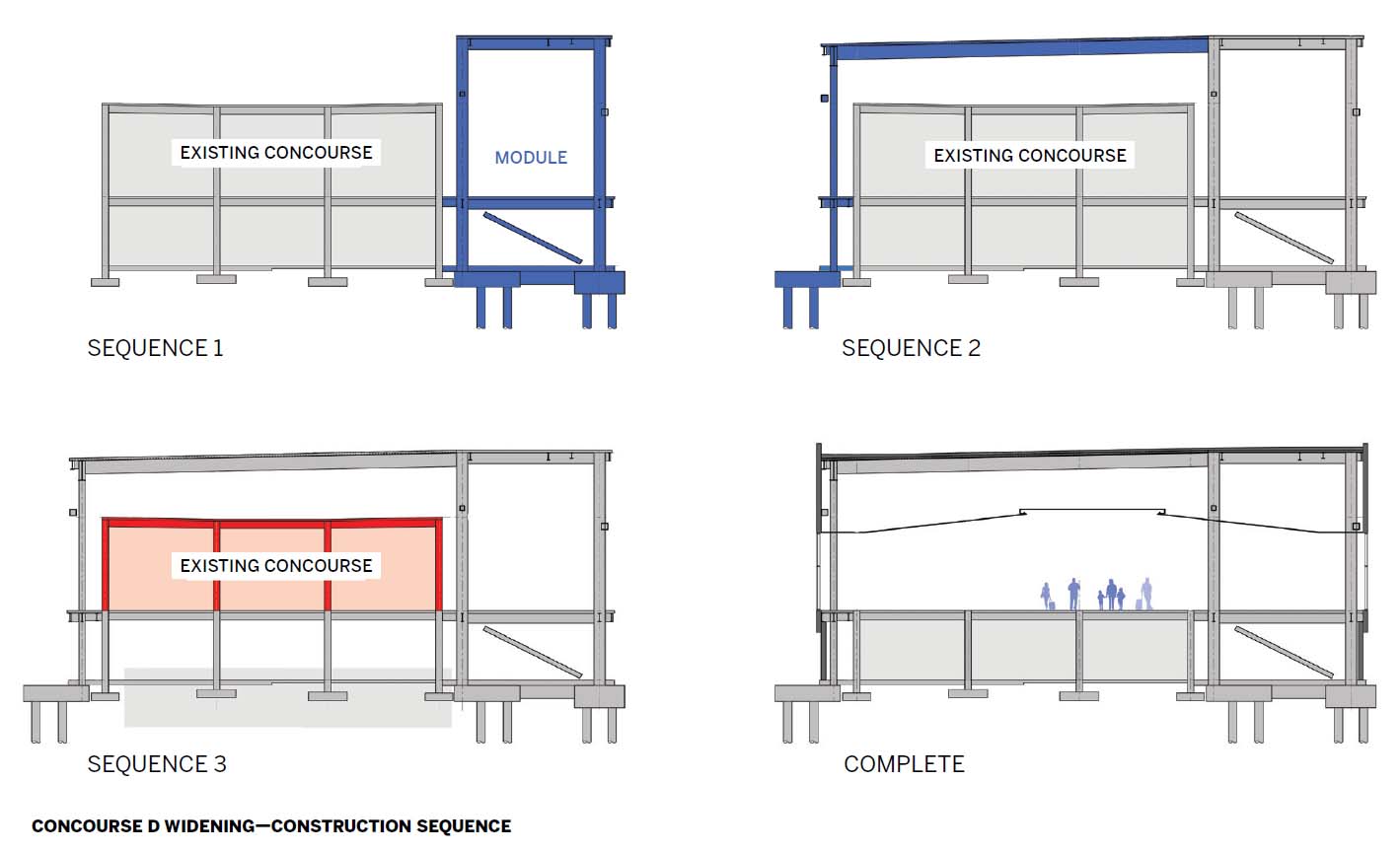
The expansion is being implemented in phases, so that no more than eight gates are taken out of operation at any one time, a mandate from the client, explains Todd McClendon, senior vice president of aviation with WSP, the project’s program manager as part of a joint venture with H.J. Russell and Turner & Townsend. Starting with the north wing, contractors are building steel-framed, shoebox-like modules—some as large as 30 by 192 feet—in a nearby assembly yard and, as with the LAX project, moving them into place overnight with Mammoet’s SPMTs. The team will next rely on more conventional techniques to build over the existing two-story concourse, and, once the new enclosure is complete, demolish the original upper level from within.

As of September, the first five modules had been put in place, with six new gates already in use. The north wing is expected to be complete by the summer of 2027, and the entire concourse two years later. According to WSP’s initial estimates, the combination of off- and on-site construction will shave eight to 10 months off the project timeline compared to a more conventional approach. It will also keep a maximum number of gates in operation at any one time. “In terms of per-day gate revenue, it made total sense,” says McClendon.

Prefabrication or modular construction won’t be a good fit for every airport. But if the projects in Atlanta and Los Angeles deliver on their promises, we will be seeing many more relying on these strategies.

Click graphic to enlarge. Image courtesy Corgan / Goode Van Slyke
ATL Expansion.
Back to Continuing Education: Prefabrication
KEYWORDS: airport design prefabrication

Share This Story

Looking for a reprint of this article?
From high-res PDFs to custom plaques, order your copy today!

Joann gonchar

Joann Gonchar, FAIA, LEED AP, is deputy editor at Architectural Record. She joined RECORD in 2006, after working for eight years at its sister publication, Engineering News-Record. Before starting her career as a journalist, Joann worked for several architecture firms and spent three years in Kobe, Japan, with the firm Team Zoo, Atelier Iruka. She earned a Master of Architecture degree from the University of Pennsylvania and a Bachelor of Arts from Brown University. She is licensed to practice architecture in New York State.

Post a comment to this article

Report Abusive Comment

Subscription Center
  • Create an Account
  • Start a Subscription
  • Manage My Account
  • Sign Up for Newsletters
  • Visit Customer Service
  • Update Preferences

More Videos

Sponsored Content

Sponsored Content is a special paid section where industry companies provide high quality, objective, non-commercial content around topics of interest to the Architectural Record audience. All Sponsored Content is supplied by the advertising company and any opinions expressed in this article are those of the author and not necessarily reflect the views of Architectural Record or its parent company, BNP Media. Interested in participating in our Sponsored Content section? Contact your local rep!

close
  • cold storage facility
    Sponsored byCarlisle SynTec Systems

    How Architects Can Design More Continuous Cold Storage Envelopes

  • TAMLYN XtremeTrim Exterior Trim
    Sponsored byTamlyn

    Designing Cleaner Panel Facades: Why Exterior Trim Details Matter

  • Building with Vapor Barriers
    Sponsored byReef Industries, Inc.

    Vapor Barriers Help Control Moisture in Tighter Building Designs

DESIGN:ED Podcast
Listen to Architectural Record’s DESIGN:ED Podcast

Events

June 23, 2026

Enhancing Fire Resistance with Advanced PVC Solutions

Credits: 1 AIA LU/HSW; 1 AIBD P-CE; 0.1 ICC CEU; 1 IIBEC CEH

Evaluate advanced PVC solutions that improve fire resistance, support WUI compliance, and enhance resilience in residential and commercial building design.

June 25, 2026

Designing Glass Railing Systems that Enhance Aesthetics and Meet Code

Credits: 1 AIA LU/HSW; 1 AIBD P-CE; 0.1 ICC CEU

Upon course completion, participants will possess a deeper understanding of glass railings to help ensure that safety, aesthetic, and performance objectives are achieved.

View All Submit An Event

Products

2026 Architect's Square Foot Costbook

2026 Architect's Square Foot Costbook

See More Products

Popular Stories

Lorcan O' Herilhy

California Architect Lorcan O’Herlihy Has Died, Age 66

Obama Presidential Center, Chicago

The Obama Presidential Center Opens on Chicago’s South Side

Spoonbill Ranch

Johnsen Schmaling Architects Integrates Spoonbill Ranch into a Pristine Landscape

Image of Bruce Springsteen Center for American Music

The CookFox-designed Bruce Springsteen Center for American Music Opens in New Jersey

Three Courtyards House

Design Vanguard 2026: Balsa Crosetto Piazzi

Enhancing Fire Resistance with Advanced PVC Solutions - Free Webinar - June 23, 2026

Related Articles

  • U.S. Tribute to Peace Takes Flight on D.C. Mall

    See More
  • "Villa Libeskind" Takes Prefab to the Extreme

    See More
  • Anthony Timberlands Center

    Grafton Architects’ First U.S. Building, at the University of Arkansas, is a Mass-Timber Triumph

    See More

Related Products

See More Products
  • bim design firms.jpg

    BIM for Design Firms: Data Rich Architecture at Small and Medium Scales

See More Products

Events

View AllSubmit An Event
  • October 22, 2025

    Architecture at the Forefront: 2025 Design Vanguard Winners, Part II

    NOW ON DEMANDCredits: 1 AIA LU/Elective; 1 AIBD P-CE; 0.1 ICC CEU; 0.1 IACET CEU Principals share recent projects and their experience starting an architecture firm as part of Architectural Record’s series for students and emerging professionals.
  • September 24, 2025

    Architecture at the Forefront: 2025 Design Vanguard Winners, Part I

    NOW ON DEMANDCredits: 1 AIA LU/Elective; 1 AIBD P-CE; 0.1 ICC CEU; 0.1 IACET CEUThis webinar, part of Architectural Record’s series for students and emerging professionals, features principals sharing recent projects and their experiences starting a firm.
View AllSubmit An Event
×

The latest news and information

#1 Source for Architectural Design, News and Products

SUBSCRIBE
  • RESOURCES
    • Advertise
    • Contact Us
    • Submit
    • Store
  • ACCOUNT CENTER
    • Create an Account
    • Start a Subscription
    • Manage My Account
    • Sign Up for Newsletters
    • Visit Customer Service
    • Update Preferences
  • PRIVACY
    • PRIVACY POLICY
    • TERMS & CONDITIONS
    • DO NOT SELL MY PERSONAL INFORMATION
    • PRIVACY REQUEST
    • ACCESSIBILITY
  • SERVICES
    • Marketing Services
    • Reprints
    • Market Research
    • List Rental
    • Survey/Respondent Access
  • STAY CONNECTED
    • Linkedin
    • Facebook
    • Instagram
    • YouTube
    • X (Twitter)

Copyright ©2026. All Rights Reserved BNP Media, Inc. and BNP Media II, LLC.

Design, CMS, Hosting & Web Development :: ePublishing