A Reshuffling of Priorities at the GSA Rattles Architects
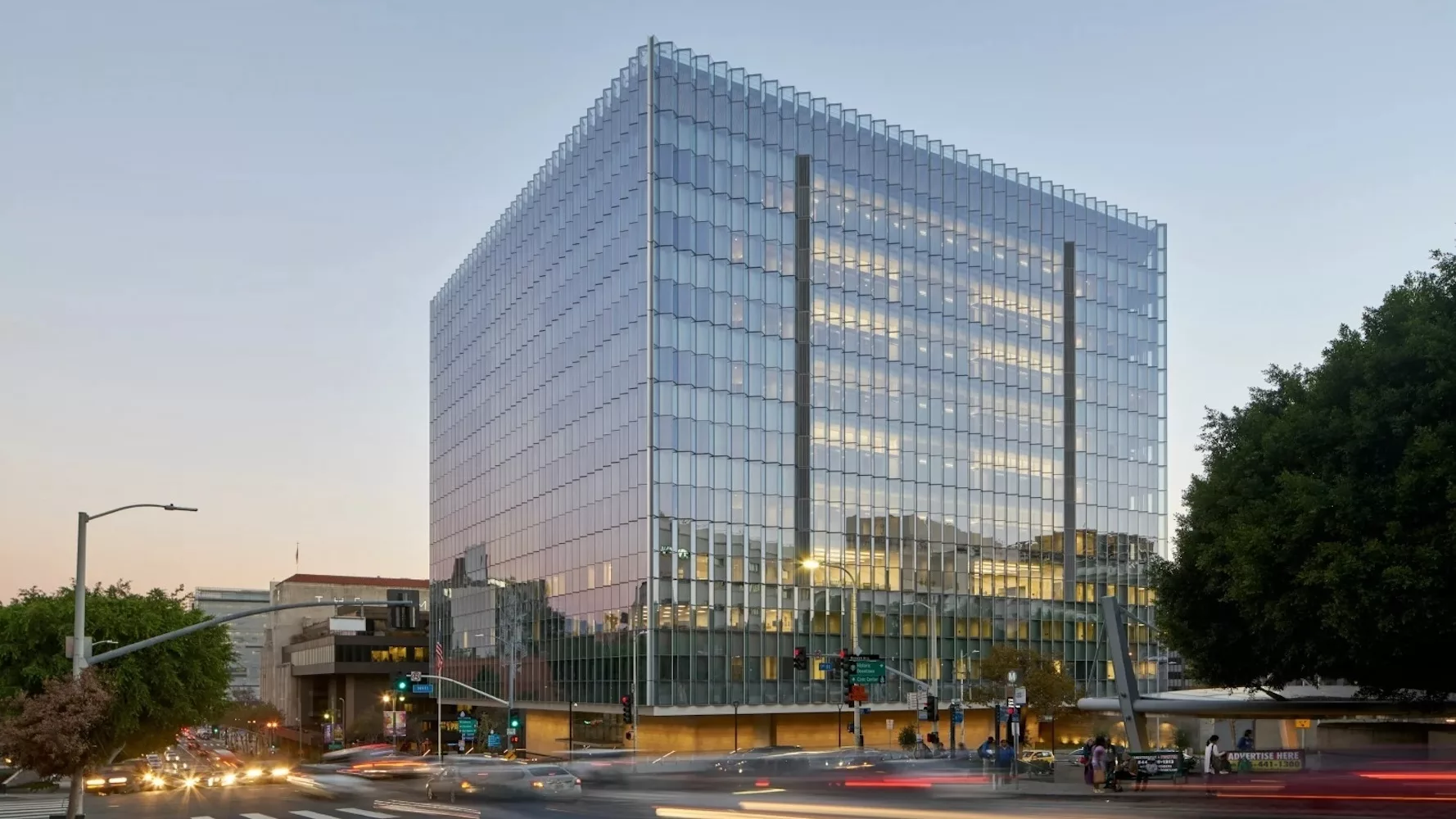
Completed in 2016 and featured in RECORD the following year, the SOM-designed United States Courthouse in Los Angeles is a 2018 recipient of a COTE Top Ten Award from the AIA. Multiple GSA projects have won the award, which recognizes sustainable design excellence. Prioritizing sustainability in federal building design may now fall to the wayside under the Trump administration. Photo © Bruce Damonte
The U.S. General Services Administration (GSA) has long had a reputation as a coveted client among architects. The agency is the nation’s largest landlord, with some 8,800 owned or leased assets across the country totaling about 370 million square feet, and encompassing everything from courthouses and office buildings to data centers. But there is more to the agency’s appeal than mere scale. For decades, the GSA has been known for commissioning high-profile, forward-thinking, and resilient civic buildings. But that seems to be changing as the Trump administration imposes its agenda. Among the White House’s earliest actions was an official memorandum paving the way to once again—as Trump did in his first term—attempt to establish classical architecture as the official style for federal buildings. The agency also has a goal, first reported by Wired, to sell a large share of its buildings, reducing the size of its owned real-estate portfolio by 50 percent. And now RECORD has learned of a pause in payments—at least temporarily—to architects, for work they have already performed.
One architecture firm* had nearly $2 million in outstanding invoices. However, after being informed last week that payment was in process, the company received its funds earlier this week. Though this is welcome news, the firm’s principal describes the situation as “scary,” since the office has obligations to both its employees and the project’s subconsultants.
Other architects with GSA projects say their invoices have been paid without delay, but they are experiencing other disruptions, particularly those relating to the efforts to reduce the size of the federal workforce. A firm with multiple GSA projects has lost more than half of its agency contacts. The architects do not know if these staff, who they called “excellent” and “highly productive,” took early retirement, accepted the buyout offer from Elon Musk’s so-called Department of Government Efficiency (DOGE), or were terminated. But the firm’s leaders are concerned about the loss of knowledge and continuity. “Federal buildings have necessarily complicated safety and security requirements, and agency experts who advise on these requirements and inspect the construction to assure they are met are no longer available to perform these vital roles,” the architects say. “As professionals, we will do all that we can to make up the difference, but we worry about the potential impacts on quality and safety.”
At least some of the vulnerable projects are so-called land ports of entry (LPOEs) along the country’s borders with Canada and Mexico. Observers highlight the irony of disrupting the completion of these projects given the new administration’s focus on immigration and border security. Upgraded facilities, they say, are critical for managing the flow of goods and travelers. One architect designing an LPOE points out that cancelling or delaying the project would have negative knock-on economic consequences—both in terms of construction jobs and ongoing commercial activity. “The ripple effects will be insane,” he says.
According to a senior GSA employee, the paused projects depend on funds from either the 2022 Inflation Reduction Act (IRA) or the 2021 Infrastructure Investment and Jobs Act (IIJA), the latter of which passed with bipartisan support. The laws include provisions to address climate change, with grants and tax credits promoting clean energy, low-embodied carbon materials, and mitigation of urban heat islands, among other strategies. The IRA and IIJA are at odds with one of President Trump’s inauguration day executive orders, “Unleashing American Energy,” which calls on federal agencies to pause the distribution of funds appropriated through either law, even though these disbursements have been approved by Congress. “It calls into question who holds the government’s purse strings,” says the employee.
The pause signals a radical reshuffling of priorities for an organization that has long been considered a leader in green building. The GSA adopted LEED in 2000, when the rating system was still fledging, helping establish it as a standard in both the public and private sectors. The agency’s buildings have earned nine Top Ten Committee on the Environment (COTE) Awards from the American Institute of Architects since 2007. According to RECORD’s GSA source, among the agency’s in-progress projects, two or three more would be strong contenders for the AIA’s prize, which recognizes sustainable design excellence. “If they make it through construction unscathed,” he adds.
Design and construction industry insiders say sustainable strategies are sound fiscally. “GSA’s work to improve federal building energy efficiency is a cost saver for taxpayers,” says Ben Evans, federal legislative director for the U.S. Green Building Council. He cites U.S. Department of Energy stats that show 2023 energy use in federal buildings was down 27.5 percent per gross square foot compared to 2003, and down 50.6 percent relative to 1975. Energy costs for federal buildings, which were more than $10 billion in 1985, were $6.7 billion in 2023, according to the data. “If I were DOGE,” says Evans, “I would be looking to do more of this, not less.”
Looking for quick answers on architecture and design topics?
Try Ask RECORD, our new smart AI search tool.
Ask RECORD →
In another example of a profound change in values, last week the agency rescinded its “Facilities Standards for the Public Buildings Service,” known as P100, replacing it with a set of “Interim Core Building Standards.” According to the GSA source, the P100, which set out performance-based and prescriptive requirements to be used in programming and design, helped ensure buildings that would last 100 to 150 years. In contrast, the new document is based on code minimums, he says, “shifting the financial responsibility to future generations.”
Somewhat perplexingly, projects with less than 50 percent of construction activity completed as of January 21, 2025 (as measured in dollar value) are mandated to comply with the replacement standards. “I have no idea how you would even accomplish this if a building is half built,” says one architect. “Fortunately, we don’t have to address this on our project.”
It is unclear what the end goal of the administration’s mandates is. But they seem unlikely to produce significant savings—certainly not in the long run. What they will do, says the firm with multiple GSA contracts, is reduce the purview of architects to simply facilitating construction. “We hope our role is something larger.”
*The architects and some other sources who spoke with RECORD for this article did so on the condition of anonymity.
Looking for a reprint of this article?
From high-res PDFs to custom plaques, order your copy today!