From the RECORD Archives: Thomas Phifer’s Taghkanic House

The inaugural Architect of RECORD winner, Thomas Phifer, had his first Record House in 2003 with Taghkanic House. The modernist home is situated on a secluded, wooded site in New York’s Hudson Valley. Past a long, winding driveway, emerges a stately, glass-and-steel pavilion surrounded by manicured lawns dotted with pruned Linden trees. The pavilion comprises just one—albeit substantial—room with a 15-foot-high ceiling and 360-degree views of the surrounding landscape. Below the pavilion, an expansive plinth is embedded in the grassy hill. The lower level contains the bedrooms, kitchen, and service areas, as well as amenities, including an indoor pool and wine cellar. Like Eero Saarinen’s Bell Labs, which was featured in RECORD’s October 1962 issue, readers may recognize Phifer’s Taghkanic House from the hit Apple TV series Severance as the home of Lumon’s sinister CEO James Eagan.
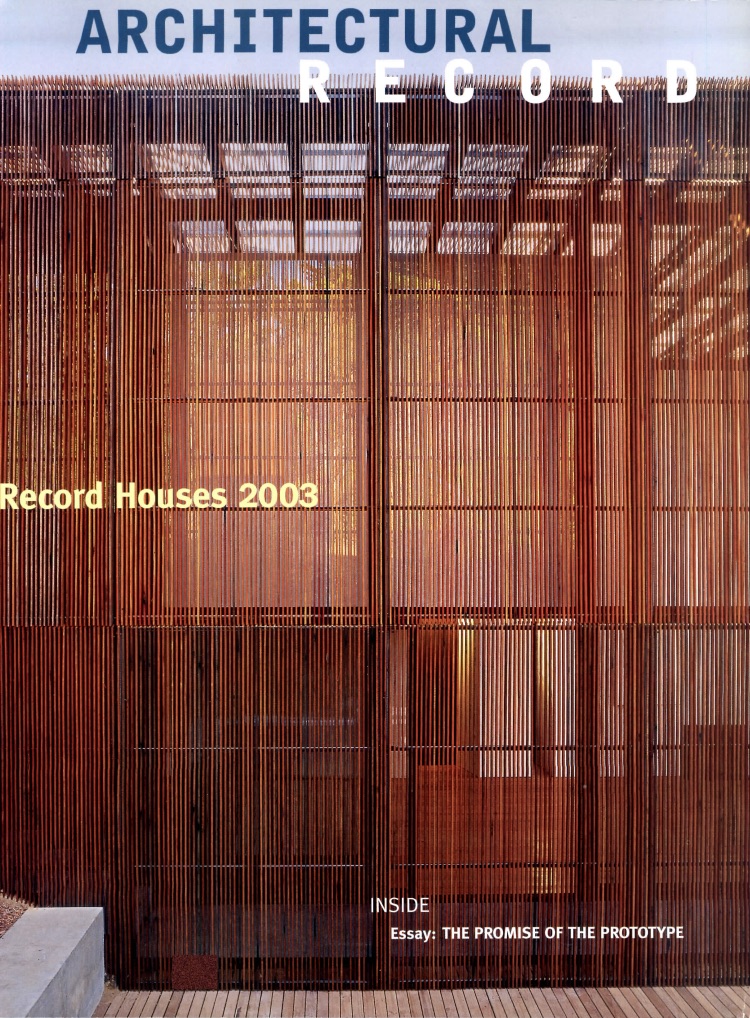
© Architectural Record, April 2003
“Thomas Phifer creates a dematerialized pavilion on a plinth of his Taghkanic House in the serenity of New York’s Hudson Valley”
By Suzanne Stephens
Architectural Record, April 2003
From the main road, there is no hint that a house rises beyond the vista of trees, fields, and hills. As one approaches by the long, winding drive, the pavilion’s astringently delineated glass-and-steel-frame structure appears so evanescent that is looks like the abstracted lineaments of a Modern villa hovering like a ghost over the terrain. From this perspective, the weekend house seems to have only one room—albeit a sizable, 30-by-60-foot one with a 15-foot-high ceiling. But there’s much more to it. Gradually, a lower level comes into view, where glass-walled rooms jut out of the ramparts of the hill on which the pavilion sits.
This underground substructure, about four times the size of the pavilion, contains six bedrooms, a study, media room, kitchen and breakfast room, not to mention a wine cellar and a refrigerated cheese room. The owner, a very private person, wanted a place where he and his family could spend weekends and entertain friends amid the rolling hills and woods of the Hudson Valley, without ever having to lay eyes on another house. He also did not want his house to obtrude on the landscape. Not even the glass, wood, and steel guesthouse, a delicately diminutive complement to the main building, is easily visible.

© Architectural Record, April 2003. Photo by Scott Frances
In taking on the commission, Thomas Phifer, a New York architect, envisioned a dematerialized pavilion on a plinth. The rectilinear, tautly planar structure seems to perch lightly on the landscape in the manner of the early Modernist villas of Le Corbusier and Mies van der Rohe, or the late Modernist houses of Richard Meier. At the same time, Phifer’s embedding of the lower level of the house in a grassy knoll recalls Renaissance country villas atop strongly demarcated hillside terraces.
Phifer’s exploration of these particular themes makes a strong case for architecture reflecting biography. The architect, who started his own office in 1997, was a design partner in the firm of Richard Meier and Partners from 1986 to 1996. And in 1996, when Phifer went off to Rome as a fellow of the American Academy, the young Modernist was soon fascinated by the Renaissance approach to placing villas in the landscape.
© Architectural Record, April 2003. Photo by Scott Frances
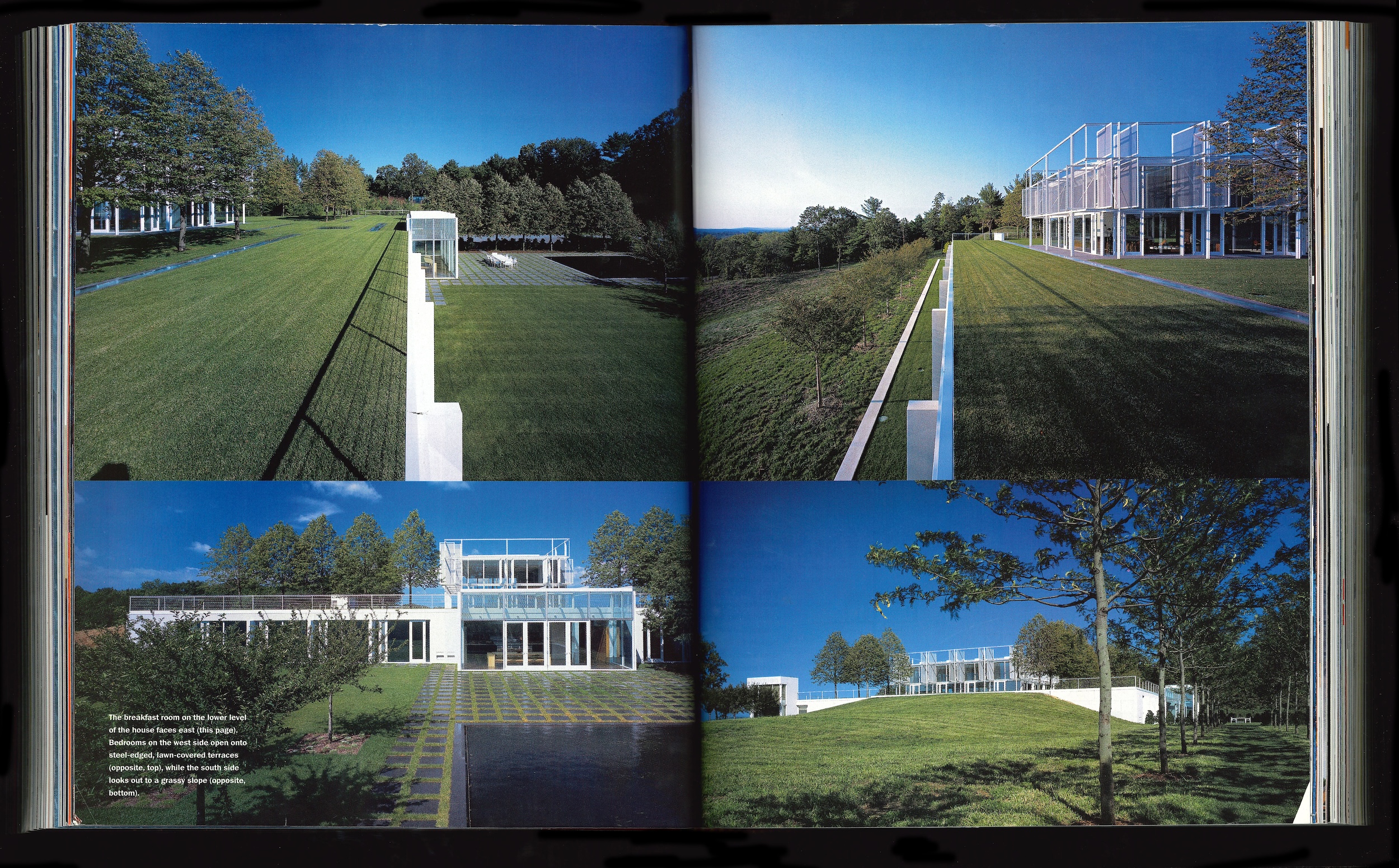
Working here with landscape designer Dan Kiley, Phifer carved out a bank of bedrooms, along the western side of the slope, with the kitchen, indoor pool, and service areas gouged out of the opposite side. Kiley knowingly reinforced the architectonic qualities of the house through the manicured lawn, rectilinear pavers, and clipped Linden trees on the podium, as well as the bosque of Sargent crab apple trees beside the geometrically defined terrace off the lower level’s breakfast room.
The most startling thing about the spacious subterranean domain is that one doesn’t have a sense of being below ground. Each leg of the H-shaped plan is edged with floor-to-ceiling glass window walls, opening up the interior to views and light. Long slots of skylights penetrate the grassy roof, bringing additional illumination indoors. The slots also demarcate the location of the east and west retaining walls of the concrete structure, “where architecture meets earth,” says Phifer.

© Architectural Record, April 2003. Photo by Scott Frances
Connecting one side of the house to another (the two legs of the H) is an underground transverse hall 75 feet long, a masterly volumetric exercise of planar surfaces, where the poured-in-place-concrete structure has been plastered and, in some places, sheathed in sand-colored anigré wood. Although this hall lacks skylights, it receives ample illumination from the window walls at either end and is pierced at midpoint by a stair with glass treads and risers leading to the light-filled pavilion above.
In the pavilion, the view dramatically expands in all directions. “You can detect the change of seasons just by the atmosphere of the light coming into the house,” Phifer points out. To reduce glare, he designed a series of aluminum-mesh screens that are manually operated on the pavilion’s east, south, and west faces, and fixed on the north elevation. As further protection from the sun, Phifer mounted an upper register of screens directly above the first level along the south. When the shades are closed, the pavilion reads as a serenely articulated box, with a concatenation recalling the linear rhythms of an Italian palazzo. When the screens are rotated, they establish a peculiar dynamism—like square sails on a landlocked ship. “The light is cut 70 percent when the shades are shut,” Phifer claims. “And since the windows and skylights in the ceiling of the pavilion are operable, the room gets a lot of natural ventilation during hot days.”
Looking for quick answers on architecture and design topics?
Try Ask RECORD, our new smart AI search tool.
Ask RECORD →

© Architectural Record, April 2003. Photo by Scott Frances
In order not to obstruct the views, the interior designer, Muriel Brandolini, arranged low-slung geometric seating around the living room’s fireplace. Browns, reds, and oranges dominate in both living and dining areas, with a few pieces, such as sculptural rocking chairs designed by Ron Arad, added for pizzaz. “The space was beautiful, but felt cold,” says Brandolini. “I wanted to make it warm and livable—not austere.”
With its earth tones inside and carefully tilled landscape outside, the house represents a thoughtful effort to integrate the themes of nature and culture, while keeping the two distinct. At the same time, the house authoritatively melds two architectural vocabularies, where Classical principles of proportion, scale, and rhythm carefully control Modern materials such as concrete, lightweight steel, and glass.
Looking for a reprint of this article?
From high-res PDFs to custom plaques, order your copy today!