‘E.1027’ Documents—and Dramatizes—Eileen Gray’s Battle with Le Corbusier for Control of Her Modernist Masterpiece
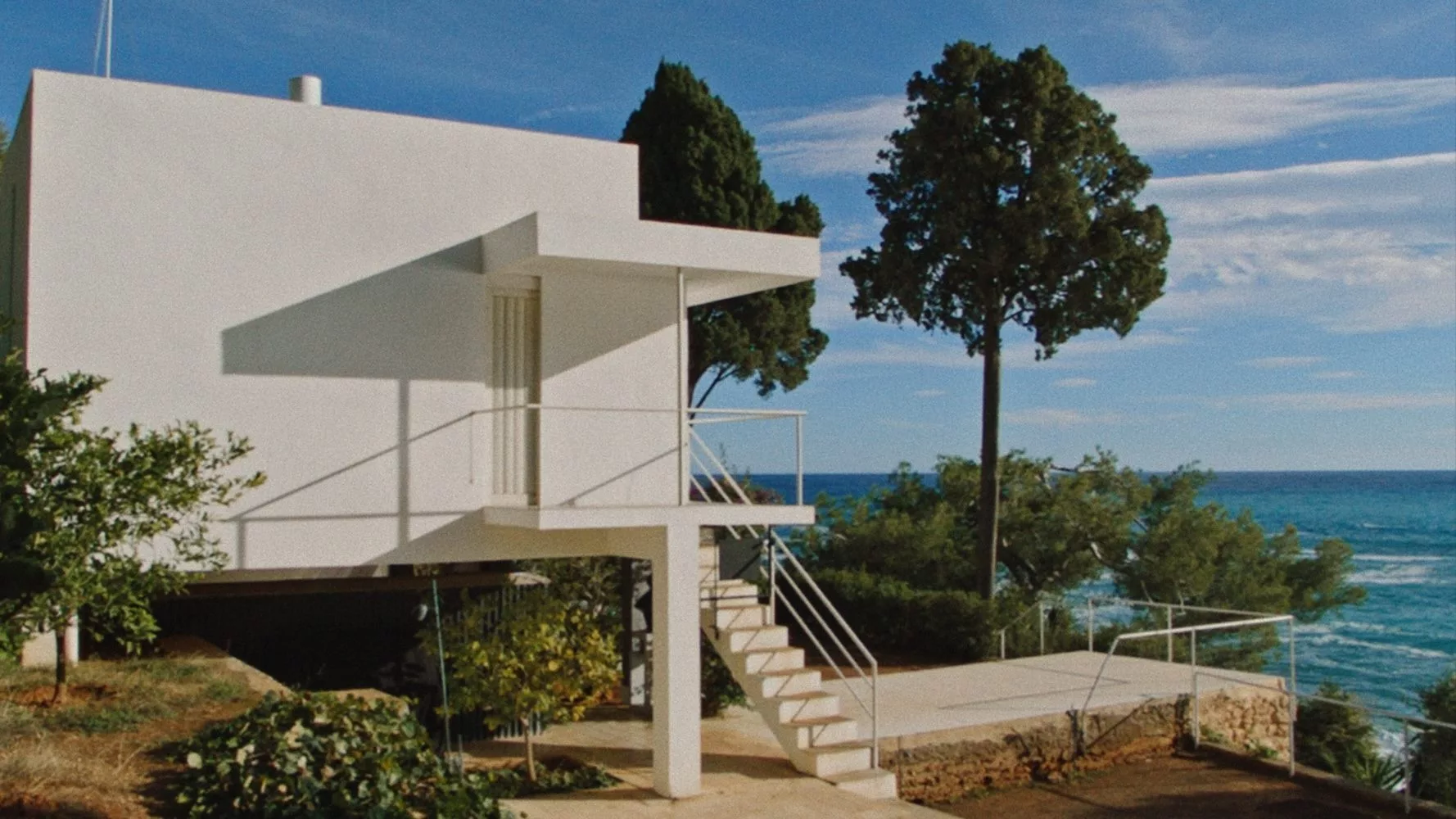
To call E.1027: Eileen Gray and the House by the Sea a documentary—as some have—is to do it (and documentaries) a disservice. The film is something else, something stranger, more impressionistic. The general contours of a reenactment-heavy docu-drama are there in director Beatrice Minger’s exploration of Gray’s life as an avant-garde designer who in 1929 built, with Romanian architect and writer Jean Badovici, E-1027, a Modernist villa on the shores of Cape Martin, France. But it’s not the plodding experience you’d get from, say, PBS. Rather, it’s an art film mash-up of documentary, narrative fiction, home movie, and black-box theater. It’s a nervy approach to subjects ripe for the staid archi-doc treatment of clinical examination: Gray, the house, Modernism. Approaching them the way Minger and her collaborators have, though, feels honest and creates an uncommon encounter with architectural history.

Image courtesy Rise and Shine World Sales
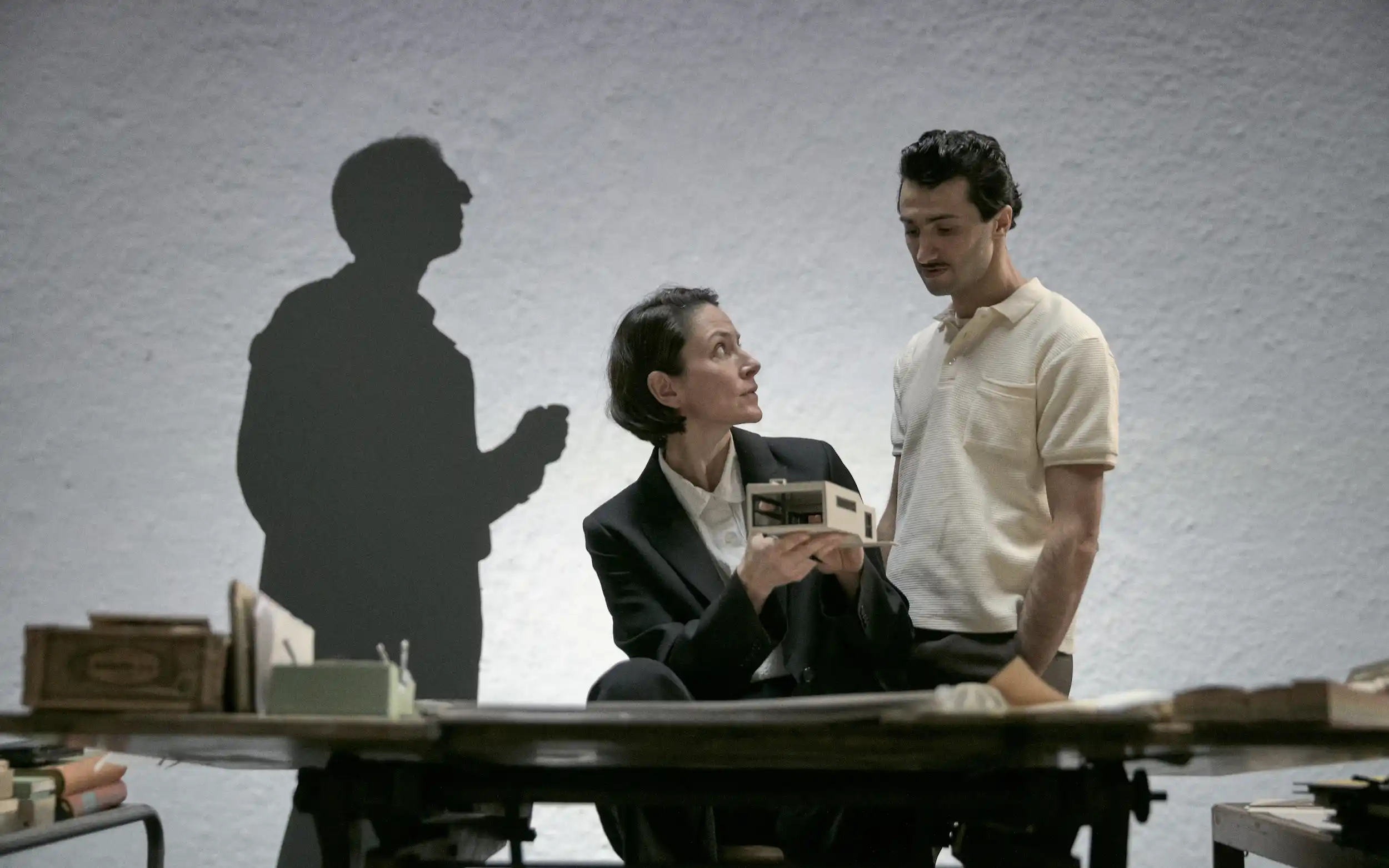
On its title alone, you’d expect at least a biography of the villa that Ireland-born Gray created almost a century ago. But E.1027, which opens in New York on May 16 and Los Angeles May 23, is more interested in probing the impact the house had on three principal figures: Gray, Badovici, and Le Corbusier, who became enamored—some would say obsessed—with the house. The first 20 minutes or so center on Gray (Natalie Radmall-Quirke) encountering screens hanging on a dark set with historical footage projected on them as she narrates her life, including as a successful interior designer in Paris, up to meeting Badovici. There are some sets, but they’re more hinted at through the barest implementation of furniture and props. The commitment to such Brechtian staging is total; when Gray and Badovici (Axel Moustache) get in a car to find a site for the house, Badovici pulls up two chairs, the actors pantomime opening doors, and Gray holds a disconnected steering wheel to simulate driving.
This staging continues through the conceptualization, designing, and building of E-1027—a name Gray coined in tribute to its creators: E for Eileen; 10 for J, as in Jean; 2 for B (Badovici), and 7 for G (Gray)—at which point the film shifts to being on location. We see Gray and Badovici, and soon enough Le Corbusier (Charles Morillon), engaging with, living in, and otherwise occupying the house. It’s a kind of time travel: there are no tourists (though we do see them later), and the place looks much like it would have in 1929 (thanks to extensive restoration work that began about a decade ago and completed in 2021). The footage is both high-gloss digital, for when we’re meant to be in the narrative, and grainer and washed out, like old 8mm home movies, when things become more interior and driven by emotionality. It’s a risky choice for Minger; this could easily feel like a gimmick, especially when the film adds back into the mix that stage-bound setting. But the three together are a potent combination, making us question not only the nature of this kind of film—what are we missing when everything is filtered through decades of academic remove?—and the motivations of the three characters.
Over and over, Gray tells us how much the house meant to her—that it was a place where she could focus and work. But this soon turns to lamenting the loss of that idyll and her need to leave when Badovici, as publisher of an architecture journal, writes about E-1027 and begins entertaining his cosmopolitan friends. For his part, Badovici kind of floats through the story, caught between a kind of lush-life imperative and conflicting loyalties to Gray and his friend Le Corbusier. The latter stalks through the story as a kind of opportunistic shark. When we first meet him, he and Gray are engaged in a debate about what a house is. She says it’s a body meant to embrace its inhabitants; Le Corbusier says it’s a machine for living. The chasm between the two—humanist, utilitarian—couldn’t be clearer. But then Le Corbusier visits the villa. And visits again. And again. And builds a rough-hewn cabin nearby. And lurks around Badovici, ultimately convincing him that what the white-walled structure is missing is some color. This leads to a montage of sinewy arms, a sweaty back, and flexing thighs—culminating in a seen-from-behind full-body nude shot—as Le Corbusier paints his famous frescoes in the house.
Film still courtesy Rise and Shine World Sales
Honestly, I never imagined I’d see a film where a naked Le Corbusier looks over his shoulder and through those owly glasses as his dares us to judge his painting—to judge him. It’s unquestionably a showstopping moment, one that is a bit distracting. Yet it fits with the narrative Minger is weaving. This refuge, conceived and built by a woman with relatively little power in the world and even less in architecture had her masterpiece hijacked by the quintessential lone genius: spiritually, psychologically, even physically. (We learn in the film that over the years, Le Corbusier was so linked to the house that many thought he designed it.)
The film goes a bit slack from here, with a bunch of black-box scenes of arguments over the frescoes, who has rightful claim to the house, and so on. There is also a kind of notebook-dump narration from Gray about her life and the house after Badovici’s death, then her own. (She died in 1978, aged 98.) In this, E.1027 feels a bit more traditionally documentary-like. But then, over the closing credits, we see the three actors dancing slowly in a spotlit area of the stage, as if they’re in a David Lynch movie. It’s a fitting coda, a final expect-the-unexpected moment from a film as individual and uncompromising as Eileen Gray herself.
Looking for quick answers on architecture and design topics?
Try Ask RECORD, our new smart AI search tool.
Ask RECORD →
Looking for a reprint of this article?
From high-res PDFs to custom plaques, order your copy today!