Practice Matters
Thought Partner: AI and Design
Jonah Hawk grew up surrounded by architects but never became one himself. Instead, his interest in technology steered him, in the early 1990s, to learn computer-aided drafting (CAD), which eventually led to rendering and 3D visualizations and animations at various firms, and about 20 years ago he was hired by ZGF Architects. In late 2007, Grasshopper3D, an algorithmic modeling tool for Rhino, was introduced, and Hawk dove in. “I made a point to open Grasshopper every single day without fail, got good at it, and eventually dropped all the visualization work altogether,” he says. “I was always more fascinated with the technical side of the software than the aesthetic side of it.”
It was good preparation for the arrival of artificial intelligence (AI), machine learning (ML), and large language models (LLMs). Hawk, who is now associate principal and design technology manager at ZGF, went deep into the technology, testing and pushing dozens of generative-AI tools, such as ChatGPT and Midjourney, which produce outputs like text and images based on inferences and patterns in large data sets. He quickly discovered the potential of these apps’ APIs (or application program interfaces), the set of rules that allows developers to build new software on top of other programs. After more experimentation, Hawk created, and in 2023 ZGF launched, ZGF.ai, which gives the firm an internal AI toolkit that does the job of numerous commercially available products. It includes ChatZGF, which generates notes from meeting transcripts, assists with coding, and checks grammar and style; a text-to-image generator that mimics DALL-E; and AI-aided rendering analysis. This was soon followed by Ziggy, an AI chatbot built on pyRevit that lets users check building-code documents and run diagnostics on BIM models, among other functions. Hawk admits the tools are a little clunky and unpolished, but they are now used by nearly 200 of ZGF’s 700 employees.
Hawk’s experience is just one example of how AI is being integrated into the practice of architecture. Artificial intelligence has existed in our everyday digital experience for years: think autocorrect in Microsoft Word or voice-based personal assistants like Apple’s Siri. And since the public release of ChatGPT in late 2022, AI has appeared in a growing number of existing tools, including those in the AEC industry. Its impact has also been felt in nearly every aspect of the profession, from architect-client relationships to how ideas are conceptualized and modeled. The largest AI apps are publicly available, which means anyone who wants something built can come to a meeting with an AI-generated image as a starting point. This reality has also led to a deluge of superficial illustrations that would make a parametricist blush. While social media are awash with such images, the architectural tomorrow many of them hope to inspire—one where a machine disrupts the architect out of a job—seems a distant fantasy.
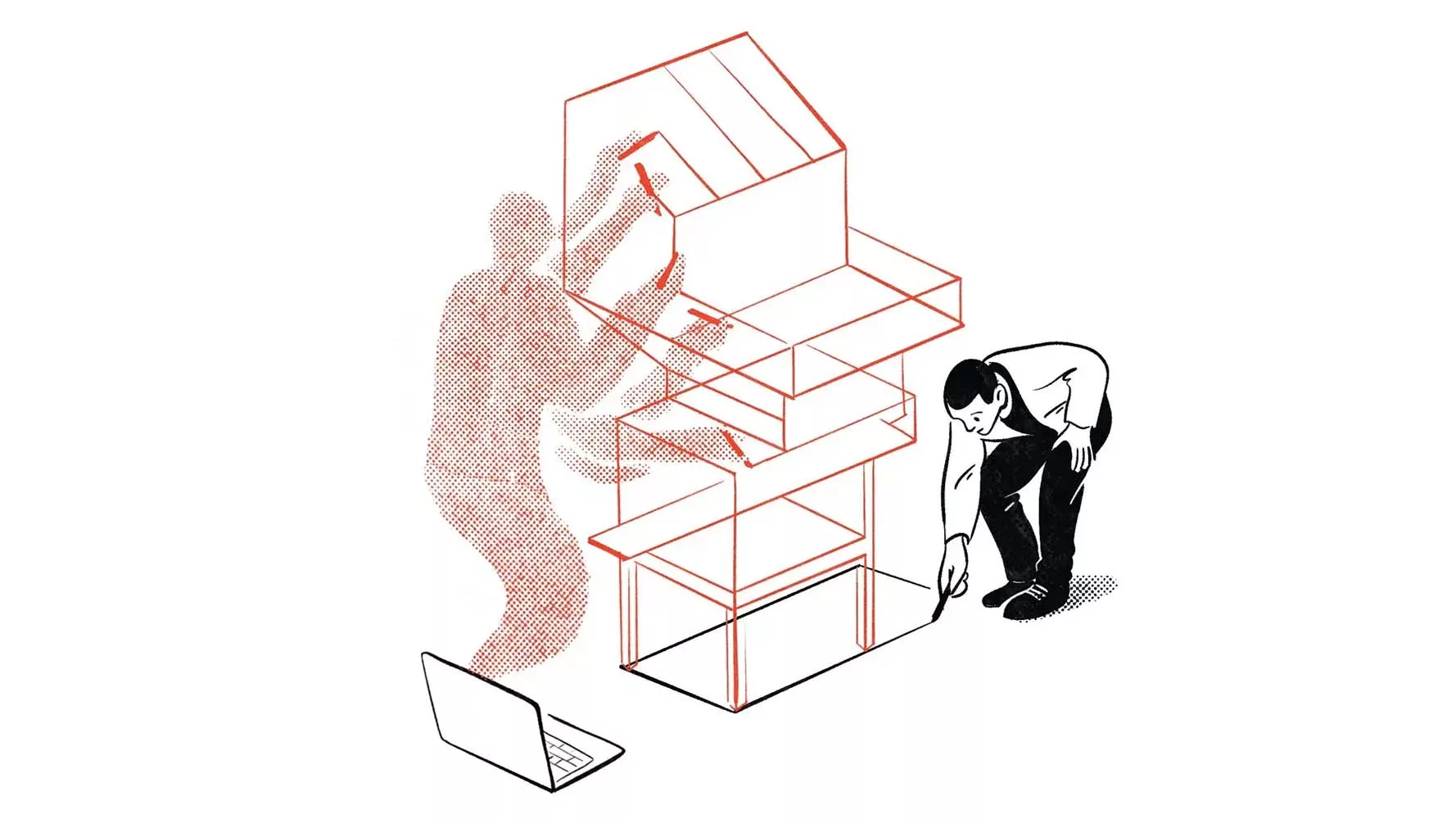
The profession has been slow to embrace AI. An AIA survey released in March 2025 found that, while 53 percent of architects have experimented, only 6 percent regularly use AI. Where it has been adopted, the process has been deliberate and tactical, with tools introduced to complete hyperspecific tasks rather than totally upend the work. This is evident in new AI-based products like Gensler’s gBlox.CO2, a platform that draws on troves of data to add carbon and emissions analysis for massing models, and computational fluid-dynamics simulators from Autodesk Forma, which use ML and neural networks to process a building’s floor area, height, structural system, and primary use to render predictive wind and acoustic analysis. These applications point to a more practical future of augmentation—what Ellis Herman, principal product manager at Autodesk, calls “AI on the shoulder.”
“I think there’s huge potential to make complicated things more accessible to more people,” says Herman, who is trained in physics, math, and mechanical engineering but not architecture. “You can actually include these outcomes in every project you do, because you’re able to use these tools without needing so much technical training.”
But architects still need to understand how the technology works. The consensus view is that waiting for AI to blow over is not an option. “It’s not going away,” says Brian M. Kelly, an architect and associate professor at the University of Nebraska. “We have to be engaged in the process to help make it what we think it collectively should be.” This means knowing AI’s potential and limitations. It can help create organizational efficiencies and leverage proprietary data to optimize and improve an LLM’s accuracy and quality. It’s also trained with biased and junk inputs and prone to errors and hallucinations, meaning no one—least of all those creating buildings—can simply off-load responsibility to the machine. The only way anyone can know the technology’s potential is by actually using it. “I think the challenge is finding the time and the resources to understand what AI means for the profession, to truly begin implementing it in our practices, and to leverage it in a way where we are seen as leaders in this space,” says AIA president Evelyn Lee.
Technologists like Hawk and Ellis say the best way to do that is by playing every day with applications like ChatGPT or Midjourney. Architects should learn how the tools work, push them to their limits, and try creating some of their own using LLMs’ coding capabilities. This will not only affect their work—Kelly says AI has “made my ideation more divergent” and “challenged me to look at things in ways I wouldn’t have expected”—but also improve their interactions with clients. As Lee notes, if architects recognize how someone generated a building design with, say, DALL-E, they can more easily explain the image’s shortcomings—and what the human can offer.
Looking for quick answers on architecture and design topics?
Try Ask RECORD, our new smart AI search tool.
Ask RECORD →
“I see AI as a really great opportunity to switch up our business model and repackage our services in a way that actually gets us paid for the value we believe we are delivering to clients,” Lee says. “It gets us to focus on the things that we are more passionate about, including client engagement—rather than having our heads down in construction documents and specifications—while expediting our ability to deliver smarter, more intelligent, sustainable, resilient buildings.”
Naturally, there’s existential angst looming over every conversation about AI: will it take my job? Some professions are certainly in danger. Architects, though, might be safe—for now. LLMs and other models lack the lived, real-world experience and intuition of someone who has designed buildings for decades, or studied with someone who has. But AI is nonetheless a powerful tool for augmentation.
“You won’t be replaced by AI, but you will be replaced by the architect that’s leveraging AI to its fullest extent,” says Lee. “Jobs may go away, but we never consider—and I don’t think we can honestly conceive—all the jobs that this could create. So the question becomes: how do we reskill ourselves toward those new opportunities?”
Best not to ask ChatGPT.
For a deeper dive into artificial intelligence and its impact on architecture, watch the Architectural Record webinar Artificial Intelligence, Machine Learning, and the Future of the Firm: A Conversation for Emerging Professionals, which features ZGF’s Jonah Hawk and Autodesk’s Ellis Herman.
Looking for a reprint of this article?
From high-res PDFs to custom plaques, order your copy today!