A Pair of Helical Staircases Swirl Above MAD Architects’ Fenix Museum of Migration in Rotterdam
Rotterdam

Architects & Firms
An otherworldly sculptural assemblage of serpentine steel now glistens on the banks of the River Maas, fronting Rotterdam’s City Harbor. It is called the Tornado, a pair of swooping, helical staircases that ascend to form a lookout above the Fenix Museum of Migration, which opened in May.
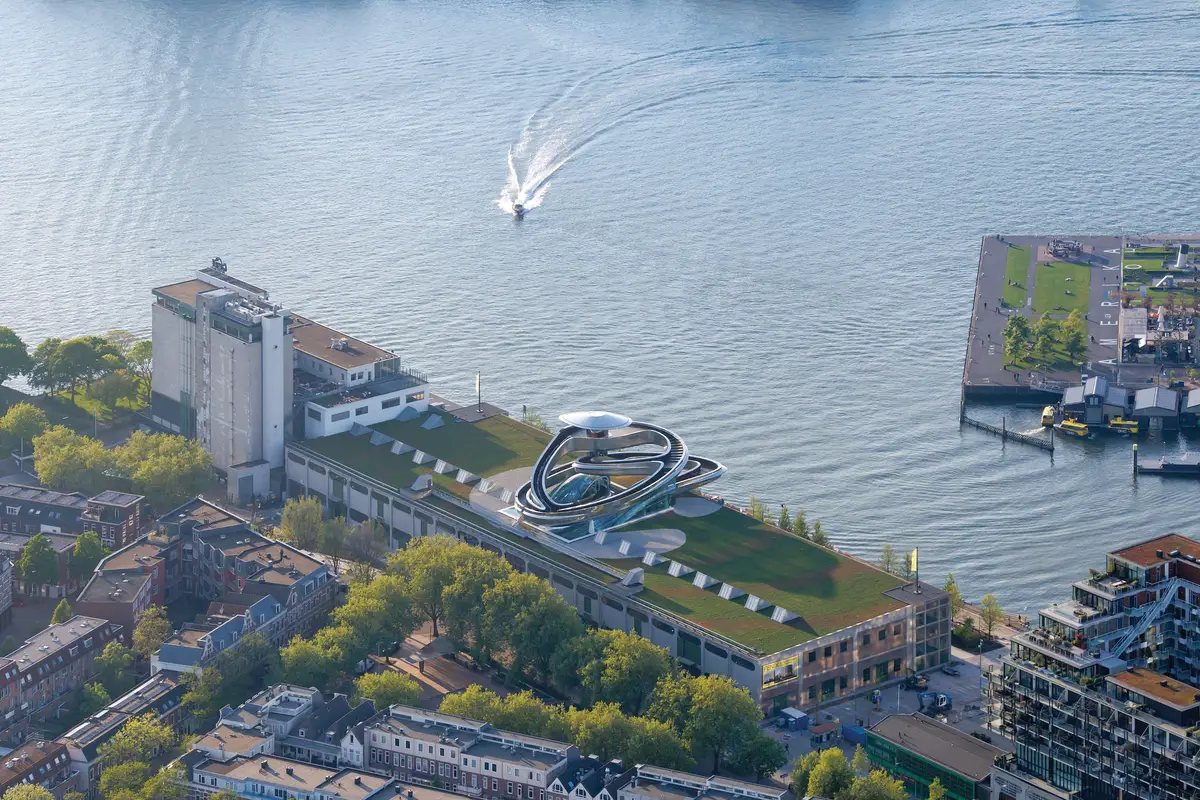
The museum stands next to the River Maas. Photo © Iwan Baan, click to enlarge.
The Tornado is just one part of the 172,000-square-foot building, a low-slung reinforced-concrete warehouse of two stories (topped by the swirling stairs) that was meticulously restored after decades of neglect. It is Beijing-based MAD Architects’ first completed cultural project in Europe, designed in collaboration with local conservation architect Bureau Polderman.
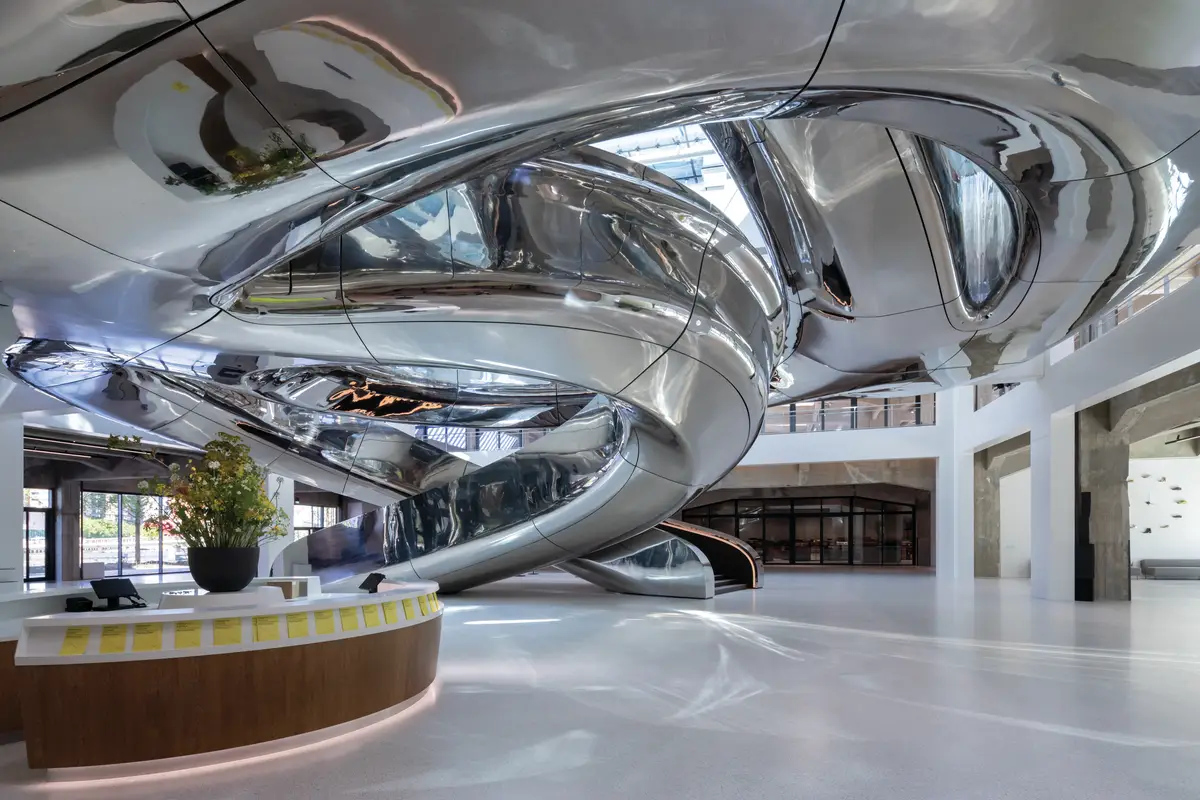
Vertical circulation flows through the Tornado. Photo © Iwan Baan
The museum is funded by the Droom en Daad (Dream and Do) Foundation, an organization established in 2016 to advance the arts and culture in the working-class city. “The real essence is not just about migration, but movement,” says Droom en Daad managing director Wim Pijbes. “People moving from one place to another, to find hope and a better future somewhere else. The museum is very much rooted in Rotterdam, which, as a port city, is always in flux.”
One would be hard pressed to find a location more suitable for a center dedicated to human migration than Rotterdam, where residents hailing from 170 countries make up approximately 45 percent of the city’s population, or than in the postindustrial Katendracht peninsula, on which the museum resides. The structure, originally known as the San Francisco Warehouse, was built in 1922 as the transshipment hub of the Holland-America Line. It was, at nearly 1,200 feet long, one of the largest warehouses in the world at the time of its construction. The surrounding neighborhood, predominated by the Holland-America Line’s campus, was also the embarkation point for millions of European emigrants bound for the United States, many to Ellis Island, and became a multicultural hub of its own, eventually evolving into mainland Europe’s first Chinatown.
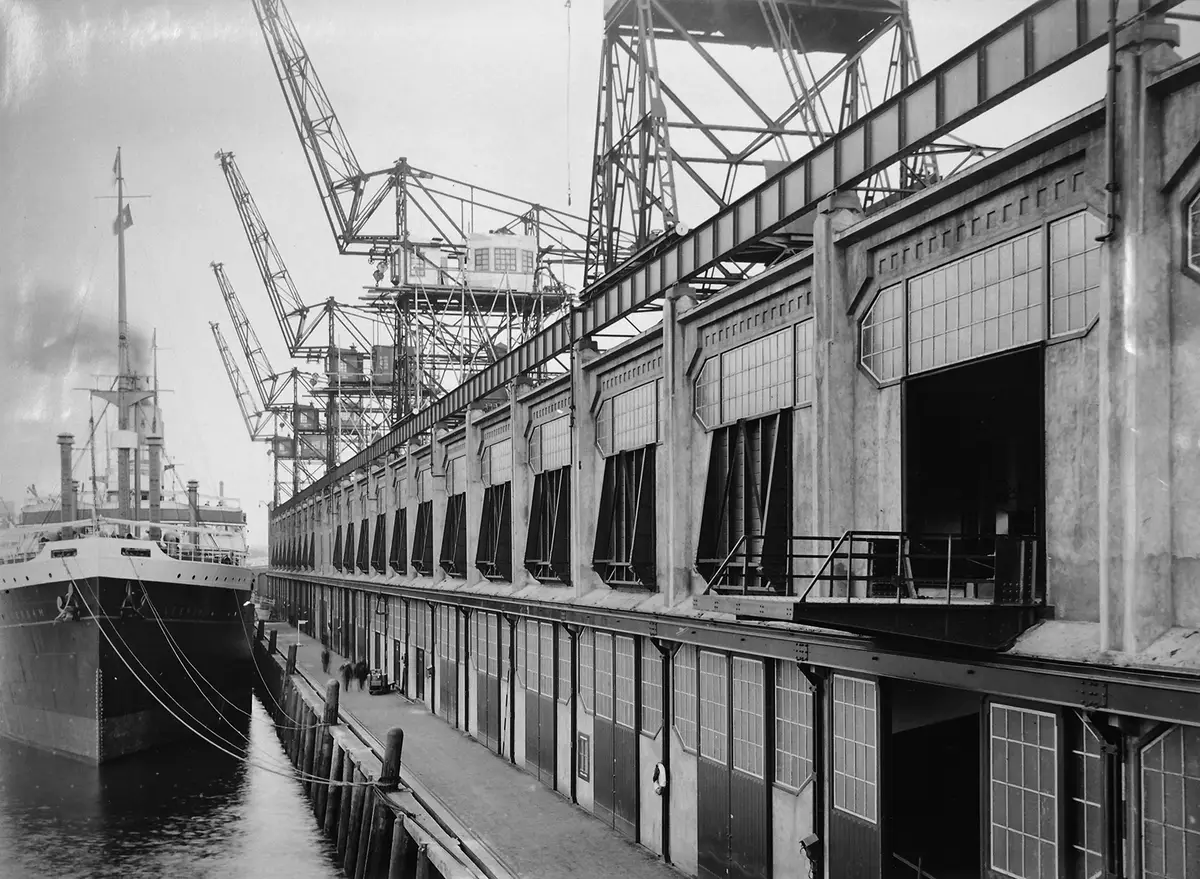
The San Francisco Warehouse was once one of the largest in the world. Photo © Rotterdam City Archives
Rotterdam was not spared the ravages of the Second World War. Nazi Germany leveled the city center during its invasion of the Netherlands in 1940, and, on the way out, in 1944, detonated the San Francisco Warehouse quay, among other pieces of key infrastructure, to ruinous effect. A calamitous fire within the premises followed, several years later. In the 1950s, municipal authorities decided to rebuild the structure as two separate buildings, Fenix Warehouse I and Fenix Warehouse II. The city center, unlike many others across the continent, was reconstructed with contemporary architecture rather than historicist facsimiles, and, in the succeeding eight decades, emerged as a global capital for design.
Droom en Daad purchased Fenix Warehouse II in 2018, and its challenge, alongside that of the design team’s, was to accurately represent the peripatetic nature of the diasporic world while balancing the programmatic demands of a community-minded museum. The evocation of human migration in built form is achieved through two distinct and complementary measures: the conservation and repair of the historic warehouse and the insertion of the helical staircases.
“We wanted a contrast between the old and the new. The staircase is completely different from the original building. It is light, dynamic, curvy, and shiny, both in material and in form,” says MAD founder and principal partner Ma Yansong. “The old warehouse is a heavy concrete structure. But through this disparity we created a new composition and a new feeling that this composition became the image of the museum. It feels more complete.”
Looking for quick answers on architecture and design topics?
Try Ask RECORD, our new smart AI search tool.
Ask RECORD →
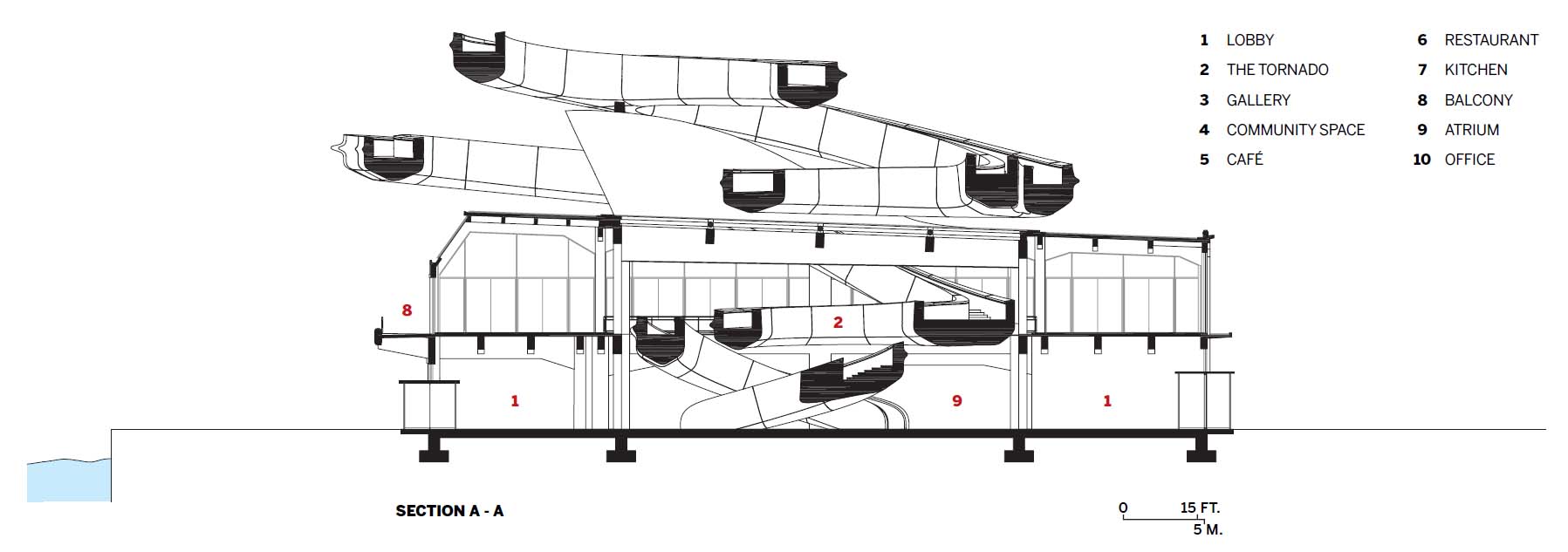
Large glazed entrances, placed at the center of the north and south elevations, lead to an expansive atrium with the Tornado at its center. The space is amply illuminated by a large skylight inserted at the interface of the roof and the staircases. Detailing and furnishings are minimal throughout much of the museum and its galleries, to highlight the transfixingly repeated pattern of board-formed concrete structural elements—its exposed columns, beams and walls—and allowing the museum’s collection to shine.
The ground floor includes a café and museum shop and two smaller temporary-exhibition galleries. One displays The Family of Migrants—a collection of approximately 200 photographs by 136 photographers documenting migration over the last century—the other, Suitcase Labyrinth, housing a maze comprising thousands of worn valises donated by families across the world.
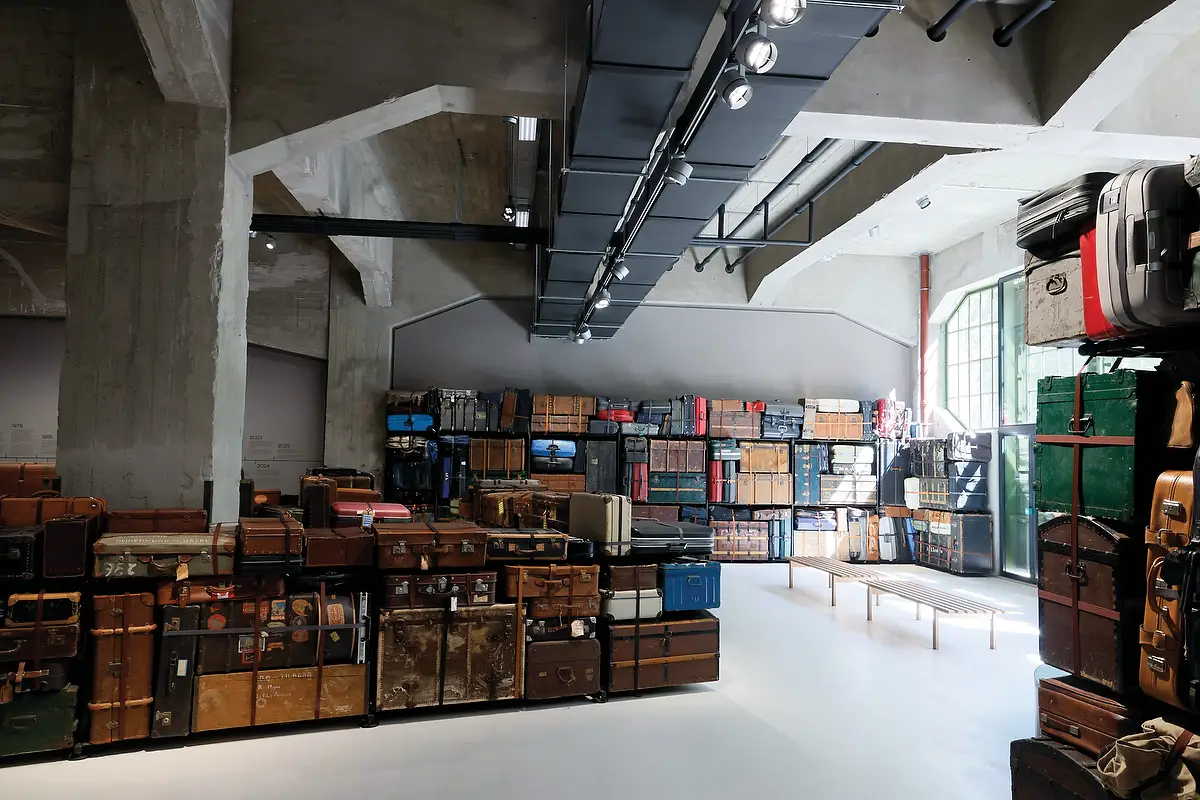
1
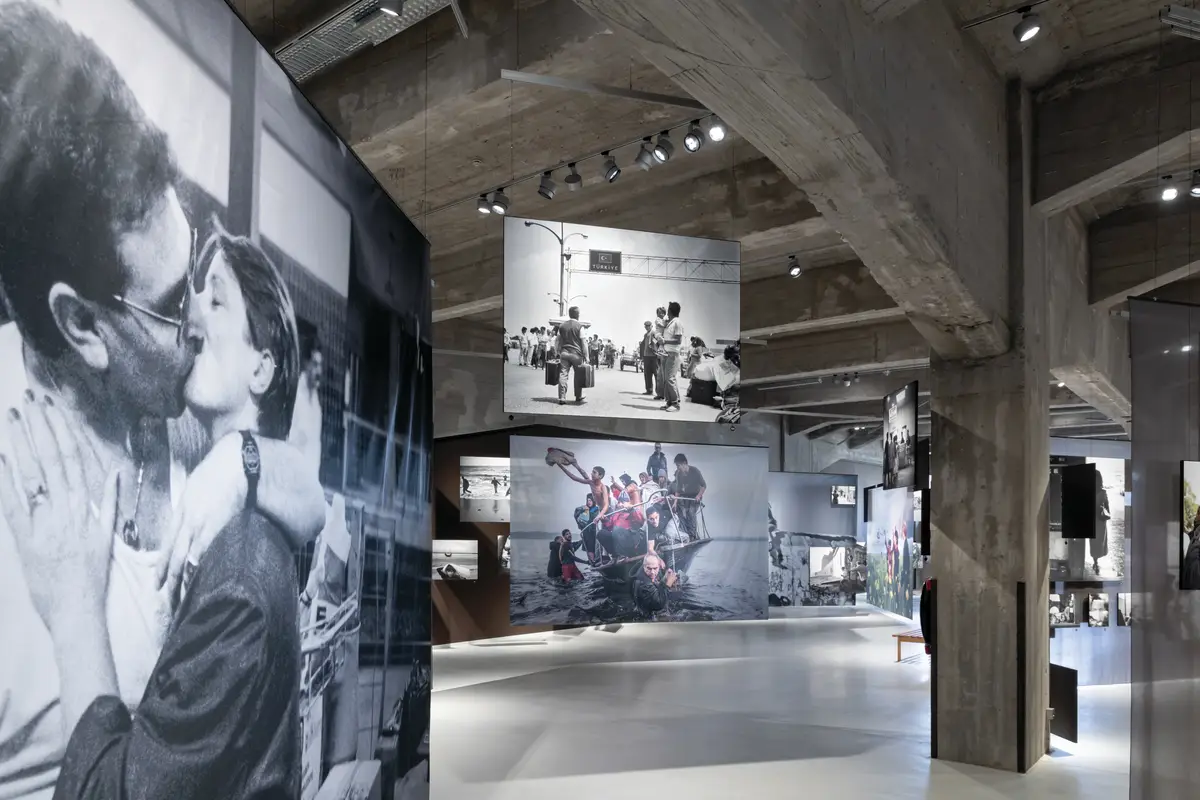
2
Two exhibition spaces are located on either side of the ground floor (1 & 2). Photos © Iwan Baan
The eastern zone of the ground floor is apportioned for a 24,500-square-foot community hub titled Plein (Square). This hall is open to the public throughout the day and hosts a wide variety of events organized by the museum and by locals: film screenings, theater, and workshops. “Plein functions as an indoor-outdoor public square, for people in Rotterdam to take ownership of their stories and to meet each other through formal and informal means,” says Fenix Museum director Anne Kremers. An area housing a restaurant and space yet to be programmed will open on the ground floor later at some point in the near future.
The primary, roughly 55,000-square-foot gallery is located on the second floor, split in two and accessed via a Tornado landing. There, visitors encounter All Directions, a rotating exhibition featuring some 150 artworks from the institution’s permanent collection.
When Droom en Daad acquired the warehouse, the building was structurally sound, if in need of some repair. “The successive alterations to the building over the previous 70 years had created a great deal of confusion, which required architectural clarification,” explains Bureau Polderman restoration architect Philip Mannaerts. Additionally, reinforced concrete throughout the structure was spalling, and other elements, such as the multipaned steel casement windows, were rusted.
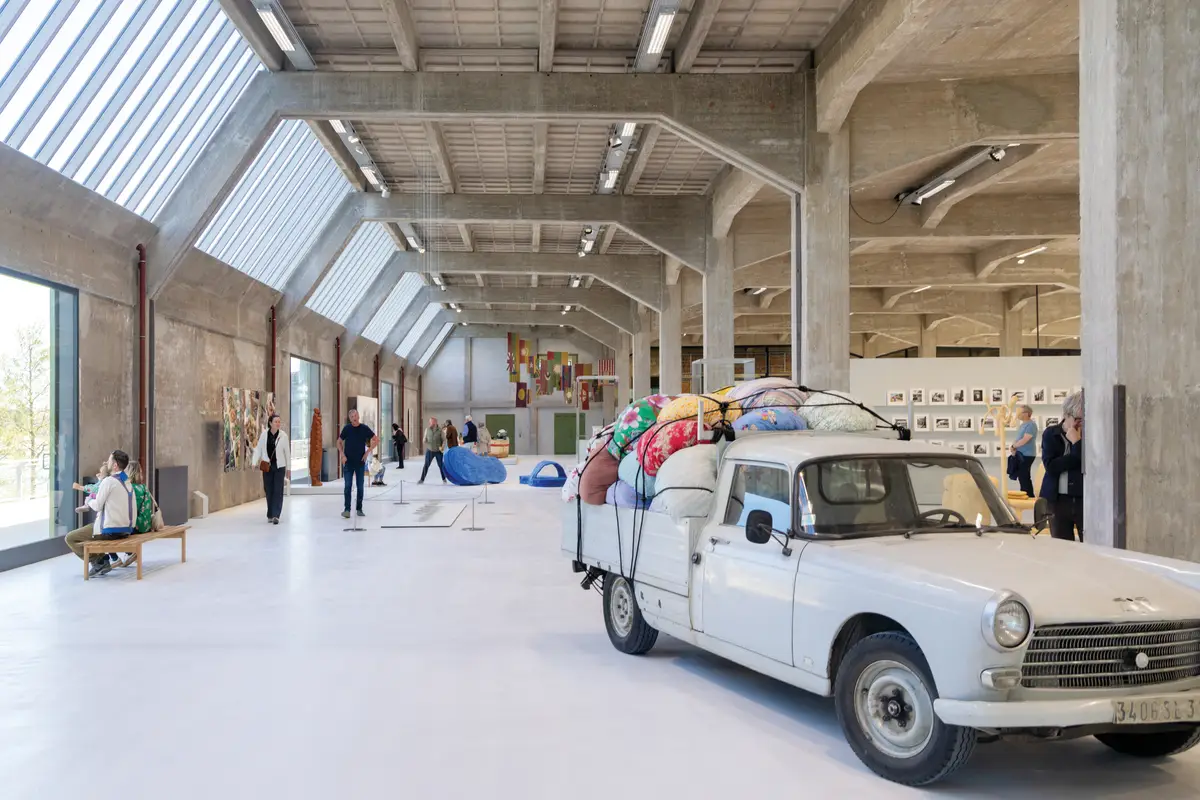
Reinforced concrete is exposed throughout the structure. Photo © Arch-Exist
The design team remedied these issues by stripping the entire south facade of its granite, cement, and crystalline waterproofing admixture before restoring the concrete and replacing the former coating with a more breathable stucco finish. The other three elevations were methodically blast-cleaned and spot repaired where necessary, and the interior was stripped of its many paint layers and similarly touched up. The casement windows were removed, restored, fitted with insulated glass, and painted in their original forest green finish.
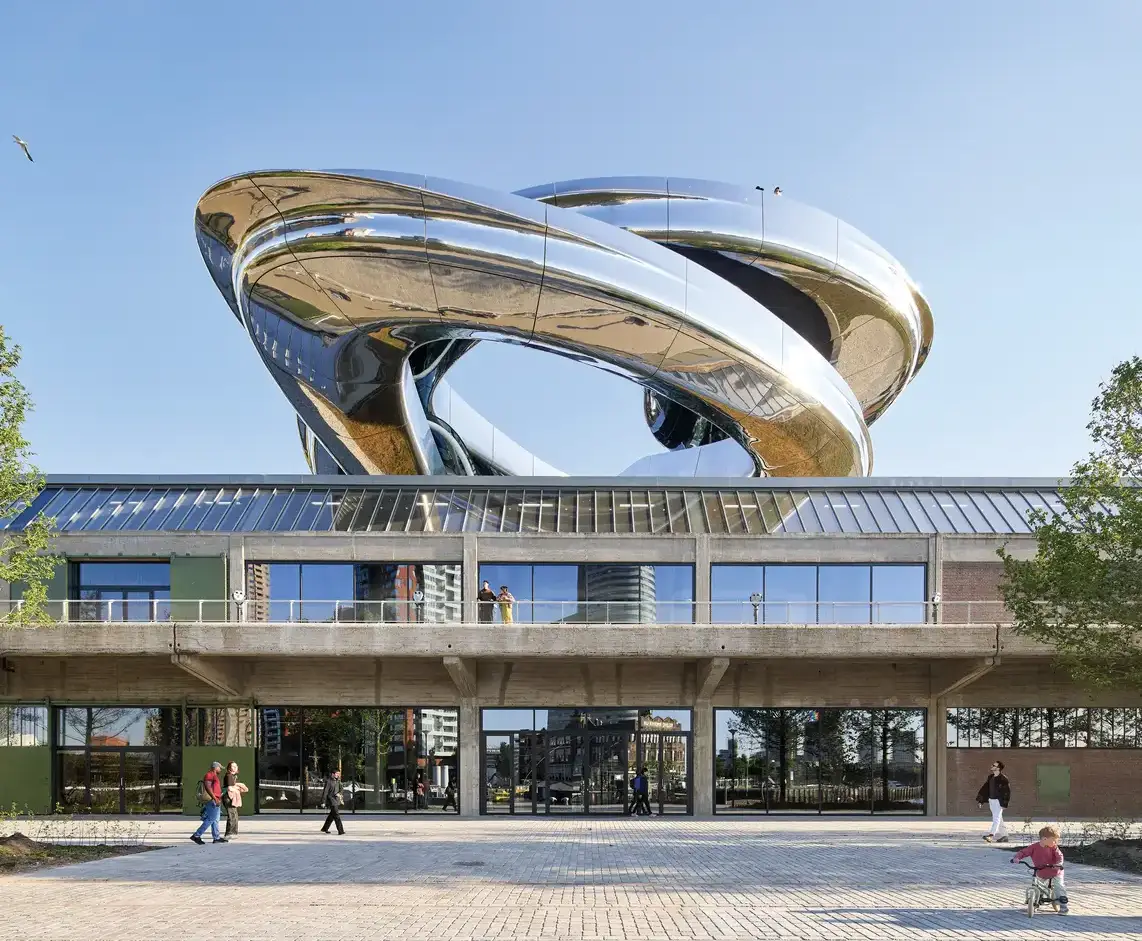
A centerpiece like the Tornado could easily fail to dazzle were it built with shoddy detailing (it helped that the fabricator specializes in roller-coaster construction). But, to the design team’s credit, the piece lands smoothly—working practically for vertical circulation and appearing, rather paradoxically, both monumental and weightless at the same time. This effect was achieved by resting the Tornado on a newly installed white-painted structural steel grid that matches the spacing of the warehouse’s original columns and beams. Structural steel tubes support the staircases, which are clad in nearly 300 unique stainless-steel panels, each of which was polished to create a dynamic reflective finish. Within the Tornado, its wainscot and stair treads are paneled with 12,500 planks of thermally modified wood. Both materials are durable, capable of withstanding the wear and tear of museumgoers, and, above the roofline, the Netherlands’ notoriously damp climate. The viewing platform is supported vertically and horizontally by a glass-enclosed steel elevator core that rises from the atrium’s southwest corner.
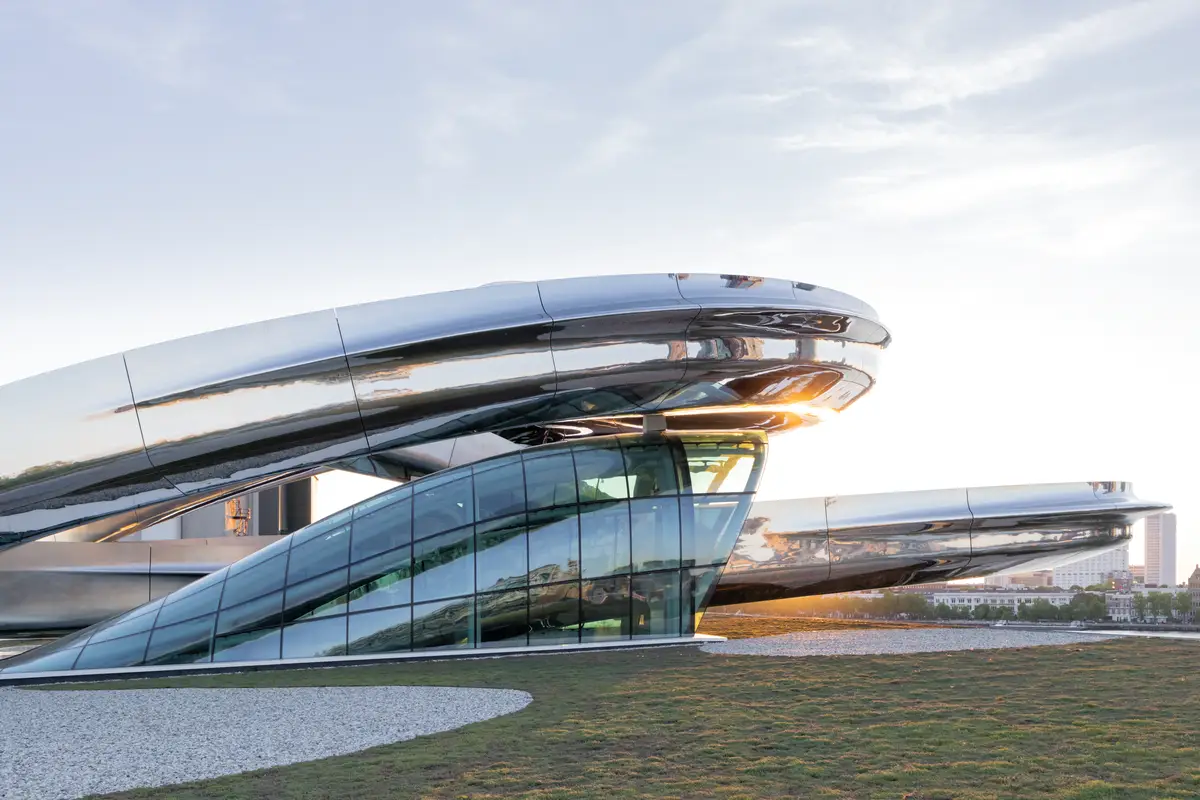
The building is topped by a green roof. Photo © Iwan Baan
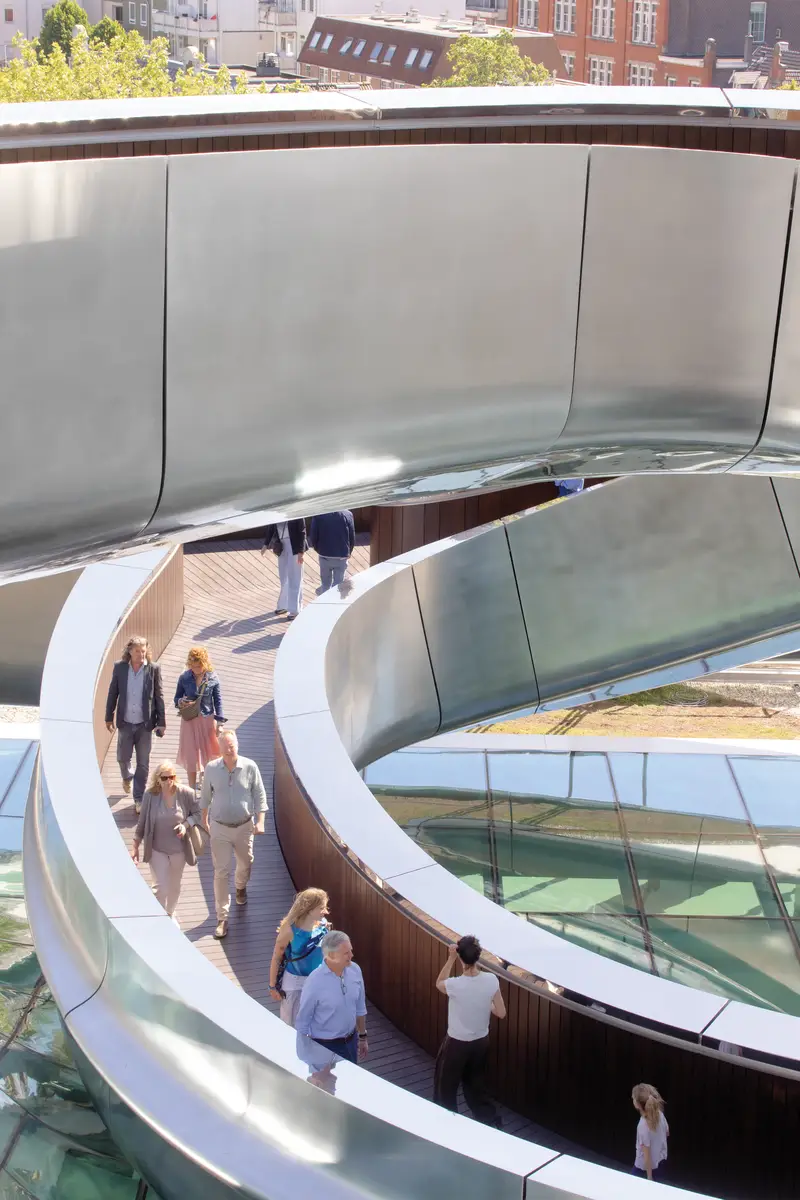
Besides its showstopping effect, the Tornado is also intended to serve as an allegory for the immigrant experience. Rather than a purely linear adventure in which one moves from point A to point B, the two staircases intersect at various platforms, inviting visitors to take different routes to and from its summit.
3
4
Visitors may choose different paths to the Tornado summit (3), which seemingly floats above the museum (4). Photos © Arch-Exist (3), Hufton+Crow (4)
On a sunny day in May, the result of these cumulative gestures was striking. The Tornado glimmered as I ascended, each twist and landing offering different vantage points on the city and chance encounters with strangers as they, too, made their own journeys. From the canopy, a panorama of Rotterdam lies before you: the city and its many towers stand stalwart. Facing northeast, the Port of Rotterdam, and its dockyards and cargo terminals, with their ubiquitous cranes, extend for miles across the horizon, giving life to, and depending on, this proud city of immigrants.
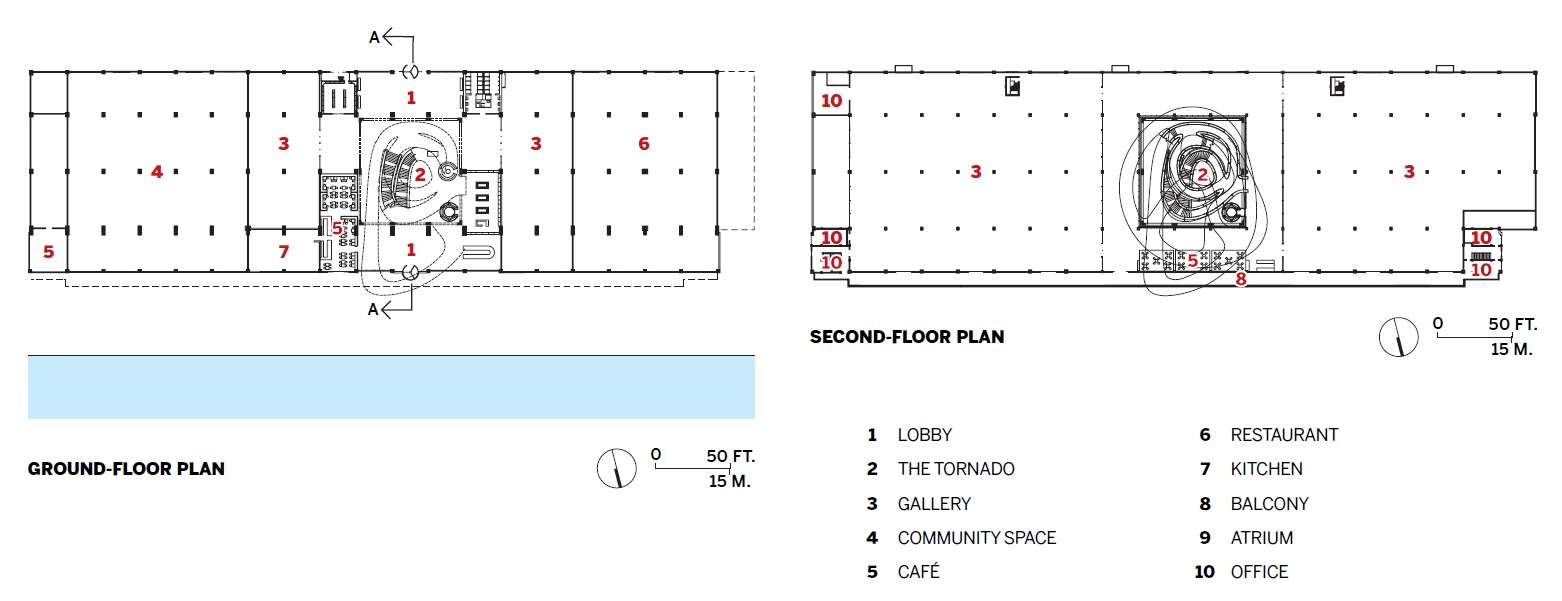
Click plans to enlarge
Click section to enlarge
Credits
Architects:
MAD Architects — Ma Yansong, Dang Qun, Yosuke Hayano, principal partners; Andrea D’Antrassi, associate partner in charge
Architect of Record:
EGM
Engineers:
IMd Raadgevende Ingenieurs (structural); DWA (m/e/p)
Consultants:
Bureau Polderman (renovation); Beersnielsen Lichtontwerpers (lighting); LBP Sight (building physics); Atelier Tomas Dirrix, Roland Buschmann (interiors)
Construction Management:
Erkel beheer, 4Building
Client:
Droom en Daad Foundation
Size:
172,000 square feet
Cost:
Withheld
Completion Date:
May 2025
Sources
Steel Structure:
CSM
Exterior Cladding:
CIG (steel); Woodwave; Van de Vegt (window restoration)
Glazing:
North Glass; IFS
Doors:
Bauporte
Interior Finishes:
Hoogendoorn (millwork); Duracryl Flooring Systems
Looking for a reprint of this article?
From high-res PDFs to custom plaques, order your copy today!