In Transit
Woods Bagot Carefully Considers Scale and Materiality When Designing Australian Commuter Stations
Australia

Architects & Firms
All across Australia, population growth and urban sprawl have caused an increasingly urgent need for cities to update strained public transportation systems. While many already have tram and train networks that provide access to their central business districts, existing routes are being extended and entirely new lines are cropping up to alleviate the demand on outdated infrastructure and to reach underserved areas.
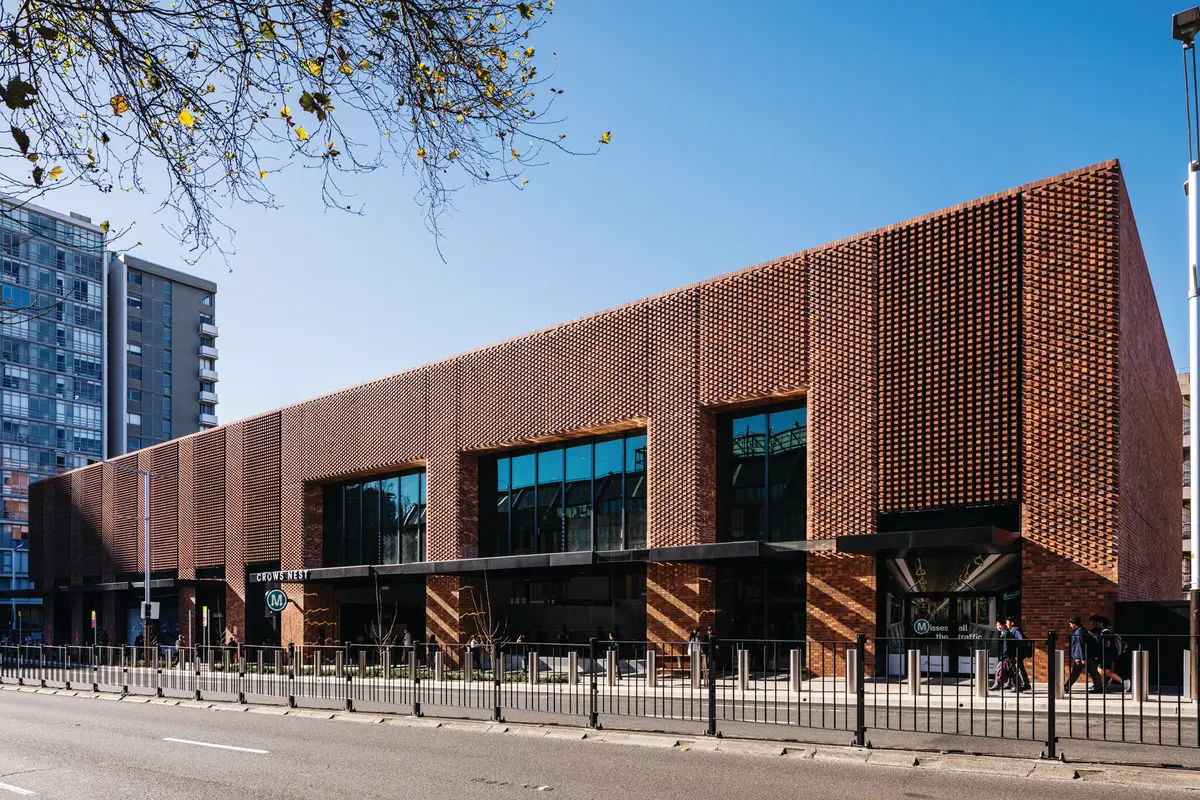
With a goal of adding 46 stations to the Sydney metropolitan area by 2030, the government-led Sydney Metro initiative has become the country’s largest public transit endeavor to date. Following a rigorous competition process, global architecture firm Woods Bagot, headquartered in the city, was selected to deliver several of them. Perhaps the most well-known is the site-specific addition to and renovation of the city’s Central Station, which honors the historic sandstone structure. But the firm has also been able to deliver similarly impressive work at a smaller scale—including one in a quiet suburban neighborhood located three miles north of Sydney’s Central Business District (CBD). Crows Nest Station, recently opened, embraces the area’s industrial history of brickmaking and takes inspiration from an unexpected discovery during excavation.
1
Crows Nest Station (1) is part of a mixed-use development under construction (2). Photos © Trevor Mein, click to enlarge.

2
Consisting of tightly packed small buildings along main roads and quiet, Federation-style houses, the neighborhood of Crows Nest is a flourishing suburb with a working-class history. When inserting a new station into an existing community, Woods Bagot principal Lucian Gormley asks, “How do you avoid making people feel alienated by the large scale required of infrastructure projects?” For his team, the answer came down to a careful approach to materiality and proportion.
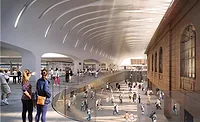
Although restricted to a palette of durable materials resistant to high levels of foot traffic, the team introduced an intentional modularity, breaking down design elements to a human scale. When arriving via train, passengers step onto a tiled platform patterned to echo the warp and weft of rugs—a kind of welcome mat to the neighborhood, Gormley explains. Perforated steel panels—in both weathering and warm gray varieties—line the walls and ceilings of this subterranean area, which leads up to a spacious, below-grade mezzanine that distributes pedestrian flow to two ground-level headhouses. In the mezzanine, concrete wall panels were faced with bricks; headers protrude progressively toward the ceiling, echoing the Flemish-bond facades of the surrounding suburb while also adding texture and shadow. The exterior, which is integrated into a larger mixed-use development that spans almost an entire block, utilizes the same panelized wall system, but, for the station, it has been modified to include a structural-steel upper level, creating a porous parapet that conceals mechanical intake and exhaust.
3
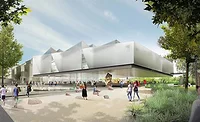
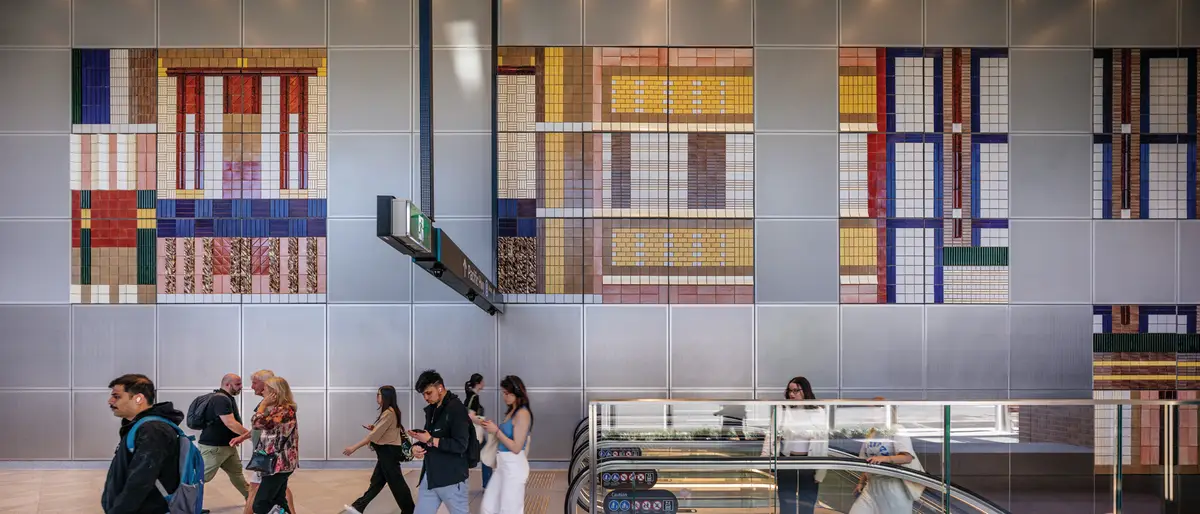
At Crows Nest Station in Sydney, passengers enter street-level vestibules with tile artwork (3), descend to a spacious brick-lined mezzanine (top of page), and board trains from a protected platform (4). Photos © Trevor Mein

4
Inside the street-facing vestibules, colorful ceramic wall reliefs recall the industrial history of the site and pay homage to the heritage element recovered during excavation—a shard of Victorian tile. Esther Stewart, the artist behind the reliefs, collaborated with Australia’s oldest continuously operating ceramics producer to develop a series of unique tile types and glazes that play on the find. These were then collaged into abstractions of roofs, facades, architraves, ornament, and foliage, as a way to “preserve the skyline” using a material present throughout much of Sydney.
Although some transit stations, such as the one in Crows Nest, must integrate into an established neighborhood, Woods Bagot faced a different set of challenges on the other side of the country. In Perth, the firm was selected to lead the design of five stations in a rapidly developing area for the city’s largest public transit expansion in nearly 20 years. Rather than fitting into an existing cityscape, these new stops in the expanded Metronet system act as starting points.

5
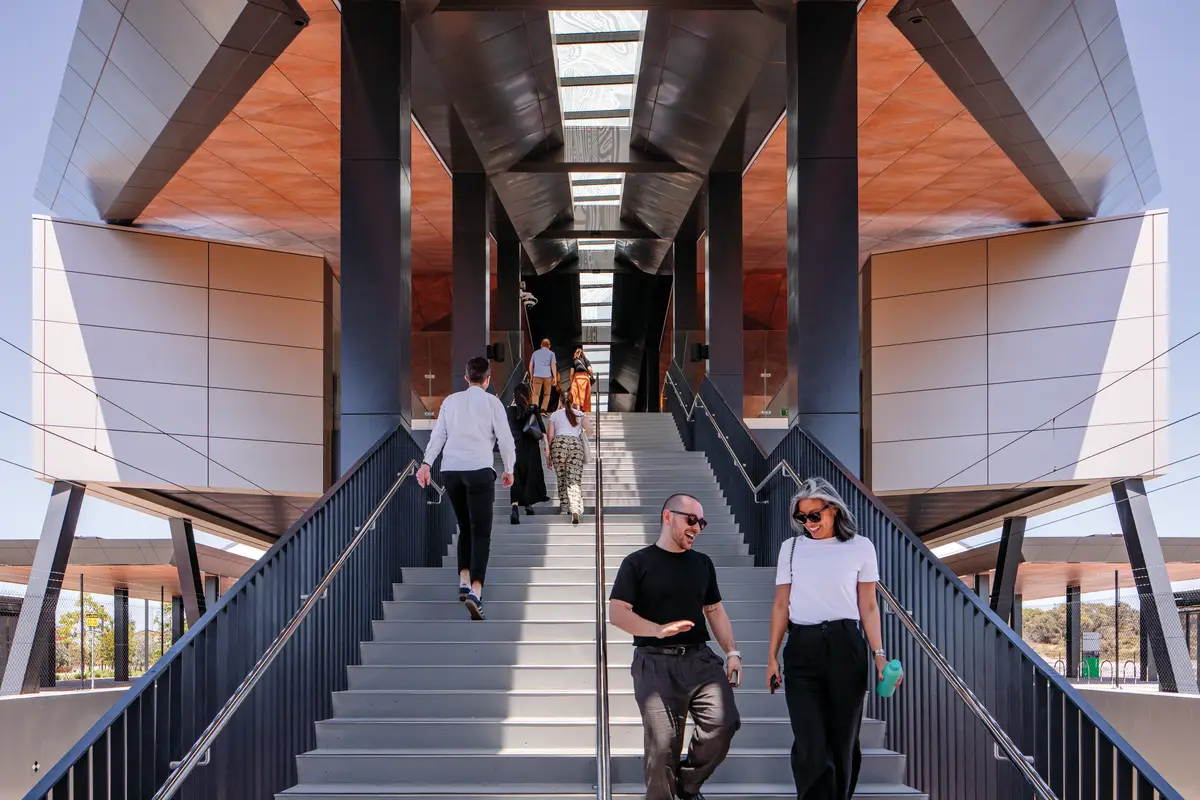
Along the Morley-Ellenbrook Line in Perth, metro stations take on different forms but share a material palette (5 & 6). Photos © Trevor Mein

6
The Morley-Ellenbrook Line consists of 13 miles of new track that connects Perth’s CBD to the northeastern suburbs through the Swan Coastal Plain, an area particularly important for native banksia trees. Floating above open-air platforms, Woods Bagot’s triangulated canopies protect commuters from the bright Western Australian sun. The five stations share an overarching visual identity, with similar tectonics and matching materiality, but site-specific responses give individual structures a unique presence. While some are located on the edge of existing commercial and residential centers, most aim to be catalysts for transit-oriented development. Fourteen artists also collaborated to produce works painted onto the stations’ walls, etched into skylights, and patterned on scrims, further enlivening the stops by adding color and animating the movement of daylight.
7
The open-air stations in Perth hover above the tracks, shade commuters, and play host to outdoor seating and public artworks (7 & 8). Photos © Trevor Mein

8
Although both Perth and Sydney are in the process of delivering their largest public transit plans to date, government-funded infrastructure initiatives have long been a cornerstone of Australia’s economic strategy, aimed at stimulating job growth. With new train lines also under way in Melbourne, and transit-oriented strategic planning beginning ahead of the 2032 Brisbane Olympics, Australia is in a dynamic era of infrastructure growth. Balancing new development while preserving the character and integrity of each place is no easy feat, and the outcomes are yet to be seen. The future of Australian cities ride on these new projects—and let’s hope the journey benefits all.
Read about other transit projects from our July 2025 issue.
Crows Nest Station
Credits
Architect:
Woods Bagot
Engineers:
Robert Bird Group (structural); SMEC (electrical, civil); NDY (mechanical, hydraulic, fp)
Consultants:
Oculus (landscape); Surface Design (facade); Büro North (wayfinding)
General Contractor:
AW Edwards
Client:
Sydney Metro
Size:
173,900 square feet
Cost:
Withheld
Completion Date:
August 2024
Sources
Masonry:
Namoi Valley Brick (brick)
Interior Finishes:
Cor-Ten, Rimex
Flooring:
Sam the Paving Man
Morley-Ellenbrook Line Stations
Credits
Architect:
Woods Bagot
Associate Architect:
Taylor Robinson Chaney Broderick
Engineers:
Jacobs Arup Joint Venture, Floth Engineering, ADG Engineers
Consultants:
TCL, UDLA (landscape); ESD (sustainability); Artify (art); Definition (signage); O’Brien Harrop (accessibility)
General Contractor:
Laing O’Rourke
Client:
Laing O’Rourke
Owner:
Public Transport Authority
Size:
430,550 square feet
Cost:
$1.08 billion
Completion Date:
December 2024
Sources
Cladding:
Austral (bricks); Mondoclad (metal panels); Equitone (cladding system)
Interior Finishes:
Bluechip (ceiling panels); Dulux (paint); Metz (tile)
Looking for quick answers on architecture and design topics?
Try Ask RECORD, our new smart AI search tool.
Ask RECORD →
Looking for a reprint of this article?
From high-res PDFs to custom plaques, order your copy today!