In Transit
Seattle’s Evolving Downtown Waterfront Gets a New and Improved Ferry Terminal at Colman Dock
Seattle

Architects & Firms
For more than a half-century, Seattle’s Colman Dock ferry terminal at Pier 52 clung to the edge of the Elliot Bay waterfront like a hulking barnacle. Gray and architecturally mundane, it successfully directed passengers onto multimodal vessels bound for Bremerton and Bainbridge Island—two cities located west of Seattle in Washington’s Kitsap County—but the experience before boarding was lackluster, thanks to the 1960s-era terminal building’s dim, constricted, and confusing interiors. If those weren’t issue enough, by the mid-2000s, it had become clear that the dock infrastructure, much of which dated back 80 years, needed extensive reinforcement.
“The old terminal was an east–west [oriented] facility that didn’t take advantage of its position on the water,” says Alan Johnson, a project engineer at Washington State Ferries, a division of the Washington State Department of Transportation (WSDOT), who notes that more than 9 million passengers walk, drive, or bike through Colman Dock each year, making it the highest-traffic ferry terminal in the state and among the busiest transit hubs of its kind in the world. “It was enclosed, and there wasn’t much in the way of windows, and both the terminal building and the trestle were seismically vulnerable,” adds Johnson.

1
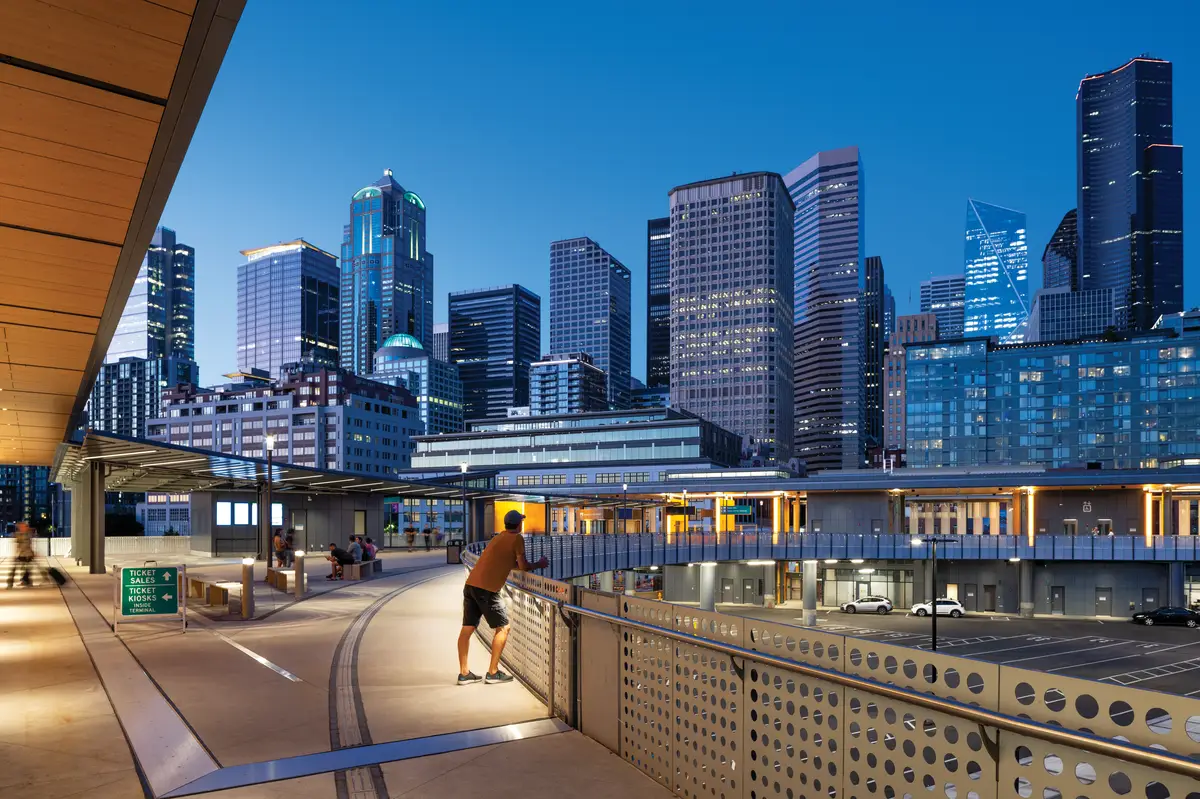
Public art and yellow portals (1, 3) enliven the terminal’s elevated plaza (2) and spacious passenger waiting area (4). Photos © Sean Airhart, click to enlarge.
2

3

4
Working with local architecture giant NBBJ, WSDOT spent more than a decade planning the repair and replacement of the dock and its passenger facility, followed by six years of construction. One of the most complex challenges was figuring out how to keep service uninterrupted and running smoothly throughout the entirety of the undertaking. “There was lots of phasing involved,” says Johnson, recalling various makeshift bridges and constantly moving temporary entrances and exits.
Customer and staff safety and ease of commute were top priorities, but NBBJ also had to take the marina’s position on a changing urban waterfront into consideration. Long an industrial hub, the zone spanning the western edge of downtown Seattle was cut off from the rest of the city for decades by the large and noisy Alaskan Way highway viaduct. In an effort to revitalize the area—for tourists and locals alike—and create a seamless connection to the downtown’s commercial core, the city worked with New York–based Field Operations on a redevelopment of the waterfront that included more pedestrian pathways, new parks, and, most importantly, the demolition of the much-maligned viaduct, which was replaced with an underground tunnel.
“Once the viaduct came down, and we had this beautiful new waterfront, the small, waterside entry of the old terminal didn’t feel right anymore,” says Nick McDaniel, a senior associate at NBBJ and lead designer on the project.
Working to optimize views and provide a more civic-oriented experience, NBBJ designed two elevated, rectangular glass-and-steel volumes, linked by an elevated central plaza that, according to McDaniel, creates a “public space in the city that wasn’t there before.”

5
Beyond the terminal’s entry pavilion (5), an elevated plaza carries foot passengers across the car deck (top of page) to a waiting area (6). Photos © Sean Airhart

6
From the street, pedestrians arrive at the open-air entry pavilion through varying routes: up a set of stairs on either the north or south end of the building, via a pedestrian bridge that connects Colman Dock directly with 1st Avenue, or up a centrally located elevator. Once through the entry (which has spaces for retail and restaurant tenants), passengers are funneled across the sweeping curved plaza, capped on one side by a dramatic aluminum canopy, toward a second building that holds the waiting area.
Looking for quick answers on architecture and design topics?
Try Ask RECORD, our new smart AI search tool.
Ask RECORD →
As customers move through the terminal, they are given directional cues via tactile paving and the use of yellow in wayfinding, which signifies the project’s entry and exit portals. (NBBJ worked closely with a national nonprofit, Lighthouse for the Blind, to ensure maximum accessibility for the visually impaired.) “It’s a relatively simple idea,” McDaniel says, “but this is a transportation project—it’s got to get you where you need to go.”
Inside the passenger waiting area, a simple palette of glass and concrete continues, with the phenolic-panel ceilings extending out into generous overhangs that frame the water views and provide shading—part of an energy-use-reduction plan that relies fully on natural ventilation for cooling and radiant floors for heating. A series of automated operable windows open and close in response to sensors taking measurements of factors such as temperature, wind speed, and humidity levels.
Much of the project’s work can’t be seen, because it’s underwater. Three-quarters of the dock’s 75-foot-long wood pilings were replaced with steel counterparts, which support a new car deck and can withstand higher levels of seismic activity. In a separate project led by the City of Seattle, an old pier to the north was removed to make way for a new seawall, meant to attract marine life.
The finished project includes public art from members of the Muckleshoot and Suquamish tribes, as well as several non-Indigenous local artists. At night the terminal’s entry pavilion glows softly: vertical steel fins with strategically placed lanternlike lighting create a welcoming effect. It’s another in a series of moves by NBBJ to further deepen the ties between the city and its residents and visitors.
“With public projects, trying to meet everybody’s needs can lead to a logjam where you end up with the lowest-common-denominator solution,” McDaniel says. “But, here, WSDOT wanted to do more than just move people around. This is their gateway from the Puget Sound to the city.”
Click drawings to enlarge

Read about other transit projects from our July 2025 issue.
Credits
Architect:
NBBJ
Engineers:
WSP (prime, civil); KPFF (structural); FSi Engineers, Greenbusch Group (mechanical, plumbing); Wood Harbinger (electrical)
Consultants:
HBB Landscape Architecture, Dark Light Design (lighting), Ilium Associates (environmental graphics)
General Contractor:
Hoffman-Pacific Pile & Marine Joint Venture
Client:
Washington State Ferries
Size:
296,000 square feet (site area) 31,250 square feet (building area)
Completion Date:
August 2023
Sources
Curtain Wall:
Wausau
Metal Roofing:
Morin
Glass:
Guardian
Wall Panels:
3form
Looking for a reprint of this article?
From high-res PDFs to custom plaques, order your copy today!