House of the Month
Bishop McDowell Extends Nova Scotia’s Vernacular with a Contemporary Oceanside House
Lawrencetown, Nova Scotia
Architects & Firms
A hill, a gable, and a wall: these were the essential elements that the design studio Bishop McDowell, of Halifax, Nova Scotia, zeroed in on to create a trim, 2,300-square-foot house in the Canadian Maritimes. Both the response to the site and the adroit manipulation of two basic architectural forms resulted in an inventive yet forthright programmatic solution for a young couple, Michelle MacDonald and Joe Romkey, and their two children.
The couple, who wanted a year-round residence in the countryside, found an acre on the edge of wetlands in the village of Lawrencetown, famed for its surfing beaches. “One break is near the house, so we can watch the surfers,” says Romkey, who began “hanging ten” himself after moving to this property, not far from the city of Dartmouth, where he has a financial-planning office.
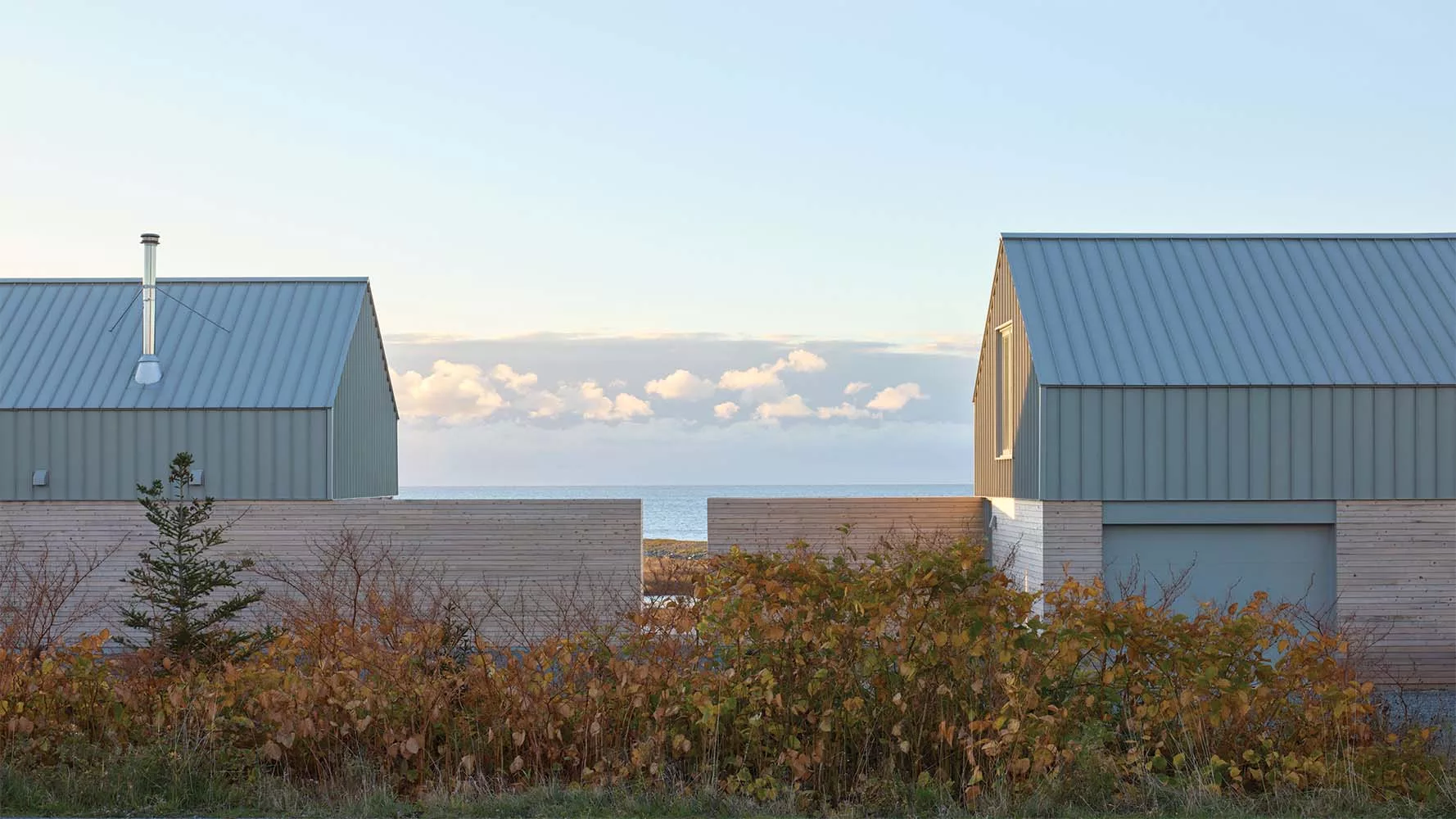
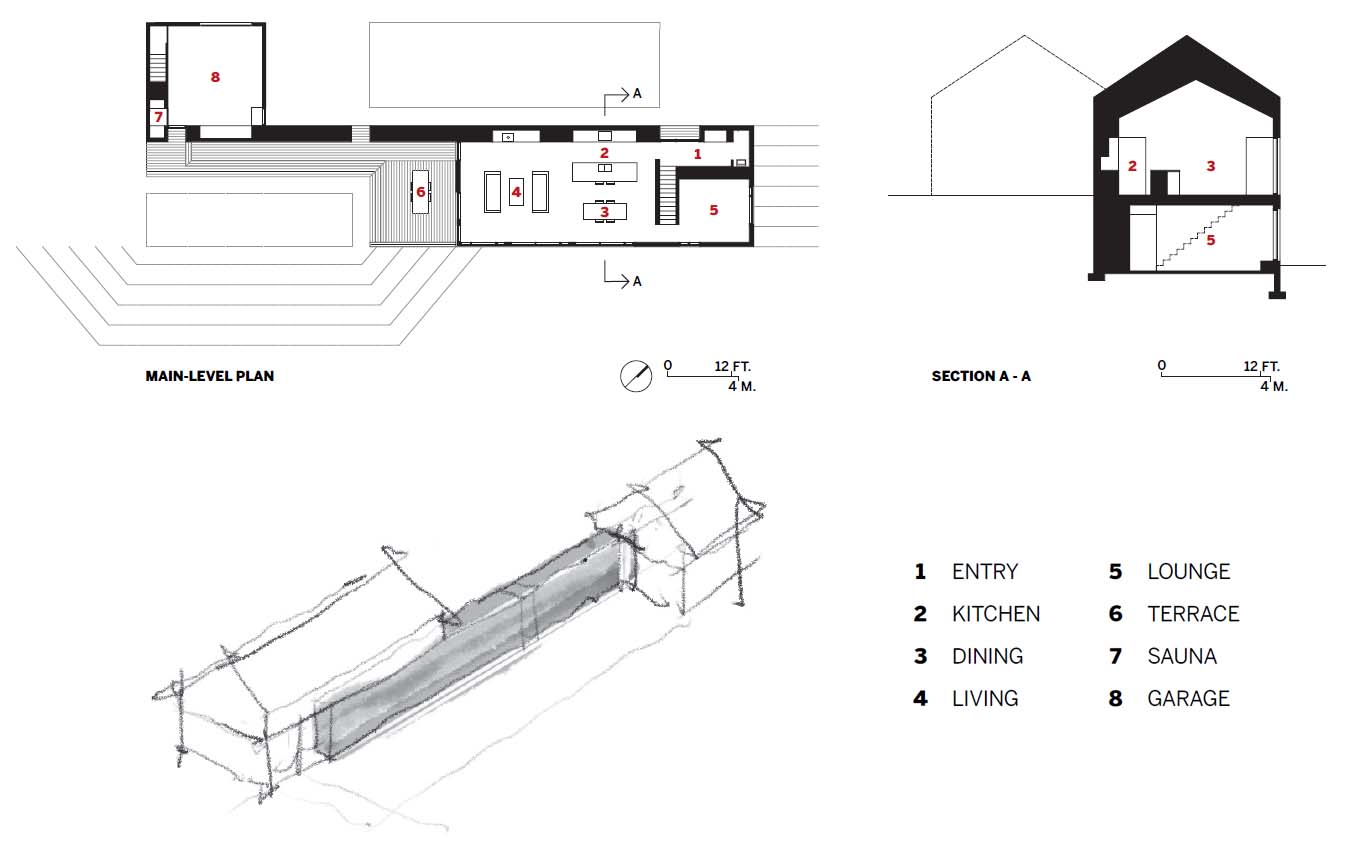
The site, edged by a road, includes a slope that spills down to marshy water and the Atlantic Ocean beyond. The firm’s principals, Matthew Bishop and Lucas McDowell, based their parti on a linear wall that runs along the crest of the hill and connects the main volume, containing the living spaces, with the garage. “Then we took the primary form of the gable, split it into two pieces, and placed both aligned with the wall, but offset from each other,” says Bishop.
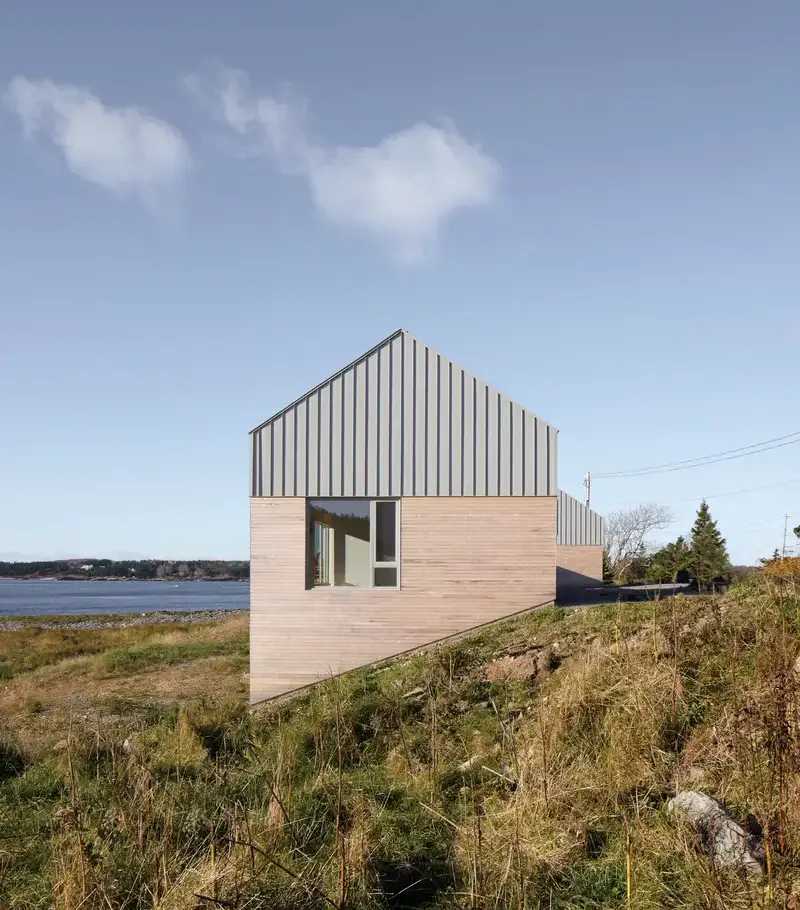
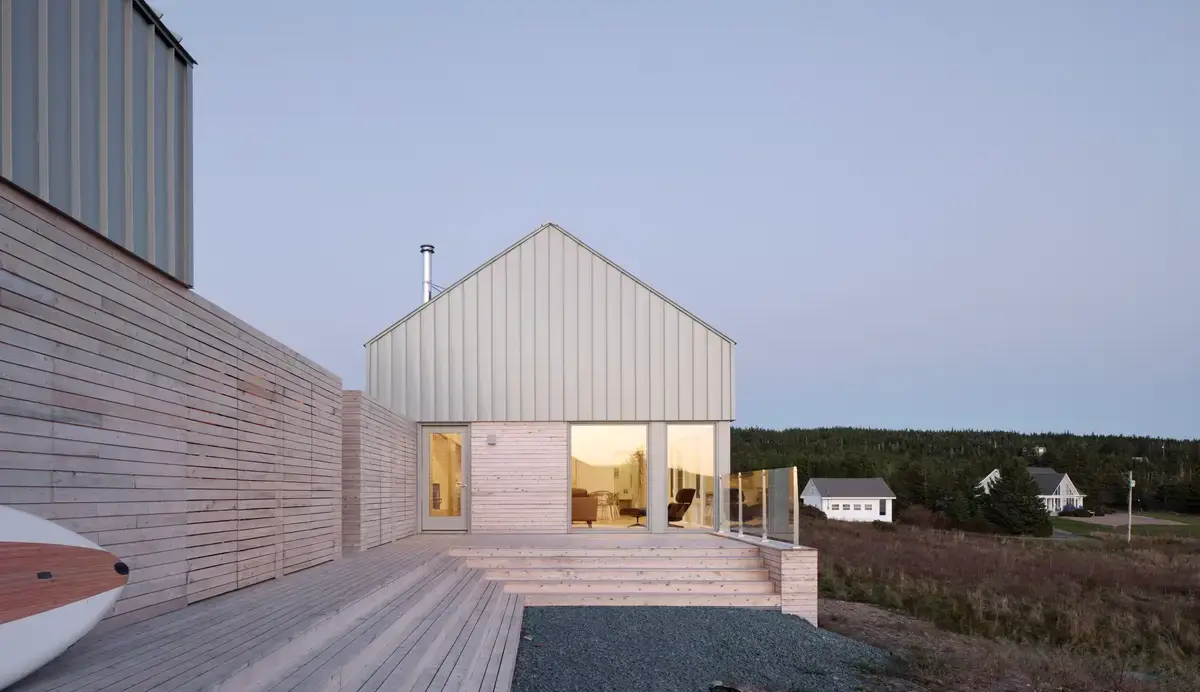
A datum line running across the elevations separates standing-seam metal panels from white cedar shiplap boards. Photo © James Brittain, click to enlarge.
Accordingly, the house extends from the wall toward the water, easing down the slope, while the garage projects from the wall toward the road. The elevation facing passing cars reads as a single story, but the section reveals an upper story reserved for public living spaces, with bedrooms tucked into a floor underneath. The smaller, garage volume frames the arrival area and discreetly includes a guest room within its gable.
Standing-seam painted steel roofs cover the timber-frame structures. “There are metal-roofed sheds and gabled cottages in the area that we wanted to hold on to,” explains McDowell. The muted stone-gray color of the roofs is repeated in the windows’ frames. In another gesture to the context, Bishop and McDowell clad the exterior walls in white cedar, a local material, and emphasized the tailored silhouette of the complex with stringent detailing: the roofs lack eaves and the horizontal shiplap boards conceal fasteners.
The clients heard about Bishop and McDowell from builders in the area and were attracted by their portfolio, which showed open plans and simple, crafted interiors. “We wanted a modern take on the Nova Scotia vernacular,” says Romkey. MacDonald adds that she was also impressed by the pristine detailing in the houses.
Bishop and McDowell, who received their master’s in architecture degrees from Dalhousie University, worked for the well-known Halifax firm of MacKay-Lyons Sweetapple Architects before opening their own practice last year. During the young designers’ stint there, they developed a proclivity for a geometric, modern vocabulary and for regional forms and materials. But, as Bishop puts it, “We want to embrace lessons from the past while still developing our own identity.”
Looking for quick answers on architecture and design topics?
Try Ask RECORD, our new smart AI search tool.
Ask RECORD →
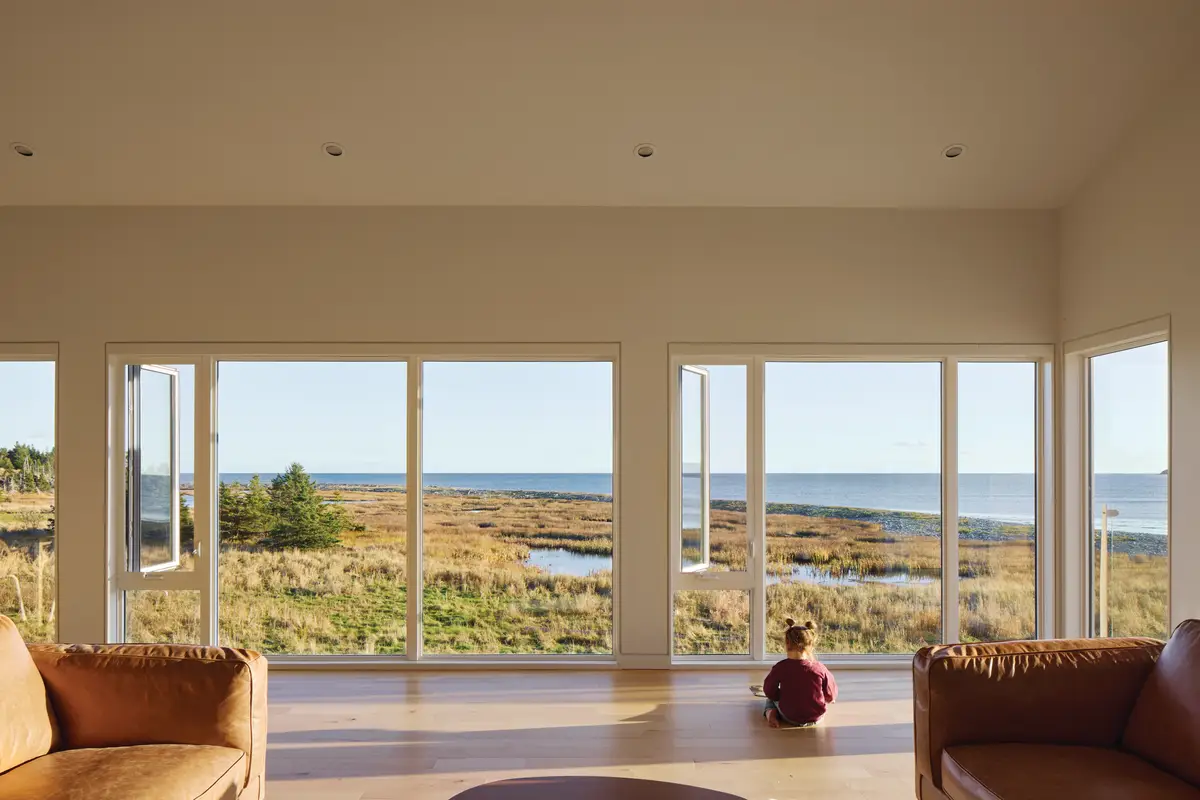
The design for this house—the first on their own—illustrates that point well. As you approach it from the road, you catch a fleeting glimpse of blue-gray water through a narrow opening in the connecting wall. Entering a glass door in a recess at the eastern end of this threshold, you find yourself in a modest vestibule. But not until you turn right into the “great room” of the house is there the ta-da moment, when the panoramic view of the ocean opens up dramatically to the south. “The sunrises and sunsets are breathtaking,” says MacDonald. “And the sun lights up the meadow grass as if it’s on fire,” Romkey adds.
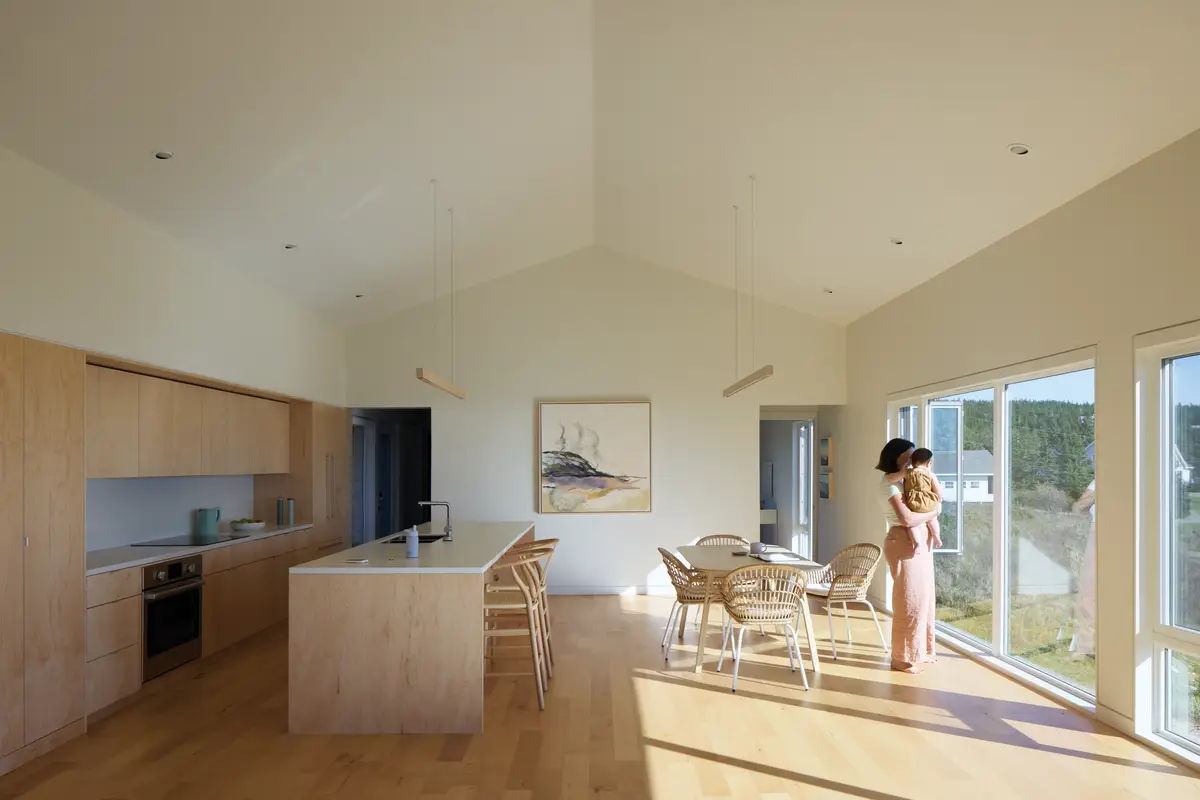
The living/dining area expands upward to a vaulting roof, a spatial dynamic that surprised the clients. “We almost opted for a flat ceiling,” says Romkey. “Fortunately, we were talked out of that.” Maple floors and millwork, as well as off-white drywall and Midcentury Modern furniture, introduce a Scandinavian sensibility to the interiors; sheer shades and casement windows provide cross ventilation as well as mitigate glare and heat from the sun. Electricity is the primary source for heating and cooling, although a fireplace inserted into a niche in the north wall warms the room on cold, wintry days. Also tucked into this long working wall are the kitchen, storage, and laundry.
1
2
The living/dining space (1 & 2) overlooks marshland, which is dotted by small vernacular structures (3). Photos © James Brittain
3
And there is more: Bishop and McDowell managed to fit a studio in the southeast corner of the main floor to accommodate various activities for MacDonald and the children. Downstairs, a recreation room separates the primary bedroom from the children’s sleeping quarters and opens to the outdoors. Nearby, a stepped terrace sits on higher ground to the west, where it is easily accessible from the great room. “From the terrace, we watch foxes, deer, herons, and eagles,” says MacDonald, noting that the wall shields this open space from the noise of passing cars and from gusty winds. At the west end of the wall, the designers also fit in a sauna, which is glazed on the side with the water view.
Even with all of these assorted architectural features, the clients note that their house blends into its local context—it isn’t gigantic or showy. And that was precisely the point: Bishop and McDowell approached the site deferentially, employing familiar architectonic components using a few novel moves.
Click drawings to enlarge
Credits
Architectural Designer:
Bishop McDowell — Matthew Bishop, Lucas McDowell, principals; David Burlock, designer
Engineer:
Rural Roots (structural)
Consultant:
SDMM (surveyor)
General Contractor:
Axios Construction
Client:
Michelle MacDonald and Joe Romkey
Size:
2,300 square feet
Cost:
$876,000 (construction)
Completion Date:
October 2024
Sources
Cladding:
BML Metals (metal panels); Ridge Cedar (wood); Soprema (moisture barrier); Owens Corning (roof membrane)
Windows/Doors:
Kohltech
Hardware:
Weiser, Yale
Glass Railing:
Invisirail
Interior Finishes:
Benjamin Moore (paint); Corian (solid surfacing); Olympia Tile, Ceragres (floor and wall tile); Richmond Flooring (wood floors)
Lighting:
aaline (downlights)
Plumbing:
Blanco, Aqua (faucets)
Energy:
Supreme Novo (wood stove)
Looking for a reprint of this article?
From high-res PDFs to custom plaques, order your copy today!