Architectural Record
search
cart
facebook twitter linkedin youtube
  • Sign In
  • Subscribe
  • Sign Out
  • My Account
Architectural Record
  • NEWS
    • Latest News
    • Awards
    • Interviews
    • Obituaries
    • Podcasts
      • Design:Ed Podcast
      • Sponsored Podcasts
  • OPINION
    • Book Reviews / Excerpts
    • Exhibition Reviews
    • Forum
  • EXCLUSIVES
    • Videos
    • Design Vanguard
    • Top 300 Firms
    • Sponsored Content
    • Sponsored eBooks
    • From the Archives
  • CONTINUING ED
    • Editorial Continuing Ed
    • CE Center
    • CE Academies
  • PROJECTS
    • Buildings By Type
    • Reuse & Renovation
    • Museums & Arts Centers
    • Colleges & Universities
    • Multifamily Housing
    • Interiors
    • Lighting
    • Kitchen & Bath
  • HOUSES
    • Record Houses
    • House of the Month
    • Featured Houses
  • PRODUCTS
    • Products by Category
    • Record Products of the Year
    • Latest Products
  • EVENTS
    • Dates & Events
    • Record on the Road
    • Innovation Conference
    • Sustainability in Practice
    • Women In Architecture
    • Webinars
    • Ad Excellence Awards
    • Submit an Event
  • CONNECT
    • Ask RECORD AI
    • Newsletters
    • Contact
    • Advertise
    • Editorial Calendar
    • Store
    • Customer Service
  • SUBMIT
    • Submission Guidelines
    • RECORD Competitions
  • MAGAZINE
    • Subscribe
    • My Account
    • Digital Edition
    • Current Issue
    • Firm Pass
    • Historic Archive
ProjectsBuildings by TypePark & Public Space Design

At North Carolina’s Fort Fisher, a New Visitor Center Delves into the History of the Site While Bracing for the Future
By Vernon Mays
Fort Fisher Visitor Center
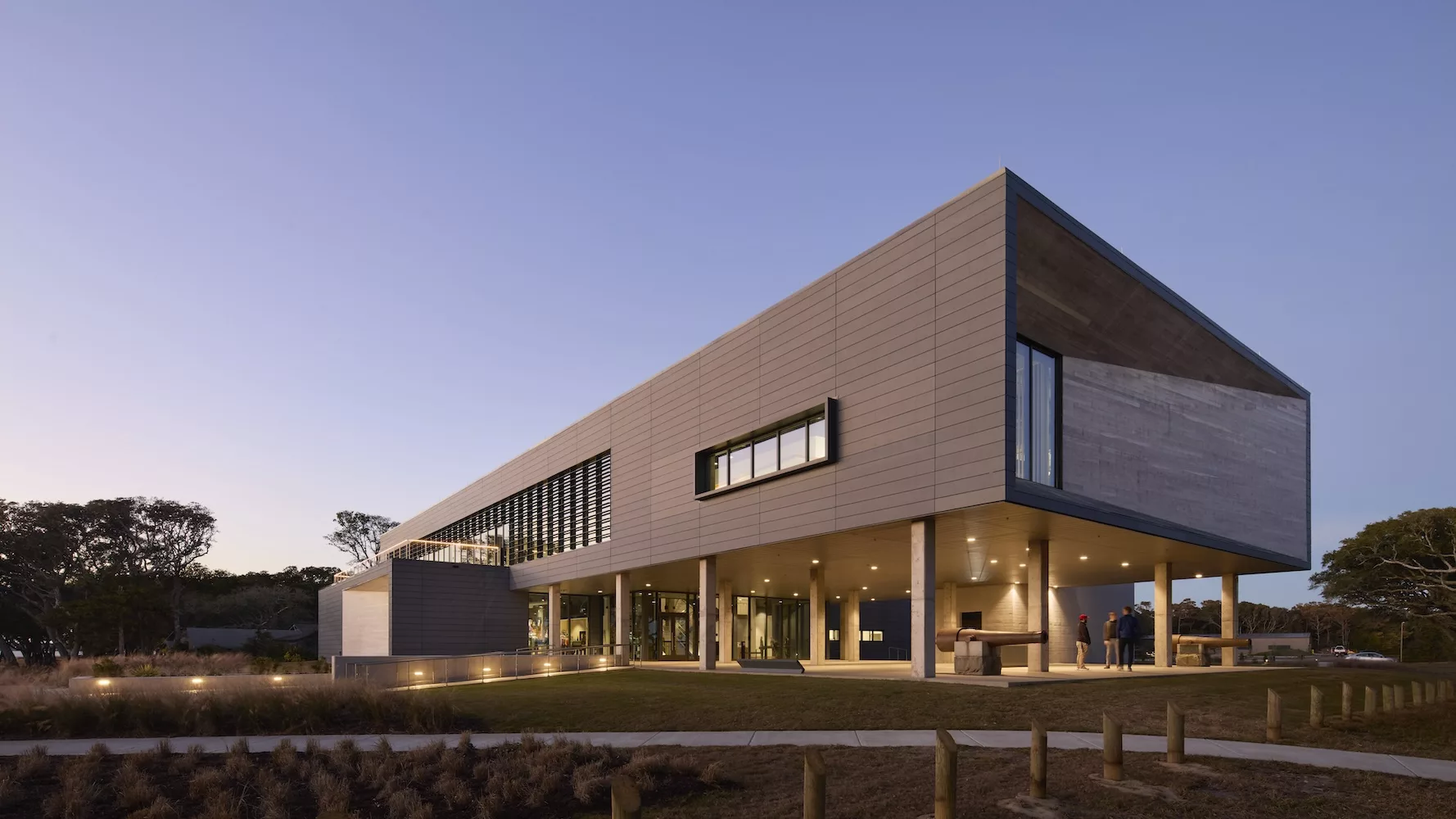
The new visitor center at the Fort Fisher State Historic Site in Kure Beach, North Carolina. Photo © Mark Herboth
July 11, 2025

Architects & Firms

Clark Nexsen
✕
Image in modal.

While perhaps lesser known than other Civil War sites, the earth-and-sand stronghold at Fort Fisher in Kure Beach, North Carolina, was witness to one of the most consequential battles in the conflict. The mile-long fort protected the last surviving supply line for Robert E. Lee’s Army of Northern Virginia. So, when it fell after a massive Federal assault in January 1865, the Confederacy’s defeat was virtually ensured.

Located just south of the city of Wilmington, the historic site, managed by the North Carolina Department of Natural and Cultural Resources, hosts up to a million visitors each year. Busloads of school children arrive like clockwork. But the existing visitor center, built in the 1960s, had served its useful life. “It was entirely dark inside,” says Dennis Stallings, a principal at Clark Nexsen, a JMT company, based in Virginia Beach, Virginia. “Plus, when you got out of your car and walked toward the building, you couldn’t see beyond it to the remnants of the old fort.”

fort fisher visitor center

Photo © Mark Herboth

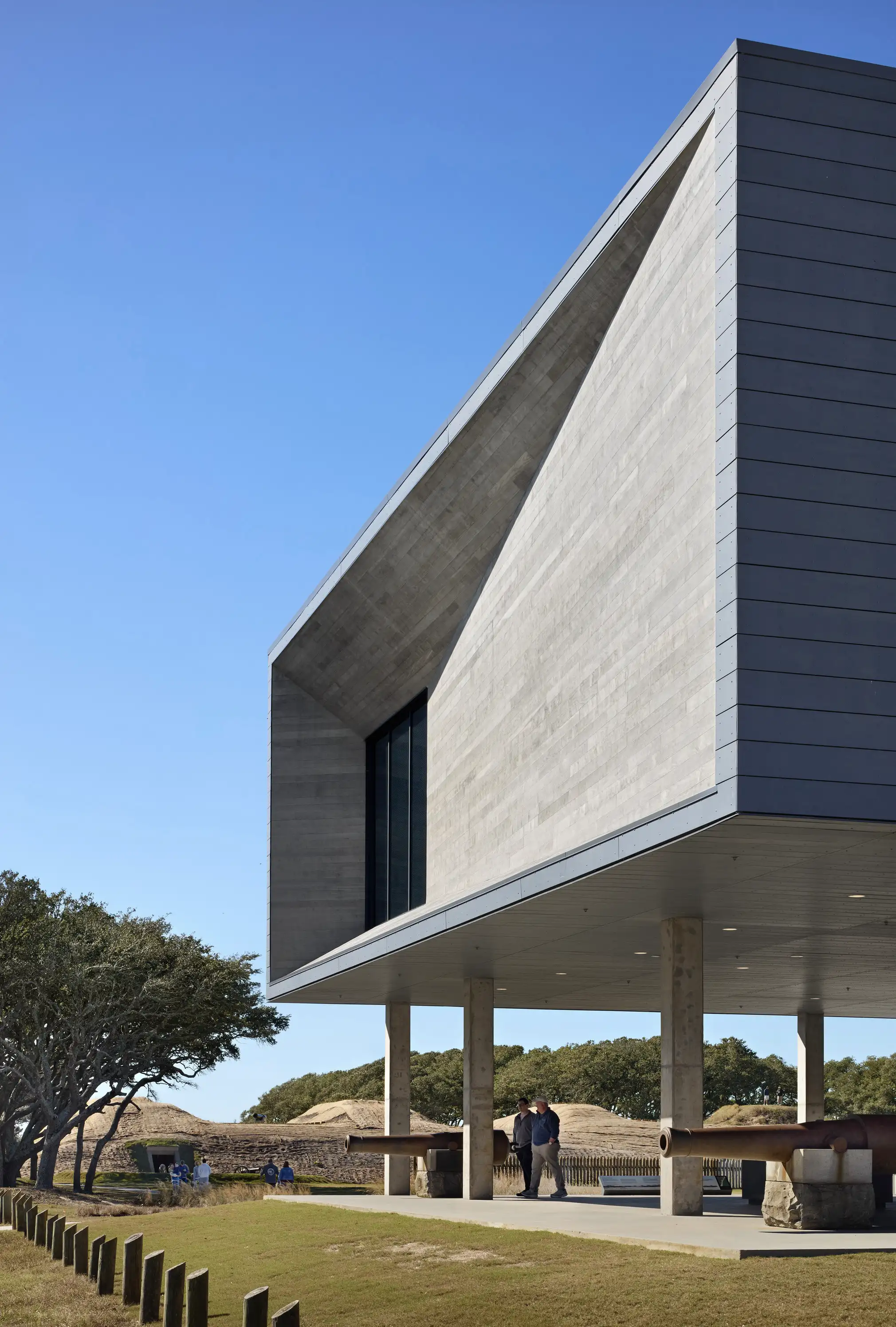
For its new visitor center, the client wanted upgraded exhibition space that would fully retell the story of the Fort Fisher site. The program also included staff offices, an orientation space, a multipurpose room for community events, and a gift shop. Early in design, Clark Nexsen decided to raise the building to provide clear views of the fort’s earthworks. Starting conceptually with a rectangular volume, the design team rotated the lower floor 90 degrees to offer a passage beneath the upper floor and reveal the earthen mounds. That move also provided a covered area under the building where visitors can gather.
fort fisher visitor center

Photo © Mark Herboth

fort fisher visitor center

Photo © Mark Herboth.

The sleek modern structure, partially lifted on columns, is a welcome departure from the hackneyed beachfront architecture so often seen in coastal communities. Clad in a mixture of a dark charcoal grey fiber cement rainscreen with light gray wooden accent walls, the exterior exudes a warm materiality that complements the twisted trunks of surrounding live oaks. On the building’s south face, a broad glass curtain wall admits generous daylight.

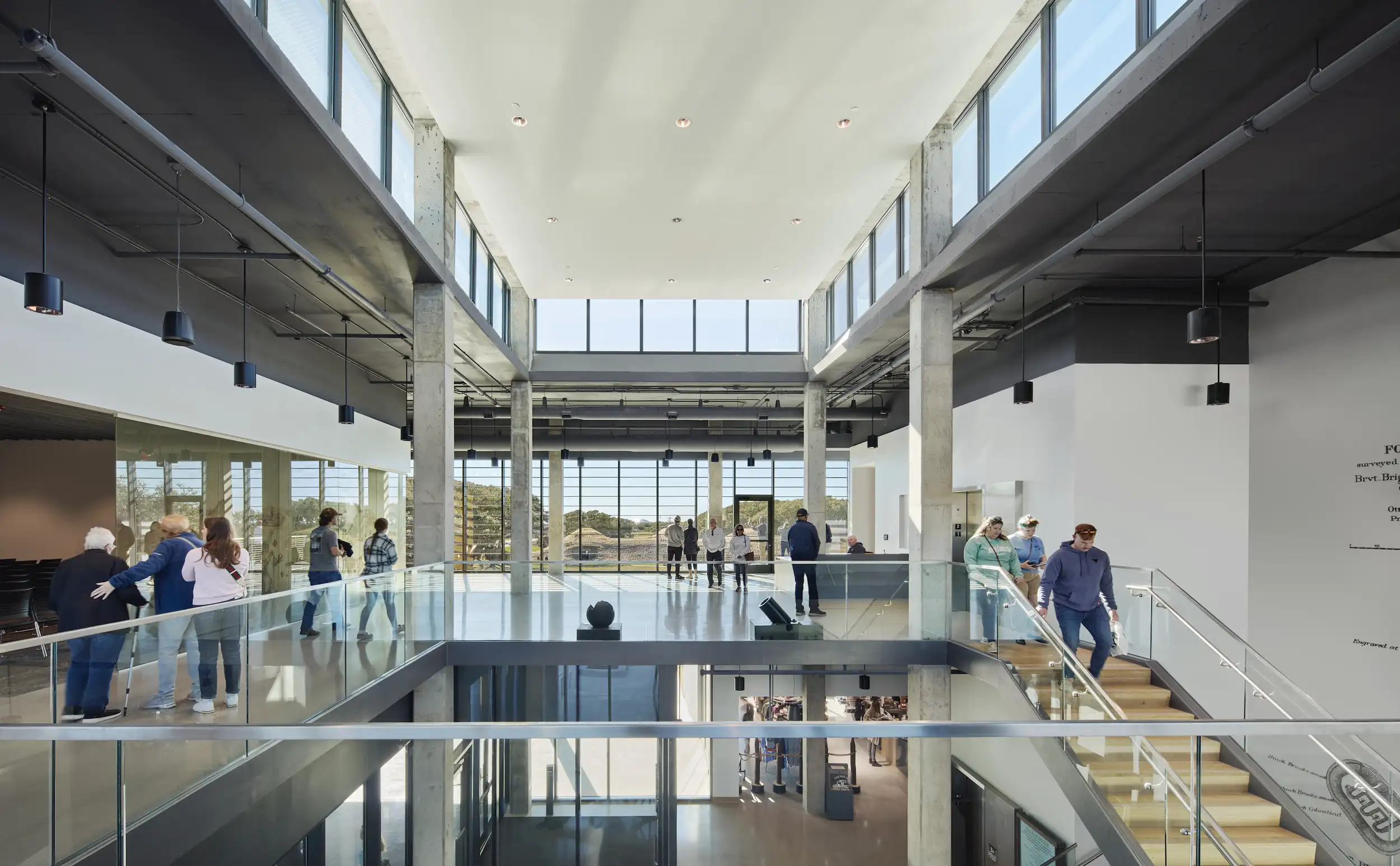
Inside the 22,000-square-foot building, visitors are greeted by a reception area tucked beneath an open staircase that’s illuminated by a rooftop clerestory. At the top of the stairs, the orientation area features a brief video to set the stage for further exploration. It’s surrounded by the exhibit galleries, which tell a story that reaches far beyond the siege of the fort. “There is archaeological evidence of indigenous people that inhabited the site 9,000 years ago,” Stallings says. That story is now told, along with the narrative of enslaved laborers used to construct the fort.
fort fisher visitor center

Photos © Mark Herboth

After 150 years of tidal shifts and hurricane-force winds, most of the original fort has been lost to beach erosion. That meant resilience was a key goal for the project. “The majority of the envelope is intended to be both resilient and energy efficient,” says principal Rob Harkey. Not only is the rainscreen system robust, but the recessed areas surrounding the feature windows are clad in acetylated wood, a long-lasting material that’s resistant to mold, mildew, rot, and insects.

The threat of high water was addressed by placing the first floor two feet above the 100-year flood plain, a decision that was tested by a tropical cyclone shortly before the center opened in 2024. Water pooled in the parking lot, but the building remained dry.
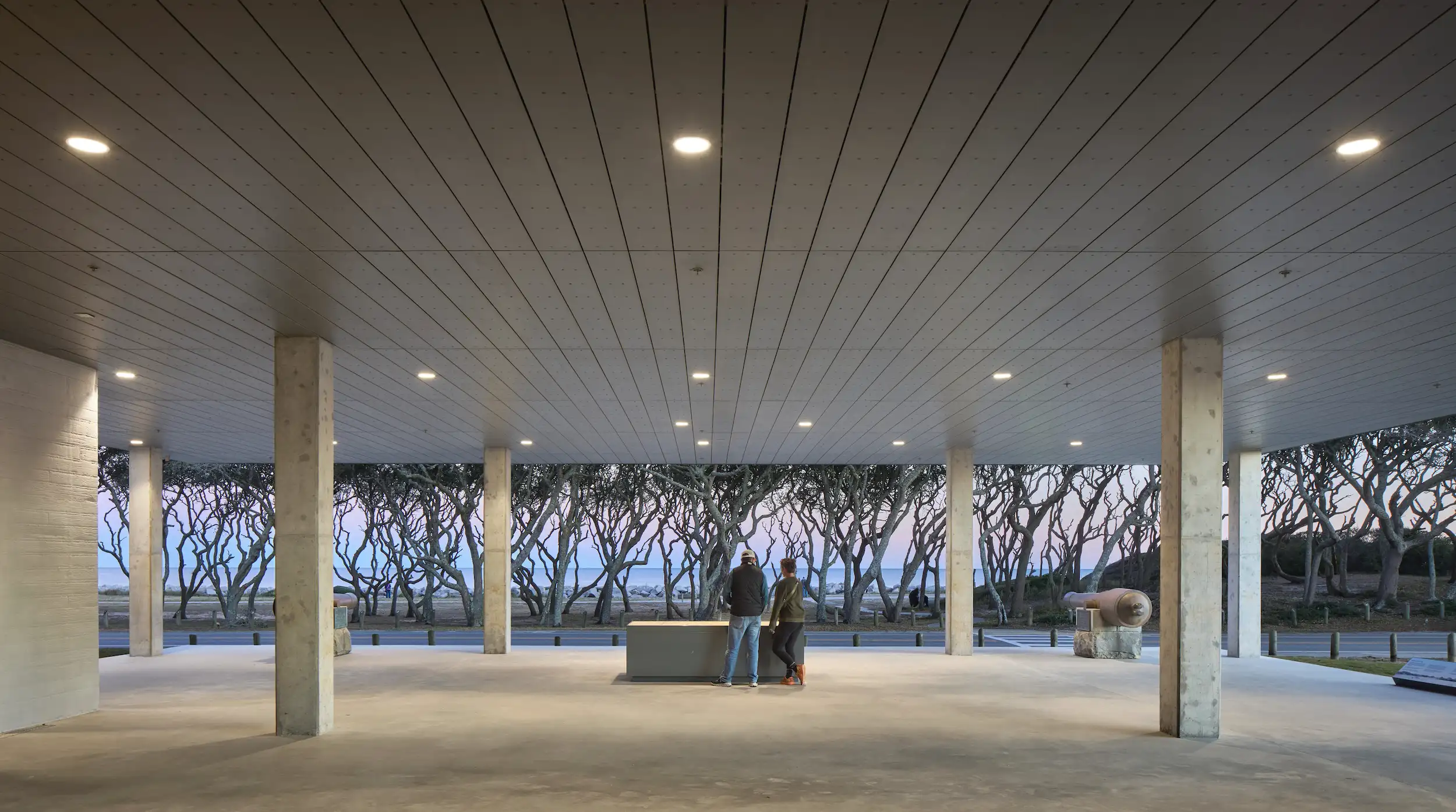
fort fisher visitor center

Photo © Mark Herboth

Ultimately, the design for the new visitor center was aimed at improving the visitor experience. That was accomplished first by making a better connection between the building and the site, bringing more daylight into the space, and framing important views. But it goes a step further by honoring the legacy of everyone whose lives left an imprint on this hallowed ground.

Looking for quick answers on architecture and design topics?
Try Ask RECORD, our new smart AI search tool.
Ask RECORD →

KEYWORDS: North Carolina

Share This Story

Looking for a reprint of this article?
From high-res PDFs to custom plaques, order your copy today!


Vernon Mays is a writer and editor based in Richmond, Virginia.

Post a comment to this article

Report Abusive Comment

Subscription Center
  • Create an Account
  • Start a Subscription
  • Manage My Account
  • Sign Up for Newsletters
  • Visit Customer Service
  • Update Preferences

More Videos

Sponsored Content

Sponsored Content is a special paid section where industry companies provide high quality, objective, non-commercial content around topics of interest to the Architectural Record audience. All Sponsored Content is supplied by the advertising company and any opinions expressed in this article are those of the author and not necessarily reflect the views of Architectural Record or its parent company, BNP Media. Interested in participating in our Sponsored Content section? Contact your local rep!

close
  • TAMLYN XtremeTrim Exterior Trim
    Sponsored byTamlyn

    Designing Cleaner Panel Facades: Why Exterior Trim Details Matter

  • Building with Vapor Barriers
    Sponsored byReef Industries, Inc.

    Vapor Barriers Help Control Moisture in Tighter Building Designs

  • Duct Interior with Prodeq System
    Sponsored byHenry, a Carlisle Company

    Designing Resilient Water Containment Systems

DESIGN:ED Podcast
Listen to Architectural Record’s DESIGN:ED Podcast

Events

June 11, 2026

Very Early Warning Fire Detection for Mission-Critical Facilities

Credits: 1 AIA LU/HSW; 1 AIBD P-CE; 0.1 ICC CEU

Examine advanced fire detection strategies that support uptime and enhance safety in data centers and other mission-critical facilities.

June 16, 2026

Focus on the Façade: Exploring Steel, Timber & Fire-Rated Curtain Walls and Channel Glass Systems

Credits: 1 AIA LU/HSW; 1 AIBD P-CE; 0.1 ICC CEU

Explore modern façade and glazing systems that enhance daylighting, fire safety, and thermal performance while expanding architectural design possibilities.

View All Submit An Event

Products

2026 Architect's Square Foot Costbook

2026 Architect's Square Foot Costbook

See More Products

Popular Stories

Coronado Bridge

The Architect’s Guide to San Diego

SanDiegoAirport

Top 300 Architecture Firms of 2026

Practice Matters illustration

By the Numbers: Counting America's Architects

Crane Cove, ONO

Design Vanguard 2026 Winners

House on a Hill

Design Vanguard 2026: Forma

Focus on the Facade - Free Webinar - June 16, 2026

Related Articles

  • Vincent Scully: Architecture, Urbanism, and a Life in Search of Community

    A New Biography, Written with Sympathy and Style, Delves into the Life of Vincent Scully

    See More
  • A sneak peek at Weiss/Manfredi's new visitor center for the Brooklyn Botanic Garden

    See More
  • Lunch on a Beam cover

    ‘Lunch on a Beam’ Explores the History of a Legendary 1932 Photo Captured Atop a Classic New York Skyscraper

    See More

Related Products

See More Products
  • 3dthinking.jpg

    3D Thinking in Design and Architecture: From Antiquity to the Future

See More Products
×

The latest news and information

#1 Source for Architectural Design, News and Products

SUBSCRIBE
  • RESOURCES
    • Advertise
    • Contact Us
    • Submit
    • Store
  • ACCOUNT CENTER
    • Create an Account
    • Start a Subscription
    • Manage My Account
    • Sign Up for Newsletters
    • Visit Customer Service
    • Update Preferences
  • PRIVACY
    • PRIVACY POLICY
    • TERMS & CONDITIONS
    • DO NOT SELL MY PERSONAL INFORMATION
    • PRIVACY REQUEST
    • ACCESSIBILITY
  • SERVICES
    • Marketing Services
    • Reprints
    • Market Research
    • List Rental
    • Survey/Respondent Access
  • STAY CONNECTED
    • Linkedin
    • Facebook
    • Instagram
    • YouTube
    • X (Twitter)

Copyright ©2026. All Rights Reserved BNP Media, Inc. and BNP Media II, LLC.

Design, CMS, Hosting & Web Development :: ePublishing