Alice Walton Expands Her Vision of Integrating Art and Wellness with Two New Major Buildings at Crystal Bridges

Much like the small but rapidly growing city in Northwest Arkansas that it calls home, the 134-acre campus of the Crystal Bridges Museum of American Art in Bentonville has been abuzz with new development over the last several years. The pièce de resistance, a 114,000-square foot expansion of the Safdie Architects–designed museum complex that will effectively double its size, won’t make its public debut until next spring. More recently, though, the campus has gained two new landmark buildings that seemingly have little to do with art: an allopathic medical school that welcomed its inaugural class of 48 students this week and an office building, which opened in May, that houses a policy-shaping nonprofit focused on disrupting traditional health care systems.
Those confounded by such improbable new additions to the campus of a world-class art museum don’t know Crystal Bridges founder Alice Walton. Art and healthcare are twin passions of the 75-year-old collector and philanthropist, who is the youngest of retail empire–builder Sam Walton’s four children. To Walton, both seemingly divergent interests—making great art more accessible and improving health outcomes, particularly in her home state, which consistently ranks as one of the unhealthiest—are intimately intertwined.
“I've always very deeply, personally known the power of art in mental health and wellbeing and how a focus on art can keep you balanced in the toughest of times,” Walton tells RECORD, recalling how her beloved watercolors and art books grounded her while recovering from a 1983 car accident that required multiple surgeries spanning a decade. “Later, when we started building Crystal Bridges—and I was a total outsider in the museum world—one of the things that amazed me was that museum directors who typically come from the curatorial side of the aisle weren’t really cognizant of the powerful role they can play in the health and wellbeing of a community.”
Walton’s focus on wellness, from a philanthropic standpoint, is also personal. “I care deeply about this state and rural America,” she says. “Quality healthcare is the last major hole we have in this region and I felt like it was time to really try to do something to fill the gap.”

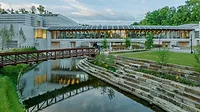
Patio and lawn view of the institute. Photo © Timothy Hursley, courtesy Heartland Whole Health Institute
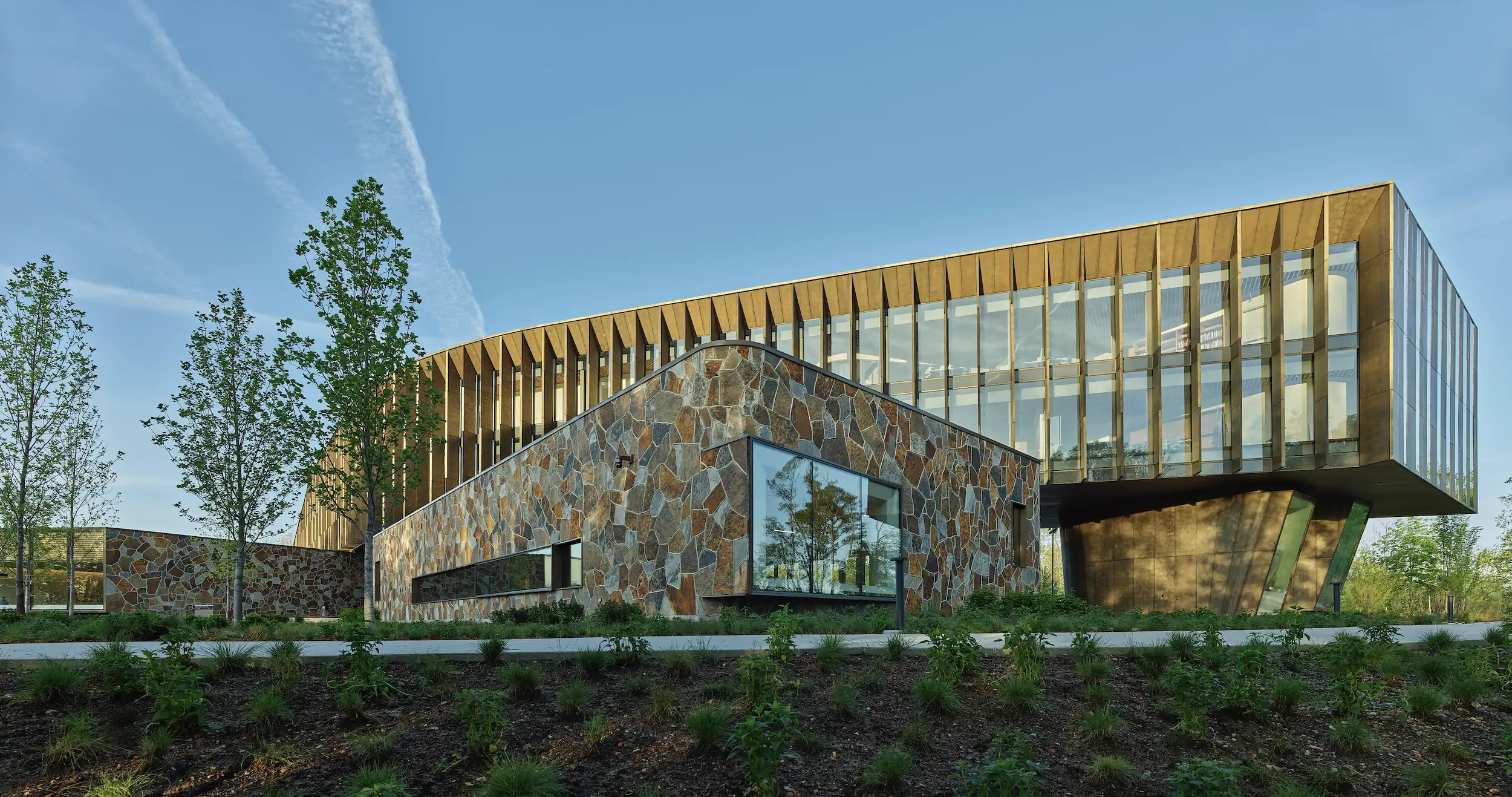
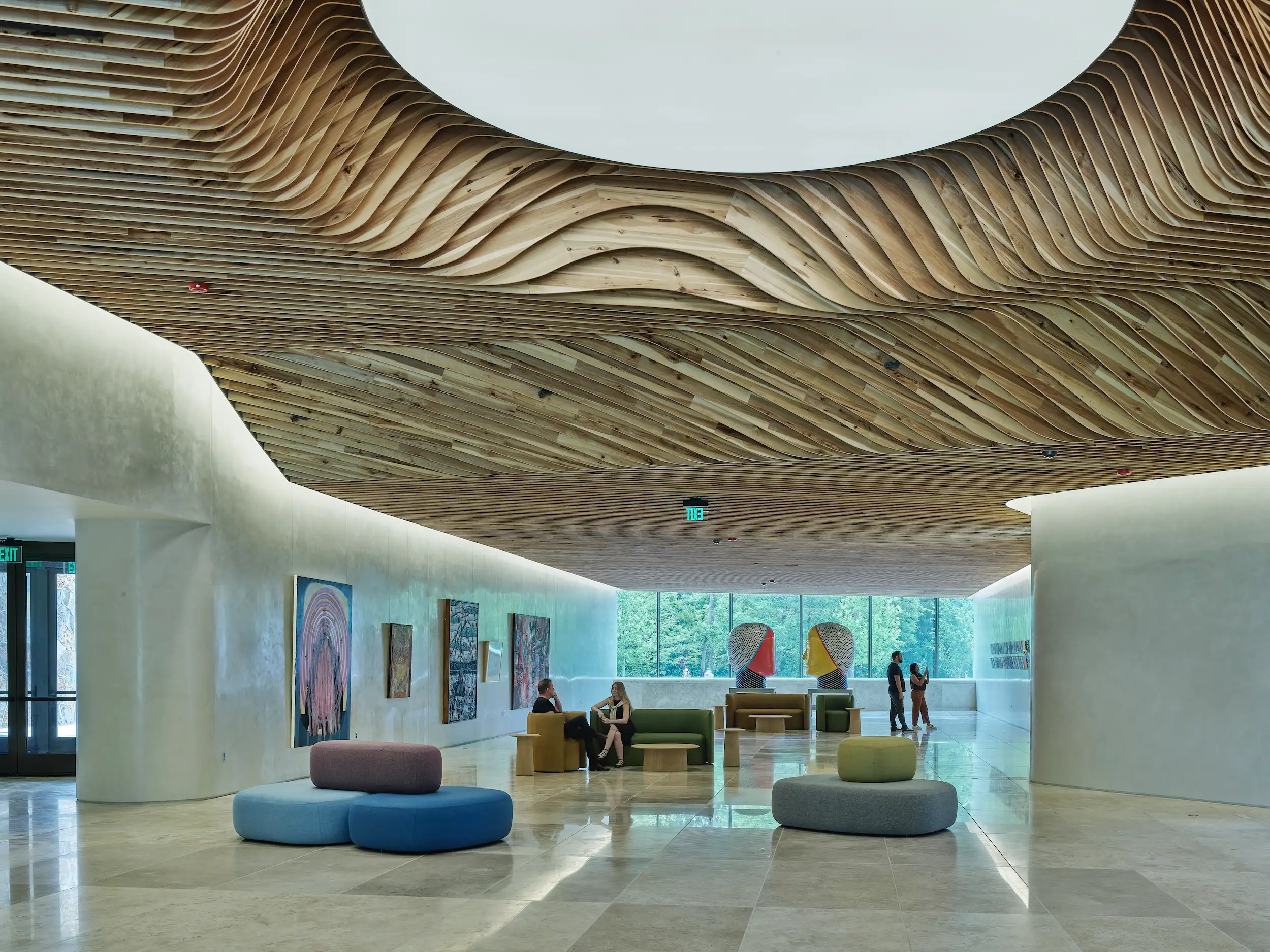
Exterior wiew of the ground-floor gallery, which focuses on wellness-themed art. Rotating pieces are also displayed elsewhere throughout the institute. Photo © Timothy Hursley, courtesy Heartland Whole Health Institute
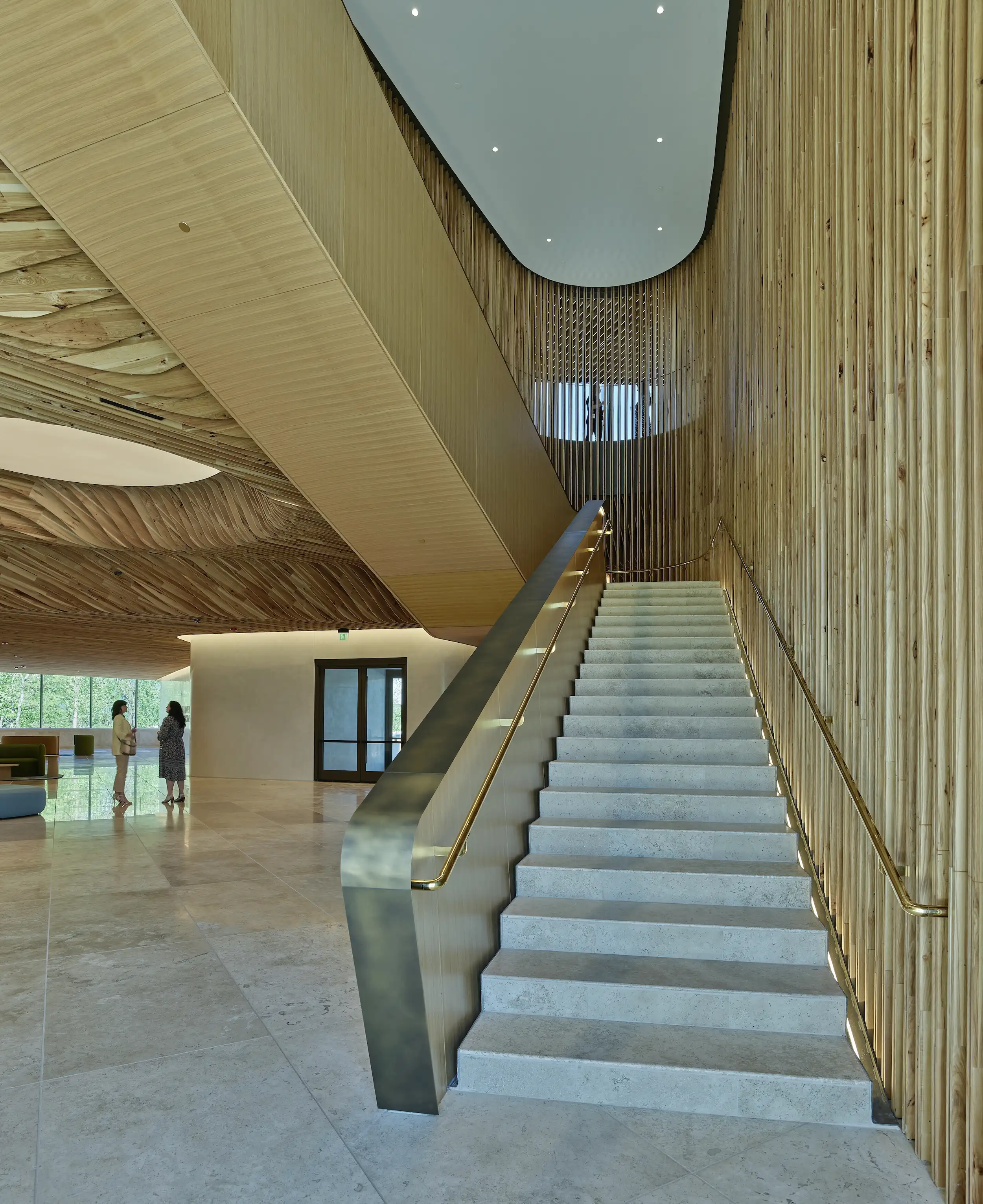
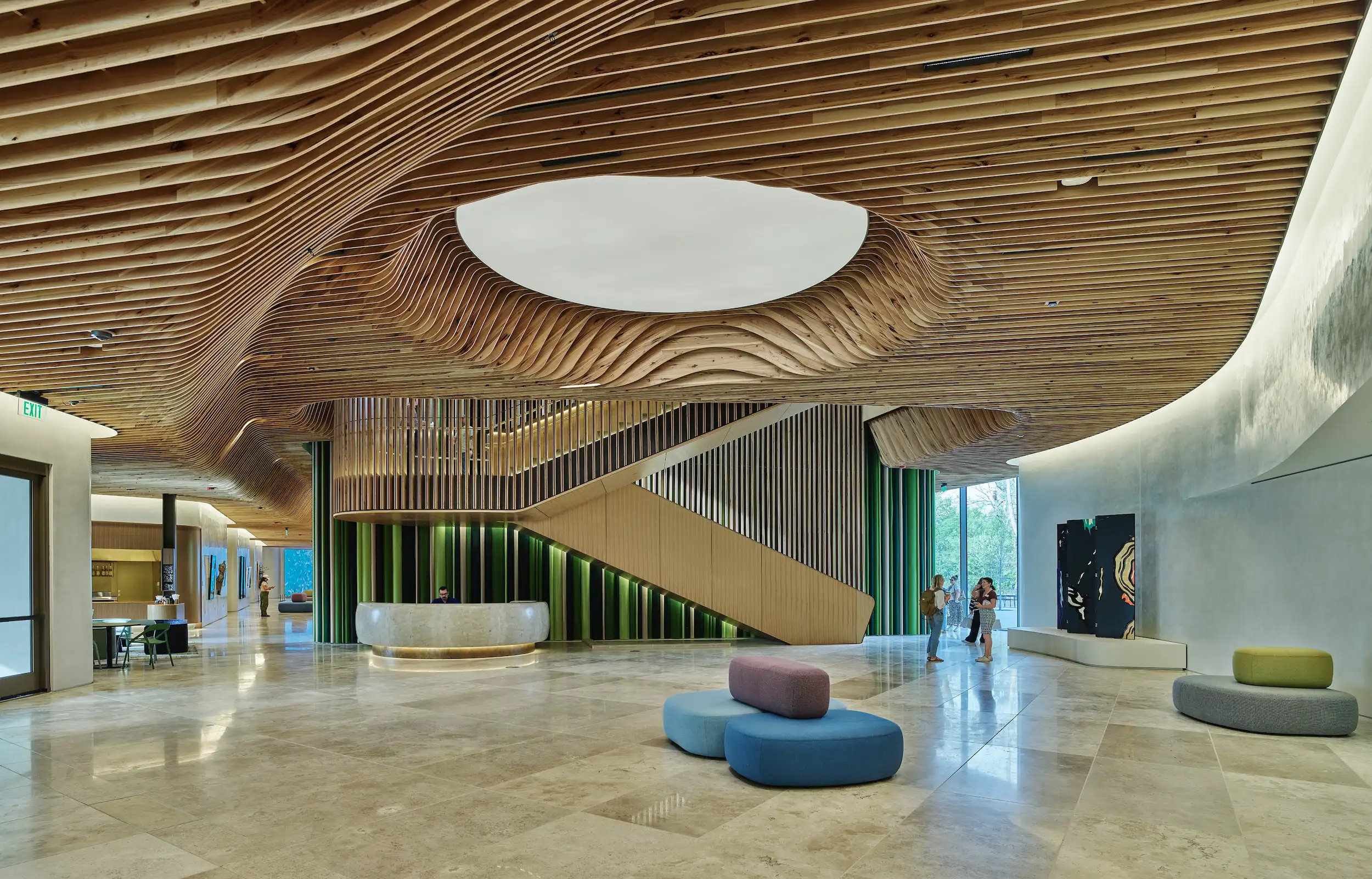
The lobby stair nods to Alvar Aalto, says Blackwell. Photo © Timothy Hursley, courtesy Heartland Whole Health Institute
Walton relays this from the boardroom of the new, Marlon Blackwell Architects (MBA)–designed Heartland Whole Health Institute (HWHI), a built manifestation of her desire to effect change.
In addition to its namesake nonprofit, which describes itself as dedicated to “transforming health care through research, advocacy, education, and community engagement,” the 85,000 square foot building is home to two other groups previously scattered across Bentonville in rented offices: museum art-sharing initiative Art Bridges Foundation and Art + Wellness Enterprises, a professional services entity that provides support to a variety of Alice Walton-funded interests, including the admission-free Crystal Bridges itself. Open, daylight-filled office and amenity spaces for these organizations are spread across two floors of a structure that MBA founding principal Marlon Blackwell describes as “literally a suspended curved bridge.” Wrapped in a glass curtain wall shaded by weathered brass vertical fins, the structure spans two “rock” volumes clad in vernacular giraffe stone, typically found in residential and church architecture across the Ozarks. The use of roughly 720 tons of a historically hardscrabble material sourced from Arkansas and Oklahoma “takes things that are local to us and elevates them” says Meryati Blackwell, principal and director of interiors at MBA. “It feels like home.”
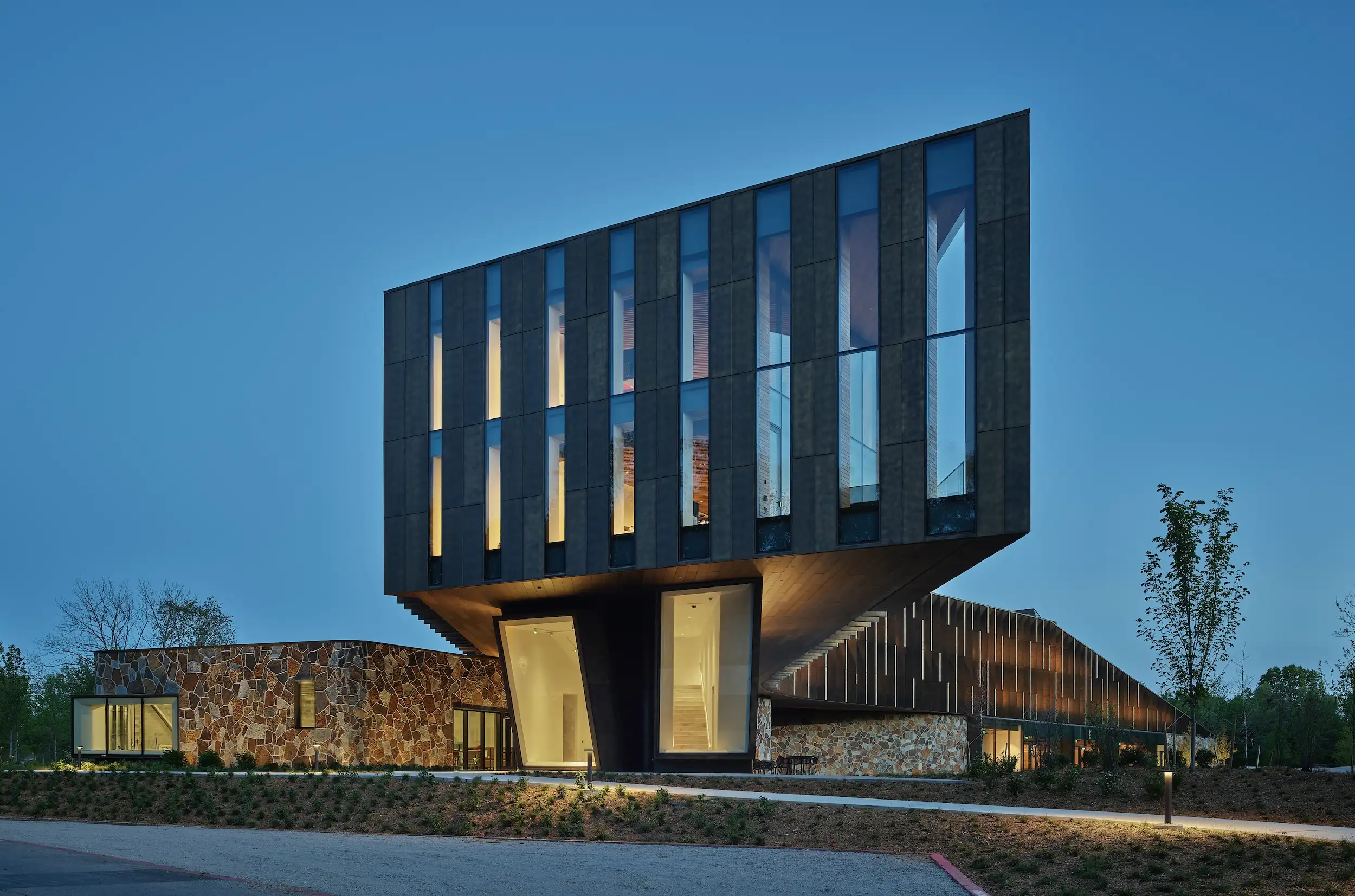
First proposed as a boxy timber edifice, the curvilnear building provides a seamless connection to the outdoors with ample glazing and shaded terraces. Photo © Timothy Hursley, courtesy Heartland Whole Health Institute
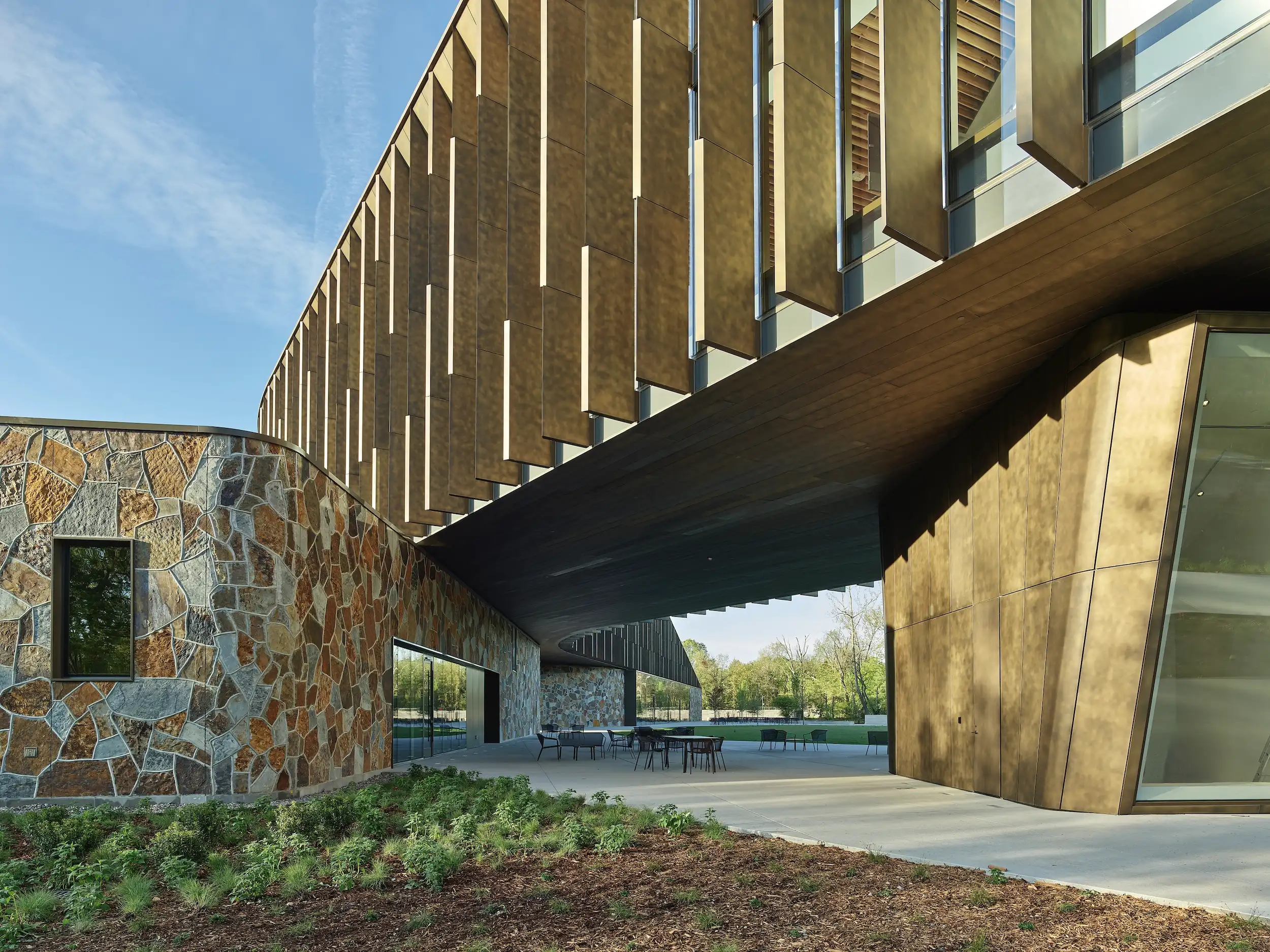
The public ground level of HWHI features an art gallery, event spaces, and a café. Outside, a monumental dogtrot serves as an inviting sheltered space for employees, museum guests, and locals to gather, especially during blazing hot Arkansas summers. The institute, which Blackwell describes as his Fayetteville firm’s first “museum-quality building,” is prominently positioned off the main drive that winds through Crystal Bridge’s trail-laced, heavily forested campus to Safdie’s museum, which is ensconced in nature at the bottom of a deep ravine.
1
2
3
Public spaces of the institute include an outsized dogtrot (1) and a gallery showcasing works such as Jun Kaneko’s Untitled, Heads (2). The lobby (3) features an undulating pecan-ply ceiling, Venetian plaster walls, and wool felt acoustic panels adjacent to the grand stair. Photos © Timothy Hursley, courtesy Heartland Whole Health Institute
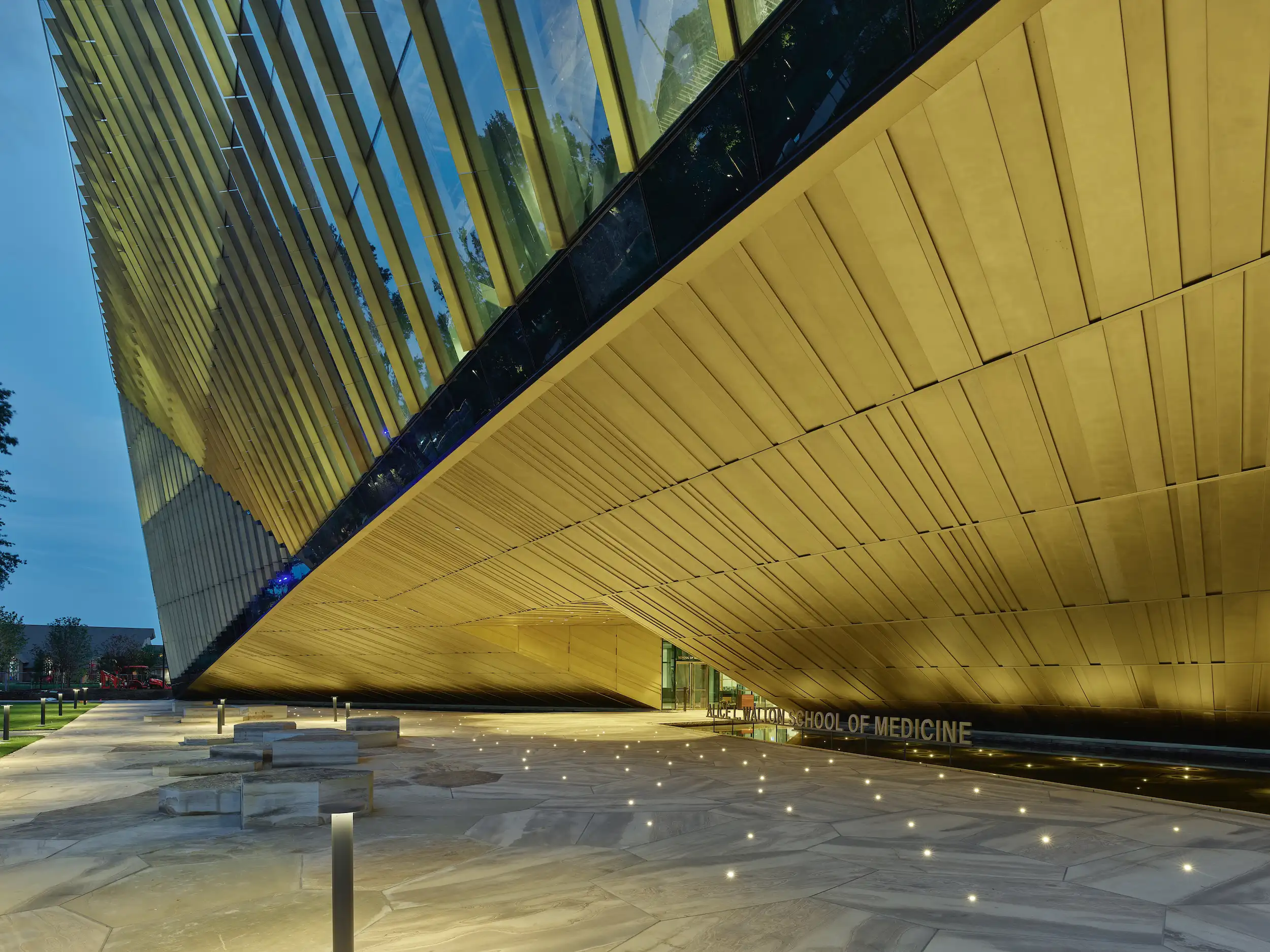
To the north of the HWHI along J Street, the other campus addition focused on transforming healthcare is the Alice L. Walton School of Medicine—also known by its peppy acronym, AWSOM. It received partial accreditation in October of last year and offers a four-year program centered on a holistic, whole-person approach that complements the transformative work underway at the institute. Like Blackwell’s curvilinear, sheltering building, AWSOM, designed by the Little Rock office of Polk Stanley Wilcox, takes its cues from the geology of the Ozarks albeit in a more starkly angular form. A core design feature of the exterior, which mimics the peaks and valleys of the Ozarks, is an abstracted “bluff shelter” on the street-facing east facade that cuts through the 154,000 square foot building.
Built from glass, precast concrete, and marine-grade brass, the spatially and technically sophisticated structure also has a multitasking program: the first level is home to a teaching clinic and public gallery while lecture halls, a library, café, theater, student lounges and a gym, administrative offices, and study areas populate the floors above. The facility also features state-of-the-art simulation and anatomy labs and a makerspace. Tucked beneath the four-story, steel-framed building is underground parking.

AWSOM’s main entry provides access to a clinic and public gallery. Beyond is the woodland amphitheater and its naturalistic water feature, which leads up to the rooftop park's second-level café plaza. Photo © Timothy Hursley, courtesy Alice L. Walton School of Medicine

The 8,000 square feet of perforated brass sunshade fins help to mitigate heat inside the school while allowing for abundant natural light. Photo © Timothy Hursley, courtesy Alice L. Walton School of Medicine
While the HWHI pays homage to the region through its organic form and materiality—including the building’s interior, with its local pecan woodwork, expanses of travertine flooring, and conspicuous splash of forest-referencing green felt in the lobby’s elevtore–core accoustical walls—AWSOM was envisioned as an extension of the landscape. To the west, the roof slopes down to the school’s surrounding public parkland and gardens—designed by project collaborator, the New York–based OSD: Office of Strategy + Design—and marks the start of a 2.1-acre rooftop park, its artificial topography created with geofoam, stacked, as OSD principal and creative director Simon David puts it, “like an oversized topo model.” Key features of the park include a woodland ramble that begins at the building’s base and leads to a sky meadow. Four stories up at the top of the park, where the roof grading is calibrated with the building slab, a scenic “bluff” overlook provides even more sweeping views. (The park’s scramble stairs are tied as the most unique method of accessing a rooftop from a building exterior in Bentonville.)
Back on lower ground, other elements across the school’s 14-acres of open green space include a manmade pond with a terrace and boardwalk, healing gardens, a teaching farm, and a “woodland amphitheater” complete with a cascading water feature. In total, more than 500 trees were planted on and around AWSOM—along with thousands more new plantings—including an allée of tulip poplars, replacing an existing tree-lined passage that was destroyed when a tornado tore across the Crystal Bridges campus in July 2024.
4

5

6
Detail of brass soffit with satin finish at the entrance (4); a student lounge looks out to the rooftop park (5); a lawn and tree-lined walkway lead to a welcome plaza at the front of the school, which straddles the neighborhood-campus divide along J Street (6). Photos © Timothy Hursley, courtesy Alice L. Walton School of Medicine
“From the beginning, we talked about doing a project where the site and building are indistinguishable,” explains Polk Stanley Wilcox principal Wesley Walls. “Alice didn’t want the building to overwhelm the site, so we came up with this idea about the building growing out of the landscape and letting the park roll up onto the building.”
As David adds, fusing the structure with not just the existing landscape but with the adjacent residential neighborhood across J Street was also an early strategy. It was about “making a handshake between those two things, uniting the community and landscape and elevating the qualities of each,” he says. “You see this concept in just about everything, from the massing of the building as a kind of big plateau, to the materials, which go from civic and honed to more crude and natural.”
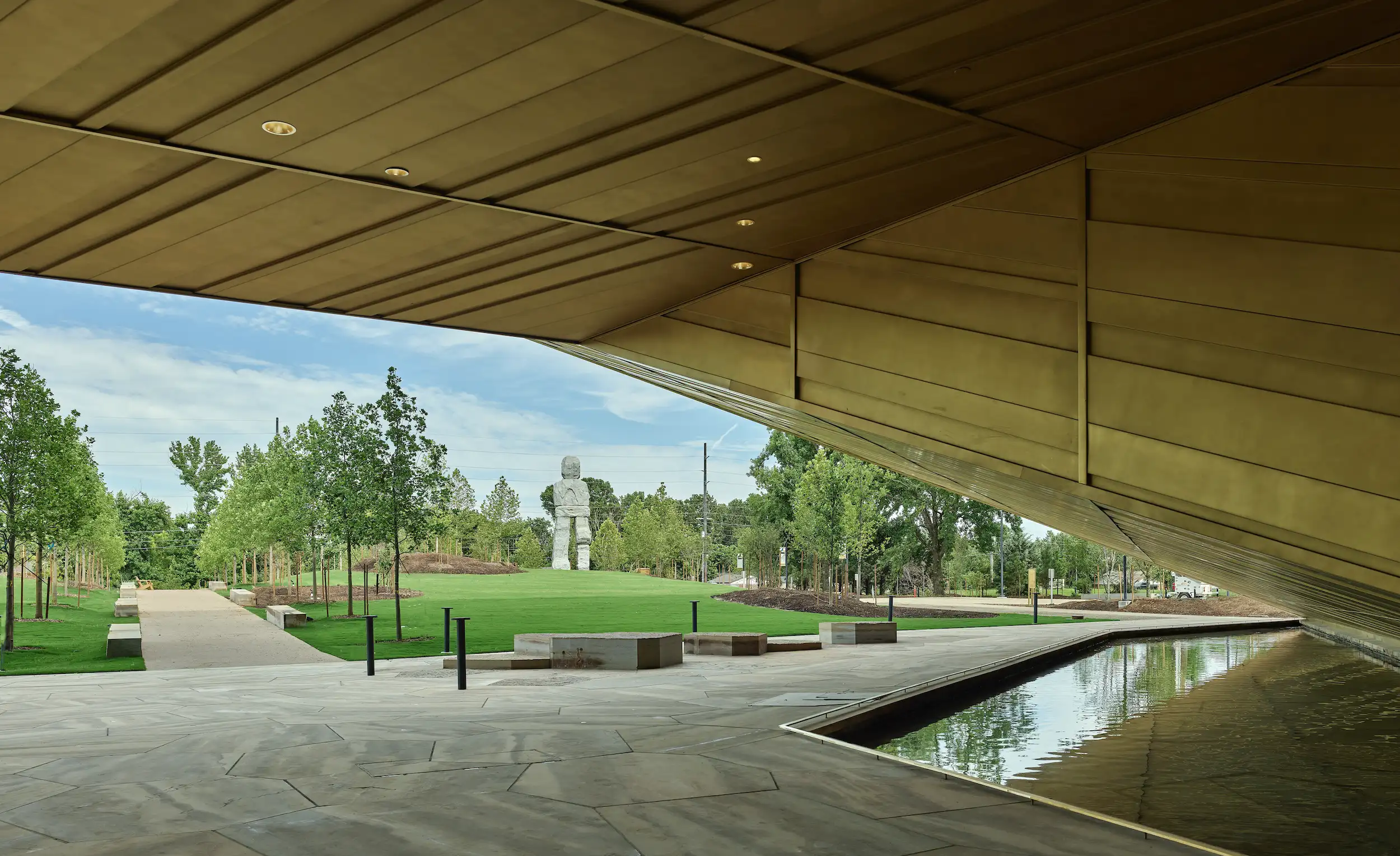
Looking out from the main entry of AWSOM toward Ugo Rondinone’s The Melancholic, 2015. Photo © Timothy Hursley, courtesy Alice L. Walton School of Medicine
Walton’s core mandates for both buildings were that they be integrated into nature, accessible to the public, reflect the history of the Ozarks, and, with Crystal Bridges, create a cohesive campus. It's a happy coincidence then that they, both won out of competition in 2020 (HWHI) and 2022 (AWSOM), were ultimately designed by architects based in the Natural State. (MBA is also the designer of the Crystal Bridges museum store and ArtPark, a new 6-story campus parking structure that doubles as community gathering space. Polk Stanley Wilcox, which joined the Walton Family Foundation’s Northwest Arkansas Design Excellence Program earlier this year, again teamed with OSD for a mixed-use development on J Street opposite AWSOM that will provide student and workforce housing. That project is slated for completion in 2027.)
“I didn’t set out to use Arkansas firms” says Walton. “But it means the world to me that they are, so that people, through these buildings and through this campus, learn about architecture in Arkansas.”
“What I wanted at Crystal Bridges was art and the healthcare worlds to collide,” she adds. “And with these buildings they now do.”
Looking for quick answers on architecture and design topics?
Try Ask RECORD, our new smart AI search tool.
Ask RECORD →
Looking for a reprint of this article?
From high-res PDFs to custom plaques, order your copy today!