MoMA Resurrects Kisho Kurokawa's Nakagin Capsule Tower in a New Exhibition

Japanophilia has a long history at the Museum of Modern Art. In 1954, MoMA had a timber house in Nagoya disassembled, shipped across the Pacific, and installed in its newly built sculpture garden on 54th Street. To accompany the installation, the museum’s longtime architecture curator, Arthur Drexler, published a 250-page treatise entitled The Architecture of Japan, which made the familiar claim that traditional Japanese design prefigured the free-flowing spaces of Modernism.
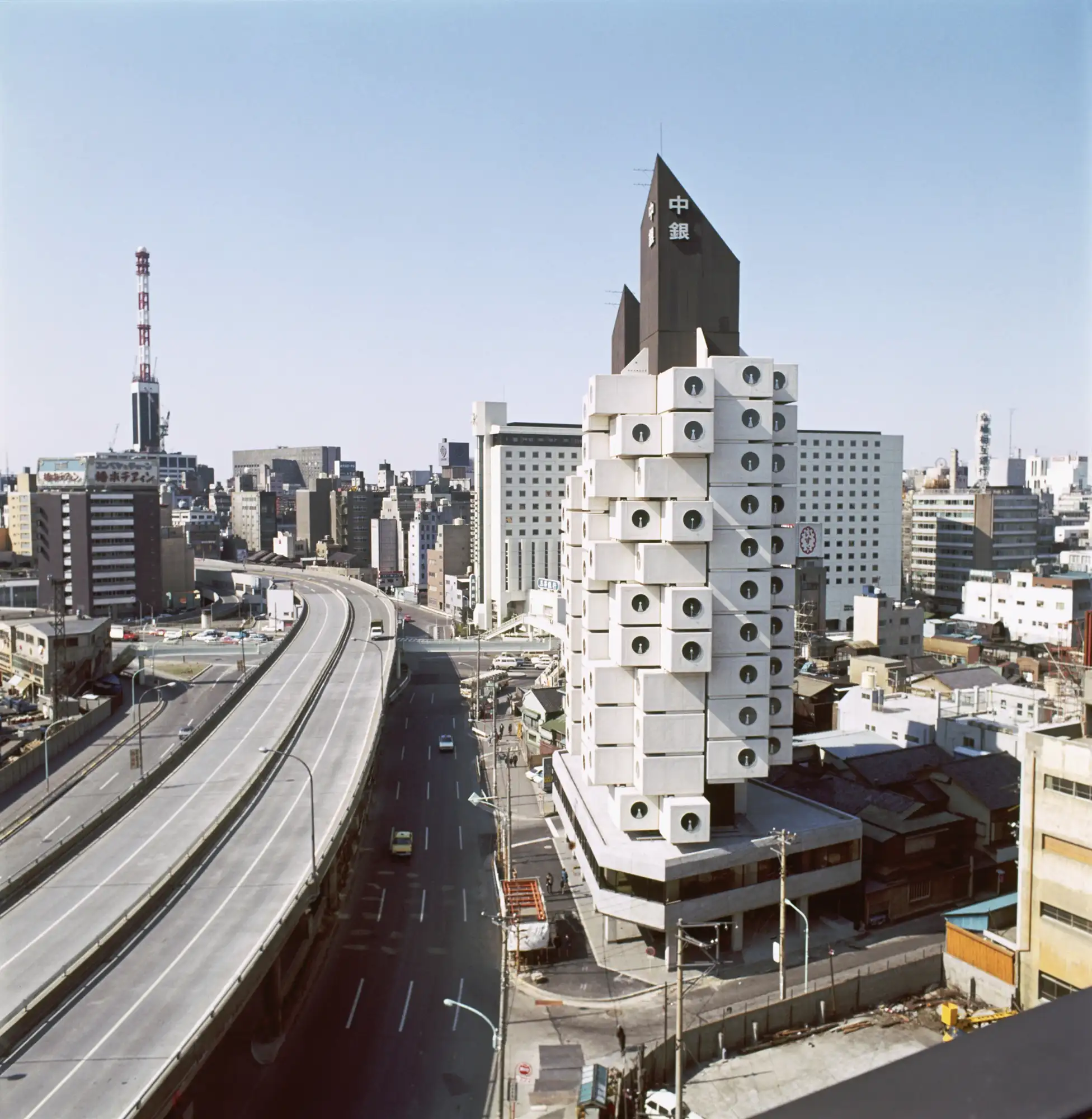
Kisho Kurokawa, Architect & Associates (Tokyo, est. 1962). Nakagin Capsule Tower, Tokyo (1970–72); exterior view, 1972. Photo by Tomio Ohashi
Seven decades later, a small but forceful MoMA exhibition centers around another dwelling unit that made the trans-Pacific journey: a capsule from the top floor of Kisho Kurokawa’s famed Nakagin Capsule Tower, an icon of Metabolism that was demolished in 2022 after decades of deferred maintenance. A group of residents who had banded together out of affection for the building organized the donation of the best-preserved units to museums around Japan and the world; MoMA received unit A1305, which, following a several-year restoration, has now made its American debut as the centerpiece of The Many Lives of the Nakagin Capsule Tower, organized by Evangelos Kotsioris and Paula Vilaplana de Miguel, which will remain on view through July 2026.
The curators initially considered placing the 8-by-13-foot capsule outdoors in the garden, but Kotsioris says they concluded that it “would be a disservice to reduce the capsule to a box” surrounded by famed works of sculpture. Instead, the show is housed in a street-facing ground-floor gallery added in the museum’s 2019 expansion, which turns out to offer several advantages. First, admission is free—no ticket required. Second, the streetscape, visible through floor-to-ceiling windows, feels like a natural backdrop for the capsule. (When you peer into the cramped living space within the capsule, you catch a glimpse of Eero Saarinen’s CBS Building through the porthole window.) And third, from the street, the capsule gives the distinct impression of a cute, one-eyed creature gazing out at its surroundings—and passersby, several of whom stopped to snap photos during my tour, have started taking note.


Installation views of The Many Lives of the Nakagin Capsule Tower, on view at MoMA through July 12, 2026. Photos by Jonathan Dorado
The Nakagin Capsule Tower, which cut a distinctive profile on the skyline of Tokyo’s Ginza district between its 1972 completion and its demolition, has long had a following outside the world of architecture—in no small part thanks to the efforts of its architect. The youngest of the original Metabolist group, Kurokawa (1934-2007) is better known for presenting the movement’s ideas about impermanence, humanism, and organic growth to the broader public than for his own theoretical contributions. Usefully, Many Lives dedicates considerable space to the publicity efforts around the building—both by Kurokawa’s office and the Nakagin company, its developer. Rejecting the cliched narrative of the tower as a “failed utopian project,” as Kotsioris puts it in a compact monograph published in conjunction with the show, the curators instead make a case for the tower to be seen both as a savvy commercial success and as an imperfectly realized material creation that would go on to have a profound effect on the people who occupied it.

Kishō Kurokawa in front of the completed Nakagin Capsule Tower, 1974. Photo by Tomio Ohashi
In an effort to appeal to suburban businessmen looking for pied-à-terres in the city center, Nakagin used savvy marketing to convince buyers to spend a hefty sum on exceedingly small units on the theory that their being replaceable in future decades was a useful feature. A slick promotional film on view in the gallery illustrates how the company achieved this feat by constructing an idealized image of the modern businessman: the project was “a worldbuilding operation, designing even the human,” as Vilaplana de Miguel puts it. (On account of several difficulties, including the presence of asbestos insulation, none of the capsules were ultimately dismounted or replaced—one of the main factors in the building’s deterioration.)
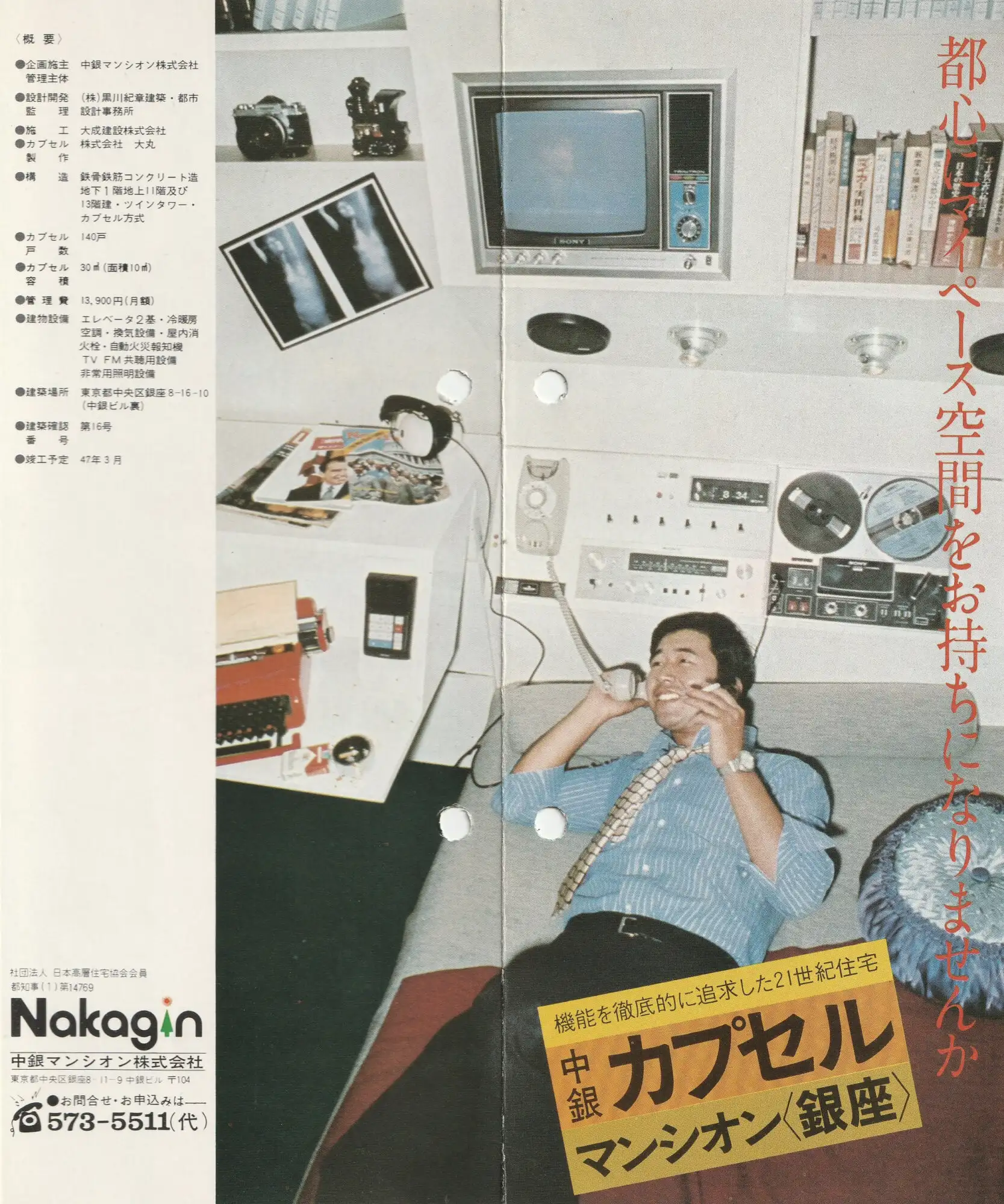
“A 21st century home that thoroughly pursues functionality: Nakagin Capsule Manshon (Ginza),” cover of promotional brochure for the Nakagin Company, 1971. Courtesy Tatsuyuki Maeda/The Nakagin Capsule Tower Preservation and Restoration Project, Tokyo
But the building’s design and conception occupy just a small portion of the gallery; the show’s larger focus is the many ways in which the tower was used, modified, and appropriated by its occupants. A series of photographs shows how different units were transformed over time—some became full-time residences, others offices, one a makeshift theater. Interviews with some of the tower’s final occupants reveal a diverse group of women and men who defied Nakagin’s highly gendered prescription. A 3D interior scan made before the demolition is presented at near-1:1 scale, allowing visitors to use a video game controller to navigate through the building’s spiraling hallways and into those units whose owners provided access. (One is left intensely curious about the units that remain locked.) At the center of it all stands capsule A1305, meticulously restored in true MoMA style. During open hours, visitors can look inside at the ingeniously compact furnishings, but due to its fragility and size, the capsule can only be entered during special events when supervising staff are on hand.

Images from Nakagin Capsule Style (Tokyo: Soshisha, 2020), showing Wakana Nitta (aka Cosplay Koe-chan) in her capsule, which she uses as a DJ-booth. Courtesy Tatsuyuki Maeda/The Nakagin Capsule Tower Preservation and Restoration Project
This attention to the everyday experience of architecture is welcome, particularly within the rarified walls of MoMA. It helps prevent the Nakagin tower from being presented as strange and exotic, or of offering simplistic lessons regarding the future of design—which is to say that it avoids the worst impulses of American institutions approaching Japanese material. The Many Lives of the Nakagin Capsule, by contrast, refuses easy answers. Instead it asks visitors to confront the tangled threads that together comprise the curious tale of one of the 20th century’s most imaginative structures.
Looking for quick answers on architecture and design topics?
Try Ask RECORD, our new smart AI search tool.
Ask RECORD →
Looking for a reprint of this article?
From high-res PDFs to custom plaques, order your copy today!