Sustainability in Practice Summer 2025
SOM Foregrounds Sustainability at a Multitasking County Office Building in Northern California
Redwood City, California

Architects & Firms
San Mateo County officials had a tripartite request for 500 County Center in Redwood City, a former timber town between San Francisco and San Jose. “They asked us if we could design an emblematic building, for a budget,” says Javier Arizmendi, principal and lead designer at Skidmore, Owings & Merrill (SOM), “and a super-sustainable one.” The ask involved collecting offices of several San Mateo departments—including county and district attorneys, the board of supervisors, human resources, and Budget, Policy and Performance Office—from nearby, unbeloved buildings into one new center. It resulted in a five-story, 207,000-square-foot design that meets these three requirements, and more.

The site is adjacent to other civic buildings. Photo © Dave Burk, click to enlarge.
The position of 500 County Center in Redwood City, and its facade, are meant to draw attention. Its site has civic structures and a parking garage to the north and a cultural and commercial district to the south. The building’s H-shaped plan, with two corner cuts, stands out from this context and creates outdoor areas opening to these two directions. The fully glazed lobby at the center of the H reads both as a through space between the two plazas and a gathering place. Community rooms—training center, gym, café, and the Chambers of the Board of Supervisors, a room that doubles as a public auditorium—add to the ground-floor activation. Above a white base in precast panels evocative of the granite used in many Bay-Area civic buildings, the center’s facade is wrapped in copper-anodized aluminum, which differentiates it from its many white-stuccoed neighbors but alludes to nearby historic brick buildings.

1
The copper-toned, metal-clad building (top of page) has a glazed lobby at the center of its H-shaped plan (1), linking two plazas (2). Photos © Dave Burk

2
To meet the county’s request for a design that kept costs within reason (the square-foot construction cost was $942), SOM considered the limited funds for its initial scheme. “Because the budget was so important,” Arizmendi says, “I knew that we had to start on a chassis, let’s call it, that was incredibly efficient.” Four circulation cores and two office wings allowed for the repetition of elements and for energy efficiency, which limited both construction and operational costs. The designers used simple materials—the concrete at the base, rather than stone, for example. They redirected some of the savings to details that users would experience intimately, such as bronze doors at the entrance and wood handrails in the exit stairwells. Purchasing some materials before Covid-era pricing made them unaffordable also helped the team meet San Mateo County’s budget.
SOM used both passive and active elements to reach its clients’ third goal of sustainability. Many of the passive factors are associated with managing the abundant California sun; these include a high-performance facade with a window-to-wall ratio of 40 percent and with operable windows used to night flush the building and precool its interior. The H-plan’s shallow floor plates help balance daylighting with solar heat gain. Active low-energy strategies also address the lighting load and include automated blinds, LED fixtures, and auto-off systems. In addition, an HVAC system using variable-air-volume and perimeter fan coil units, a heat-recovery chiller, and air-source heat pumps effected a 54 percent reduction in heating energy and a 19 percent reduction in cooling energy, according to SOM.
The designers set an initial energy budget at 23.1 kBtu/SF/year, well below the 33 kBtu/SF/year of a typical office in the area. The center is designed to meet 108 percent of its energy needs with renewables; solar arrays on the rooftop and on the nearby county-owned parking garage, as well as a power-purchase agreement with a local utility, assist in reaching this number. While operational data are not yet available, the new building is on track for LEED Zero Energy certification.
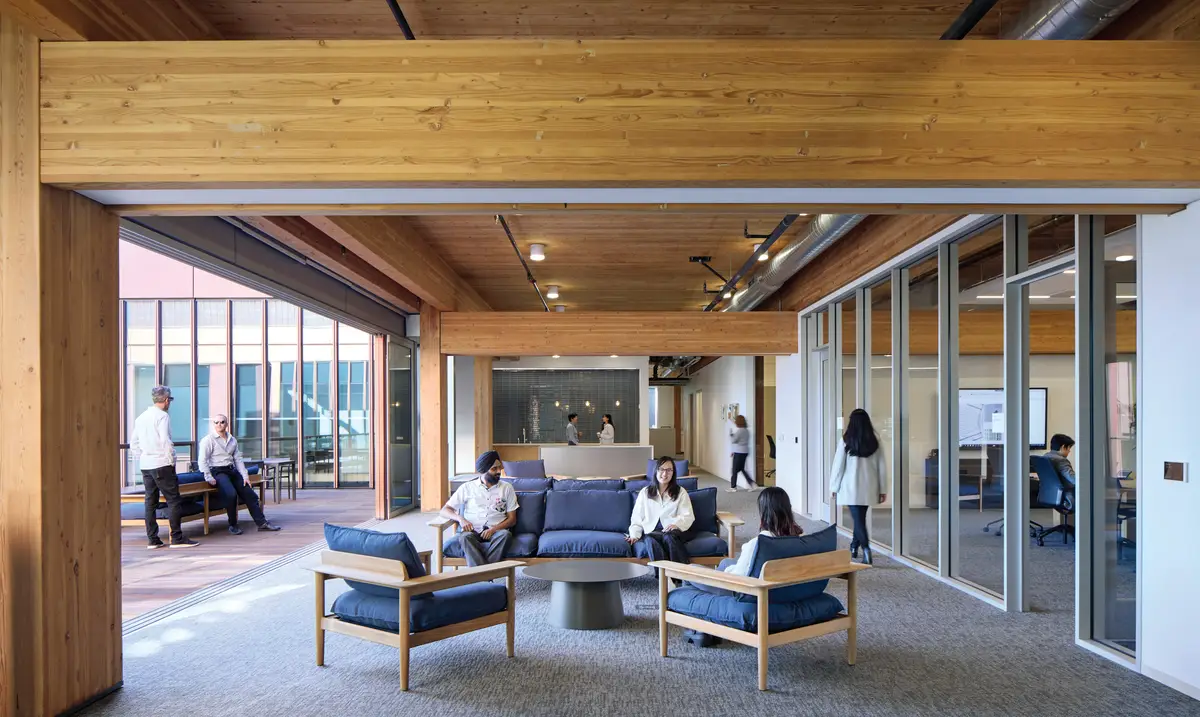
Net zero energy was not SOM’s only green goal. “For a building to be truly sustainable,” says Arizmendi, “it has to hit the operational-energy side, but also the embodied-energy side.” To make what he calls “an ultralow-carbon building,” SOM employed a mass-timber structure. The system has roughly 80 percent less embodied carbon than steel or concrete, taking into account the biogenic carbon stored in the wood, and, as a comparatively light structure, it required a smaller foundation and less excavation, contributing to a faster build. (Steel was necessary in the circulation cores and to span the ceiling of the large assembly hall.) Much of the timber structure is exposed, and finishes include Douglas fir and white oak, providing a look that seems on-brand for a former timber town. As San Mateo no longer has a thriving lumber industry, the material was sourced from suppliers in Oregon, Montana, Idaho, and Canada.
3
Much of the mass timber is exposed (3), with many finishes also made of wood (4). Photos © Dave Burk

4
The project is the first civic building in the U.S. that is constructed with mass timber and designed to achieve net zero energy. It has been visited as a model of green building by officials from Santa Clara and Sonoma counties and as far away as Australia. Local developers have also toured the work to consider ways to bring its sustainable lessons to Bay Area tech companies (albeit likely to have much larger budgets).
What makes the building truly sustainable may have less to do with its innovation than with the experience of occupying it. The center—with its inviting entrance, warm wood tones, cozy break rooms and breakout spaces, and a broad terrace facing downtown—seems a comfortable place to work. During a short site visit, on three separate occasions, employees, unprompted, were effusive about their happiness with their new office. “They love to come to work,” one woman said of her colleagues. “They used to work remotely; their old office was terrible.” If these few opinions are representative, then 500 County Center has good prospects for sustainability as a building that people will want to use for many years to come.
Click section to enlarge

Credits
Architect:
Skidmore, Owings & Merrill — Javier Arizmendi, Keith Boswell, Eric Long, Steve Sobel, Francesca Oliveira, Lonny Israel, partners and principals; Elissa Gee, Matthew Wasylciw, Ty Peterson, Gabriella Giungato, Rachel Johnson, Francke Wurzelbacher, Enrique Acosta, project team
Consultants:
Skidmore, Owings & Merrill (structure); Atelier Ten (sustainability); Cosco Fire Protection (fire/life safety); Meyers+ Engineers (AV/IT/security/acoustics/m/e/p/fp/commissioning); CMG Landscape Architecture (landscape); PritchardPeck (lighting)
General Contractor:
Truebeck Construction
Mass Timber Subcontractor:
Western Wood Structures
Client:
San Mateo County—Project Development Unit
Size:
207,000 square feet
Cost:
$195 million (construction)
Completion Date:
September 2024
Sources
Mass Timber:
SmartLam North America, DR Johnson, CoreBrace
Metal Cladding:
POHL, Hydro, Linetec, IFS Coatings, Morin
Glazing:
AGC Glass Unlimited, AGC Interpane, Vitro, GlasPro, TGP, Glassfab
Doors:
Florian Industries, Curries, VT Industries, Panda Windows & Doors
Hardware:
Schlage, Von Duprin, CRL, HID
Acoustical Ceilings:
Armstrong World Industries, Turf, Arktura, Rulon International
Special Surfacing:
3form
Tile:
Marazzi, Royal Mosa, Heath Ceramics, Fireclay Tile, Design and Direct Source
Lighting:
Lumenwerx, USAI, Glint, Bocci, Zaniboni, Extant, BEGA, Juniper, Neri
Bathroom Fixtures / Partitions:
American Standard, Kohler, Grohe, Elkay, Bobrick
Looking for quick answers on architecture and design topics?
Try Ask RECORD, our new smart AI search tool.
Ask RECORD →
Looking for a reprint of this article?
From high-res PDFs to custom plaques, order your copy today!