Newsmaker: In Conversation with Chicago Architecture Biennial Artistic Director Florencia Rodriguez

As the Windy City gears for the September 19th opening of the sixth cycle of the Chicago Architecture Biennial, RECORD caught up with Florencia Rodriguez, artistic director of what’s become the largest public architecture exhibition in North America.
Rodriguez, an Argentinian architect, author, publisher, and educator who served as the director of the University of Illinois Chicago School of Architecture from 2022–2025, spoke to us from Buenos Aires about this year’s theme, SHIFT: Architecture in Times of Radical Change. She also hints at some of the highlights of CAB 6, which will take place at the Chicago Cultural Center—the biennial’s traditional anchor venue—and at off-site locations across the city. The biennial, as always, is free.
A list of the 100-plus CAB 6 participants, including Michael Maltzan Architecture, Productura, MASS Design Group, Natura Futura, 2017 CAB artistic directors Johnston Marklee, and many others, can be found here along with other details. CAB 6 runs through February 28, 2026.
Tell us about the thinking behind the theme of SHIFT, and the importance of seeking new paths and embracing collaborative change.
The idea of having a theme that was broad and open was important for me as I didn't want to mark just one line of thinking. I wanted to address the radical transformations that we are going through, things that sometimes we take for granted or just adapt to. Collective exhibitions like CAB give us the opportunity to talk and think about these things with others. I chose an approach that would represent many things at the same time while opening up specific lines of research, which will be presented in the form of smaller capsule exhibitions with different themes. SHIFT, in that sense, represents the spirit of the era in a way. There are so many things going on, and we need to react to them—we cannot look the other way.
One of the capsules is about housing. Another, ‘Fragmented Manifestos,’ is related to recent historical moments that I wanted to bring into the conversation. In November, we are opening a big capsule exhibition at the Hancock Center called “Ecologies” whose purpose is to move us away from the traditional understanding of nature and present new approaches as to how we think about the built environment.

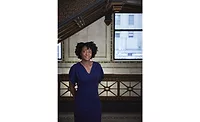
Photo by Noah Sheldon
You’ve referred to architecture and design as inherently optimistic disciplines. Optimism for the future, however, can be hard to muster these days when you read the news and turn on the TV.
Looking for quick answers on architecture and design topics?
Try Ask RECORD, our new smart AI search tool.
Ask RECORD →
Architecture, in general, is related to the future, and you must deal with things that are problems and things that you love and want to incorporate into a project. With design and architecture, we are always immersed in industry, fabrication, understanding the possibilities of new materials, and learning how to deal with specific weather conditions. And we need to make that more part of the conversation. So, it's not a naive optimism, but more about generating or supporting the mindset that we do have a role in participating in that production of possible futures. A world without solutions is a world without desire.
There are many diverse voices involved in CAB 6 as participants, many of them based in Latin America. What unique qualities can these participants bring to the table that architects or designers based in the U.S. or other parts of the world might not be able to?
It felt very organic for me to bring Latin American offices to the biennial. I’m not objective [laughs] but I think the best production right now is happening in Latin American architecture. There’s a sort of inheritance from Modernism but we’re finally finding another way to think more philosophically in contemporary terms about the world we are in. All the years that I’ve been publishing my own work here in South America I've been kind of fighting against that Modernist heritage in terms of it being an intellectual corset that wouldn't allow new narratives for architecture. And that's the value of what I see today: there are new things going on but based in genealogy in a way that’s interesting.
In Latin America there is great responsibility regarding materials and a certain mindset—you do the best with what you have and see opportunity in crises. And that is something that I would like to bring to the biennial in terms of learning from the South. Whether you work in an emerging country or a very developed country, there's likely something that we cannot build the same. But we can learn about the strategies or the thinking that got you to that place.
It seems that CAB 6 shifts its focus back to “straight” architecture when compared to recent past cycles of the biennial. Is that accurate?
I'm not sure if the next biennial will continue in the same path as it is young and still shaping itself, but this was part of my intention as a curator. I wanted to show how architecture can respond to different issues and discuss the tools that architects bring to all these shifts and transformations. So, yes, there is a kind of return to architecture although artists and other designers were also invited to participate.
Relatedly, architects Sharon Johnston and Mark Lee, artistic directors of CAB’s second edition, are returning as participants. Can you tell us more about their involvement?
I really wanted to celebrate past artistic directors of the biennial. In the case of Johnston Marklee, I also worked with them in Venice this year with Christopher Hawthorne for Speakers’ Corner. It was a fantastic collaboration, and we wanted to continue with that spirit of finding a space for criticism and conversation at CAB as well. It will be sort of a second chapter, probably smaller but just as powerful, in Chicago.
Aside from what’s been mentioned, are there particular installations, exhibitions, or programming that you’re excited about seeing unveiled?
There are many highlights and so many different layers. R&R Studios, an Argentinian office based in Miami, will be doing something fun with the concept of ‘public luxury.’ Other participants will be thinking about everyday spaces but looking at them through different lenses. There will be contributions that focus on the magic of everyday life and bigger pieces that I hope are provocative and fun.
Something very important to me is the exhibition catalogue, which will be launched in November. It's not a typical catalogue—it’s more a book about conversations. For me, it's another piece of the exhibition that’s very relevant, and that I hope keeps on circulating afterwards.
Is there a single message that you’d like visitors to CAB 6 to come away with?
I don't want everybody to go with the same message. I want people to feel that they’ve been invited to think differently. I believe in the value of certain discomfort—it’s important to be open to the possibility to change the way we think about things, particularly at this moment in which we’re being pushed to one pole or the other. And that’s the spirit of SHIFT: You take away something that provokes a little bit of change.
Looking for a reprint of this article?
From high-res PDFs to custom plaques, order your copy today!