The Sixth Chicago Architecture Biennial is at Its Strongest When Championing Design as a Tool for Social Good
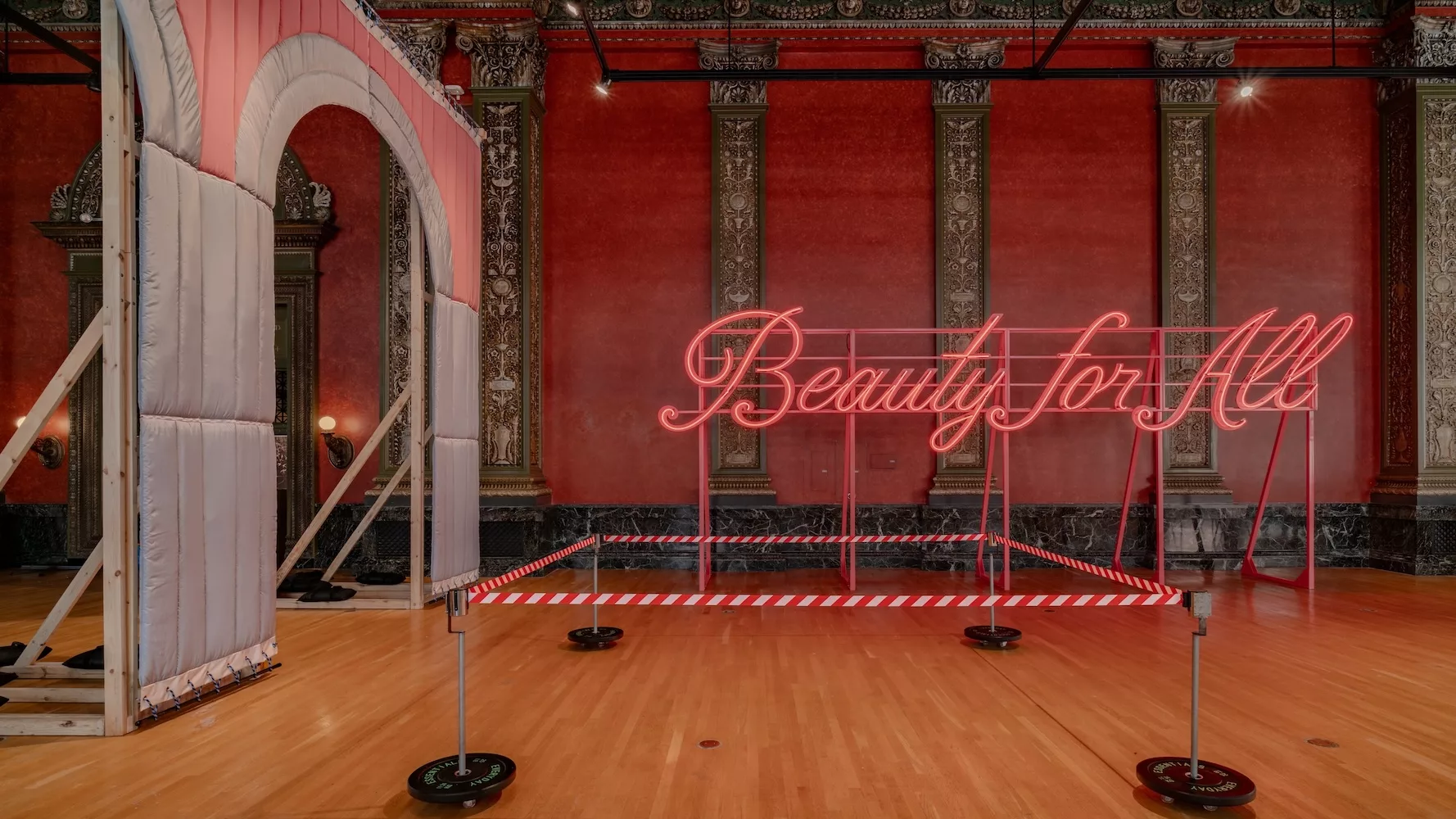
Installation views of BURR’s Minor Tectonics (2025) and Beauty for All (2025) by R&R Studios at the Chicago Cultural Center, one of multiple exhibition sites for the sixth Chicago Architecture Biennial,
During the lead-up to the September 19th opening of the Chicago Architecture Biennial (CAB)’s sixth edition, Shift: Architecture in Times of Radical Change, there was curiosity as to whether artistic director Florencia Rodriguez would pull off a shift all her own by recalibrating the exhibition to have a renewed and more sharply defined focus on the subject promoted in its very name.
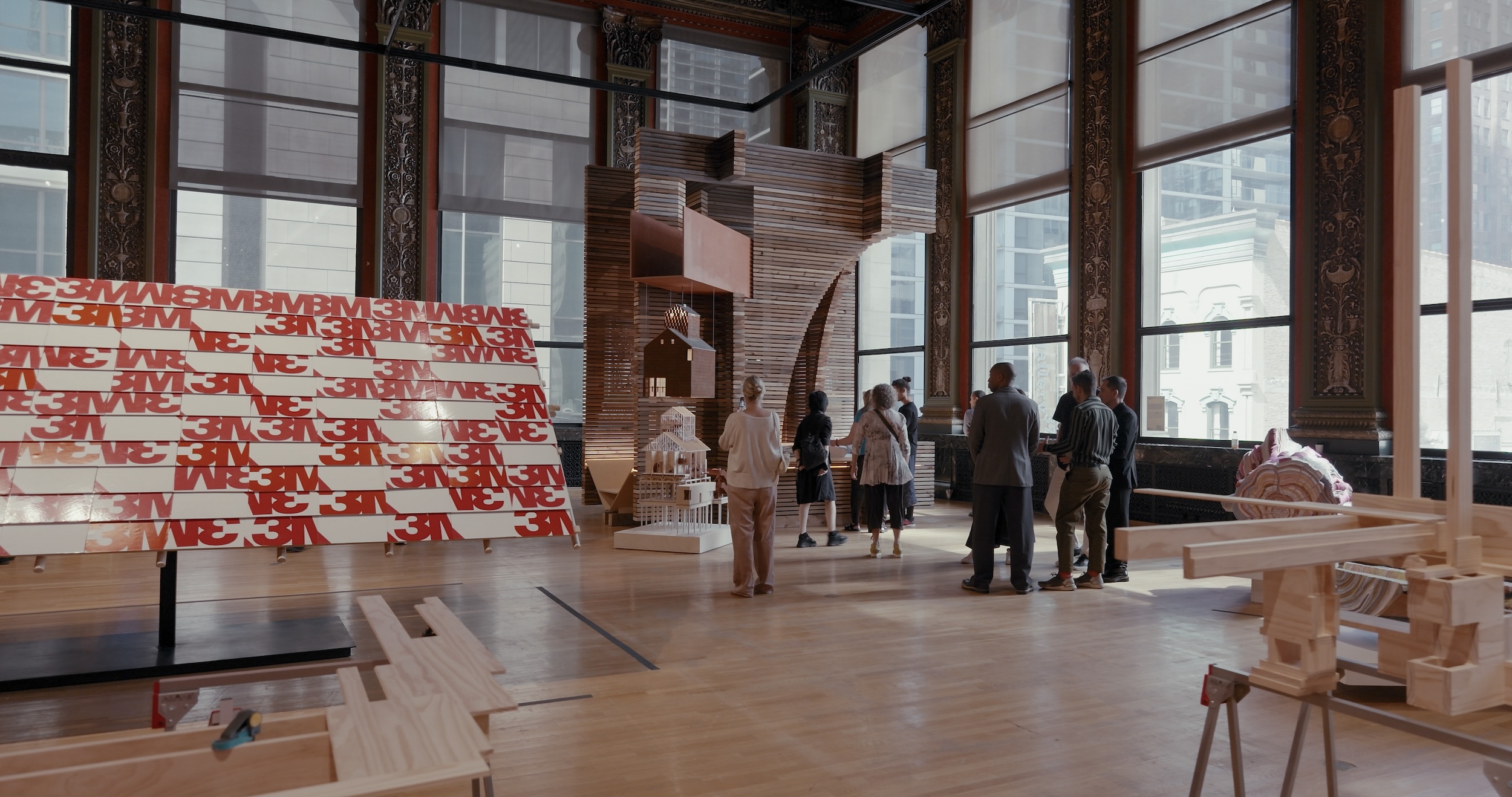
Various commissioned works are on view in the Chicago Cultural Center’s Yates Gallery through February 28. Pictured here, among other works, is Shifting Reuse and Repair by LA DALLMAN Architects (center) and Air Vapor Barrier (left) by Oscar Zamora and Michael Koliner. Photo © Robert Chase Heishman, courtesy the artists and Chicago Architecture Biennial
Rodriguez, a Buenos Aires–based architect and academic who recently concluded a three-year post as director of the University of Illinois Chicago School of Architecture, confirmed to RECORD in August that this was indeed her intention as a curator. “I want to show how architecture can respond to different issues and discuss the tools that architects bring to all these shifts and transformations,” Rodriguez said, referring to the need to adapt during an unpredictable time marked by social, political, and environmental crises. “There are so many things going on, and we need to react to them—we cannot look the other way.”

2025 Chicago Architecture Biennial director Florencia Rodriguez stands in front of The Linen Closet (2025), a work by artist and designer Jason Campbell of ellProjects, at the Chicago Cultural Center. Photo © Robert Chase Heishman, courtesy the artist and Chicago Architecture Biennial
While not always successful, Rodriguez has put together an exhibition more cohesive than recent editions of CAB. Those, while not lacking in ambition and standout commissions, suffered from fuzzier curatorial approaches that were more of a free-for-all. Shift feels tighter—more intimate, more urgent—and, ultimately, more focused on the practice of architecture, even though it’s not always entirely clear what sweeping changes some of the more than 90 participants are responding to. This reining-in is aided by CAB’s downscaled footprint within the Chicago Cultural Center, which largely limits the exhibition to gallery spaces on the first and fourth floors. The soaring Sidney R. Yates Gallery and adjacent main exhibition hall are where Shift’s more monumental installations—such as the puffy, towering fabric arches of BURR’s Minor Tectonics and the glowing pink hue of Beauty for All by R&R Studios—can be found. On a tour during opening weekend, Roberto Behar, cofounder of R&R Studios, referred to his practice’s urban-billboard-riffing light installation as a “gentle visual manifesto.” In a biennial providing more than a few Instagram-friendly backdrops—including not one but two inflatable installations—Beauty for All takes the proverbial cake.

Variations in Mass Nos. 5, 6, 7 (2025) by Jacqueline Kiyomi Gork. Photo © Robert Chase Heishman, courtesy the artist and Chicago Architecture Biennial
BURR, an experimental practice based in Madrid, and R&R Studios, established in Miami by Argentinian partners, represent just a small sliver of Shift’s many Spanish-speaking participants. Practices from South America comprise a particularly sizable share of the exhibition roster, which Rodriguez describes as an “organic choice.”“In places like Latin America, there is great responsibility regarding materials, and a certain mindset—you do the best with what you have and see opportunity in crises,” she said.
The biennial also benefits from Rodriguez’s curatorial technique of dividing Shift into loosely themed “capsule” exhibitions; most were unveiled on opening weekend, with others to be rolled out gradually throughout the biennial’s five-month run. One of the capsule exhibitions not to open in September is Ecologies, which debuts November 7 in a vacant retail storefront at 840 North Michigan Avenue on Chicago’s Magnificent Mile. Among the more than 30 participants presenting at the site include Johnston Marklee, Worofila, The Bittertang Farm, Oshinowo Studio, Natura Futura, and Estudio Planta.

1

2
Building by Writing (2025) by Stan Allen (1) and Hard Sun Interstate (2025) by Sam Chermayeff Office and Hard Sun (2) at the Graham Foundation. Photos © Robert Chase Heishman, courtesy the artists and Chicago Architecture Biennial
In addition to that forthcoming satellite exhibition, longtime biennial partner institution the Graham Foundation, and artist Theaster Gates’s Stony Island Arts Bank, also serve as venues for the capsules Fragmented Manifestos and Melting Solids, respectively. Featuring works by participants such as Diller Scofidio + Renfro, Stan Allen, MOS with Tony Cokes, Abigail Chang, and WAI Architecture Think Tank, both sites are worth the detour from the Cultural Center. Also farther afield is Traces, a work conceived by Balsa Crosetto Piazzi in collaboration with Giordis Ortiz. Assembled using 10,000 dry-stack bricks on the front lawn of the Griffin Museum of Science and Industry at Jackson Park, the large-scale installation, meant as a commentary on permanence, roughly outlines the footprints—certainly not to scale—of the many grand yet ephemeral structures that populated the “White City” of the 1893 Chicago World’s Fair.

Surfaces in Flux (2025) by Objects of Common Interest/LOT and 11x17’s Two Foundations (2025) on display at the Chicago Cultural Center. Photo © Robert Chase Heishman, courtesy the artist and Chicago Architecture Biennial
Two of the stronger Shift commissions are presented as architectural models. Staged in the Yates Gallery, Fragments of Disability Fictions presents four New York spaces—John Portman’s Marriott Marquis in Times Square and Chelsea Piers among them—reimagined through the lived experiences of disabled people past, present, and future. Eschewing model foam for a deliberately unpolished mishmash of wood and paint, the models, each accompanied by a “science fiction story” narrated in audio, ASL, and captioning, were conceived with input from disabled scholars, activists, and policymakers. The models and corresponding stories invite biennial-goers “to rethink who cities are built for—and how different ways of moving through the world can lead to better futures for everyone,” explains the team—Ignacio G. Galán and David Gissen, with Alessandro Orsini and Nick Roseboro of Architensions (a 2024 Design Vanguard firm). “They don’t offer utopian futures, but imagine spaces in which disabled lives can flourish, while also presenting their struggles and battles,” elaborated Galán at the opening. Joining the four models is a large map depicting the islands around Manhattan—traditionally used as spaces of confinement for disabled people, with psychiatric hospitals and such—depicted as “spaces of self-determination for different disabled communities.”
Looking for quick answers on architecture and design topics?
Try Ask RECORD, our new smart AI search tool.
Ask RECORD →
.JPG "2025 chicago architecture biennial")
A model created for Fragments of Disability Fictions (2025) by Ignacio G. Galán, David Gissen, and Architensions. Photo © Robert Chase Heishman, courtesy the artist and Chicago Architecture Biennial
In the Cultural Center’s first-floor Michigan Avenue Galleries is an oversize model of the Forget-Me-Not-Pavilion by Chicago-based Kwong Von Glinow, also a former Design Vanguard. It proposes the repair and reuse of the Chicago Horizon Pavilion, a lakefront structure designed by Ultramoderne and meant to be temporary, commissioned for the inaugural 2015 edition of CAB. Built from cross-laminated timber, the structure still stands, but has fallen into a state of neglect. “We wanted to reveal Ultramoderne’s intentions even more by finding a second life for the pavilion,” said firm cofounder Alison Von Glinow at a panel discussion held on the opening weekend at the Graham Foundation. “I think the interest and care that we need to show for the built environment, especially civic environments, is critical. We named our pavilion Forgot-Me-Not because it references the flower but also the need to remember that it is not something that just goes on forever and ever—we need to maintain it.”
The curatorial thrust of Shift, an exhibition ostensibly about adaptation, can sometimes feel slippery. But it is works like these, which clearly position architecture as a means to social good, where the latest iteration of CAB most securely finds its footing.
The sixth Chicago Architecture Biennial runs through February 28, 2026.
Looking for a reprint of this article?
From high-res PDFs to custom plaques, order your copy today!