Building Technology November 2025
Ross Barney Architects’ Foglia Center in Illinois Brings Thoughtful Design to Industrial Spaces
Crystal Lake, Illinois

Architects & Firms
As the cost of four-year degrees at colleges and universities grows ever less affordable, two-year programs at community colleges are becoming an increasingly attractive option for higher education. But the campuses of these institutions have generally not been places of great architectural distinction. That is changing. If you want proof, look at McHenry County College (MCC) in Crystal Lake, Illinois, 45 miles northwest of Chicago, where Ross Barney Architects (RBA) has recently completed the Foglia Center for Advanced Technology and Innovation (CATI), a sophisticated hub for research, technology, and creative collaboration.
MCC, established in 1967, focuses on workforce training. “This isn’t an Ivy League institution,” says RBA design principal and founder Carol Ross Barney, recipient of the 2023 American Institute of Architects Gold Medal. “It’s just a small community college in rural Illinois, trying to prepare students for both traditional and emerging technologies and trades.” MCC has forged strategic relationships with local manufacturers who need employees with such training, and CATI was designed to meet this demand, putting its graduates on a path to good jobs.
The new 48,000-square-foot facility is named after local manufacturers and philanthropists Vince and Pat Foglia. Located at the southeastern edge of MCC’s campus, it’s flanked by an access road and parking lots. It was not a promising site, but Ross Barney and her team made it work by integrating their project cohesively with existing buildings. They inserted a bar—an elongated rectangular volume—parallel to an adjacent bar of automotive shops to the west. The void between them functions as a service drive. To the east is a landscaped stormwater-infiltration basin.
1
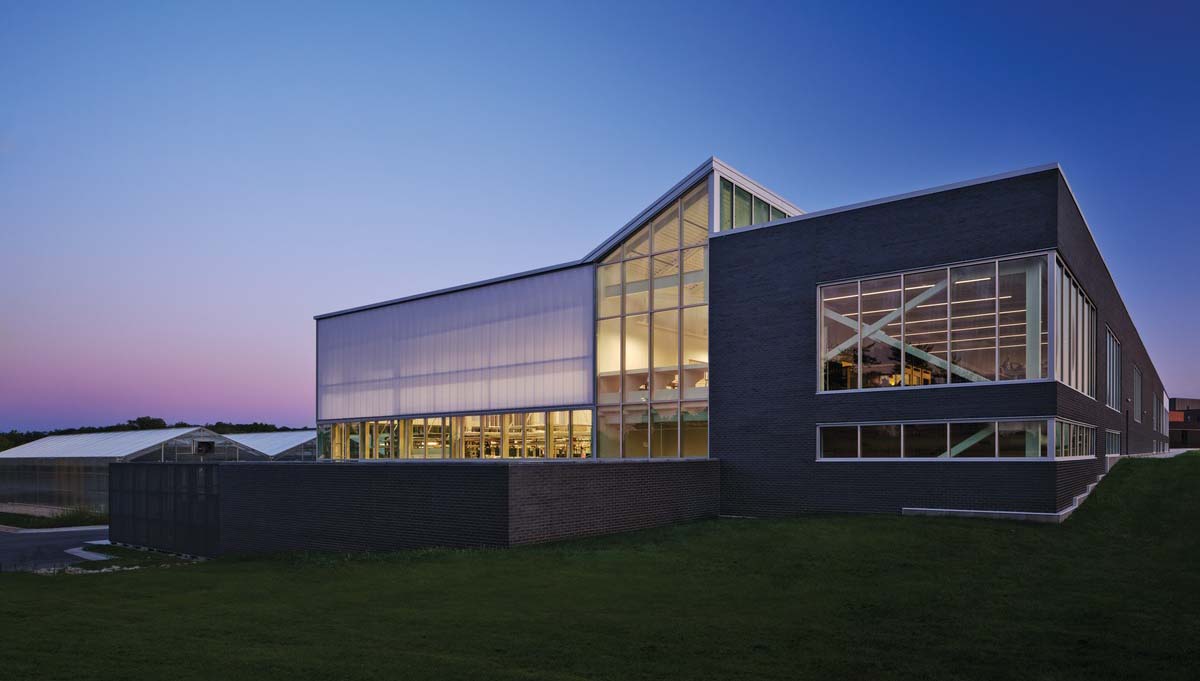
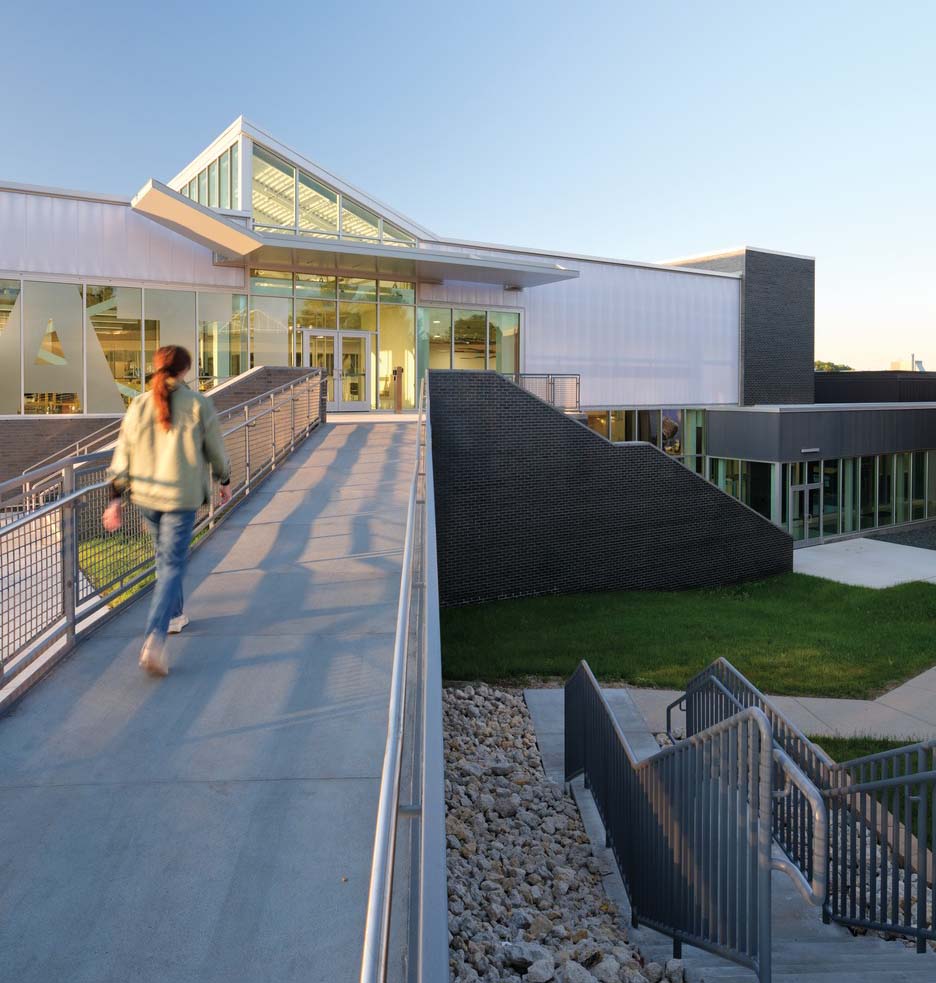
The long bar building (top of page) is bisected by a shed-roofed clerestory (1 & 2). Photos © Kendall McCaugherty
2
Several additive elements punctuate the straightforward rectilinear massing: a long shed-roofed clerestory rises above a flat roof; two mechanical wells project out and up from the west facade; and the lower level of the south wall extends to enclose an outdoor lab. At the north end is the main entrance, a sculptural collage that includes a generous canopy, a long ramp, and two stairs, one of which leads down to a lower-level entry.
Bar buildings may appear simple in site-planning diagrams, but there’s a lot going on inside this one to accommodate a varied program. “I’m a plan freak,” says Ross Barney, “and this plan is informed by the allocation of resources.” A circulation spine below the clerestory divides the volume asymmetrically along its length and offers open areas for informal collaboration, relaxing, socializing, and studying.
To the east are two floors of classrooms and labs for engineering technology, artificial intelligence (AI), industrial maintenance, manufacturing, and computer numerical control (CNC) milling, along with administration, service spaces, and a metal-fabrication shop. A makerspace, showcasing robotics and 3D printing, is located near the entry and open to the public. In tandem with an adjacent conference room, it serves as an incubator for students, faculty, and outside manufacturing partners to meet, share ideas, and develop prototypes.
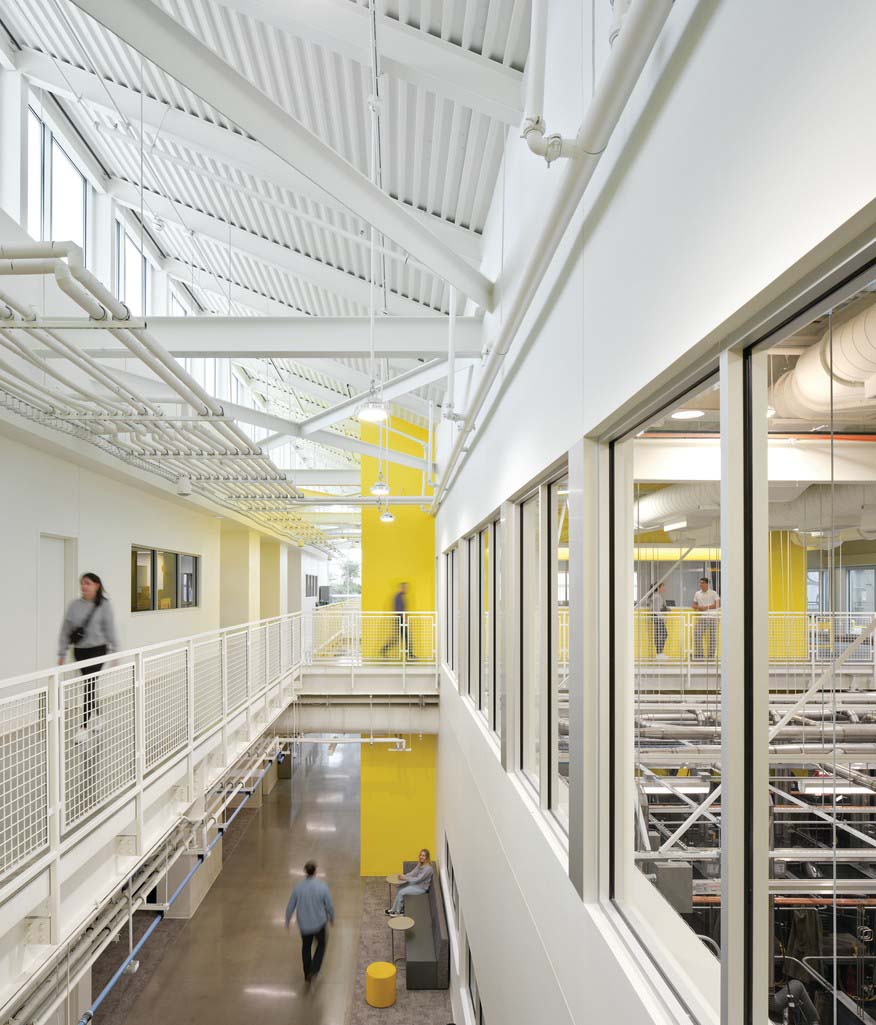
To the west are three double-height labs for welding, HVAC, and more CNC milling, plus a stair with tiered seating that serves as an occasional lecture hall and event space. On the second floor, the circulation spine pulls back from the labs, allowing daylight from the clerestory to reach the floor below, while also forming catwalks protected by gridded steel railings. These provide opportunities to observe activity in the labs, whose enclosures incorporate plentiful glass, putting their impressive inner workings on display and offering an astonishing degree of transparency.
Looking for quick answers on architecture and design topics?
Try Ask RECORD, our new smart AI search tool.
Ask RECORD →
Because the fields of study offered here are advancing rapidly, flexibility was key to planning for the future. Demountable drywall partitions between classrooms can be easily removed and relocated, making it possible to combine classrooms or change their sizes as needed. Spare electrical capacity allows for new equipment, such as more robotics gear than originally anticipated, which is already moving in.
The high-bay labs for welding, CNC fabrication, and HVAC accommodate tall equipment and the cranes that move it. “This drove their design,” says Ryan Giblin, RBA principal in charge. Conduits for power, data, and compressed air are located on overhead grids, further facilitating flexibility. Strategic planning of equipment use and location minimized redundancy, helping to reduce building size—and therefore cost—by more than 10 percent from the original program.
The HVAC lab opens to a walled outdoor space that contains condensers and air-handling units. A heated floor slab allows classes to use this area in winter. Because HVAC technology is a major component of the curriculum, the building’s mechanical wells are exposed and accessible, to create opportunities for teaching and learning.
The material palette is intentionally restrained. “Applied materials, particularly finishes, can add significant cost to a construction project,” says Giblin. “On public projects where budgets are limited and maintenance is an ongoing concern, we often look to utilize natural materials that are expressive, durable, and cost-effective.” This frugal strategy paid off. Construction cost was $562.50 per square foot despite price escalations during the pandemic —modest for a high-tech academic building.
Outside, an insulated cavity wall of ironspot brick over steel studs, generous aluminum-framed storefront glazing, and translucent polycarbonate panels wraps the building. Corrugated metal, both solid and perforated, surrounds the mechanical wells. These humble materials combine to poetic effect at the southwest corner. “The twilight view into the HVAC lab shows that even ductwork and valves can be beautiful, turning technical craft into a source of inspiration,” says Ross Barney with justifiable pride.
3
4
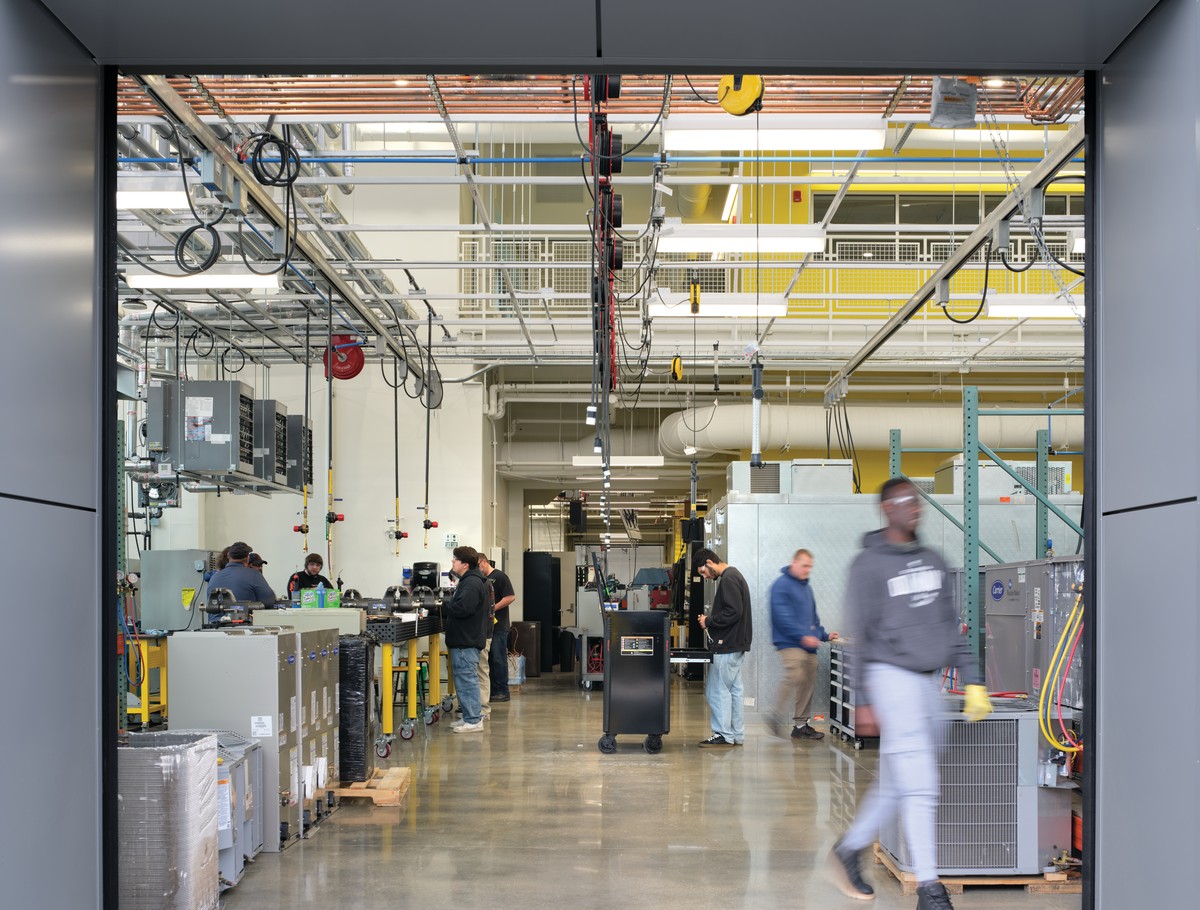
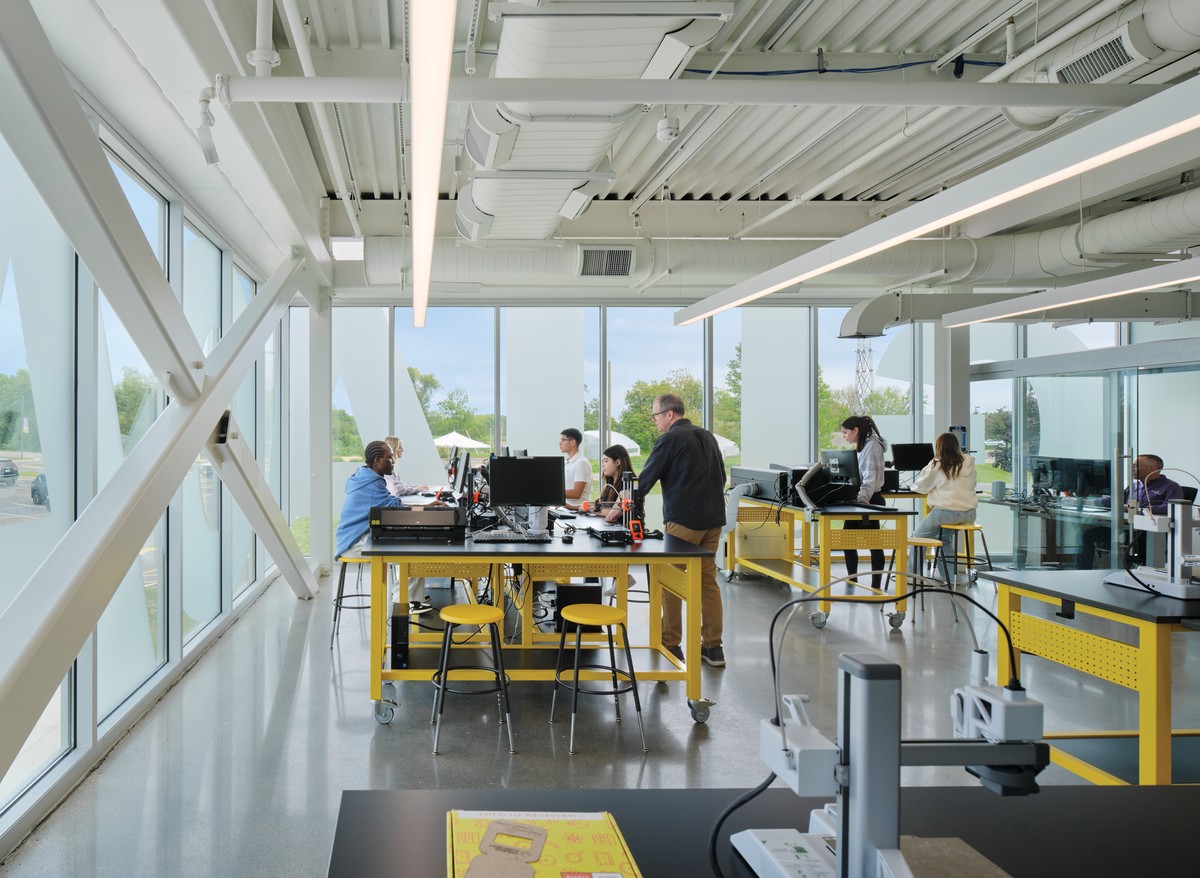
Interiors feature concrete floors and exposed steel, pipes, and ducts (3 - 5). Photos © Kendall McCaugherty
5
Inside, floors are highly polished warm gray concrete with visible aggregate. Structural steel is exposed, ducts and pipes are uncovered, and just about everything is painted white. A vivid shade of yellow accents furnishings and highlights computer labs, whose vertical volumes punctuate the circulation spine. The result is sophisticated and refined, transcending the project’s tight budget. “Everyone who comes through here says there’s an elegant utility to it,” says MCC president Clint Gabbard, who consistently pushed for high-quality design.
“It’s not enough to have space,” says Ross Barney. “It has to be space you want to be in.” With this project, she and her colleagues have succeeded handsomely in achieving that goal and in raising the bar for architecture at community colleges.
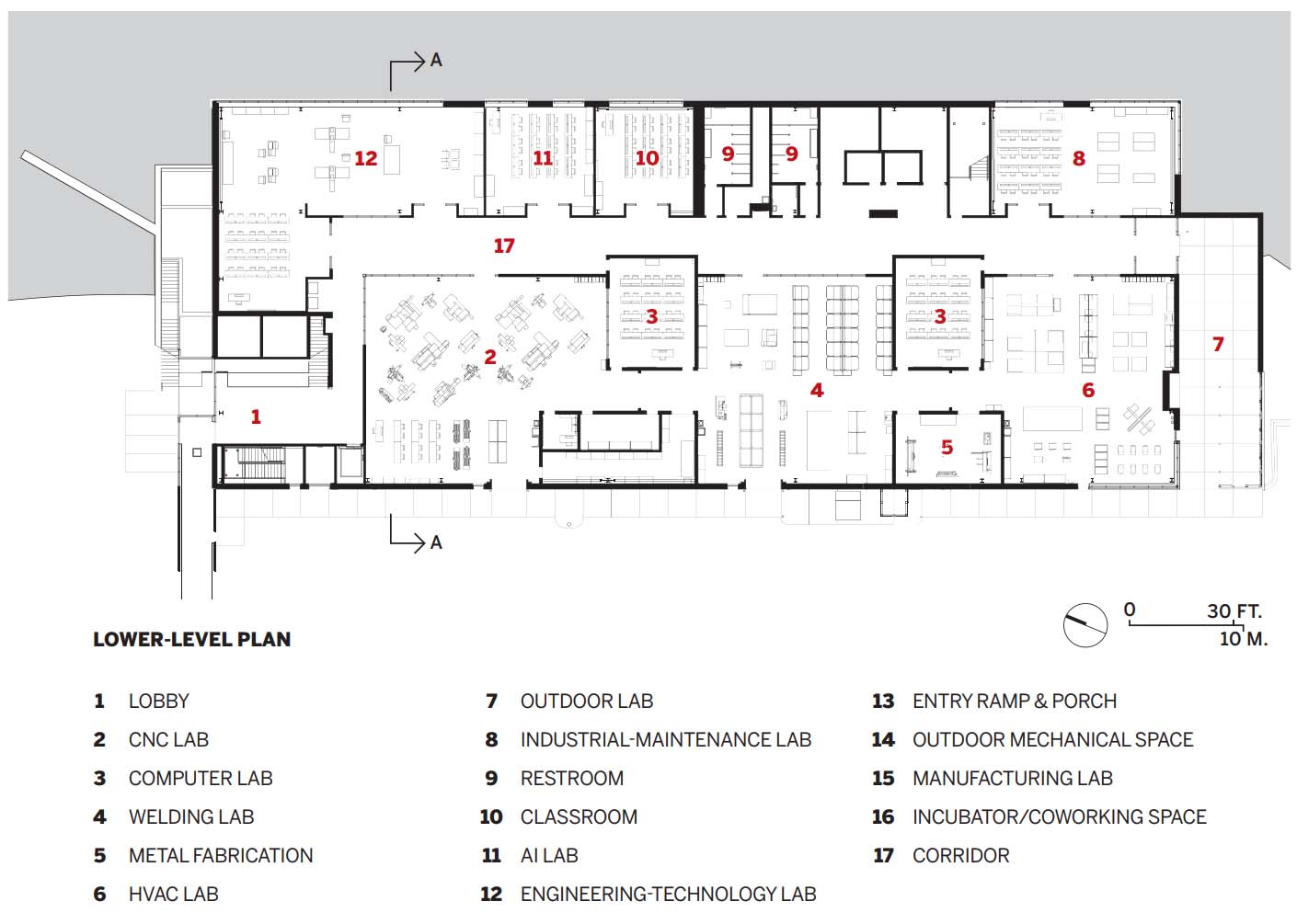
Image courtesy Ross Barney Architects
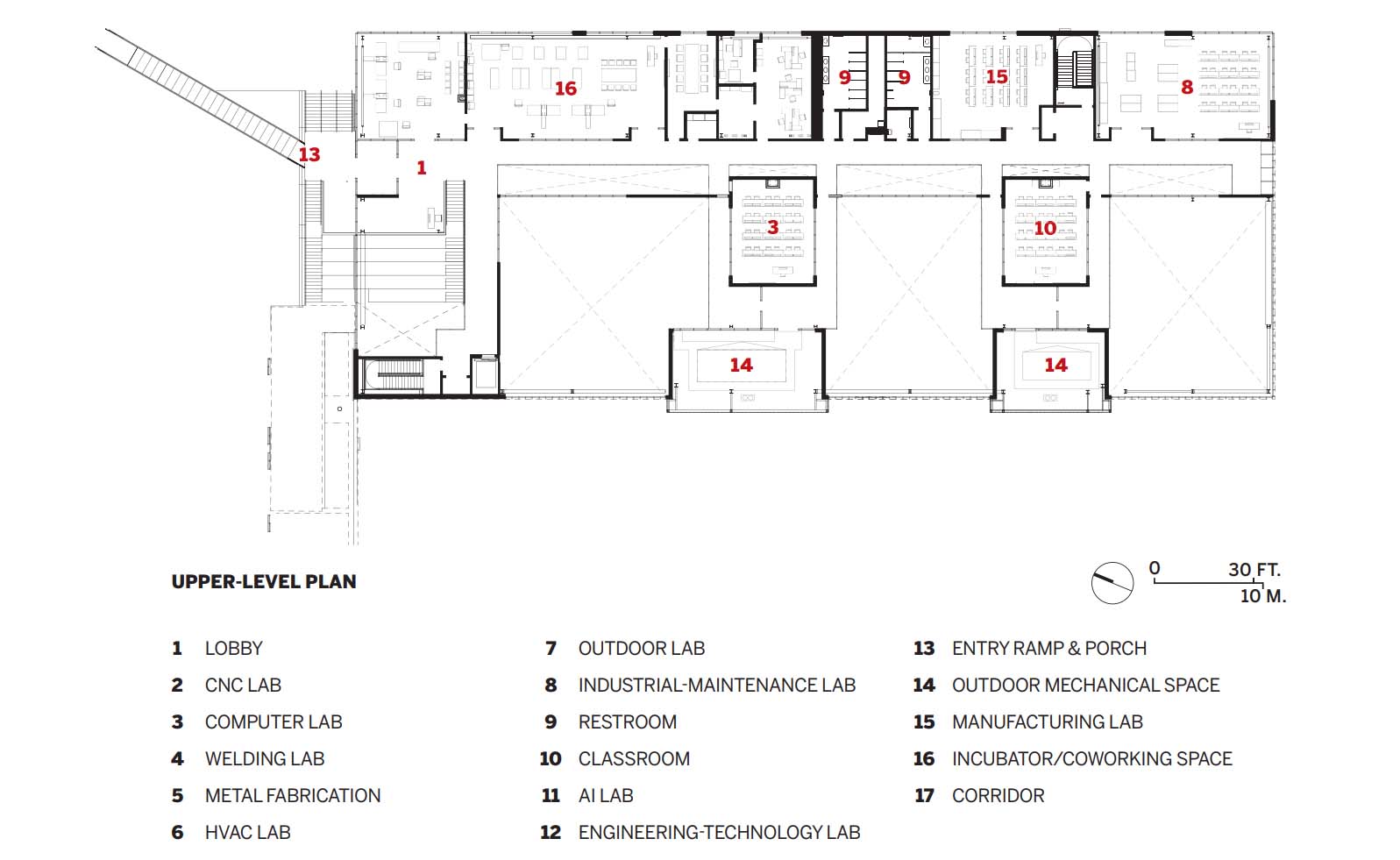
Image courtesy Ross Barney Architects
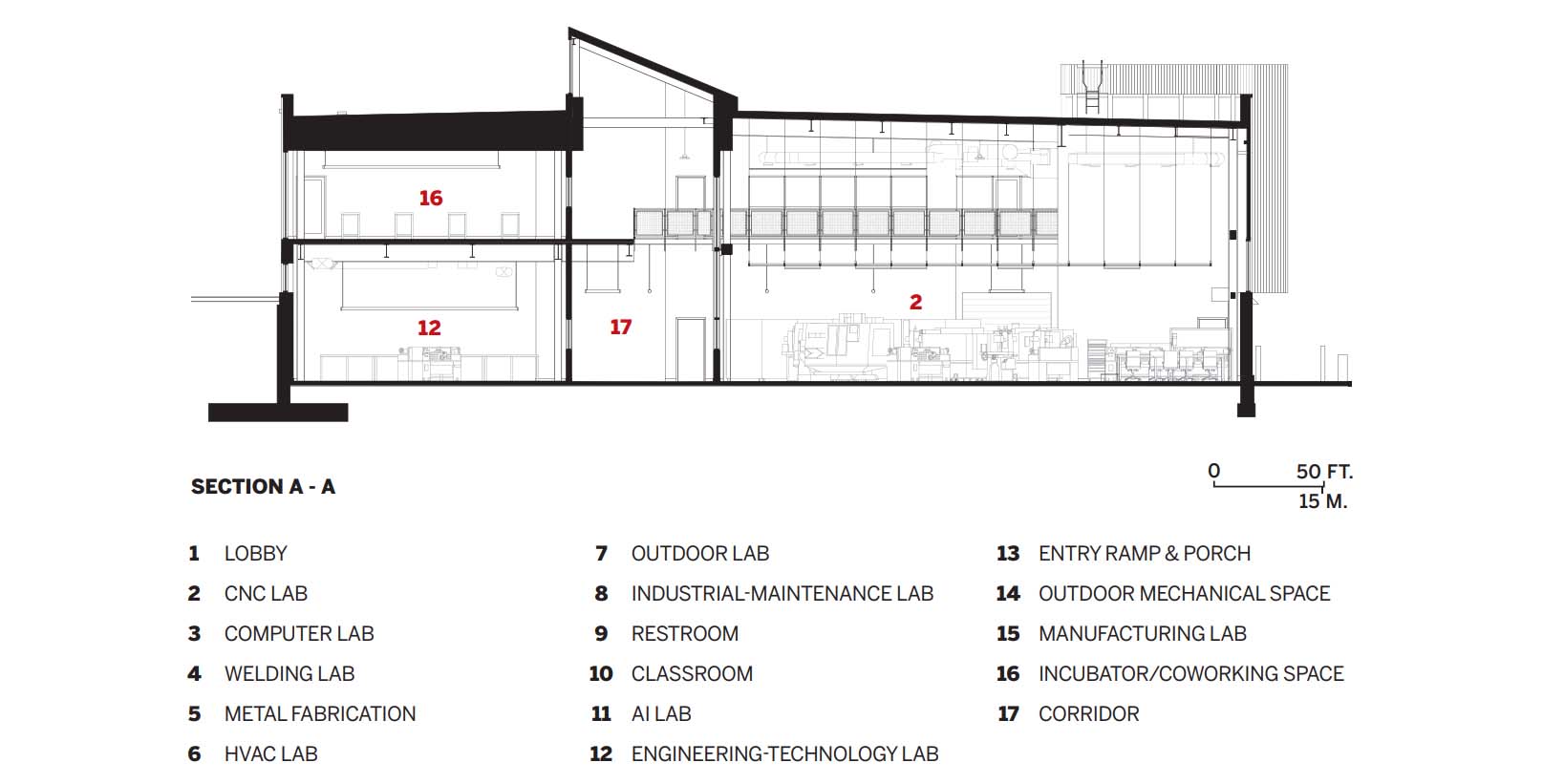
Image courtesy Ross Barney Architects
Credits
Architect:
Ross Barney Architects
Engineers:
Thornton Tomasetti (structural); dbHMS (m/e/p, fire protection); Orion Engineers (civil)
General Contractor:
The George Sollitt Construction Co.
Client:
McHenry County College/State of Illinois Capital Development Board
Size:
48,000 square feet
Cost:
$27 million (construction)
Completion Date:
August 2024
Sources
Curtain Wall:
Oldcastle BuildingEnvelope
Exterior Cladding:
Pac-Clad (metal); Endicott Clay (masonry); Henry (moisture barrier)
Roofing:
Carlisle
Lighting Controls:
Leviton
Elevators:
Schindler
Looking for a reprint of this article?
From high-res PDFs to custom plaques, order your copy today!