After a Prolonged Closure, the Studio Museum in Harlem Moves Into Its New Home
New York
Studio Museum in Harlem
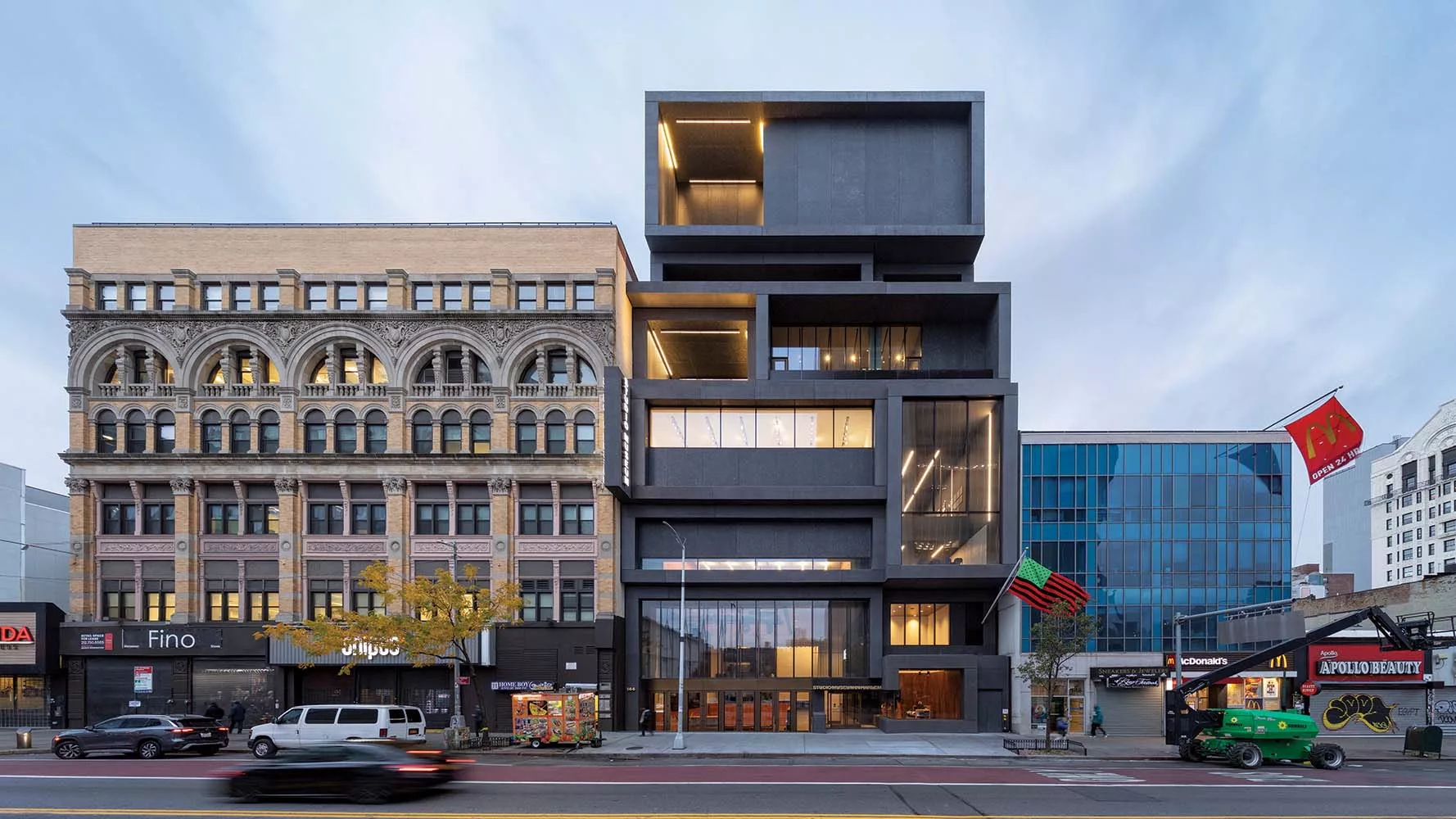
The Black Lives Matter social justice movement—triggered by the murder of George Floyd in May 2020—precipitated a frenzy in which museums across the United States scrambled to acquire work by Black artists, to diversify their collections. Promoting the work of African American and other artists of African heritage is what the Studio Museum in Harlem has been doing since its founding in 1968. Indeed, the gallery, located in its early days in rented rooms on upper Fifth Avenue and operating on thin budgets, hosted the first public showings of many Black artists whose work is now in the collections of the country’s most august institutions. This art-loving New Yorker is grateful to the Studio Museum for the introduction to artists like Barkley L. Hendricks, Mickalene Thomas, Simone Leigh, and Kehinde Wiley, long before the last was commissioned to paint a presidential portrait. Another artist who benefited from exposure to the museum’s audience was the Ghanaian-British architect David Adjaye. I remember his 2007 show there—the first presentation of Adjaye’s architectural work in the United States—for its novelty. In addition to photographs and drawings of 10 of his public building projects (some not yet built), tables in the gallery presented models at three different scales and samples of materials with which Adjaye was experimenting that were meant to be touched, much like an exhibit at a high school science fair. Fast-forward 18 years, and Adjaye’s bold sense of materiality and public imagery is again on display, this time as the Studio Museum’s splendid new building, which opened on November 15. This is the museum’s first purpose-built home after occupying a series of quarters including, for 30 years, space carved out of a turn-of-the-last-century office building. As such, the inauguration of the new museum represents not just a significant addition to New York’s cityscape, but an astonishing achievement of institution-building, decades in the making.
The Studio Museum is one of two art museums designed by Adjaye Associates in collaboration with Cooper Robertson to open in the U.S. this fall. (The other is the Princeton University Art Museum, featured in the November issue of RECORD.) Both were well into construction when Sir David fell from grace following allegations of sexual misconduct.
Adjaye Associates’ material of choice for this masterwork is black concrete, rendered in many forms and to richly varied visual and tactile effect, from large precast facade components with both honed or polished faces, to gray-black terrazzo floors and stairs, velvety interior wall panels, and dark polished-concrete floors in the galleries. Ebonized oak—yet another black—encloses a luxurious reading room on the fourth floor. This symphony in black brings to mind Amanda Williams’s brilliant 2021 installation at New York’s Storefront for Art and Architecture, titled What Black Is This, You Say?, for which she had each panel of the gallery’s kinetic facade painted with a different commercial “black” paint—all black, to be sure, but clearly suggesting a more complicated story. This is a perfect metaphor for the Studio Museum’s mission to explore the many aspects of Blackness by being “the nexus for artists of African descent, locally, nationally, and internationally, and for work that has been inspired and influenced by Black culture.”
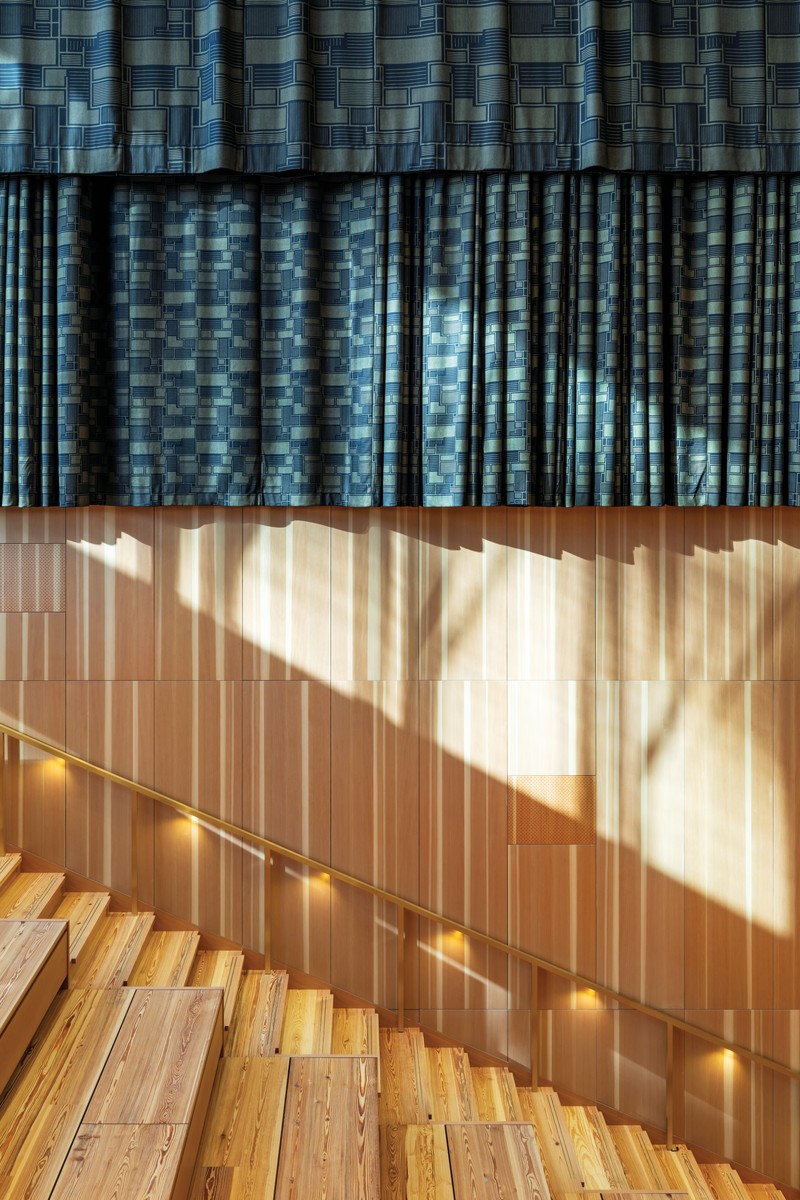
One enters the Studio Museum from 125th Street, Harlem’s bustling main street, through a low-ceilinged vestibule and into a dramatic, 26-foot-tall lobby. The ground-level streetfront is fully glazed, yielding total transparency between inside and out, and flooding the interior with daylight. The first floor of the building features an amphitheater with steps and tiered seating platforms that descend to the basement level, where a sleek café is located. Although the stair-as-seating has become a ubiquitous architectural trope, a feature of too many cultural and academic facilities built in the last decade, here it justifies itself, taking the place of lobby seating and of a formal auditorium (heavy curtains can curl around the space to enclose it). The pinewood that lines the pit offers warm contrast to the dominant black terrazzo. This amphitheater is called “the Stoop,” but it is the inverse of the stoop on a classic Harlem brownstone, which provides a seat from which to look out onto the life of the street and to chat with neighbors. In this case, it is the passerby who is invited to look in and view. The exterior glass wall folds open, with the intention that in mild weather people in the community will feel welcome to enter the museum (admission is pay what you wish) and hang out on the tiered seating, fulfilling the Stoop’s role as a social space. I will be curious next spring to see how this works.
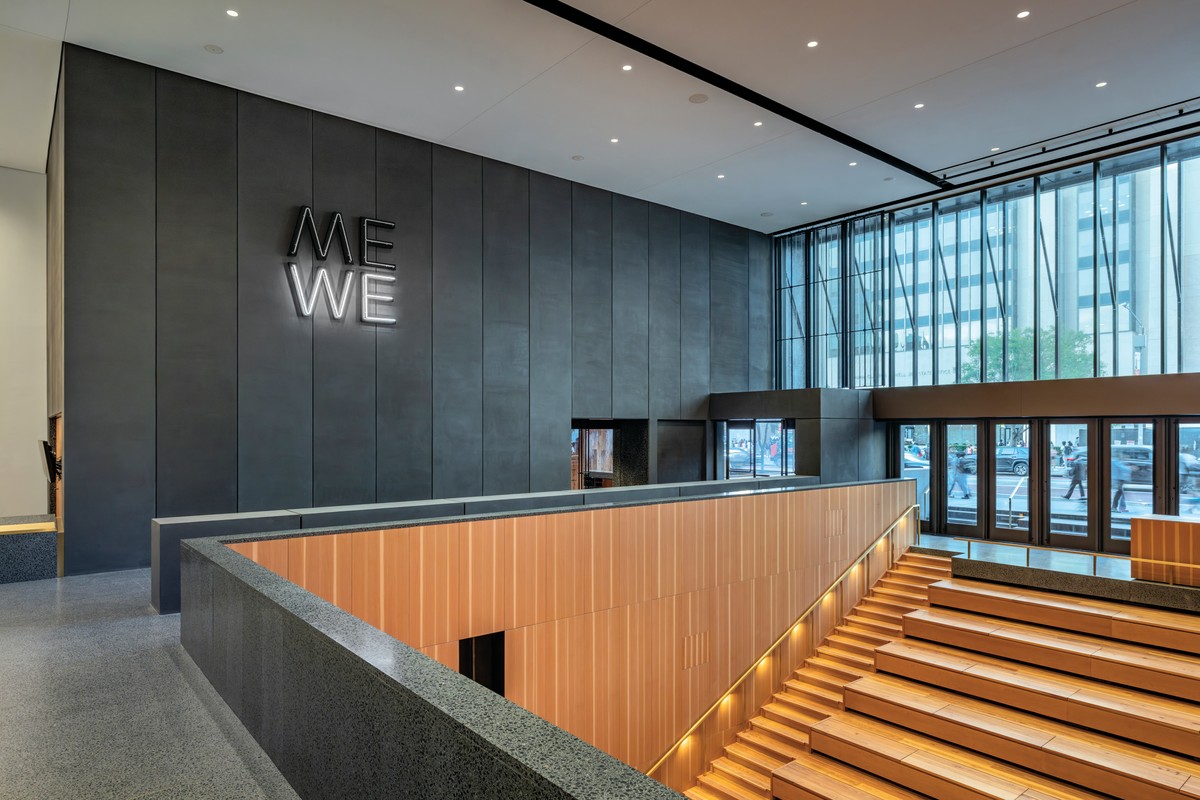
Passersby on 125th Street (top of page) can peer into the new museum and look down at “the Stoop” (above). Photo © Albert Vecerka/Esto, click to enlarge.
1
2
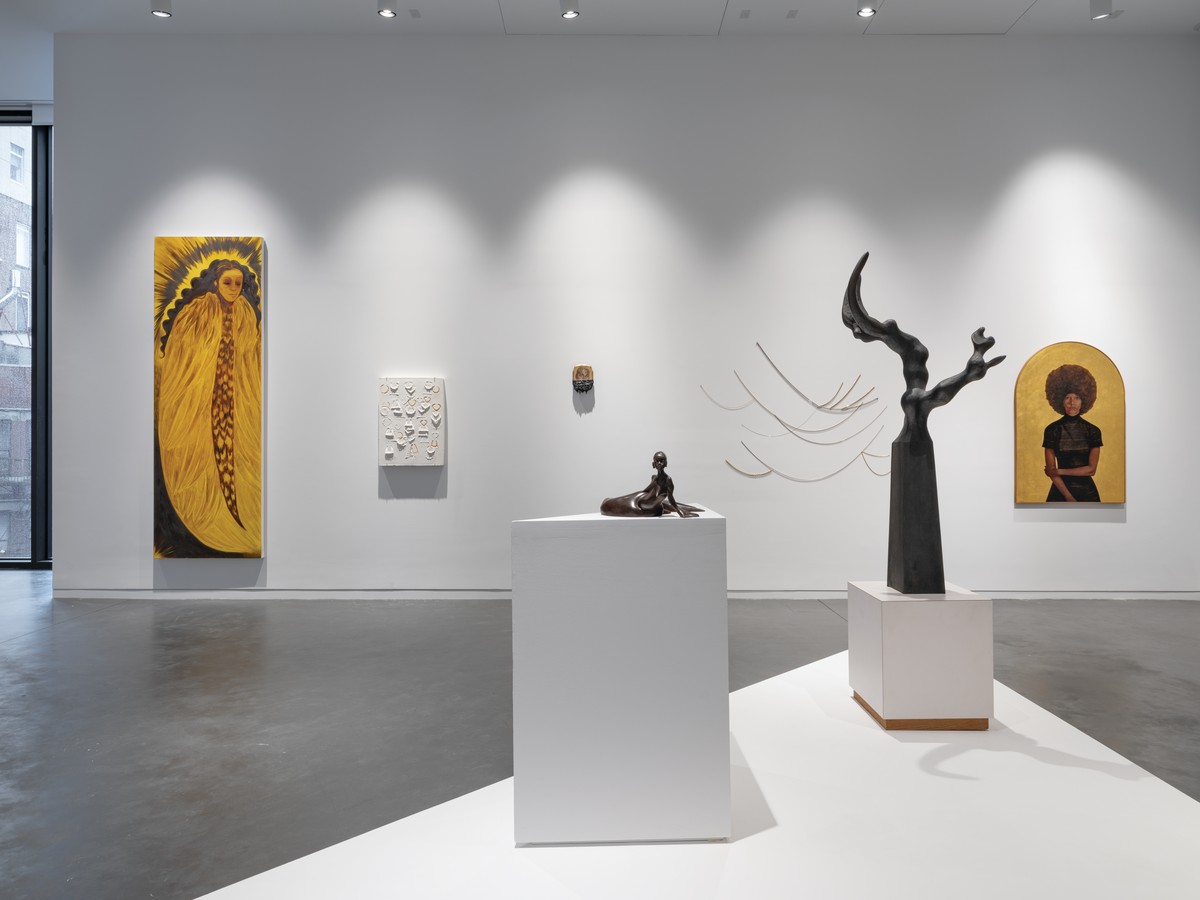
Warm pine clads the curtain-ringed Stoop (1), in contrast to the cooler palette of the galleries (2). Photos © Albert Vecerka/Esto, click to enlarge.
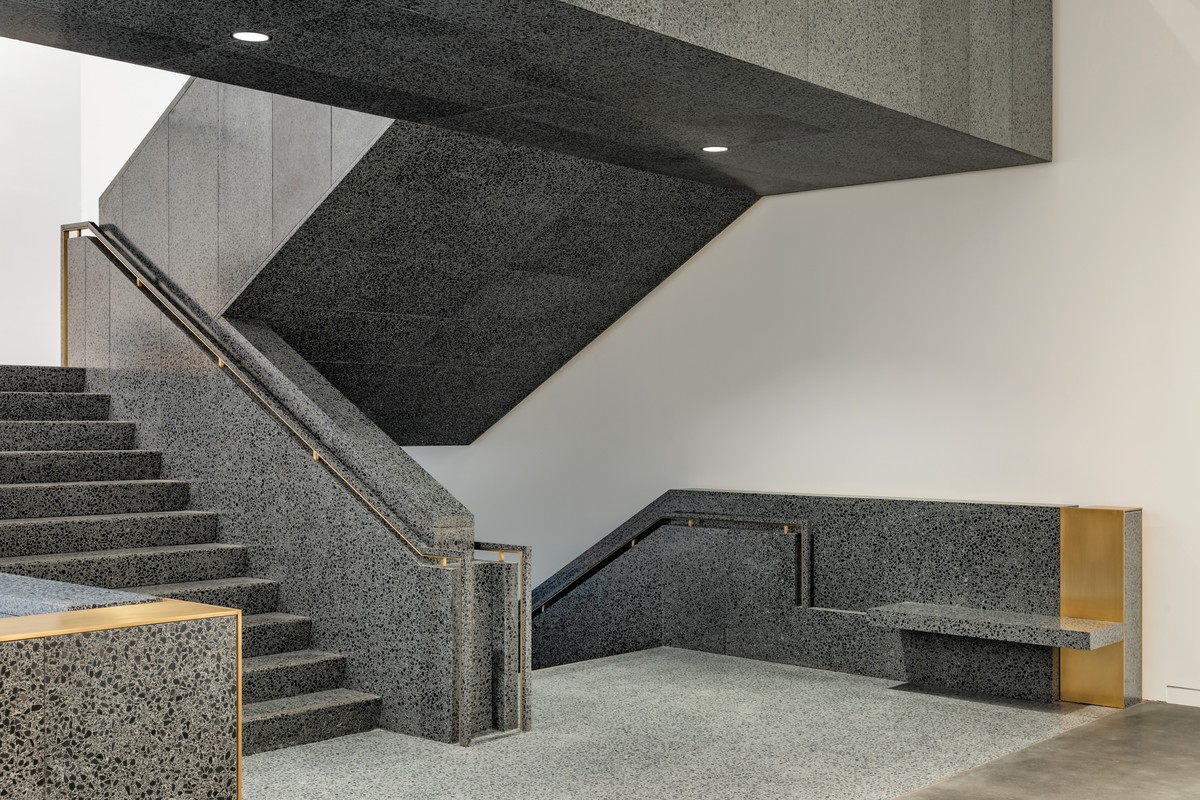
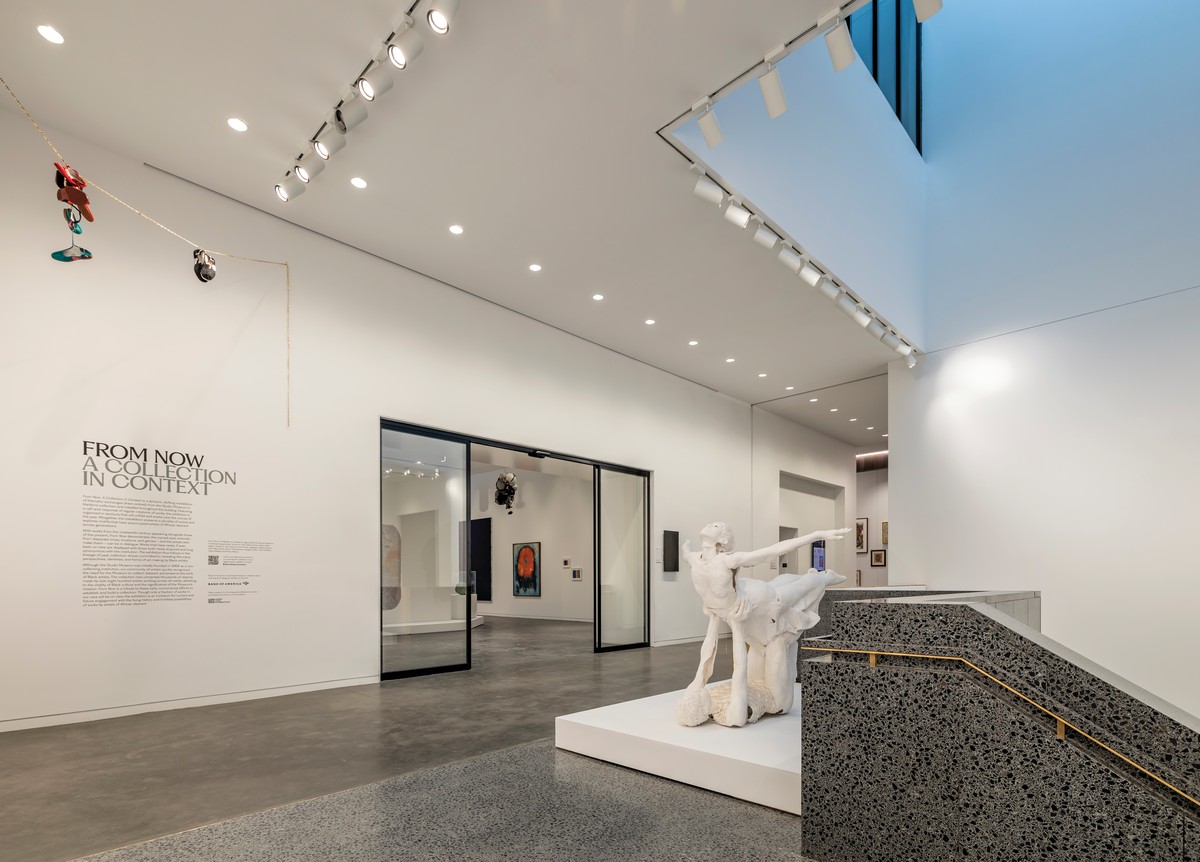
While the Stoop goes down, a monumental staircase ascends four floors in the central, top-lit atrium. Rendered in terrazzo with a gray matrix and black aggregate on all surfaces—even the exquisitely detailed handrails—the blocky geometric stair is a powerful yet perfectly scaled sculptural presence, the visual focus and organizing element of the building interior. A deep landing cantilevers over the lobby, creating a massive pulpit, and, on the climb up through the building, the visitor encounters additional generous landings occupied by seating or artworks.
3
4
A terrazzo stair trimmed with bronze (3) ascends through the museum’s central void (5), leading to galleries (4). Photos © Albert Vecerka/Esto, click to enlarge.
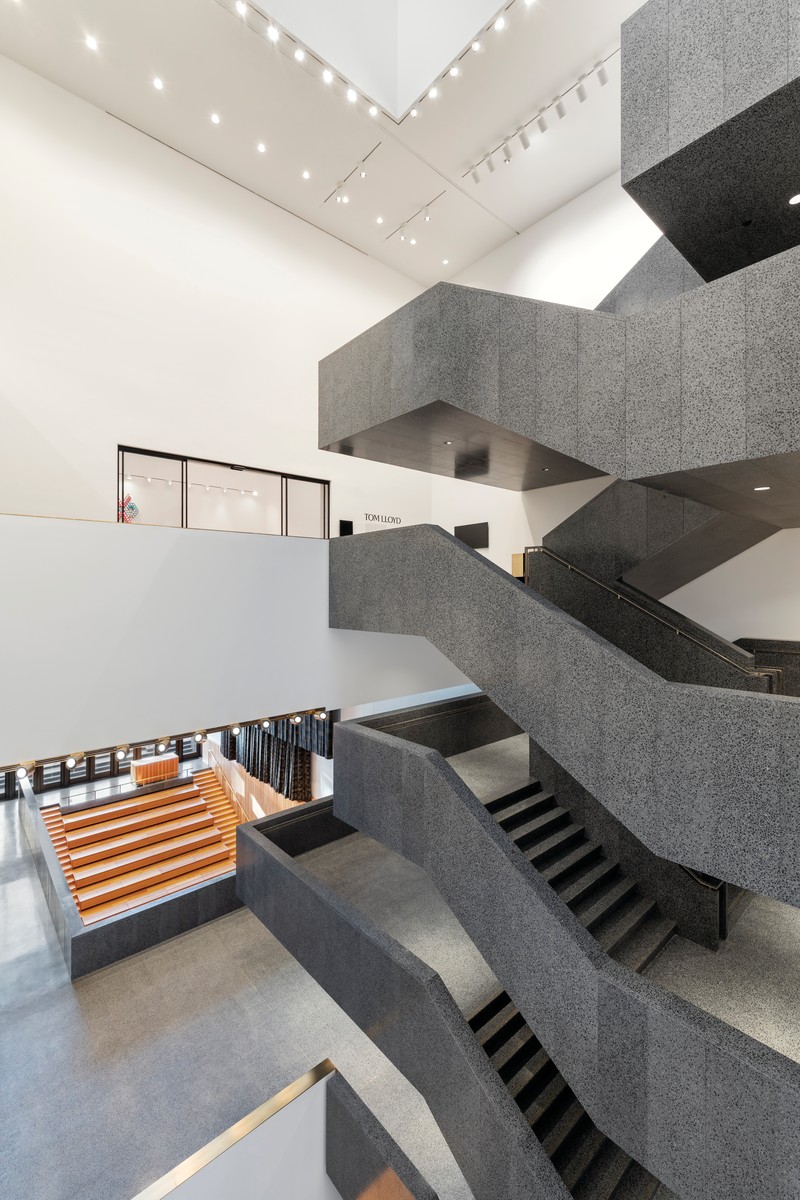
5
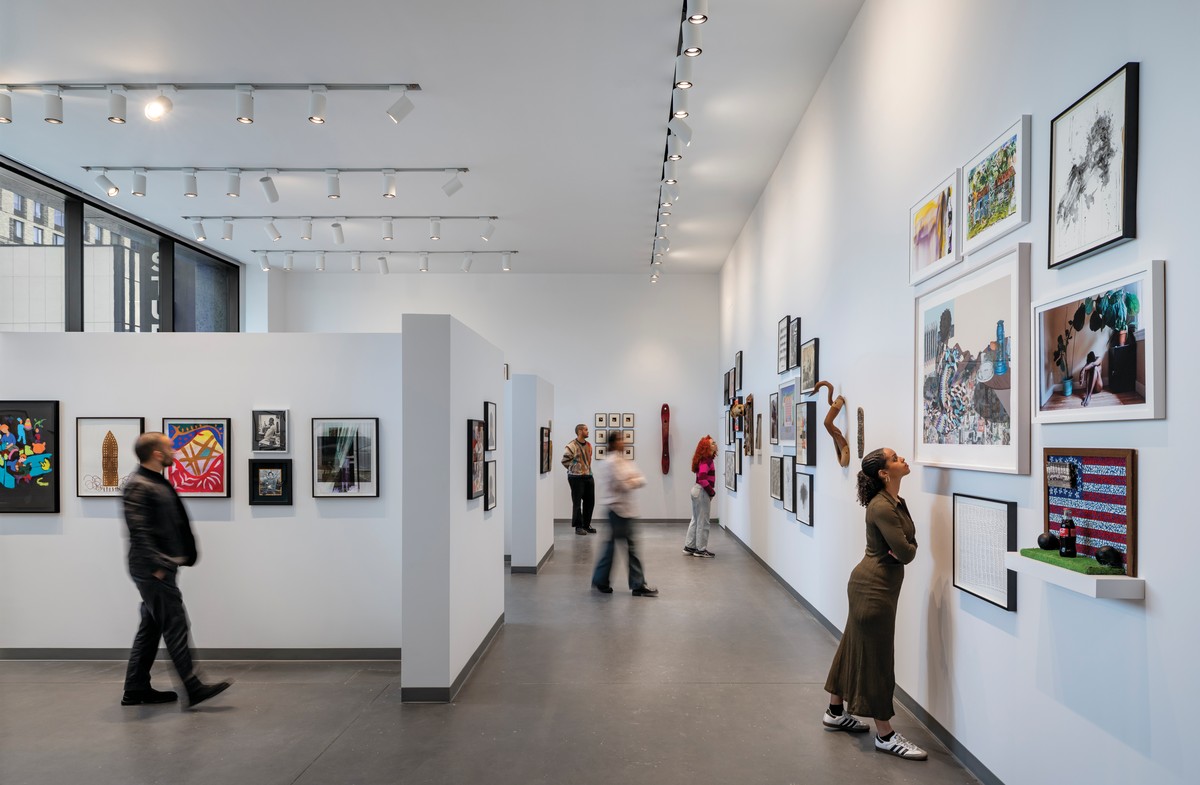
The galleries, of course, are the main reason for the new building, which, at 17,000 square feet, have double the area for exhibition space than in the museum’s former home. Director and chief curator Thelma Golden recalls that the old museum, which was loved for its intimacy, had not one wall taller than 10 feet, which obviously limited the size and type of art that could be shown; here, there are multiple spaces in which the ceilings soar over 20 feet. Galleries vary in size and character, some with natural light from clerestory glazing or strategically placed windows. Flexibility was the goal, Golden explains; curators can now mount multiple smaller shows at once or, given the short runs of stairs that connect the split-level floor plates, larger shows occupying more than one gallery.
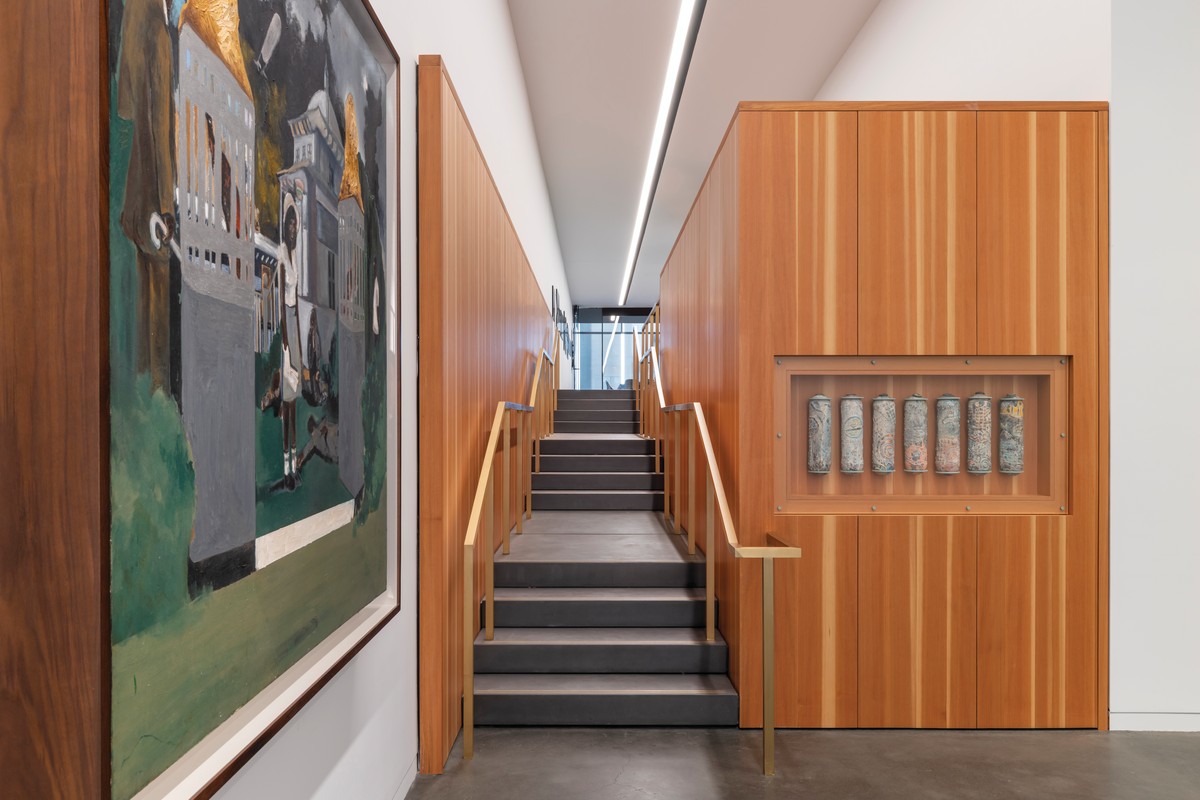
A stair connects split levels. Photo © Albert Vecerka/Esto
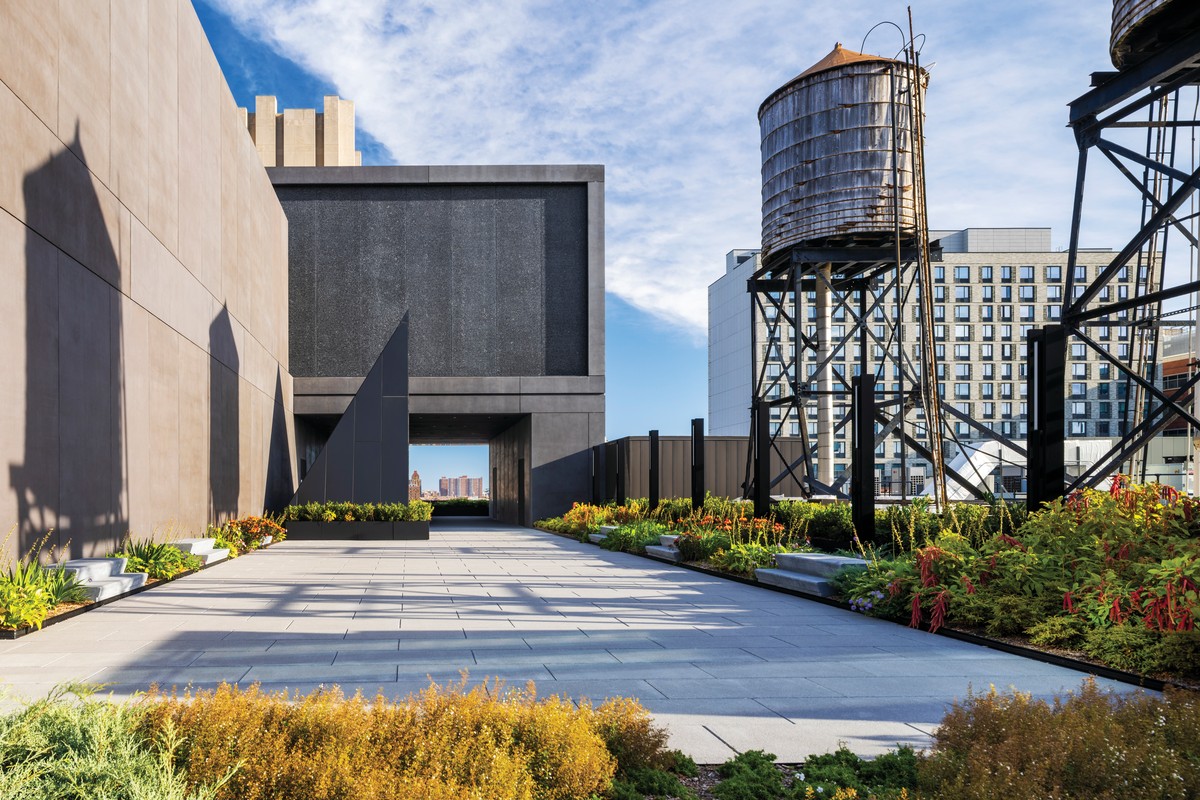
Also vastly increased is the space dedicated to educational and public programming. A large classroom on the third floor, with a low—child-height—strip of a window, a sink, and plenty of storage space for art materials, welcomes local school groups. Neighborhood teens also now have a flexible gathering space with computer stations and a huge picture window overlooking 125th Street. And artists selected for the Studio Museum’s celebrated artist-in-residence program—the roster of over 150 alumni is impressive—will enjoy well-appointed studio space along with a communal lounge with a kitchen. The fifth floor includes a flexible program space and a large conference room—with a splendid view downtown through a full-height glass wall—for board meetings and to lend out to community groups and long-standing partner institutions. Topping it all is a vast roof terrace (landscaped by local firm Studio Zewde), which will surely be in high demand for warm-weather activities.
Looking for quick answers on architecture and design topics?
Try Ask RECORD, our new smart AI search tool.
Ask RECORD →
Studios will soon open for artist residencies. Photo © Albert Vecerka/Esto
To hear Golden talk, you would think that her favorite parts of the building are the utilitarian back-of-house facilities, and that may well be true—functionality is one of her mantras. For the first time, the museum has an off-street loading dock, accessed from 124th Street, well-situated art-handling rooms, and a jumbo elevator.
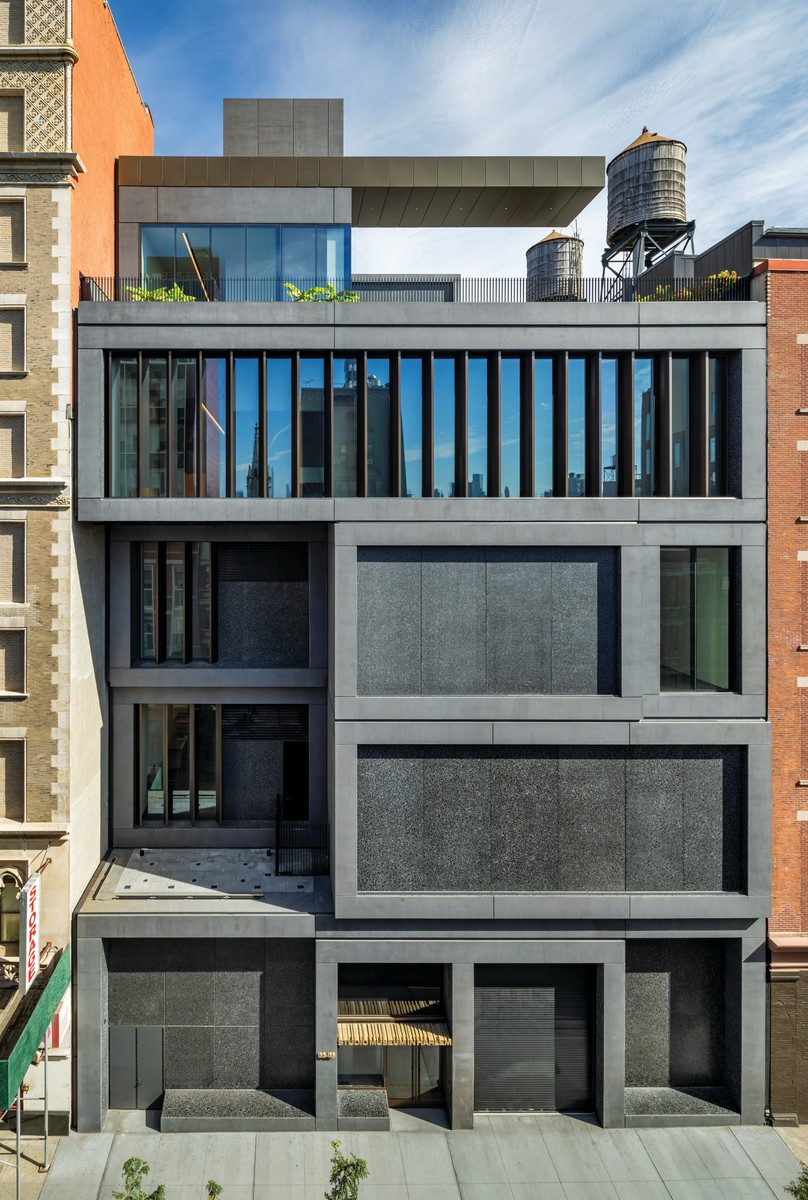
The rear elevation faces a residential street. Photo © Albert Vecerka/Esto
On 124th Street, which is largely residential, the south facade of the museum is designed, accordingly, not as a back-door afterthought but with a neighborly quotient of windows and a sculpture-ready niche. The front elevation is a different matter. Official descriptions of the building tout the concept of framing views, both into and out of the building—and, indeed, the main facade is a complex composition of rectangular boxes and frames with setbacks. The architectural hyperactivity, for better or worse, fits right into the visual cacophony of commercial 125th Street.
The Studio Museum is built on the site of its former home, and the organization had to vacate the premises in 2018 to allow for its demolition. For seven years, without any galleries, the museum loaned portions of its collection and produced off-site programs. When it returned to 144 West 125th Street last month, it not only inaugurated a new home but reintroduced itself as a transformed institution. For many New Yorkers, and certainly residents of Harlem, the old museum was a cherished neighborhood fixture—in Harlem and for Harlem. The question now is whether the Studio Museum can sustain that identity while also being the world-class art venue that its new home makes possible. To this uptown Manhattanite, the signs look good.
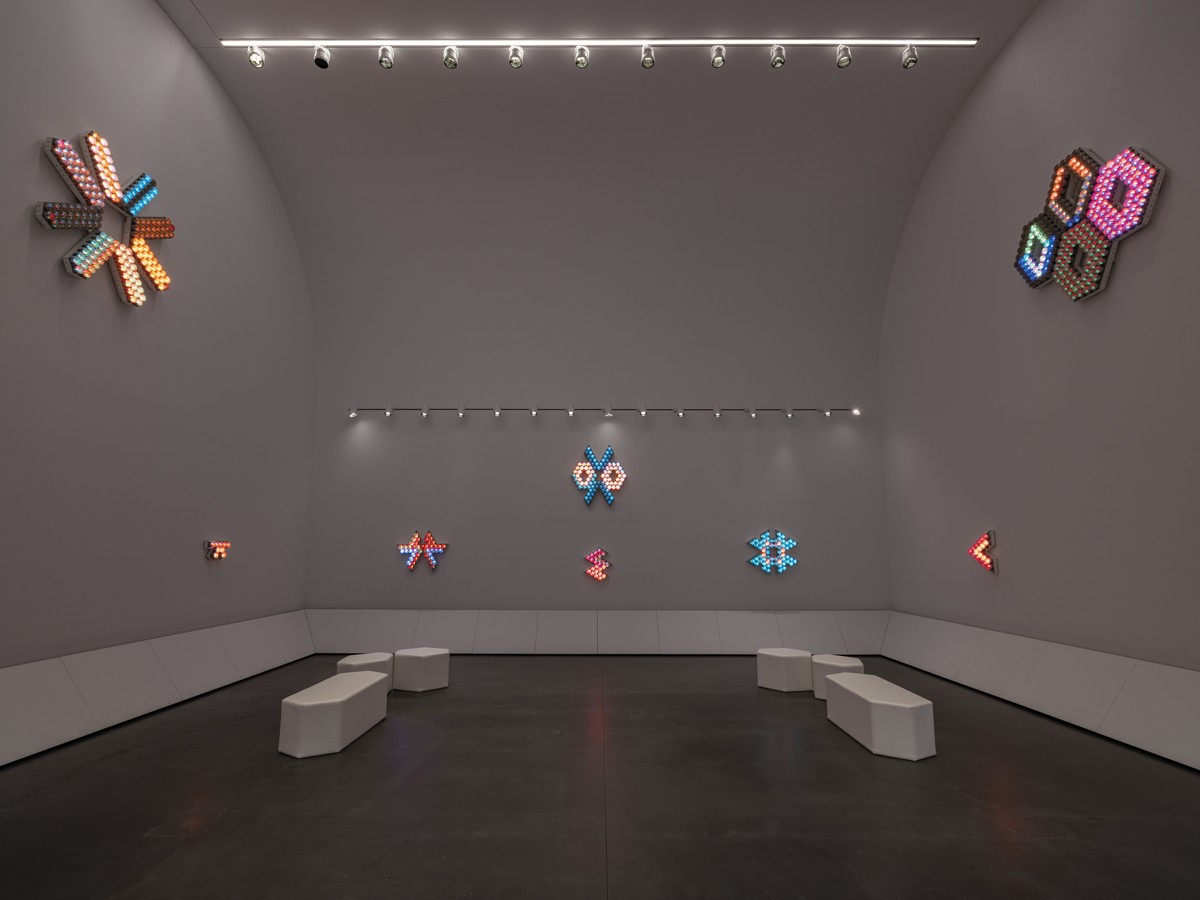
Tom Lloyd’s work is displayed in a barrel-vaulted gallery. Photo © Albert Vecerka/Esto
6
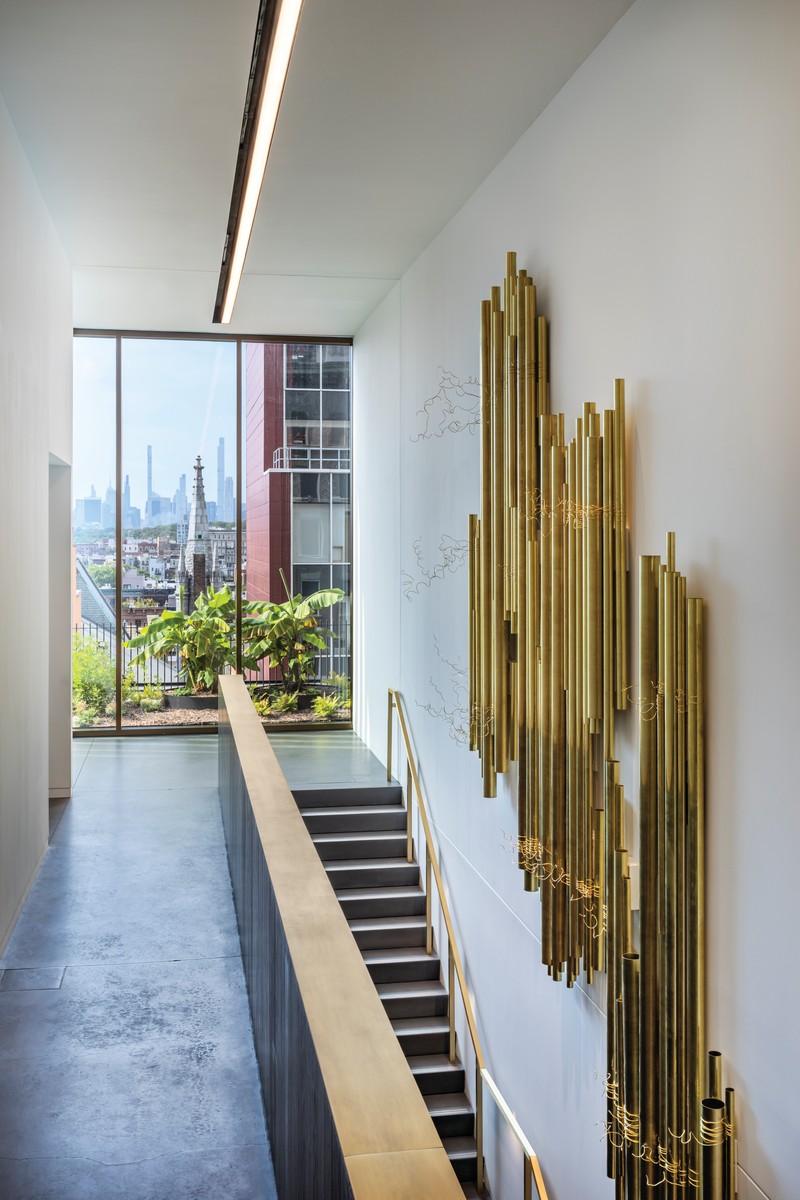
Upper floors (6) offer impressive vistas of Manhattan, as does the planted rooftop terrace (7). Photos © Albert Vecerka, click to enlarge.
7
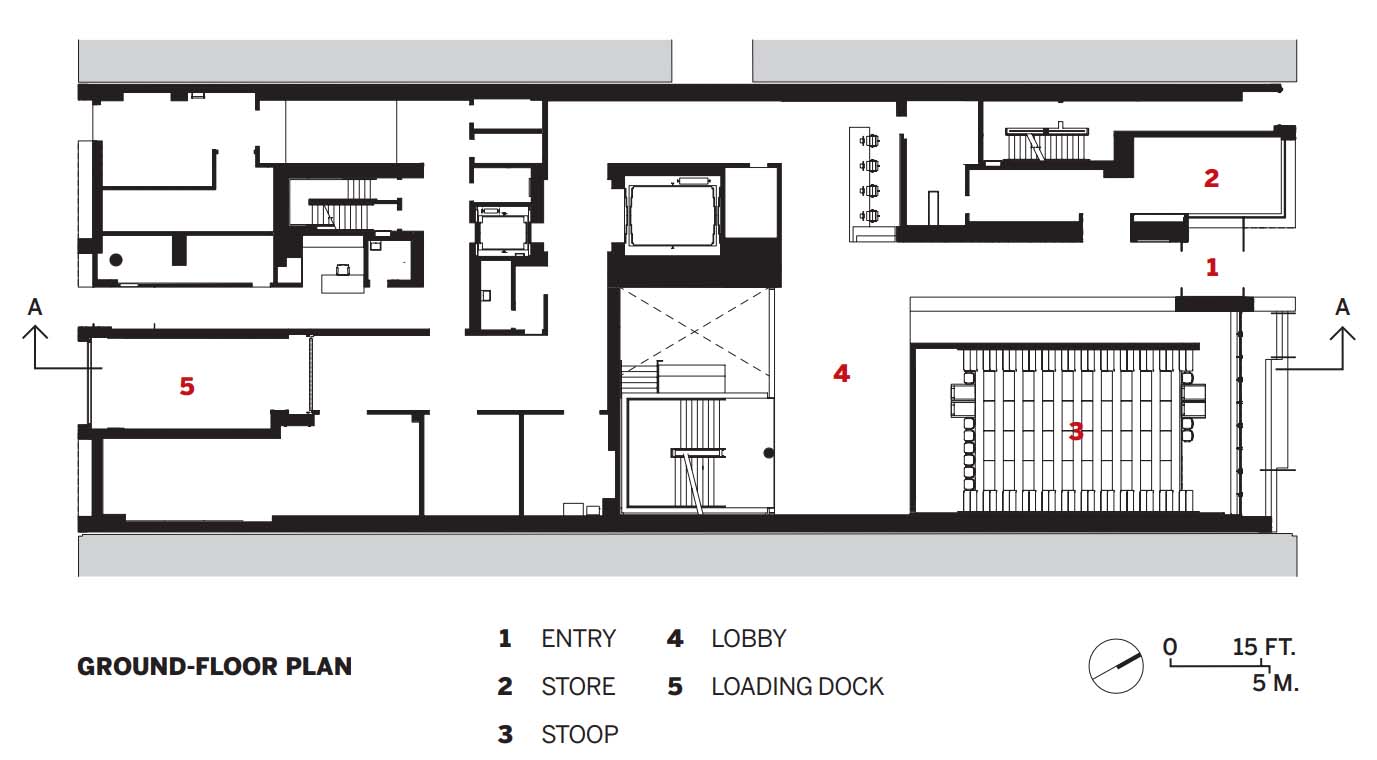
Image courtesy Adjaye Associates
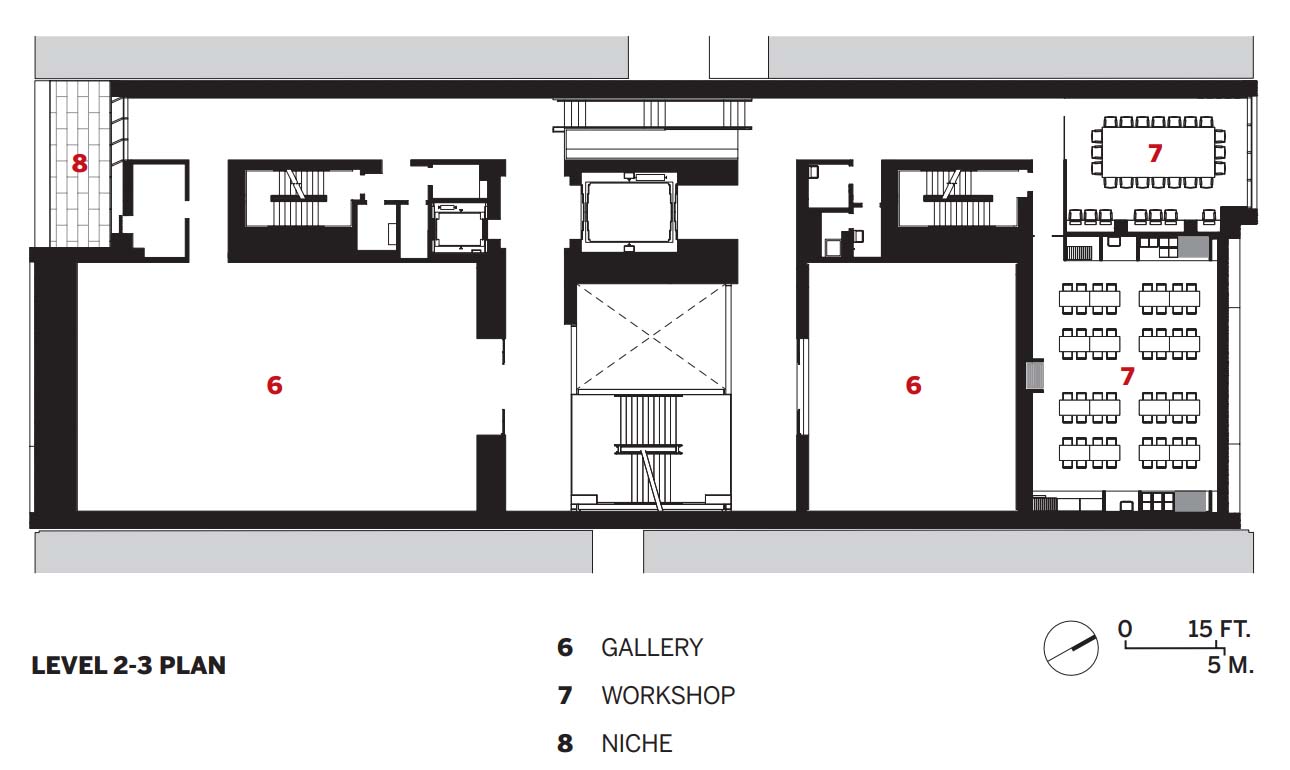
Image courtesy Adjaye Associates
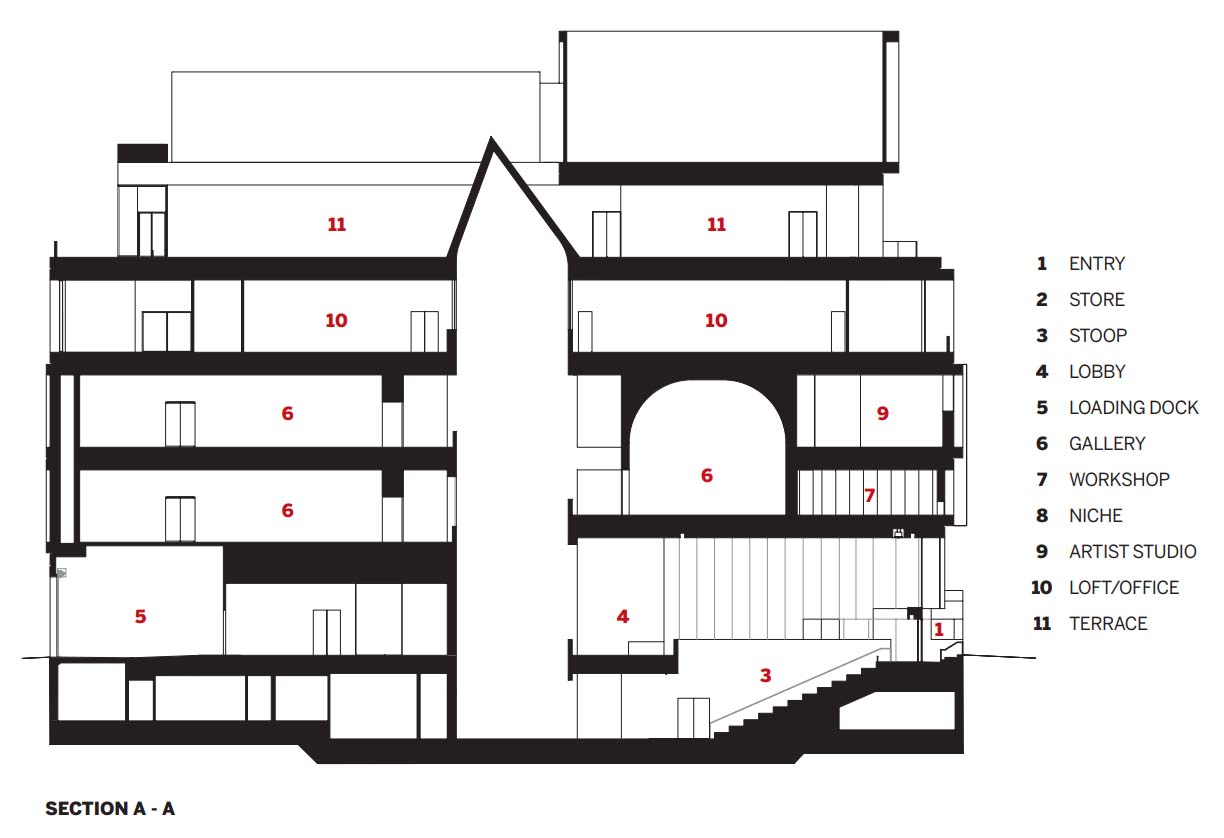
Image courtesy Adjaye Associates
Credits
Architect:
Adjaye Associates — David Adjaye, Pascale Sablan, Camaal Benoit, Russell Crader, Christina Yang, Kahila Hogarth, Paula Sanchez
Executive Architect:
Cooper Robertson (now Corgan) — Erin Flynn, partner in charge; Bruce Davis, Jonathan Pietro, Alfia White, Jason Cadorette, Christian Bolliger
Engineers:
Guy Nordenson & Associates, Simpson Gumpertz & Heger (structural); Langan (civil/geotechnical); WSP (m/e/p)
Consultants:
Studio Zewde (landscape); Thornton Tomasetti (facade); Harvey Marshall Berling Associates (AV); Fisher Marantz Stone (lighting); Fisher Dachs Associates (theater); Longman Lindsey (acoustics)
General Contractor:
Sciame Construction
Client:
Studio Museum in Harlem
Size:
82,000 square feet
Cost:
Withheld
Completion:
November 2025
Sources
Cladding:
Béton Préfabriqué du Lac (precast); Competition Architectural Metals, Wausau, Tvitec (curtain wall)
Interior Finishes:
Zonca Terrazzo and Mosaic (terrazzo); Champion Metal & Glass (brass details); Star Silent (acoustical ceilings); Armstrong (suspension grid); Bauerschmidt & Sons, Four Daughters (millwork); Benjamin Moore (paints); Abet Laminati (solid surfacing); Daltile (tile); Shaw Contract, Mohawk Group (carpet)
Skylight:
Midland Tech, Cimolai
Lighting:
LiteLab
Conveyance:
Transel
Roofing:
John Mini, Permaloc, Conservation Technology (planters); Siplat (PMMA)
Looking for a reprint of this article?
From high-res PDFs to custom plaques, order your copy today!