Dattner Architects Completes an Arboreal Pavilion for the Jewish Center of the Hamptons

Architects & Firms
When Richard Dattner was a young New York architect in the 1960s, he started designing houses for clients in the Hamptons. One high-profile couple proved especially difficult. The wife would call him at 11 p.m. to reverse the latest design decision they had made. Then the hedge-fund husband would call at midnight to demand Dattner ignore her.
“I did seven houses before I realized I did not have the temperament to work with warring spouses,” he says. “Houses bring out issues that dysfunctional couples have with each other. For the same amount of effort, I could have a substantial impact on the civic environment.”
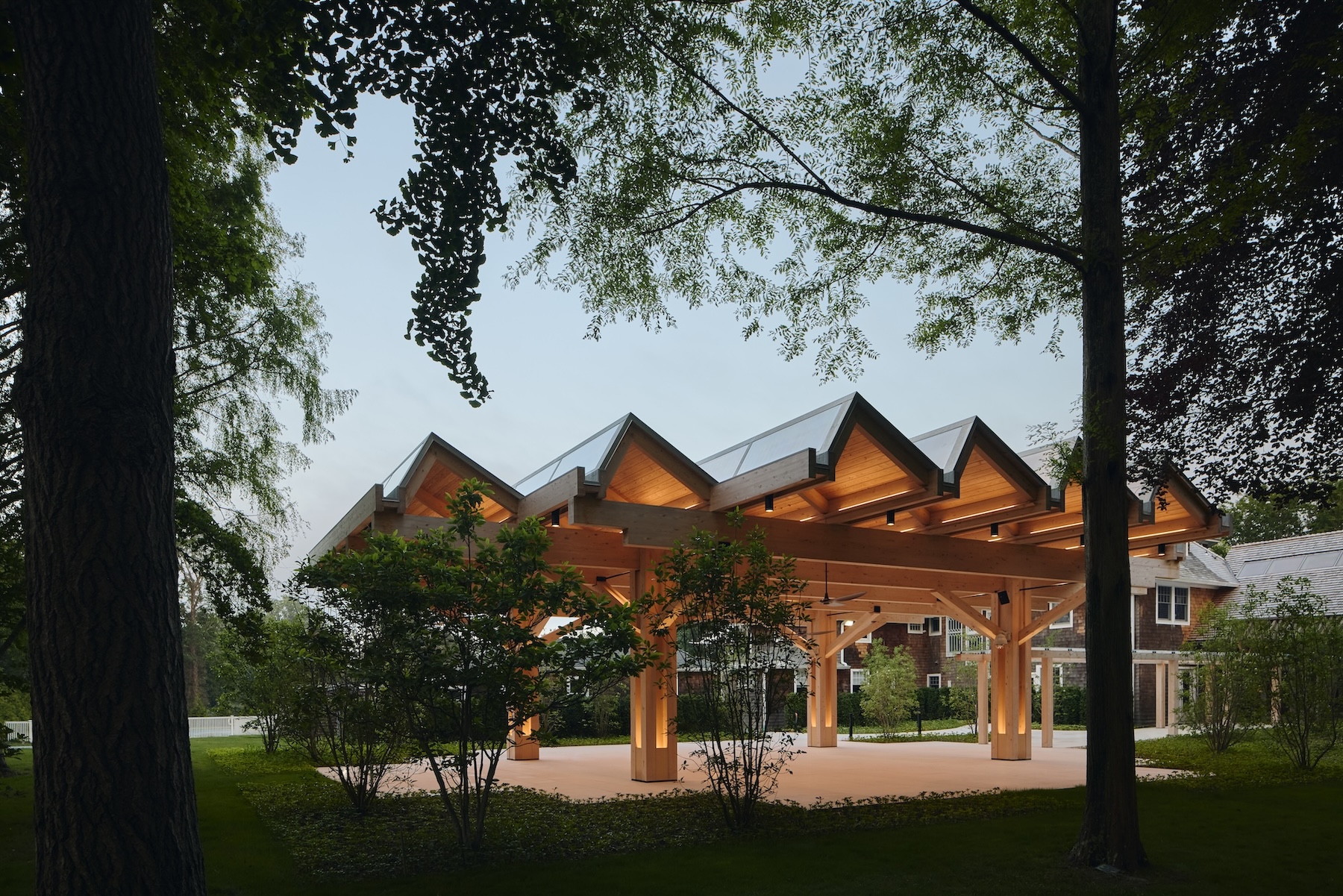
Photo © Dattner Architects/Jewish Center of the Hamptons/Glen Allsop
Ever since then, for six decades, Dattner has dedicated himself to working in the public realm. (In 1995 he wrote a book about it, Civic Architecture: The New Public Infrastructure.)
Now 88, Dattner still goes to the office three days a week, and his women-owned Manhattan-based firm employs 125 architects. He says his latest civic project is perhaps his favorite: an open-air pavilion inaugurated last summer for the Jewish Center of the Hamptons in East Hampton, New York.

Photo © Dattner Architects/Jewish Center of the Hamptons/Glen Allsop
He was commissioned to build a venue that could accommodate 250 people in an area behind the Center’s much-admired modernist synagogue, which was completed in 1989 by the Bridgehampton-based architect Norman Jaffe, who died in 1993.
Dattner already knew Jaffe’s work well, both because he, like Jaffe, was a member of the temple (named Gates of the Grove, after the trees behind it), but also because he had done pro bono projects for the synagogue for years. They were professional colleagues.
Nonetheless, the stakes were high: Dattner considered Jaffe’s sanctuary “the finest contemporary religious structure in the United States.” His challenge was to design something equally beautiful that would complement it and complete the Center’s decades-long vision for its campus. (Always modest, the Polish-born architect says that after his firm was hired for the project he negotiated a modest fee, with most of his personal hours not charged.)
The Center’s brief was simple: Make an outdoor space for religious observance, performance, contemplation, and celebrations. “My goal was to create a manmade forest in a grove of trees,” he says, noting that his inspiration came from an amalgam of favorite prayers: “It’s a Tree of Life to those who harken onto it. Its ways are ways of pleasantness, and all its paths are peace.”
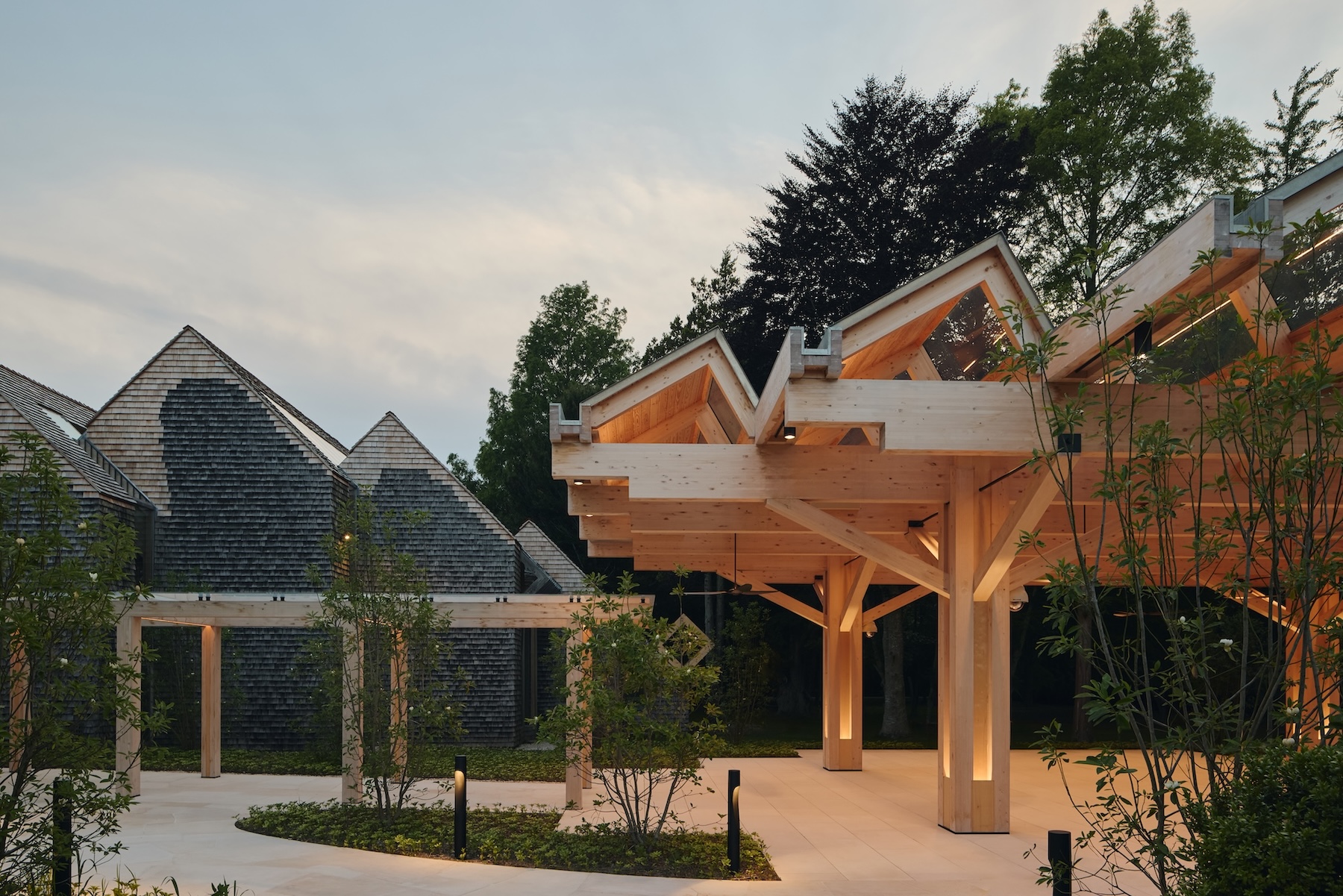
Photo © Dattner Architects/Jewish Center of the Hamptons/Glen Allsop
Dattner’s “forest” for the Center, however, has only four giant trunks. “I wanted to minimize the number of columns, to keep open the sidelines, so I decided on four ‘man-made trees’ with diagonal supports, or ‘branches,’ to reinforce the 3,500-square-foot structure,” he explains. In plan, the building is a large rectangle 60-by-68 feet, with four L-shaped pieces taken out of the corners. The saw-tooth roof is 20 feet tall, the limit for an accessory structure in East Hampton.
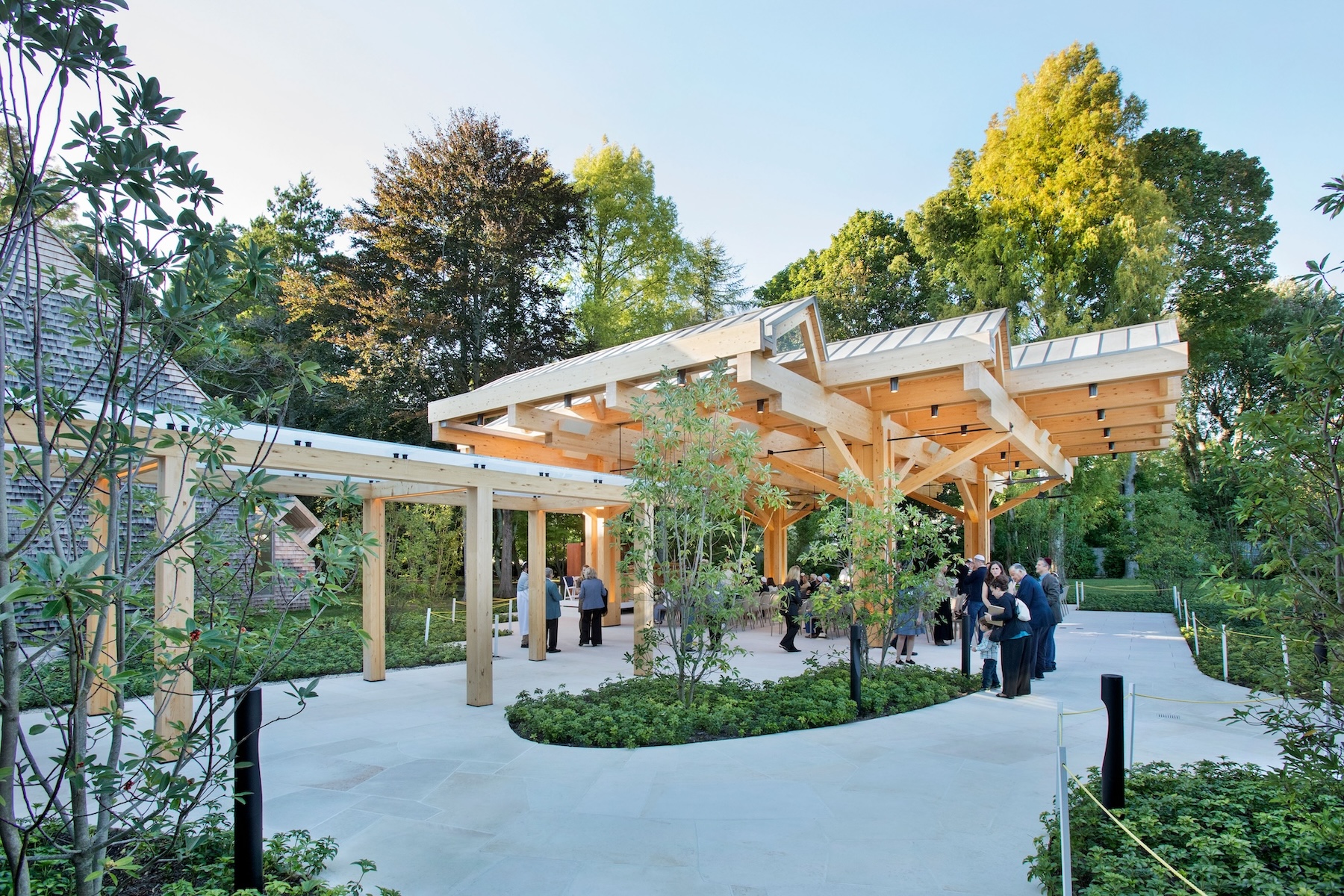
Photo © Dattner Architects/Jewish Center of the Hamptons/Phillip Lehans
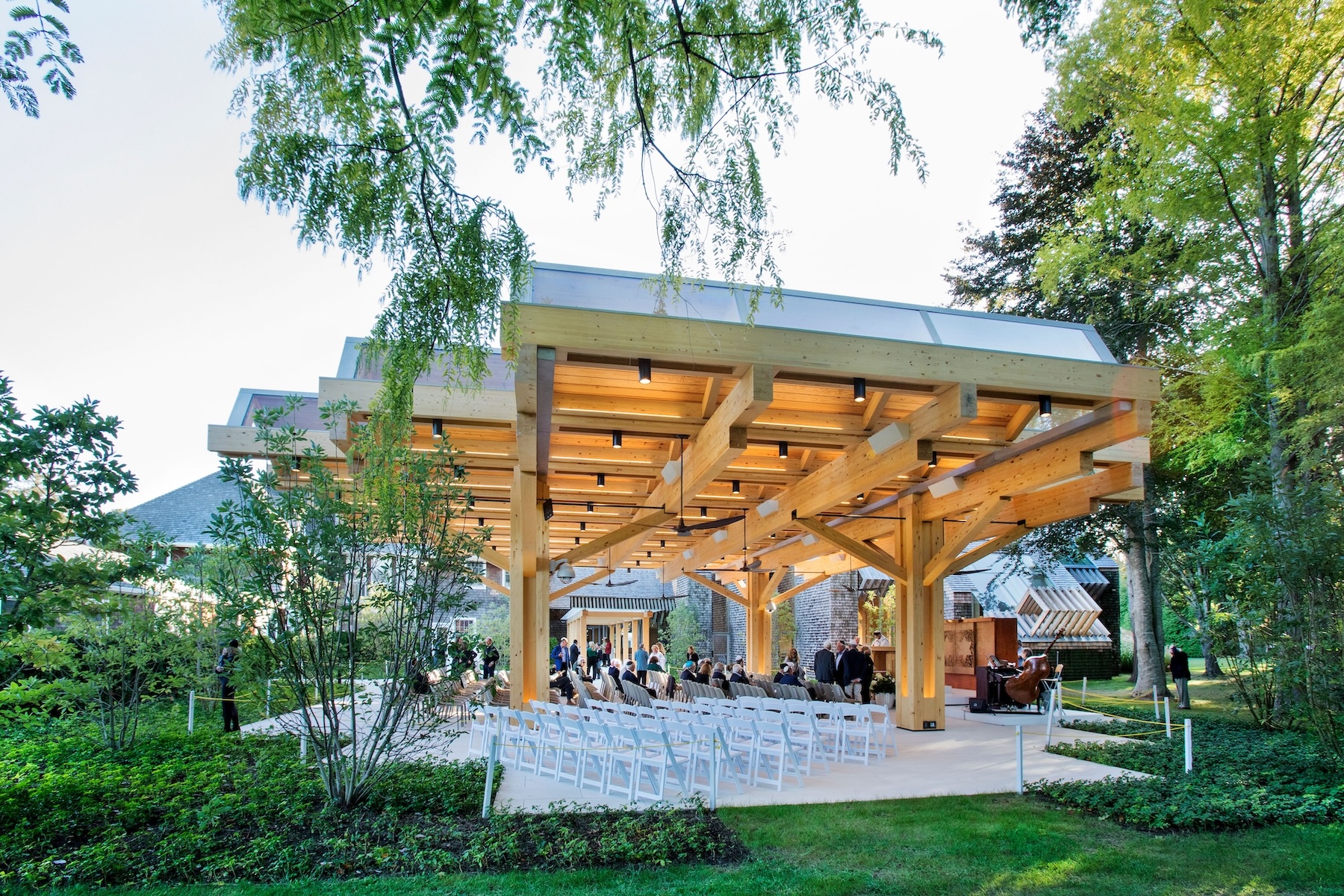
Photo © Dattner Architects/Jewish Center of the Hamptons/Phillip Lehans
Designed to fit in with the sanctuary, the new timber building is made with the same Alaskan yellow cedar and honey-colored limestone. It also features a series of similarly slanting roofs with north-facing skylights. Dattner chose glue-laminated cedar timber—a very old technology—for its sustainability.
The four columns are hollow, hiding the conduits for water drainage and the electrical lines that power lighting and audiovisual needs. Dattner arranged 27 small speakers in the ceiling to amplify speech and music without transferring any noise to the outside. “We had to do lighting and sound studies to make sure we would not disturb the neighbors,” he says.
Dattner also designed a paved, glass-covered walkway between the two buildings to protect congregants from inclement weather. The construction was prefabricated by Mid-Atlantic Timber Frames in Pennsylvania. An Amish foreman brought a crew to East Hampton that assembled the structure in six days. “It was like a barn raising,” Dattner says.
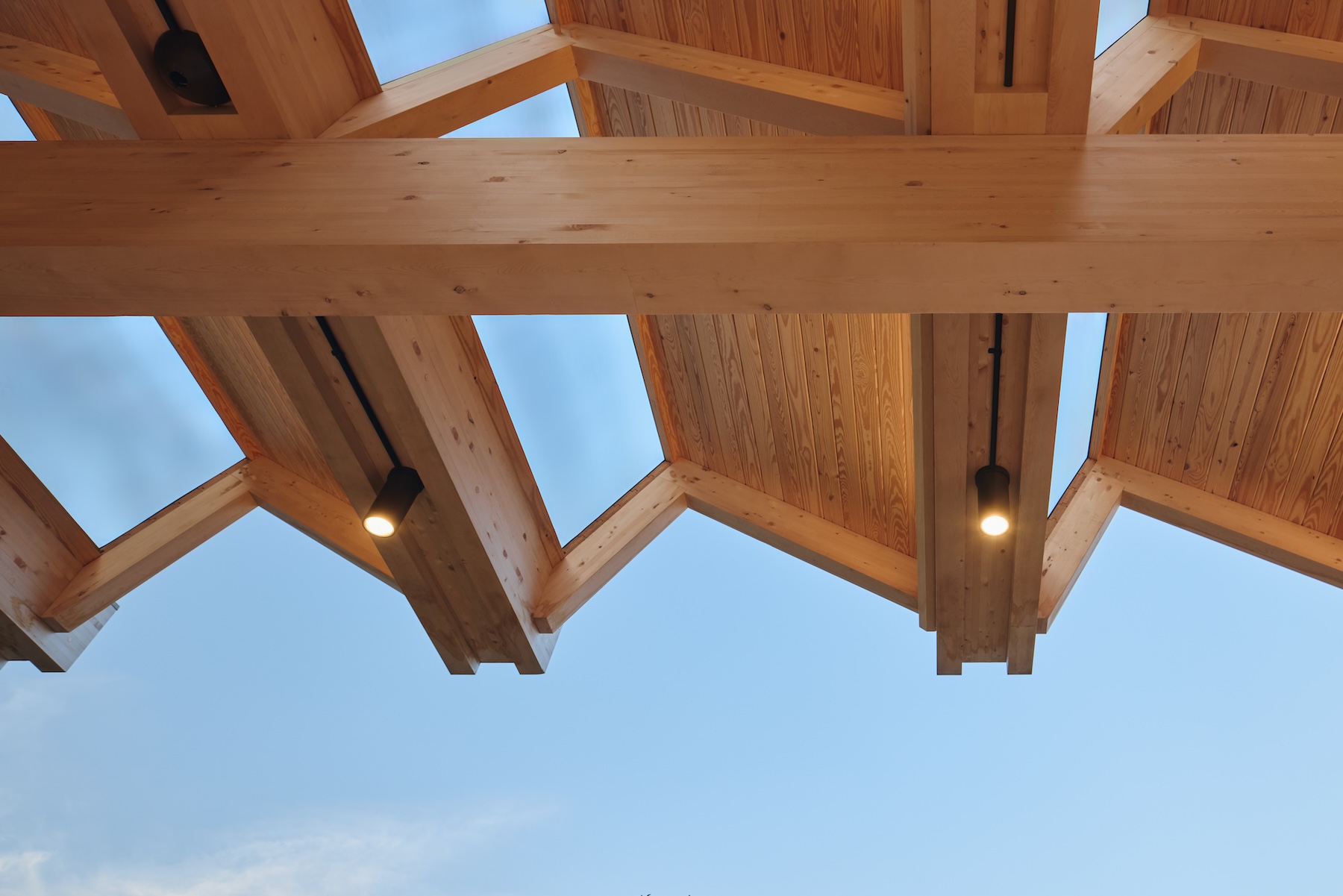
Photo © Dattner Architects/Jewish Center of the Hamptons/Glen Allsop
The firm also consulted with Chris LaGuardia, the Hamptons-based landscape architect who had collaborated with Jaffe on the temple. LaGuardia planted 22 new Virginia magnolias (whose creamy white blossoms are incredibly fragrant) to surround the pavilion, separate it from the sanctuary, and blend in with the existing trees, including a 175-year-old European beech.
Dattner calls the pavilion his “poetical” version of a post-and-beam structure. He feels that if Jaffe were alive to see it, his late colleague would no doubt find it a sensitive, thoughtful addition to the Center’s campus.
Looking for quick answers on architecture and design topics?
Try Ask RECORD, our new smart AI search tool.
Ask RECORD →
Looking for a reprint of this article?
From high-res PDFs to custom plaques, order your copy today!