Two I.M. Pei–Designed Landmark Buildings Face Potential Demolition

The I.M. Pei–designed Mesa Laboratory, headquarters of the National Center for Atmospheric Research in Boulder, Colorado. The future of the building, a preeminent hub for climate science, is murky now that the Trump administration has ordered the center to be shuttered.
While the fate of Dallas City Hall has been a question mark for some time, just this week another I.M. Pei-designed building, the National Center for Atmospheric Research (NCAR)’s Mesa Laboratory in Boulder, Colorado, has a precarious future thanks to the Trump Administration. USA Today first reported the news of Trump’s plan to dismantle NCAR, a federally funded climate and weather research center, on Tuesday. “The National Science Foundation will be breaking up NCAR," Russ Vought, director of the White House Office of Management and Budget, said in a statement to the newspaper. "This facility is one of the largest sources of climate alarmism in the country. A comprehensive review is underway and any vital activities such as weather research will be moved to another entity or location.” What that means for Pei’s Mesa Laboratory is unclear. However, given the administration’s antagonistic stance toward modernist architecture, particularly buildings of the brutalist style, there is reason for concern if the building is vacated by NCAR.
The center is “quite literally our global mothership,” Katharine Hayhoe, chief scientist for the Nature Conservatory wrote in a widely shared social media post in reaction to the news. “Dismantling NCAR is like taking a sledgehammer to the keystone holding up our scientific understanding of the planet.”
NCAR’s Boulder headquarters (1961–1967) first appeared in RECORD’s October 1967 issue and reappeared as one of RECORD’s Top 125 Buildings for the magazine’s 125th anniversary in 2016.
According to I.M. Pei: Life is Architecture, the catalogue to the recent Pei retrospective organized by M+ and currently on view at Qatar Museums Gallery – Al Riwaq adjacent to Pei’s Museum of Islamic Art in Doha until February 14, 2026, the design of the Mesa Laboratory resulted from a close collaboration between Pei, NCAR founding director Walter Orr Roberts, and a group of scientists who had a clear idea for a workplace that could facilitate both research and theoretical contemplation on atmospheric science. Pei once said of the building, which is perched in the foothills of the Rocky Mountains overlooking Boulder: “The shapes [of NCAR] have been cribbed time and again. But the spirit of the building is in the context, in the site. That you cannot copy.”
NCAR is funded by the National Science Foundation and managed by the University Corporation for Atmospheric Research, also located in Boulder. In addition to the Mesa Laboratory, NCAR operates major facilities in Wyoming and Hawaii. Since news of the center’s planned shuttering was announced, scientists and climate researchers have sounded the alarm, signaling that such a move would be a devastating setback for scientific research, particularly in the realm of climate science—an area that Trump and his allies have long dismissed as a hoax. The plan also seems to be a largely vindictive one, with a White House official telling ABC News that Colorado Governor Jared Polis, a Democrat, is to blame. “Maybe if Colorado had a governor who actually wanted to work with President Trump, his constituents would be better served,” the official said.
Polis said that the state had not directly received any information about the dismantling of NCAR. “If true, public safety is at risk and science is being attacked,” Polis said in a statement shared by the Washington Post. “Climate change is real, but the work of NCAR goes far beyond climate science. NCAR delivers data around severe weather events like fires and floods that help our country save lives and property, and prevent devastation for families.”
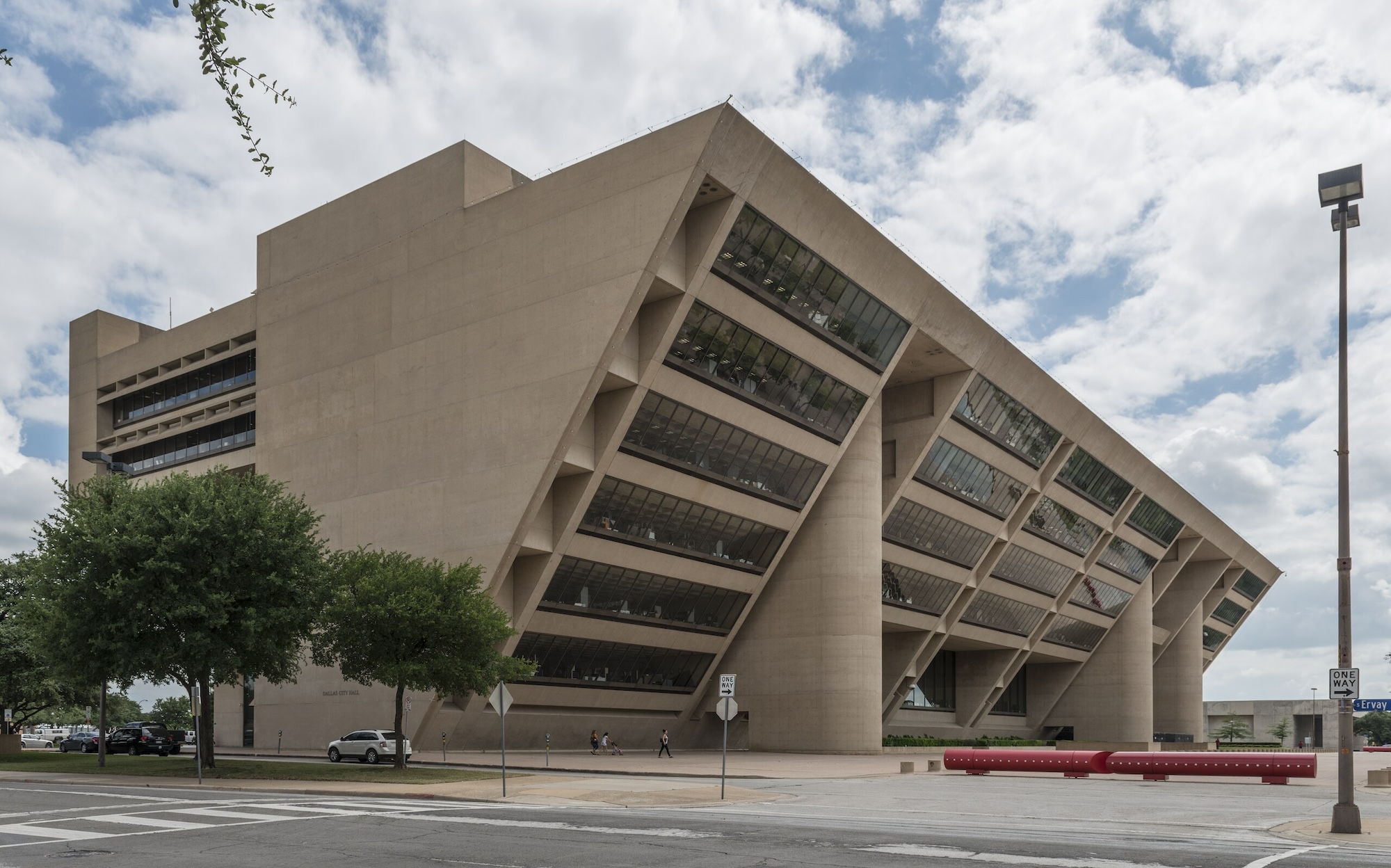
Dallas City Hall (1978). Photo courtesy Library of Congress, the Carol M. Highsmith Collection/Public Domain via Wikimedia Commons
Meanwhile, the fate of Pei’s Dallas City Hall, a brutalist landmark completed in 1978, hangs in the balance. Last month, Dallas City Council voted to begin exploring a plan to privatize the nearly 12-acre site—a scheme that would potentially entail demolishing the inverted pyramid-shaped structure and replacing it with a basketball arena and casino funded by Miriam Adelson, a Las Vegas gambling magnate and major donor to Trump and Trump-backed politicians in Texas. (The Adelson family also owns a majority stake in the NBA’s Dallas Mavericks). If the site is not sold and redeveloped and City Hall is preserved, the 47-year-old building would require $345 million in repairs and upgrades over the next decade per the latest estimates.
Looking for quick answers on architecture and design topics?
Try Ask RECORD, our new smart AI search tool.
Ask RECORD →
Writing for the Dallas Morning News, the paper’s chief architecture critic (and RECORD contributor) Mark Lamster opined: “Of all the irresponsible, ill-conceived, short-sighted, counter-productive, cynical, philistine, and downright dumb ideas I’ve heard in my time writing about Dallas, the prospect of razing City Hall stands alone. Demolishing architect I.M. Pei’s iconic building would be an act of epic mismanagement indefensible on aesthetic, environmental, financial or moral grounds.”
RECORD will provide updates regarding potential redevelopment plans for both of these sites as new information becomes available.
Looking for a reprint of this article?
From high-res PDFs to custom plaques, order your copy today!