L.A. Fires, One Year Later
Addressing the Wildfire Knowledge Gap: A Q&A with SWA’s Jonah Susskind
In 2023, global landscape architecture firm SWA Group released Playbook for the Pyrocene, a print and digital open-access publication outlining rules of thumb and applied strategies for wildfire-risk reduction at the neighborhood scale. The publication synthesizes key concepts from ecology, fire science, forestry, and land-use planning, to provide design guidance. RECORD’s deputy editor, Joann Gonchar, talked with Jonah Susskind, SWA’s director of climate strategy and one of the principal investigators for the publication. Susskind, based in SWA’s Sausalito, California, office, spoke about the motivation for the research and its continued relevance.
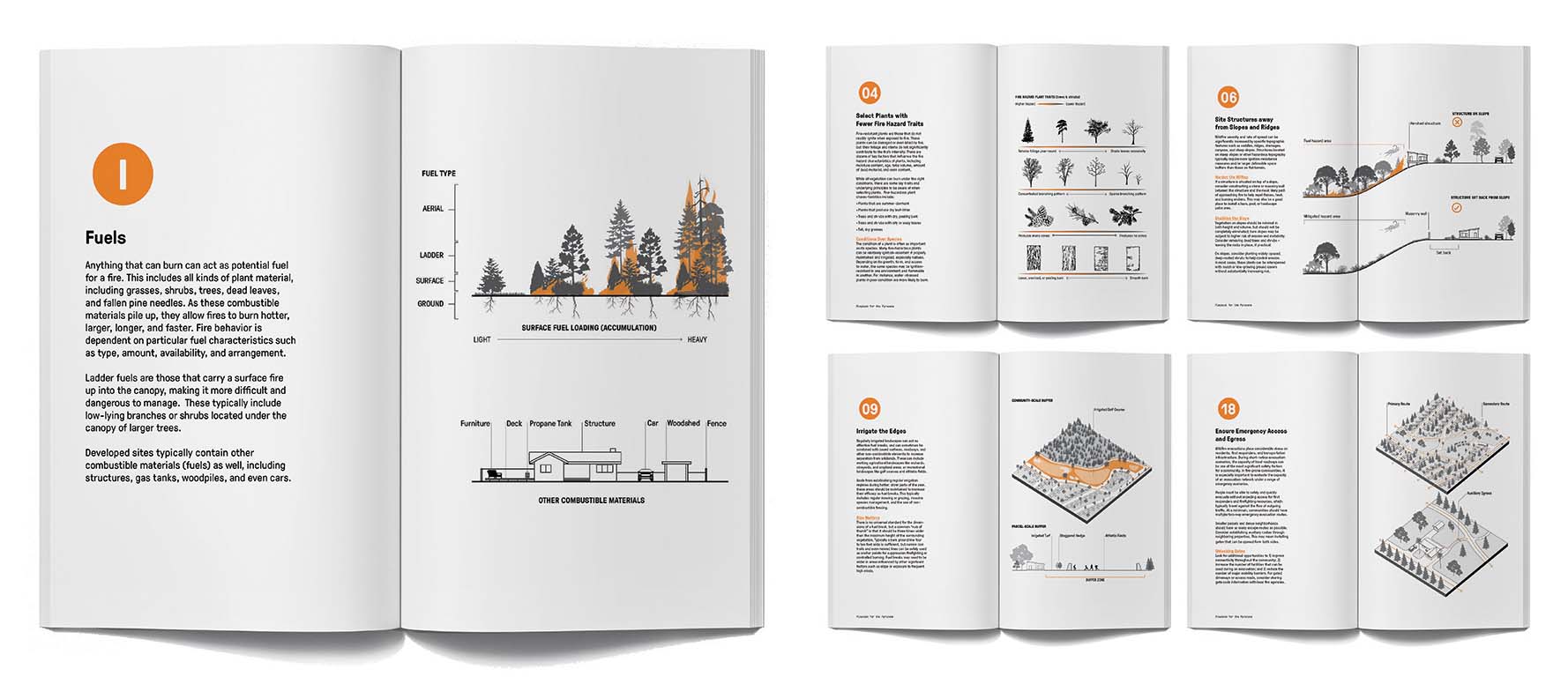
SWA’s Playbook for the Pyrocene illustrates six rules of thumb and 20 strategies for wildfire-risk reduction. Image © SWA, click to enlarge.
When did you start working on Playbook for the Pyrocene? Was the impetus a particular event or fire?
We didn’t formally start working on it until early 2022. But there had been a growing realization across the firm that we needed to better understand wildfire dynamics and best practices for landscape planning and design. That began a couple of years earlier, after the Glass Fire in 2020, which scorched a number of buildings and forested areas on two ongoing SWA projects in Sonoma and Napa counties. Our offices had been working with those clients for many years before that fire really changed our remit. Coincidentally, right around the time of the Glass Fire, a group of us in our Sausalito studio were working on fire-related research in and around Paradise, California, which had been almost entirely destroyed during the 2018 Camp Fire. It is important to also point out, with four studios in the state, SWA has been working in fire-prone landscapes for decades.
Can you elaborate on the knowledge gap that the book addresses?
During the past couple of decades, there’s been tremendous improvement in land-use planning controls and forestry techniques that reduce risk of wildfire exposure at the scale of the state, the county, or the national forest. There have also been significant innovations and advancements in building codes and noncombustible materials, along with well-published guidelines for defensible space, intended to support homeowners at the individual-parcel scale. So, Playbook for the Pyrocene tailors its strategies to the in-between scale—at the level of the community—with a focus on the work that is typically within the purview of a landscape architect.
Can you say a bit more about the role of landscape architecture in reducing wildfire risk at the community scale?
We design parks, but we don’t always talk about them as emergency refuge areas. In fact, we almost never do. But during the Camp Fire, which tore through the town of Paradise, and was one of the deadliest wildfires in American history, dozens of lives were saved when people who couldn’t evacuate in time took shelter in a park with irrigated ball fields and open green space. We can design parks as emergency refuges and also as staging areas for firefighting personnel. Trails can serve as a multimodal mobility corridors or as evacuation routes. This is the type of layering that we need to do more of.
How are the strategies outlined in Playbook for the Pyrocene shaping current projects?
In Pacific Palisades, we’re working on the redesign of a neighborhood community center and park that were damaged by last January’s fire using many of the core concepts presented in the book. The project is still in community-listening phases. There’s no planting plan yet, but there are some interesting ideas already on the table, including working with a palette that has fewer fire-hazard traits, such as vegetation that is less waxy or resinous, has more foliar moisture, and has bark that doesn’t peel or shed. We’re also beginning to look at the alignments of roadways, interior parking areas, and pedestrian pathways to optimize access as well as egress, so that they can do double duty in an emergency.
Another project, one that illustrates a different way of engaging with fire-prone communities, is a plaza we just finished in downtown Oakland. Our design team learned about a stand of eucalyptus in the Berkeley Hills flagged for removal specifically because of fire safety. SWA partnered with a local mill to repurpose the wood into eight benches for the new plaza. It’s an interesting way of thinking about engagement with wildfire-prone regions that isn’t necessarily about an emergency or the moment of disaster, or even the location of the fire itself. Instead, it is about a circular economy that leverages our relationship to fire.
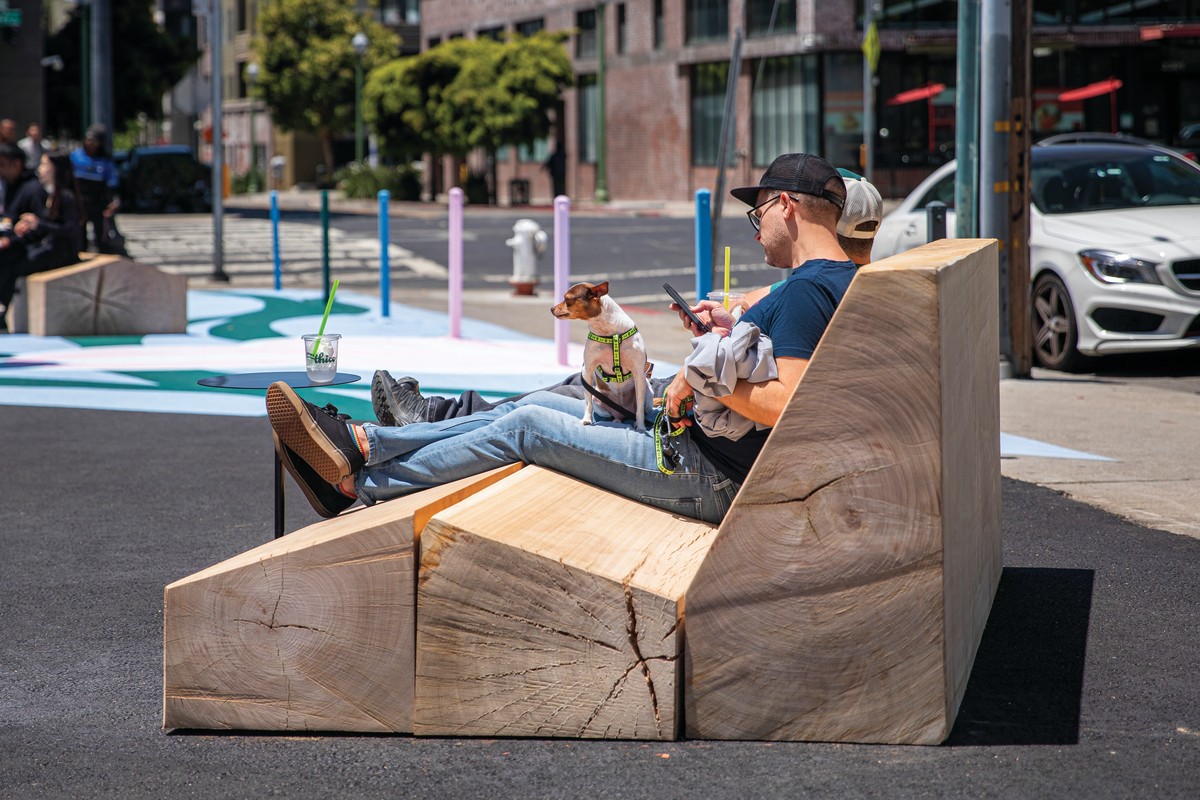
An SWA-designed plaza in Oakland includes benches made from trees felled to reduce wildfire risk. Photo © David Lloyd
Has the research for Playbook for the Pyrocene influenced the development of policy or standards?
We often disseminate our research without knowing who reads it or who it influences. But I recently learned that SWA has been actively engaged in a cross-disciplinary working group at Cal Poly San Luis Obispo, bringing together the architecture department, facilities and maintenance, and emergency services, and the WUI [wildland urban interface] Fire Institute, which is based at the university. The team was tasked with synthesizing research, operational needs, and best practices for fire science into a unified standards document. All new construction on campus will be on the hook for following it. Ultimately, the goal is to have the entire California State University system formally adopt these standards.
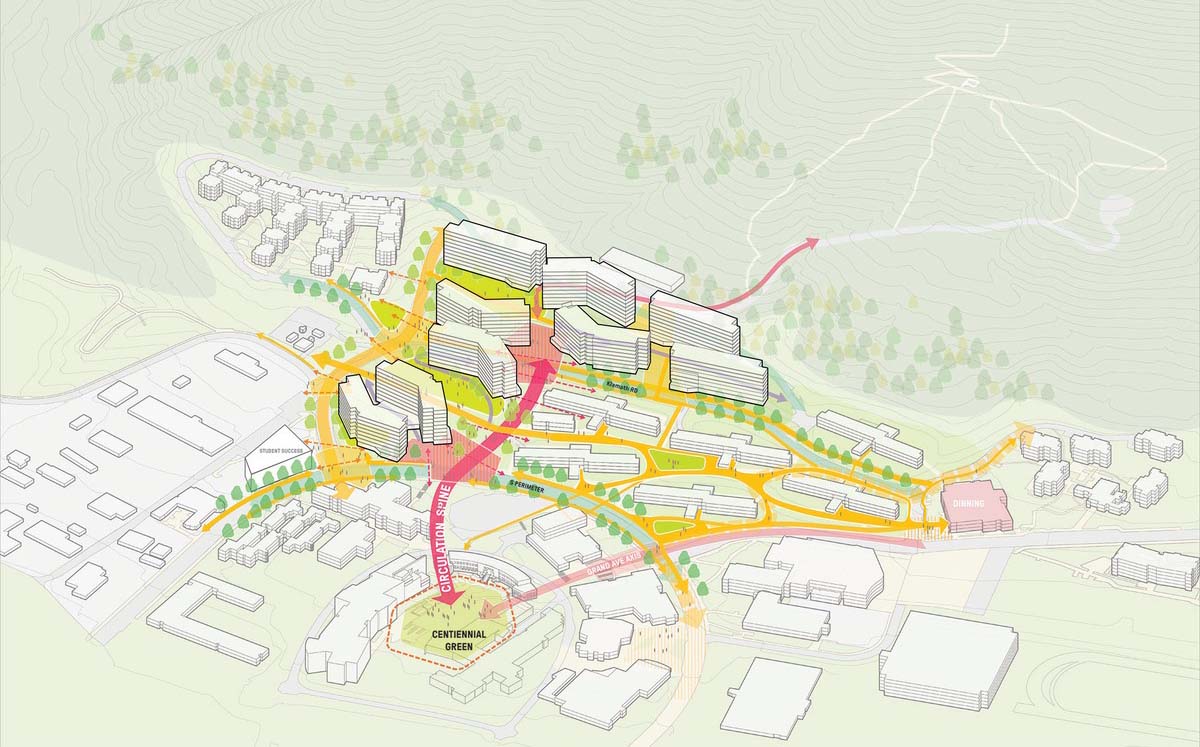
The firm is working with Cal Poly on campus-wide fire standards. Image © SWA
Since last year’s fires, have you considered updating Playbook for the Pyrocene?
Generally, the rules of thumb and the applied risk-reduction strategies presented have held up as effective approaches to design and planning in nearly all fire-prone landscapes. The caveat that continues to come up in conversation, especially over the past year, is just how nuanced today’s wildfire dilemma really is. The relationships between fire-adapted ecosystems and 20th-century patterns of urbanization in the Sierra Nevada foothills and Northern California are wildly different from those in the Southern California chaparral. Playbook for the Pyrocene continues to be a highly valuable resource, but, in future publications, I would love to see some of the chapters or ideas expanded to capture that regionally specific nuance.
Does the book have broader implications, beyond fire-risk mitigation?
People are moving to the edges of large metropolitan regions, farther from utilities, social services, and economic centers, to find affordable housing. This form of urbanization, where the built environment comes into direct conflict with wildlife systems and agricultural land, is more than just a fire challenge. We’re talking about habitat encroachment, biodiversity loss, zoonotic disease vectors, and social-equity issues. For me—and for many of my colleagues—this realignment of the edge of cities with our discipline is an important outcome of Playbook for the Pyrocene and our wildfire research.
Looking for quick answers on architecture and design topics?
Try Ask RECORD, our new smart AI search tool.
Ask RECORD →
Looking for a reprint of this article?
From high-res PDFs to custom plaques, order your copy today!