SHoP Architects Delivers an Elegant Academic Building on FIT’s Manhattan Campus

The Fashion Institute of Technology's Joyce F. Brown Academic Building opened this October. Pictured here is a central atrium melding the new structure with an older one.
Architects & Firms
The Fashion Institute of Technology (FIT), a college within the State University of New York system, has called Manhattan’s Garment District home for over six decades. Its campus, composed of a smorgasbord of structures largely built in the second half of the 20th century, occupies nearly two contiguous city blocks. As a result of that dense footprint, space is a premium commodity for the school, which counts some 8,000 students and nearly 1,000 instructors. Completed in October 2025, the SHoP Architects–designed Joyce F. Brown Academic Building (named after FIT’s longtime president) adds classrooms and much-needed social space for the tightly packed academic community.

The building is located on a narrow infill site. Photo © Christopher Payne/Esto
“One of the biggest challenges for the school was the lack of adaptable classrooms shared by all of the departments,” says SHoP founding principal William Sharples. “While there are lounge spaces throughout the campus, FIT lacked a dedicated commons for its students.”
The 110,000-square-foot building is positioned on a narrow 245-by-60-foot site, formerly filled with storage units, located squarely behind the Marvin Feldman Center (1959), the college’s first ground-up property. The center was designed by De Young, Moscowitz & Rosenberg—the firm went on to shape much of FIT’s evolving campus—and is covered with conspicuous faceted, bronze-colored aluminum panels. SHoP was commissioned to design the Joyce F. Brown Academic Building following a competition over 20 years ago in 2003 (it was one of the firm’s first major projects). The project finally broke ground in 2021; the Great Recession and other fundraising road bumps delayed construction.

At ground level, student-designed garments greet passersby. Photo © Christopher Payne/Esto

An atrium links the project to the decades-old Feldman Center. Photo © Christopher Payne/Esto
Rising to 11 floors, the structure comprises steel framing and composite floor decks, with concrete cores, and is faced with anodized aluminum panels, placed at its east and west sides. A nearly 130-foot-tall atrium, just 15 feet wide, links the new and old academic halls. The primary elevation faces north and is enclosed in unitized glass curtain wall units that each measure approximately 13-by-4 feet. Folded aluminum fins inspired by the original facade run vertically between the panes.
The primary entrance is located at the elevation’s center. It is flanked to the east by a runway-like display of student-designed attire, and storefront windows to the west offer views into the basement level’s double-height knitting lab. A foyer and presentation hall are tucked adjacent to the lobby, and 26 flexible classrooms and studios are layered throughout the building. Administrative offices, including a suite for the school president, are on the 10th floor. The most intensively used space is the student commons on the fifth level, which takes up the entirety of the column-free floor plate, and boasts 20-foot-tall ceilings.
Circulatory hallways are concentrated on the atrium-facing elevation of the new building where an “express” escalator whisks occupants from the second floor to the commons. There are direct sightlines from the corridors of the new structure into the old, where students crouch over their sewing machines and trial varied designs on mannequins.

1

2
A double-height knitting lab is placed in the basement (1); hallways provide views across the atrium into classrooms and studios (2). Photos © Christopher Payne/Esto
SHoP’s treatment of the building interior is, as Sharples puts it, “industrial chic.” Flooring largely consists of polished concrete; millwork and metal wall paneling are interspersed throughout; and metal filigrees are used for screening.
Though the design team kept the details simple, their intervention does feature several notable technical details. The insertion of the atrium transformed the envelope of the Feldman Center from an exterior to an interior wall system, which required the integration of a deluge system, with sprinklers, into window modules retrofitted with new fire-rated glazing and aluminum framing. In the event of a fire, the atrium, with the help of fans placed in the newly built mechanical penthouse, doubly serves as a smoke purge for the two buildings. The MEP system includes energy recovery devices and surpasses ASHRAE requirements for airflow. On the rooftop, 31 newly installed solar panels produce over 12,000 kWh annually.

A student commons with a 20-foot-tall ceiling is located on the fifth floor. Photo © Christopher Payne/Esto
Over the two-decade span from the competition through to the groundbreaking, SHoP’s design adapted to evolving financial realties and technological developments. Today’s ubiquity of laptops and tablets eliminated the need for a dedicated digital visualization space within the new building. Below grade, plans for a subbasement proved too much of a budget-buster and were scrapped. But the greatest change programmatically, and much to the project’s benefit, resulted from shifting the placement of the escalator and hallways from the exterior envelope to that facing the atrium. “It was a blessing in disguise,” notes Sharples.
The design team is also leading FIT’s masterplan, which will entail the renovation of the Feldman Center’s ground floor to facilitate greater connectivity between the two structures, and to include exhibition spaces. At the basement level, a concrete wall was built to be punched through later, should the funds be made available. Until then, SHoP’s intervention makes the most of a difficult infill site, with an elegant, unpretentious composition and adroit programming.
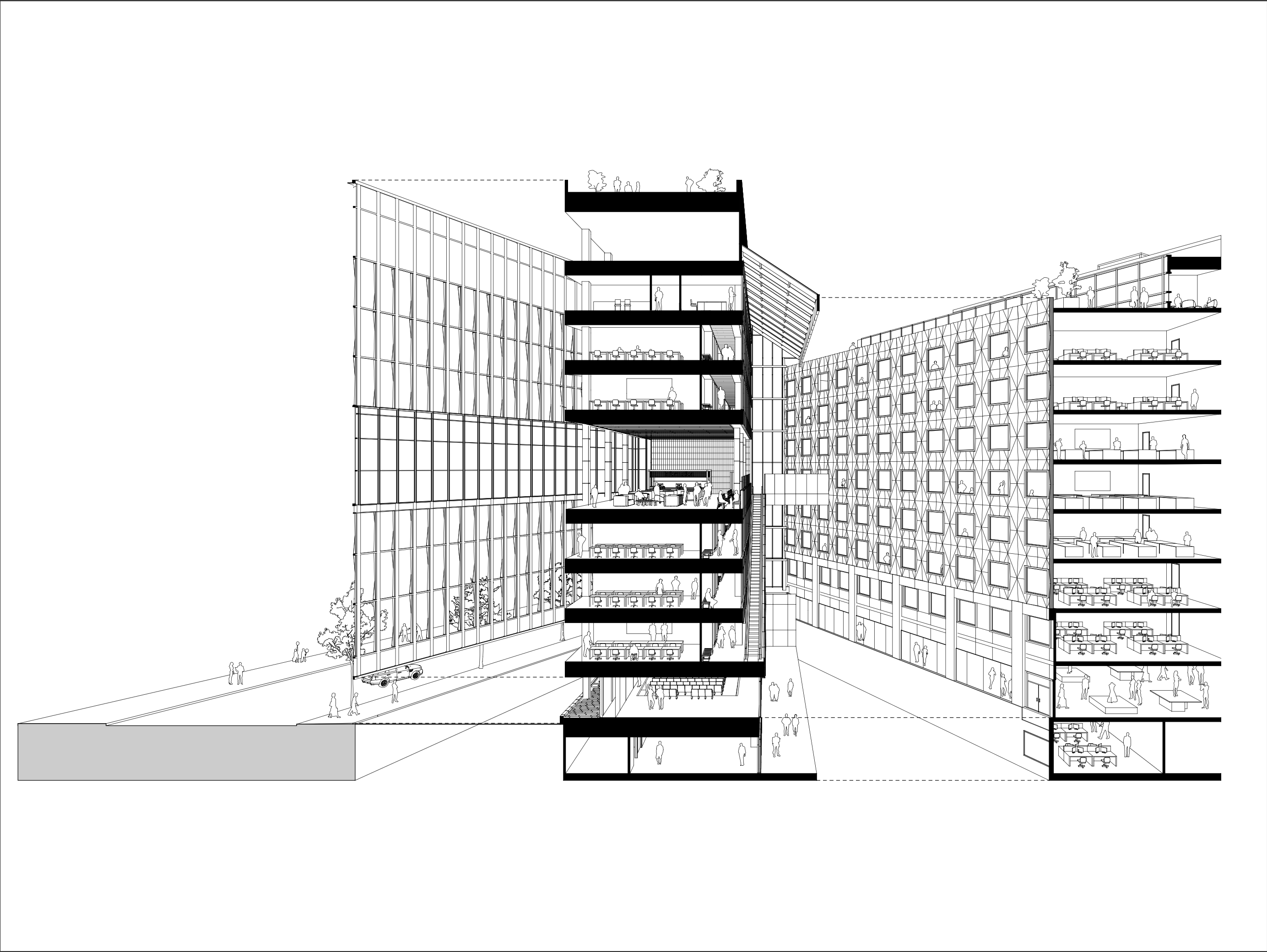
Axonometric drawing courtesy SHoP Architects; click to enlarge
Looking for quick answers on architecture and design topics?
Try Ask RECORD, our new smart AI search tool.
Ask RECORD →
Looking for a reprint of this article?
From high-res PDFs to custom plaques, order your copy today!