Books
‘Sick Architecture’ Probes the Relationship Between the Built Environment and Health and Wellness
‘Sick Architecture’ edited by Beatriz Colomina with Nick Axel and Guillermo S. Arsuaga
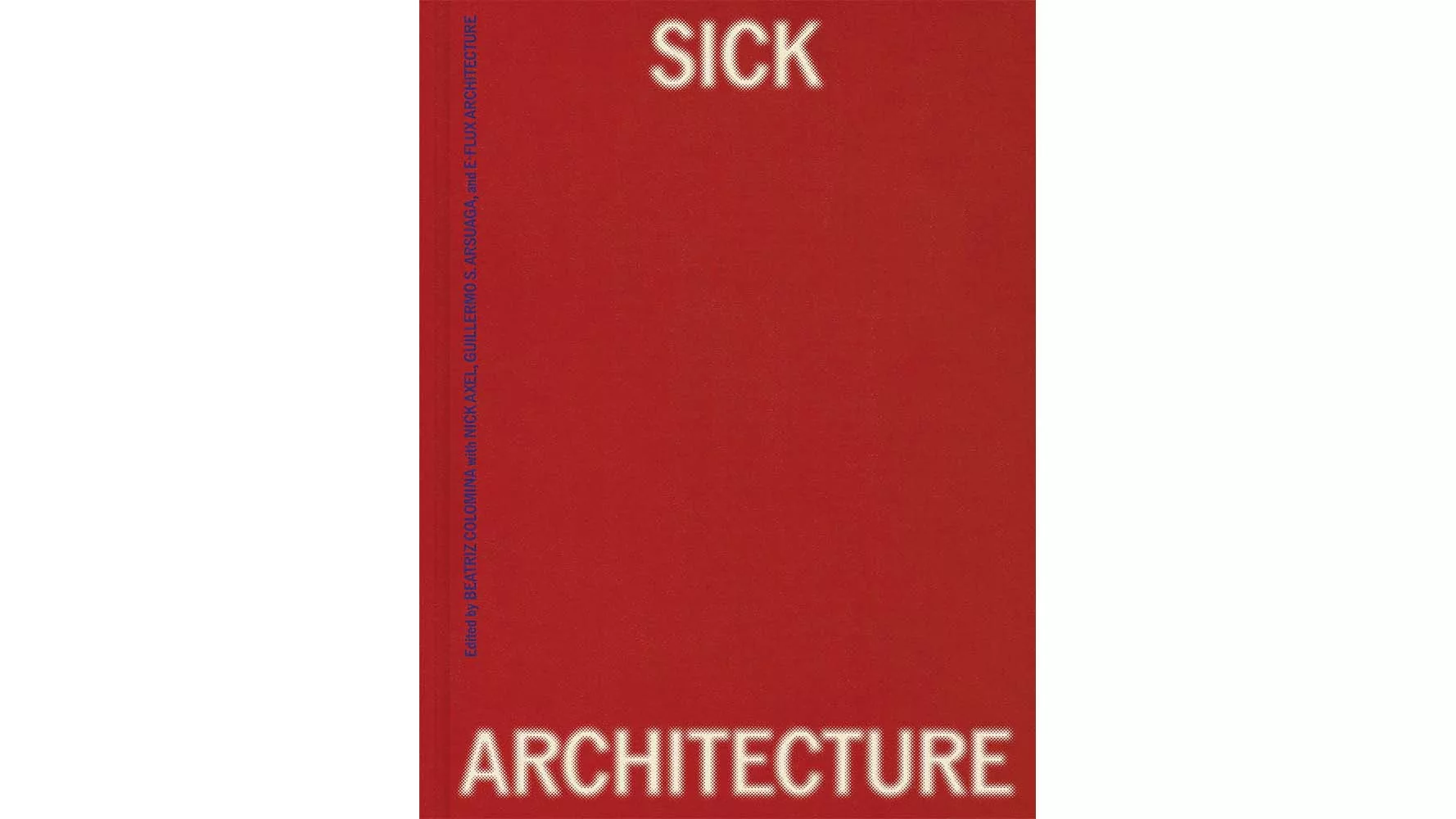
The table of contents of this book shows its chapters as a grid—like the quarantine beds pictured on a following spread—of 36 essays, all written by those afflicted with the impulse to pursue a Ph.D. in architecture. As the preface explains, the volume, originally titled “The Illnesses of Modern Architecture,” started as a doctoral seminar at Princeton’s School of Architecture in 2017, and the onset of the pandemic lent renewed urgency to the question of architecture’s relationship to disease and wellness. Written in an academic prose that often drifts into a kind of inadvertent slam poetry, essays stagger feverishly through topics from mosquito mitigation to the history of Pilates, man caves and toxic masculinity, and more. There are germs of insight—some about sicknesses and a few about architecture. It does elucidate some of the pathologies of modern architecture, though perhaps not in the way the editors intended. Following is an excerpt from Beatriz Colomina’s introduction.
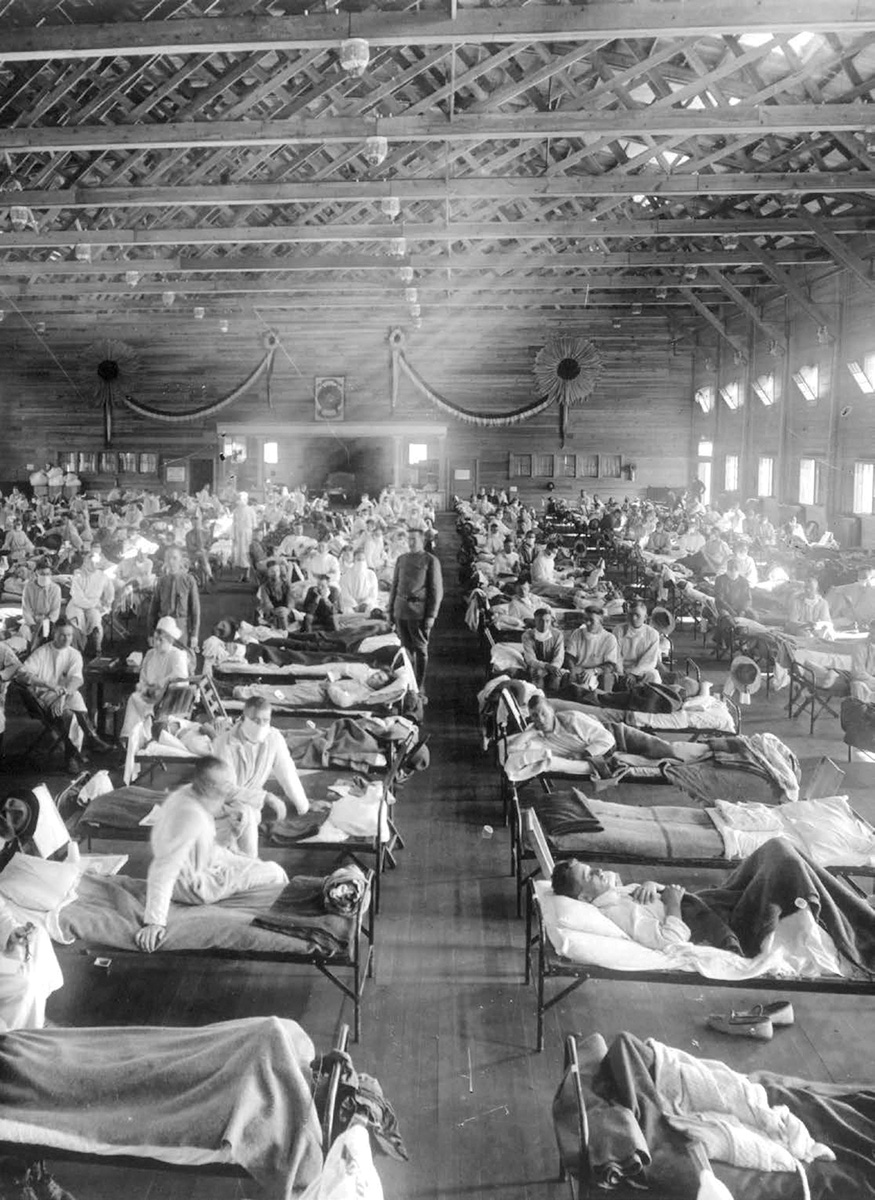
Patients housed at Camp Funston in Fort Riley, Kansas, during the Spanish Flu epidemic. Photo courtesy the National Museum of Health and Medicine, click to enlarge.
Modern architecture produces sickness, most obviously sick-building syndrome. The air-conditioning systems that architects like Le Corbusier celebrated for isolating inside air from the contaminated outside air turned out to be reservoirs and vectors of disease. As in a science fiction horror film, the architecture that was supposed to inoculate its occupants against disease turned against them. Many of the diseases of our time, including obesity, diabetes, numerous cancers, autoimmune disorders, allergies, and autism, are now understood as the consequence of the diminishing diversity of bacteria. Buildings have their own microbiomes, and the diversity of bacteria in buildings is just as important as the bacterial diversity in bodies. The bacteria of buildings continuously enter human bodies, and the bacteria of these bodies—along with those of other animals, insects, and plants—are spread out across buildings. But there is a crisis of diversity in this ecology. Just as modern architecture polemically reconfigured the 19th-century architectures that preceded it on health grounds, architecture today needs to be dramatically reconfigured in the name of newer paradigms of health and actively engaged in the production of alternative paradigms.
All the archaeological layers of sick architecture are inherently political. Models of health paradoxically produce vulnerabilities to illness. They inevitably draw and maintain lines that privilege and shelter a normalized subject from threatening others. In reverse, to think in terms of sick architecture is to recognize that all borders, whether that of a room or a nation, are medical. Reinforced by countless protocols and policing, these borders are typically not a single line but a nesting of lines at multiple scales, each with their own architecture. Sick architecture is always multiscalar, traversing and defining territory, nation, ethnicity, race, class, and domesticities. It creates models of normality, which are also models of exclusion, disadvantage, and prejudice.
As many of the essays in this collection show, the violent exercise of colonial power, whether external or internal, is inseparable from the architecture of health and is never simply about humans but trans-species relationships. In the Belgian Congo, for example, a 400-meter-wide band—the distance it was thought that no mosquito could fly—separated the Indigenous city from the European city, supposedly to prevent yellow fever. The medical border acted as a mechanism of racialization. The mosquito dimensioned the city. The construction of the Panama Canal was also predicated on the conquest of the mosquito. It involved both large- and small-scale interventions, from the clearing of forests and draining of swamps to the installation of screened verandas and other architectural devices deployed along, and reinforcing, racialized lines. Much if not most of the sick architecture in this collection is the state control of bodies, from slavery to eugenics to menstrual cycles. Even the planet is now both sick and a medical instrument to detect illnesses.
Health is not just physical. Already in ancient Greece, a variety of mental illnesses were identified and spatialized inasmuch as sufferers were forced to remain indoors or roam the outdoors without an address. Eventually, specialized buildings offered both isolation and care. The Muslim philosopher and physician Ibn Sina treated the “head sick” with calming gardens and fountains in the first mental hospital, set up in the heart of Baghdad in the eighth century. His Canon of Medicine considered psychology to be essential and was the most influential medical text in Europe up until the 17th century. The Hospital of the Innocents, considered to be the first psychiatric hospital in the Western world and the model throughout Europe and the Americas, was founded in Valencia in 1410 after observing the Islamic institutions. Eventually, the whole architecture of mental illness was undone by the anti-psychiatric movement in the 1960s, but experimentation continues today in developing architectures that allow those on an expanded mental spectrum to be at once sheltered and engaged in city life.
In fact, the question of mental health has always been part of architectural discourse. Architects act as if their designs will produce a sense of well-being, and each mental condition needs to be countered by architecture. At the turn of the 20th century in Vienna, Camillo Sitte diagnosed the modern city as producing agoraphobia, in the very moment and place the disorder was first identified. Sitte presented his urban design, inspired by the eccentric narrow streets and small plazas of medieval cities, as a psychological counter. In the late 1940s and 1950s, Richard Neutra fashioned himself as a shrink to his clients, understood as patients. Likewise, when the concept of stress was identified in the 1960s as the predominant reaction to modern life, experimental architects such as Coop Himmelblau worked with psychiatrists to produce prototypes of relaxation architectures. Hans Hollein replaced buildings altogether with an “architecture pill” providing the desired mental state. In reverse, some mental states such as autism are now seen as inherently spatial, implying an alternative architecture in their own right.
In addition to architectures for an expanded mental spectrum, there is the need to embrace an expanded understanding of the physical spectrum. Architecture that normalizes can itself be treated as a form of sickness. The diverse abilities of children, the elderly, amputees, the deaf, the blind, and the infirm call for greater hospitality, opportunity, and pleasure from architecture, redefining the very concept of care and transforming the role of buildings in a way that impacts many more than those being treated. Aino and Alvar Aalto offered a crucial paradigm shift when they argued that architects should always design for the person in the “weakest position.” The radicality of this is to rethink architecture from vulnerability itself. Sickness is not an exception but the norm, and different degrees of sickness define the human condition.
This dense array of essays engages with a multiplicity of topics, places, scales, and concepts that are loosely gathered into the overlapping categories of Bodies, Borders, Atmospheres, and Landscapes, each understood as architectural categories in their own right. The book is a nonhierarchical, kaleidoscopic almanac with many quirky entries that acts as a resource to think more widely and differently about sick architecture. It is a kind of minimum dose, with so many topics and angles waiting to be added. It is an invitation to collaboratively reconsider the ancient and always urgent question of the relationship of health and architecture.
Looking for quick answers on architecture and design topics?
Try Ask RECORD, our new smart AI search tool.
Ask RECORD →
Looking for a reprint of this article?
From high-res PDFs to custom plaques, order your copy today!