Parks & Recreation 2026
A Historic Sand Filtration Plant in Washington, D.C., is Transformed into a Multipurpose Green Space
Washington, D.C.
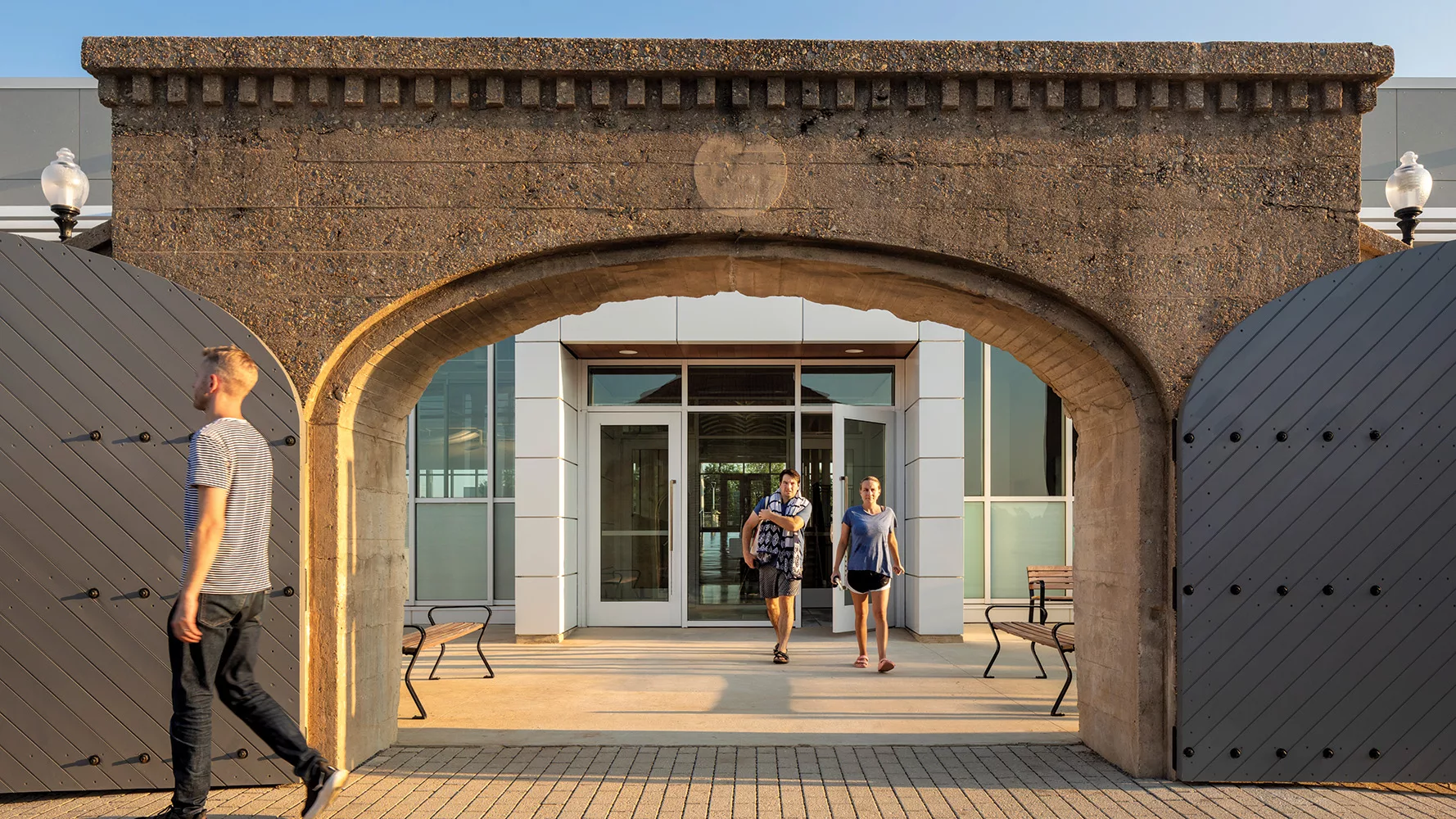
On a balmy morning in April, Washington, D.C.’s Reservoir Park and Recreation Center, the largest addition to the capital’s parks system in decades, was teeming with life. The 8.5-acre green space sits in a low-rise and largely residential area, just 2 miles from the White House in the city’s Northwest quadrant. It serves as the public-facing component of a 25-acre redevelopment that is transforming what was a sand filtration plant into the Reservoir District, a mixed-use neighborhood.
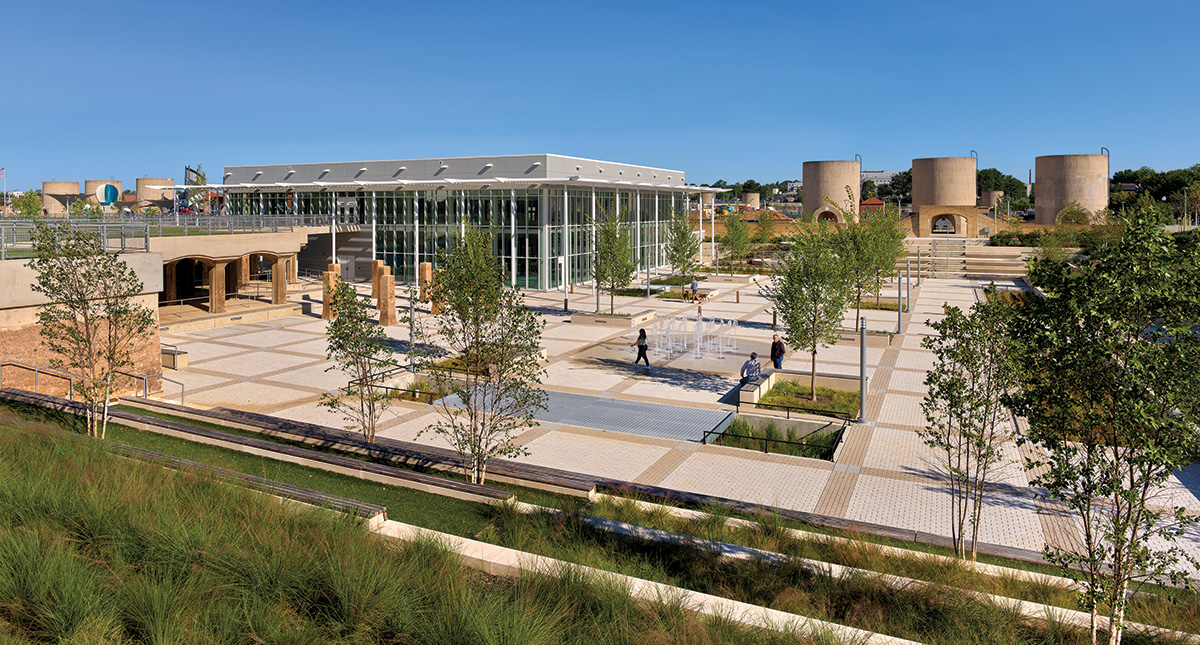
Delivered via a design-build effort led by Gilbane, the project team includes Perkins Eastman DC, serving as master planner and design architect; Quinn Evans as architect of record (the practice also lent its expertise in historic preservation); and landscape architects Rhodeside & Harwell and Nelson Byrd Woltz, the latter of which served as master planner for landscape design. The rectangular park includes an open lawn, a sunken plaza, and a playground. It is anchored by a 19,000-square-foot steel-framed and glass-clad recreation center housing a multipurpose space, a fitness room, and a swimming pool, spread across two levels.
“This neighborhood had not seen the same investment in community buildings and libraries as other parts of town,” notes Perkins Eastman DC principal Matthew Bell. “Residents were asking for the same quality-of-life improvements.”
The decommissioned sand filtration plant was built in 1905 as a key piece of infrastructure within the McMillan Plan, developed by Senator James McMillan, to rationalize Washington’s cityscape—then a jumble of monuments and add-ons to the 1791 L’Enfant Plan—according to City Beautiful principles. Integral to that goal was the distribution of clean water, to counter frequent outbreaks of cholera and typhoid. The complex was composed of 20 underground cells, each roughly an acre in size, where water from the adjacent McMillan Reservoir was purified by passing through several feet of sand and thin biofilm, also known as a Schmutzdecke. Twenty 25-foot-tall silos, arranged in two rows, stored the sand used during the process; each has been preserved. Both the catacomb-like cells and silos were built of wood-formed mass concrete; the moisture-heavy environment would have corroded rebar.
1
2
3
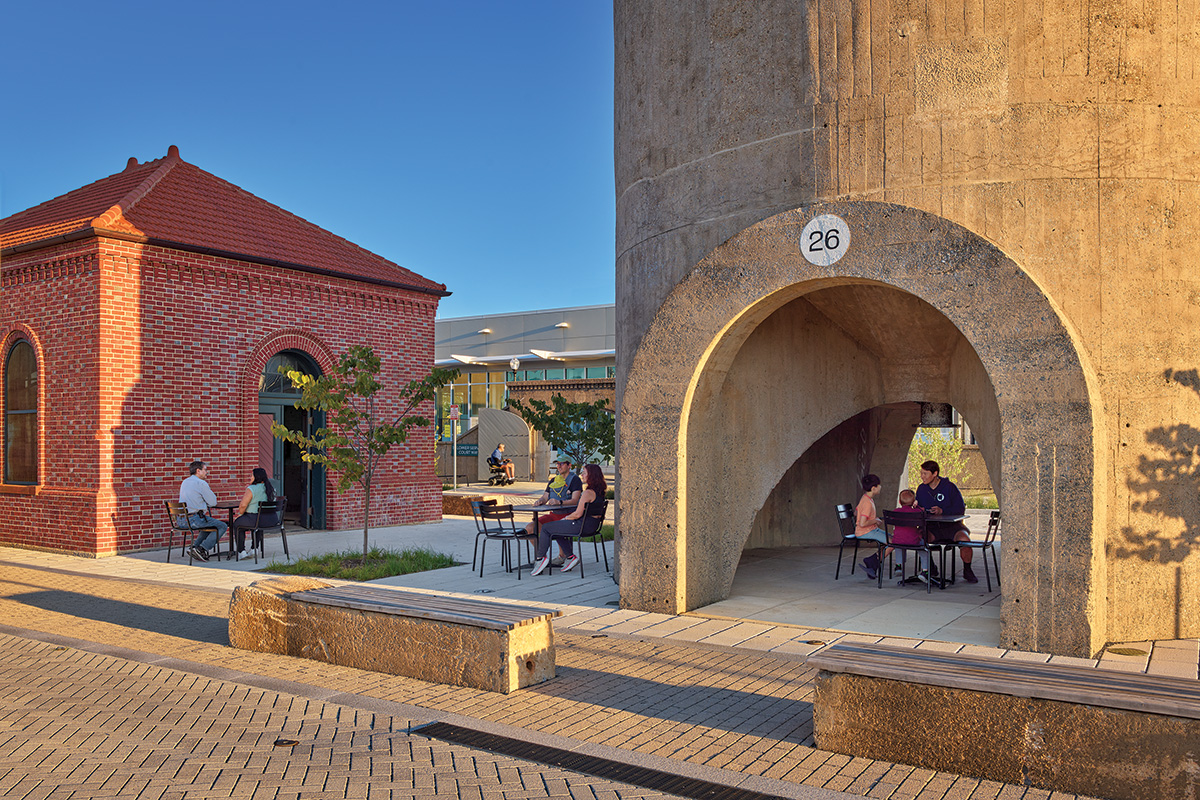
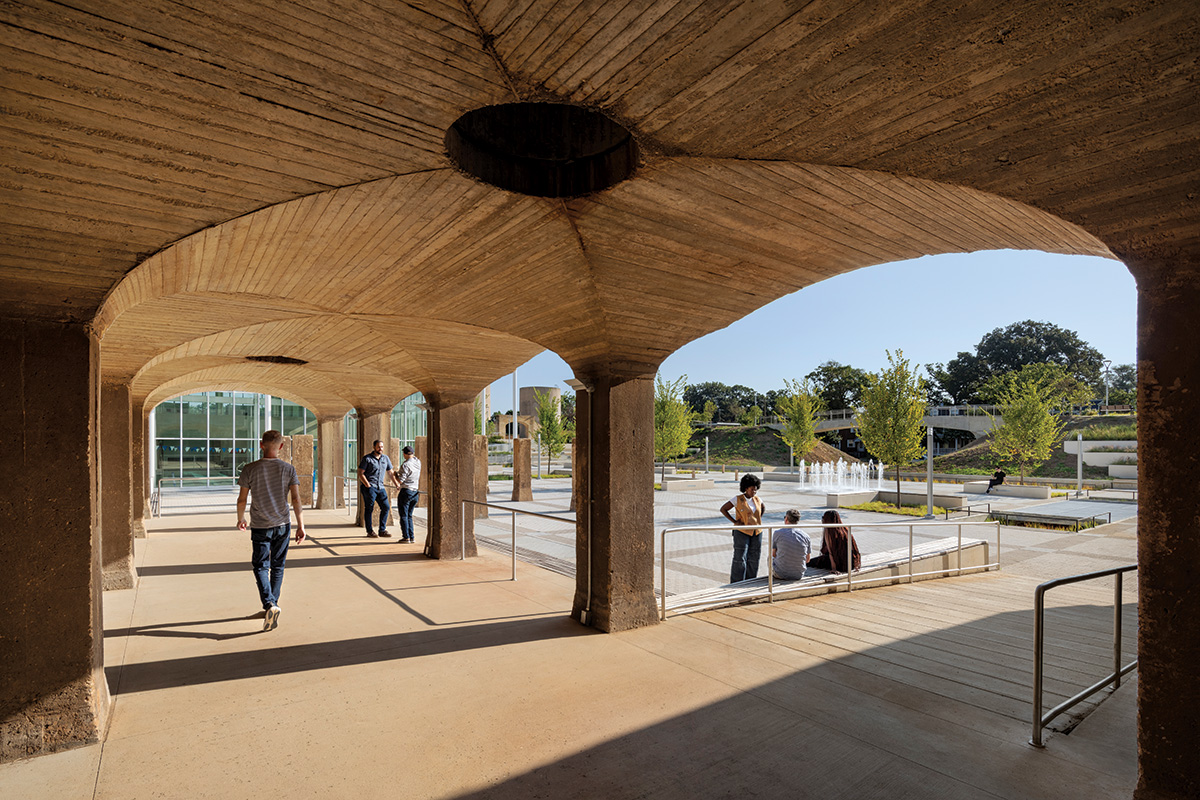
The landscaped sunken plaza is bordered by preserved silos, pump houses, and a filtration cell (1–3). Photos © Alan Karchmer (1 & 2) and Andrew Rugge (3)
A park designed by Frederick Law Olmsted once sat atop the cells, but it closed during World War II due to security concerns and never reopened. Advances in filtration technology rendered the facility redundant decades later. The plant was shuttered in 1986, sold to the municipal government a year later, and designated a city landmark in 1991. The design team began work in 2010; however, opposition to the redevelopment’s scale, loss of green space (albeit long neglected and inaccessible), and historic-preservation concerns fueled years of litigation. Back-and-forth dialogue with city agencies, and a shift from a disposition funding model of development to a more conventional public-private partnership, further delayed construction.
“There was a tremendous amount of oversight by the Historic Preservation Review Board, Commission of Fine Arts, the D.C. Zoning Commission, and the local community,” clarifies Quinn Evans principal Tom Jester. “It is a time-consuming and expensive process that ultimately creates a better project.”
Ground was broken in 2016, though full-scale work did not commence until 2022, after private financing was secured for the broader development. It includes rowhouses and apartment buildings, some designated as affordable, and planned health-care facilities.
Looking for quick answers on architecture and design topics?
Try Ask RECORD, our new smart AI search tool.
Ask RECORD →
The project’s layout was informed by the plant’s historical importance, both culturally and architecturally, and a robust community-engagement process. An existing earthen berm was stabilized and now wraps three of the park’s sides, rises to approximately 16 feet along its southern edge. A circuitous, tree-lined pathway is placed at the berm’s crest and roughly follows a trail original to Olmsted’s design.
Along the northern edge, a former service alley has been transformed into a space like a courtyard between the park and rowhouses. There, one of two preserved rows of sand silos—brick-built structures housing water-pressure regulators—and concrete containers used for cleaning sand remain as visible artifacts.
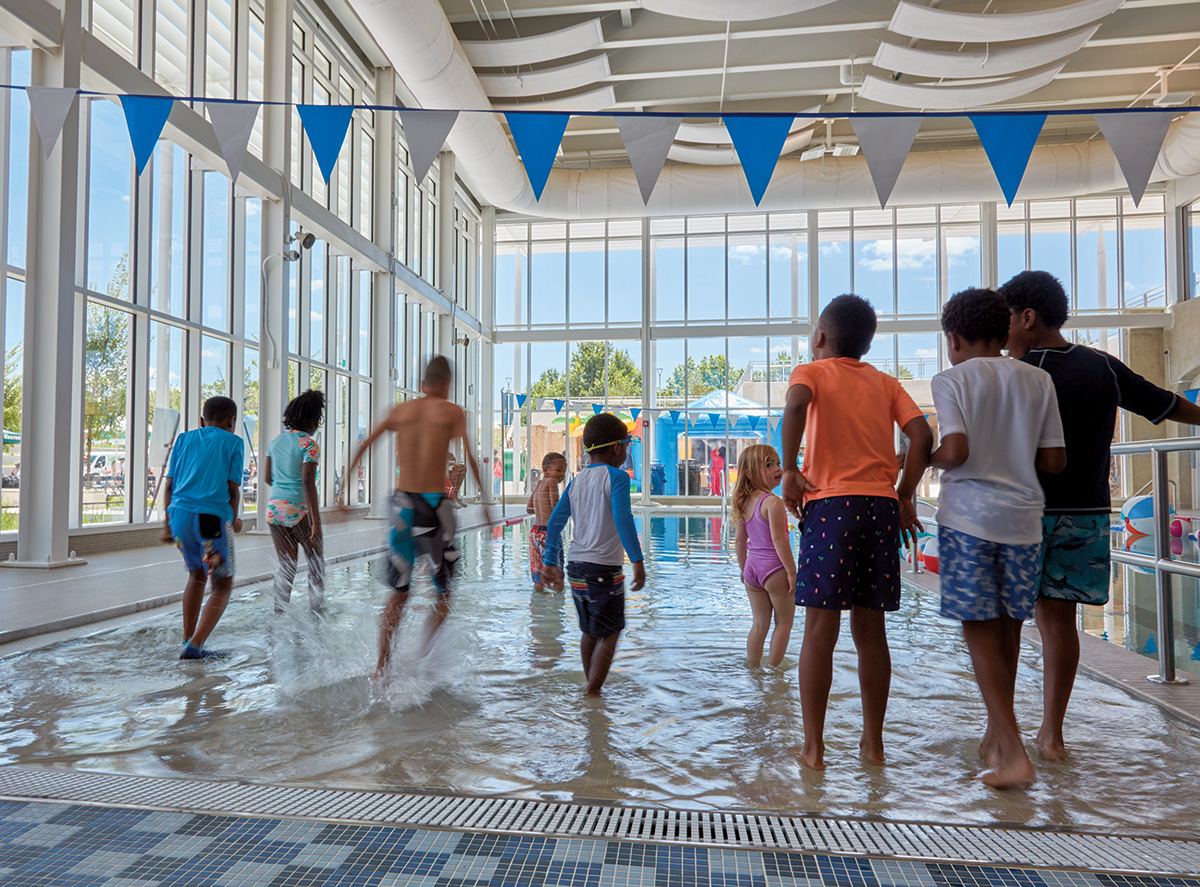
The recreation center includes a pool for learning to swim. Photo © Patrick Ross
To make way for the park and the mixed-use development, most of the filtration cells were demolished, though some columns were recycled as benches. Much of the site was filled in with soil to create a sprawling lawn, while a 30,000-square-foot sunken plaza was inserted at its eastern flank, which can be accessed by a void cut through the perimeter’s berm. One of the filtration cells was preserved (another remains in the site’s residential portion), and its approximately 14-foot concrete matrix is echoed in the spacing of the plaza’s paving, planting beds, and the center’s structural piers. The cell is topped by a concrete slab and manholes that provide glimpses into the space below. “You experience the historic structure in section,” says Jester.
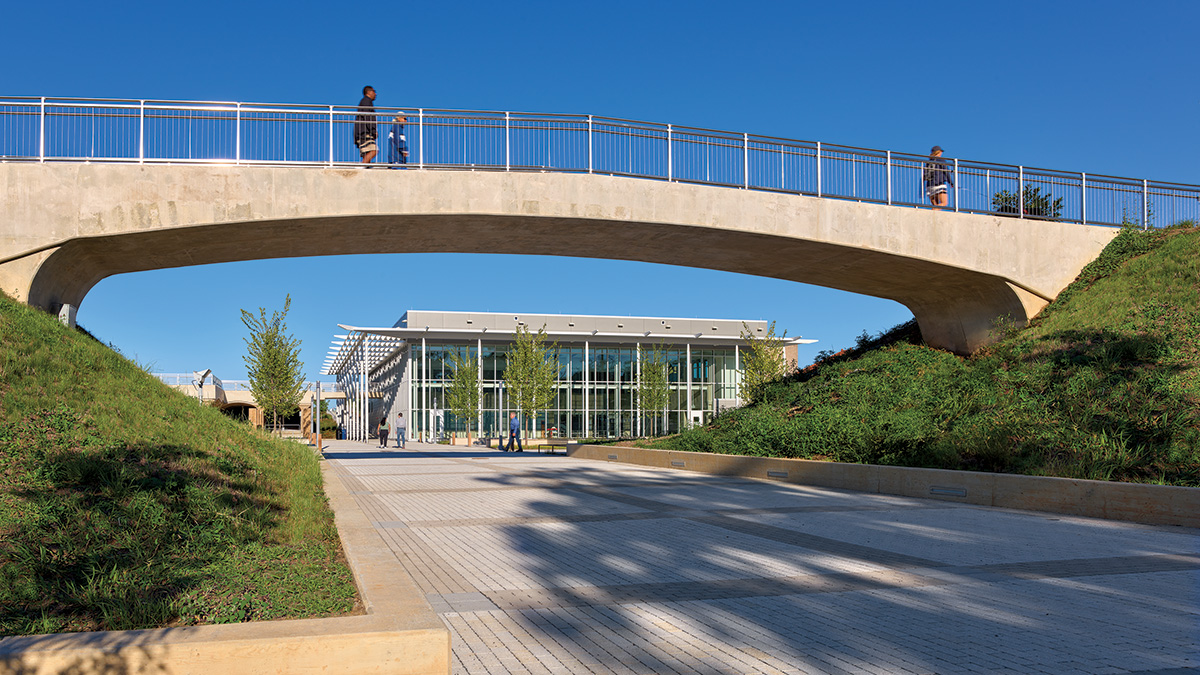
A cut in the berm leads to the plaza. Photo © Alan Karchmer
The design team aimed to make the community building, arguably the most conspicuous component of the park, both welcoming and subtle in its detailing. “The existing context has a platonic kind of geometry, so we made this a square building with modern materials,” explains Bell. “It doesn’t compete with the historic aspects.” To that effect, the structure is clad in highly transparent glazing, giving it a jewel box quality, while an expansive roof-level brise-soleil mitigates glare and solar heat gain. Primary entrances are located at the middle of the north and south elevations on the second floor. A multipurpose space looks west onto the park’s playground. The 75-foot-long lap pool and fitness room are found on the first level.
Bloomingdale, Reservoir Park’s surrounding neighborhood, is prone to flooding. To alleviate those conditions, approximately 80 percent of the site is permeable, with planted areas, bioretention gardens, and porous paving. Approximately 33 percent of the site’s vegetation and half of its trees, such as its beds of iris and switchgrass and rows of oak and maple, are indigenous.
Though the demolition of much of the plant’s historic fabric proved contentious, the long-awaited and successful renewal at Reservoir Park offers a practical urban amenity, where past and present commingle, and provides the surrounding community space to grow in the years ahead.
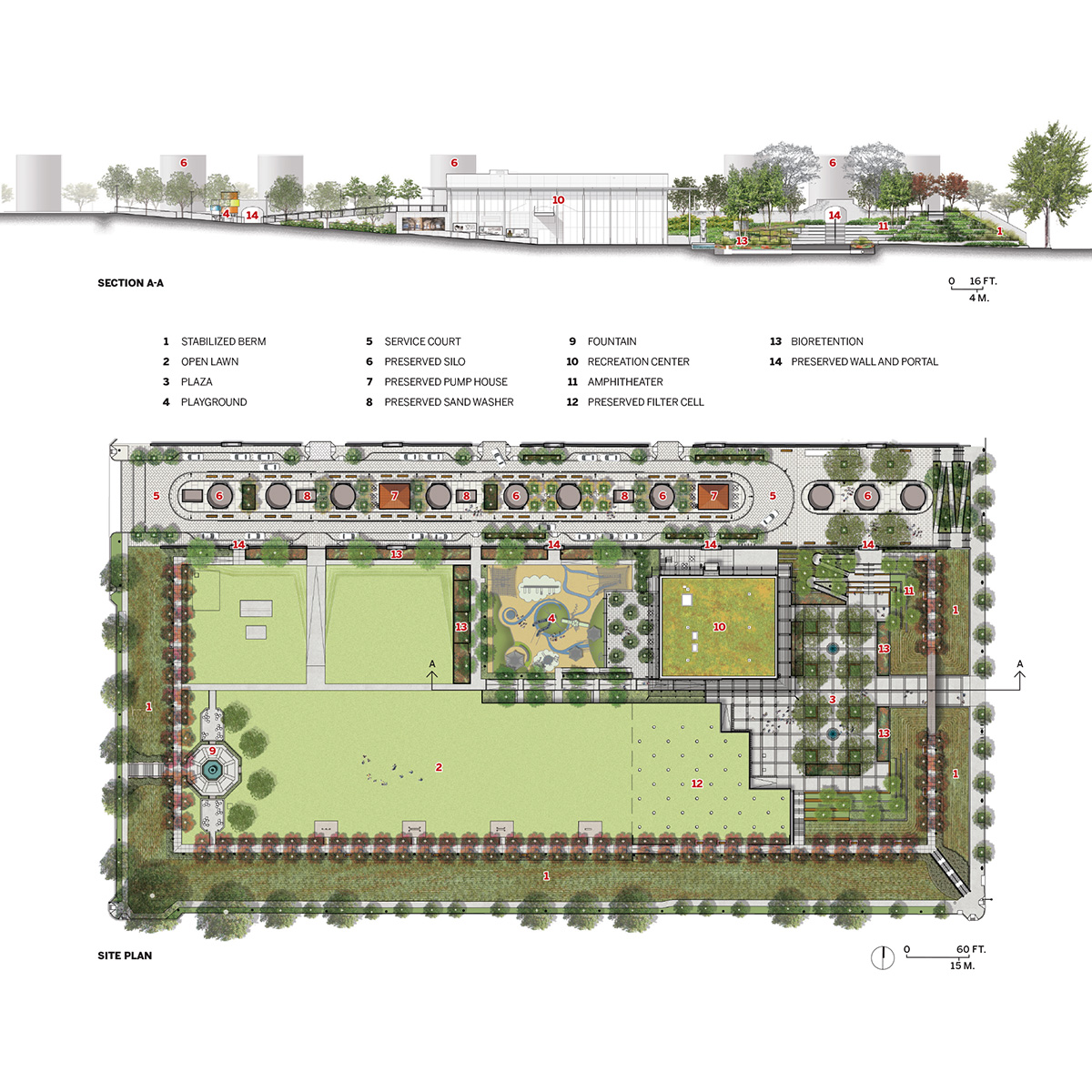
Image courtesy Perkins Eastman DC, click to enlarge
Credits
Architect:
Perkins Eastman DC — Matthew Bell, principal in charge; Christian Calleri, senior urban designer; Tim Bertschinger, senior design and project architect; Stephen Penhoet, project manager
Architect of Record:
Quinn Evans — Thomas Jester, principal in charge; Leora Mirvish, project manager; Stefan Zastawski, historic-preservation architect
Engineers:
Thornton Tomasetti, McMullan & Associates (structural); Global Engineering Solutions (MEP); Wiles Mensch Corporation (civil); Wetland Studies and Solutions (environmental)
Landscape:
Rhodeside & Harwell; Nelson Byrd Woltz (master planner)
General Contractor & Client:
Gilbane
Owner:
D.C. Department of Parks and Recreation
Size:
8.5 acres (park); 19,000 square feet (recreation center)
Cost:
$59 million (construction)
Completion:
June 2024
Sources
Exterior Cladding:
NextGen Metal Design Systems (metal panels); Kawneer (curtain wall); Arban Precast Stone
Roofing:
USG (elastomeric)
Glazing:
Vitro Architectural Glass
Acoustical Ceilings:
Armstrong, Kinetic Noise
Floor and Wall Tile:
Daltile
Furnishings:
KI
Plumbing:
Kohler
Looking for a reprint of this article?
From high-res PDFs to custom plaques, order your copy today!

.webp?height=200&t=1717782335&width=200 "AIA24_060624_KB-0006_websize (1).jpg")

