Renovation, Restoration & Adaptive Reuse: 2026
Snøhetta Adds a Sinuous Structure to a Century-Old Symphony Hall in St. Louis
St. Louis

Architects & Firms
For a hundred years, Powell Hall (1925) anchored the north end of St. Louis’s theater district as a world-class auditorium and grand foyer, packed into a brick and terra-cotta box. Designed as a theater at the peak of the movie palace boom by Chicago-based architect Rapp and Rapp—which specialized in such buildings—the original foyer was modeled after the royal chapel at Versailles, and the same gold and cream decor was carried through to the auditorium. Because not much backstage space was needed and moviegoers would spend the remainder of the evening elsewhere in the theater district, little room was made in the building for anything except those two main volumes. Space became uncomfortably tight, however, when the building was restored and adapted as the home of the St. Louis Symphony Orchestra in 1968. While musicians remarked that acoustics in the auditorium were as good as those at Carnegie Hall, practice sessions took place down in the boiler room. Overflow from the undersized lobby was onto the sidewalk.
With the newly christened Jack C. Taylor Music Center, Snøhetta has not only resolved the mismatch between the movie-theater building and the symphony-orchestra program, but it has also grasped the opportunity presented by the centennial restoration and expansion to compose an architectural identity for the symphony that acknowledges its multiple constituencies. The architect might have been tempted to create a more focused image for the institution by consolidating the project within a single shell. From a certain perspective, this would have been the most fitting response to its location. With windswept lots in three directions—two for parking, one a new plaza landscaped by Snøhetta—it is a site made for a statement building. But Snøhetta “didn’t want the sculptural qualities of the front of house to take over the whole building,” according to founding partner Craig Dykers. Jørn Utzon’s Sydney Opera House, for instance, set the precedent of creating a close fit between function, image, and institution. Snøhetta, however, aimed for a “different kind of sculpture.”

An arching addition on the south side of Powell Hall (top of page) offers a roomier entrance and lobby (above). Photo © Nic Lehoux, click to enlarge.
The architect instead designed two additions with distinct forms and functions: a grand entrance on the south side that opens onto the plaza, and a back-of-house extension to the east. At 64,000 square feet, they complement the historic Powell Hall building—which has twice the floor area of the addition—and ease its rectilinear severity. As with the firm’s Norwegian National Opera and Ballet in Oslo (2008), Snøhetta drew inspiration from the surrounding landscape. If that opera house resembles ice floes splayed against a crystalline promontory, the new entrance wing to the music center evokes a colossal snowdrift blown up against the existing block, then precisely carved with giant scallops and arches. This snowbank sculpture is conjoined with an orthogonal back side extending from the original building and clad in the same warm white brick.

1
A back-of-house expansion (1) provides state-of-the-art spaces for visitors, staff, and musicians, including an education center (2). Photos © Nic Lehoux

2
In the context of St. Louis, disaggregating the music center into a set of functional parts—lobby, auditorium, and backstage—is an act of urban generosity; because they are not bound firmly together, the parts tie easily into the fabric of the city. The most apparent connecting thread is the arch motif wrapping the lobby. Eero Saarinen’s Gateway Arch (1965), an engineering marvel clad in stainless steel, springs above the Mississippi River waterfront downtown. A more summery characterization of the lobby addition’s solid massing might be the immense natural earthworks of the river itself. Dykers mentions the “beautiful edges of the Mississippi” when describing the “geological quality” of the addition.
Circular arches also ensure straightforward buildability. “Geometrically, the shape of the facade is derived from the surface of a cylinder leaning inward by 6 degrees,” says project director Takeshi Tornier. “So each course of bricks has the same radius in plan.” The bricks’ color comes from the creamy hue of the terra-cotta tiles of the existing auditorium building, and the use of three sizes adds subtle variety.
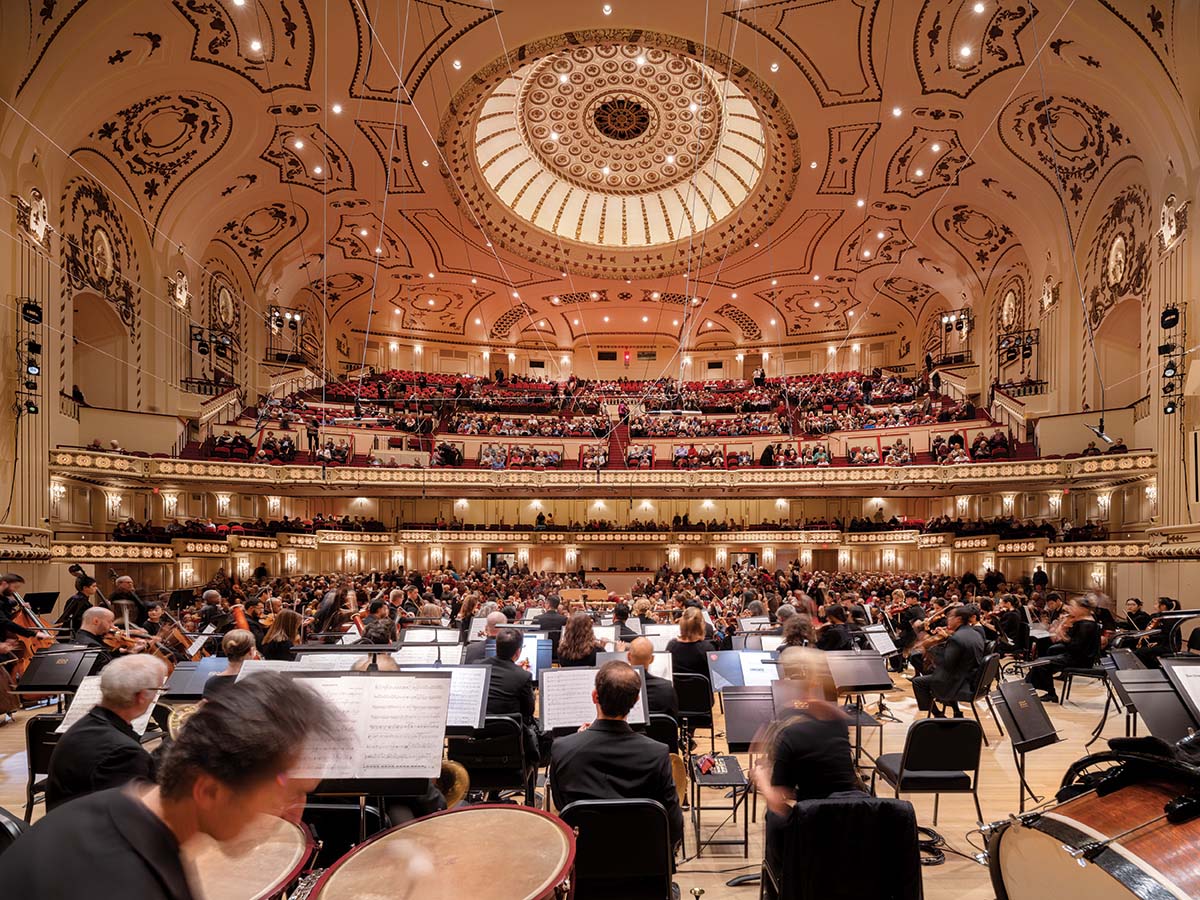
The music center’s back of house is a new collection of brick-clad boxes: a low entrance block flanked on one side by a double-height volume housing a rehearsal hall and capped on the other by a mechanical screen for a suite of air-handling units. The utilitarian atmosphere is elevated by luxurious details, like the champagne-gold panels that border the windows of the musicians’ lounge. The sequence from the parking lot to the auditorium unfolds layers of ever-quieter spaces, with finer materials—like handmade tiles in the dressing room—harbingers of the opulence at the end. The 2,150-seat auditorium was carefully restored, from the ceiling plasterwork overhead down to the newly ADA-accessible aisles and seating. Only a few small additions, like acoustic screens adjacent to the stage, will be tip-offs that anything has changed.
3
Home to the second-oldest orchestra in the country, the hall’s lobby (4), and 2,150-seat auditorium (3) received a refresh. Photos © Nic Lehoux

4
Entering from the other direction, another layered material expression greets guests in the lobby. From the street, the interior appears to have been designed through a process of carving. Upon stepping through the archway, however, one sees that it peels into constituent parts. Brick gives way to gold-hued soffits, then a glass wall; inside, reveals between the ceiling and walls and transitions from white-painted drywall to slatted white oak ceilings suggest a space assembled from expertly cut and creased paper and basswood sheets. The dramatic centerpiece—a spiraling stairway—unfurls, like a ribbon, into balconies. Wood paneling with glowing reveals encases the concession areas that accommodate the main (social) event: a night out on the town, of seeing and being seen.
Looking for quick answers on architecture and design topics?
Try Ask RECORD, our new smart AI search tool.
Ask RECORD →

5
Within the expanded movie palace (5), ornate details mingle with crisp, contemporary spaces (6 & 7). Photos © Nic Lehoux

6

7
There is nowhere for construction imperfections to hide against such a spare backdrop. Bob Johnson, project leader for Christner, the architect of record, describes an unconventional approach to concrete work on a set of exposed poured-in-place columns. Rather than relying on a second pass for finishing, builders aimed for nearly perfect results on the first go and viewed any imperfections as valuable traces of their craftwork. Perhaps as a result, the finishes are excellent. One particularly cavernous area of the lobby, for example, is capped with a special sound-dampening ceiling that transitions almost imperceptibly to conventional drywall. Throughout the building, champagne-gold details mark portals between the new minimalist and the old ornate spaces.

8

9
10
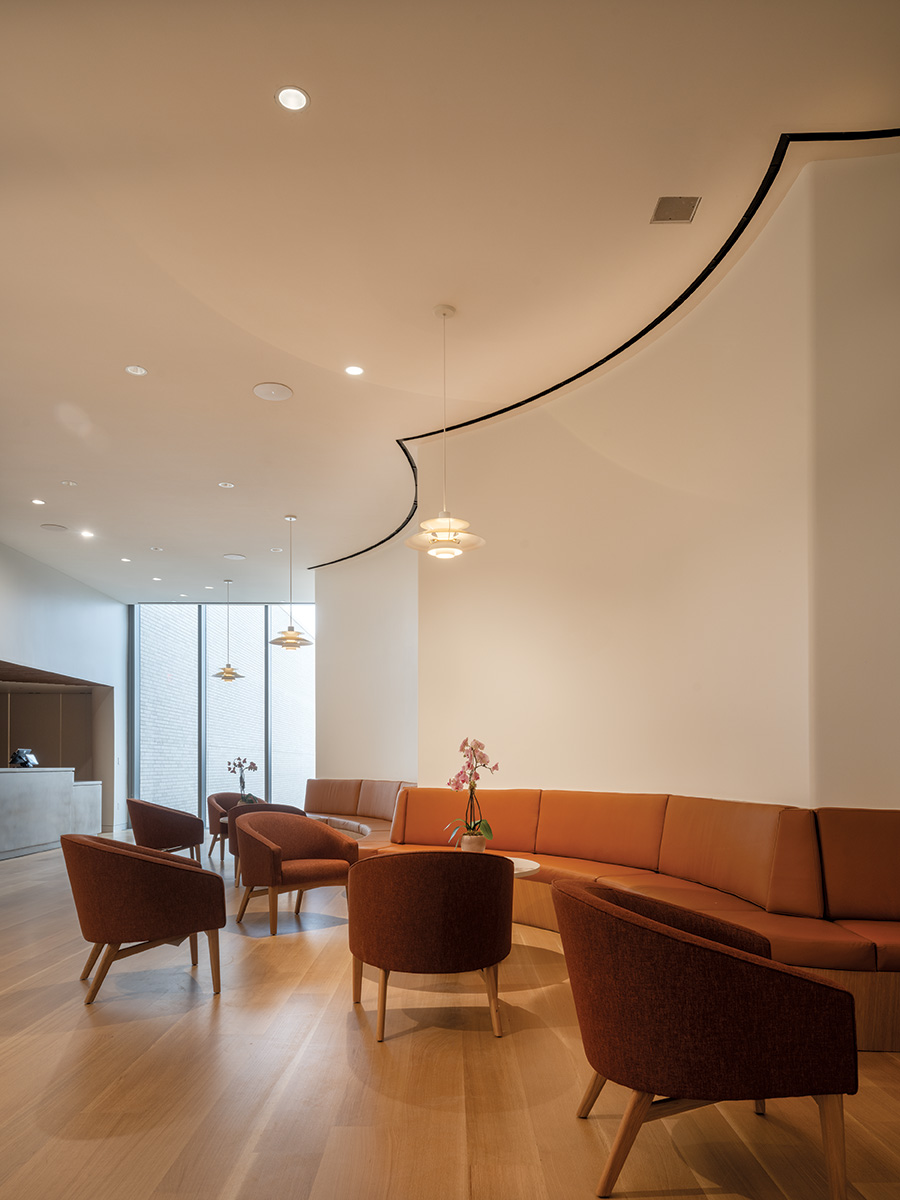
There is additional room for circulation (8), storage (9), and seating (10). Photos © Nic Lehoux
The multiple architectural characters of Snøhetta’s music center suggest a narrative for places like St. Louis that departs from the conventional story. Electoral maps showing midsize Midwestern cities as blue dots in a sea of red have probably led many people to think of them in terms of stark divisions. In truth, the demographics of orchestra audiences in St. Louis run the gamut. Season-ticket holders sit alongside those marking special occasions; the crowd for a Sunday matinee diverges from the Saturday-evening bunch.
This multiplicity is reflected in the range of entrances Snøhetta created for the music center. The existing building had two: front and back. The back entrance is still there (and much improved), while the existing front doors were made exit-only and ingress was shifted to the sides. The main entrance now leads from the new plaza at the south into the new grand lobby, as expected. The north entrance is more remarkable. It opens unassumingly near a bus stop on the street, with only minor additions, like an angular metallic canopy, signaling its novelty. The southern entrance lobby exudes grandeur, but entering from the north comes with its own perk, a shortcut: stairs just inside lead straight to what regulars say are the seats with the best acoustics, up at the top.
Snøhetta’s music center demonstrates something more impressive than the power of beauty to bring people together: togetherness need not entail conformity. The new symphony hall is replete with multiplicity, like those who people it.
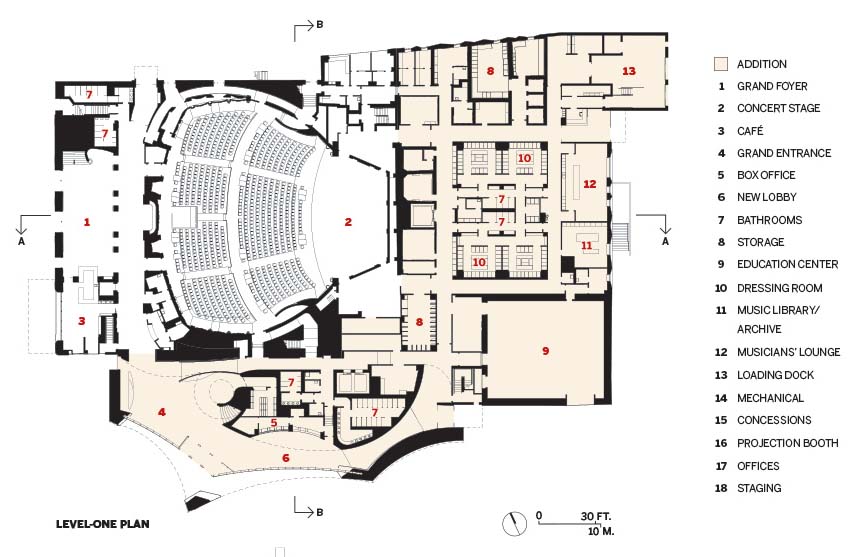
Image courtesy Snøhetta
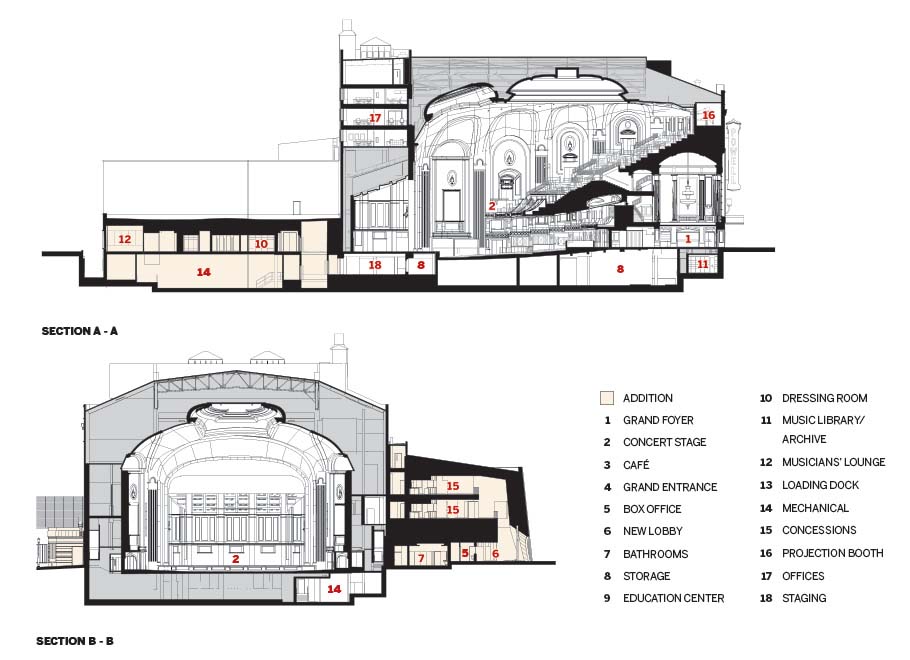
Image courtesy Snøhetta
Credits
Architect:
Snøhetta
Architect of Record:
Christner Architects (now CannonDesign)
Engineers:
David Mason + Associates (civil); KPFF (structural); Geotechnology Inc. (environmental); McClure Engineering (MEP/FP)
Consultants:
Schuler Shook (theater planning); Kirkegaard (acoustics); Front (facade); Cohen Hilberry Architects (accessibility)
General Contractor:
BSI Constructors
Client:
St. Louis Symphony Orchestra
Size:
189,000 square feet
Cost:
$155 million (total)
Completion:
September 2025
Sources
Precast Concrete:
DEX by Wells
Curtain Wall:
Saint Gobain, Millet Glass, Kawneer
Masonry:
Interstate Brick
Interior Gass Doors:
C.R.L., Oldcastle BuildingEnvelope
Acoustical Ceilings:
9wood
Looking for a reprint of this article?
From high-res PDFs to custom plaques, order your copy today!