In Brooklyn, Woods Bagot Transforms an Abandoned 19th-Century College into Housing with Character
-1535-Ret-(HR).webp?t=1771427646)
Architects & Firms
Brooklyn’s Bedford-Stuyvesant neighborhood, famous as the setting of Spike Lee’s Do the Right Thing and home of rappers Notorious B.I.G. and Jay-Z, also claims one of the largest collections of preserved Victorian-era buildings in the country. The result of a rapid urbanization process that saw Dutch farmsteads developed into housing primarily for German and Irish immigrants, long tree-lined blocks of townhouses are interspersed with schools and churches. Among them is the original site of St. John’s College, a Romanesque Revival red-brick building that opened in 1870 and served as the main campus for a century. The school relocated to Queens in the 1970s, and the Bedford-Stuyvesant facility fell into disuse and disrepair. It sat dilapidated until last summer, when it reopened as a newly renovated residential complex.
-1325-Ret-(HR).jpg "The Hartby")
Photo © Mike Van Tassell
The New York office of international architecture firm Woods Bagot transformed the former St. John’s College into 205 studios and one- and two-bedroom apartments, 30 percent of which are rent stabilized. Dubbed the Hartby, a portmanteau of the cross streets it spans along Lewis Avenue—Hart and Willoughby—the renovation also added 10,000 square feet of amenities, including a landscaped courtyard, a subterranean parking garage, a roof terrace, a gym and yoga room, a communal lounge, and coworking spaces.
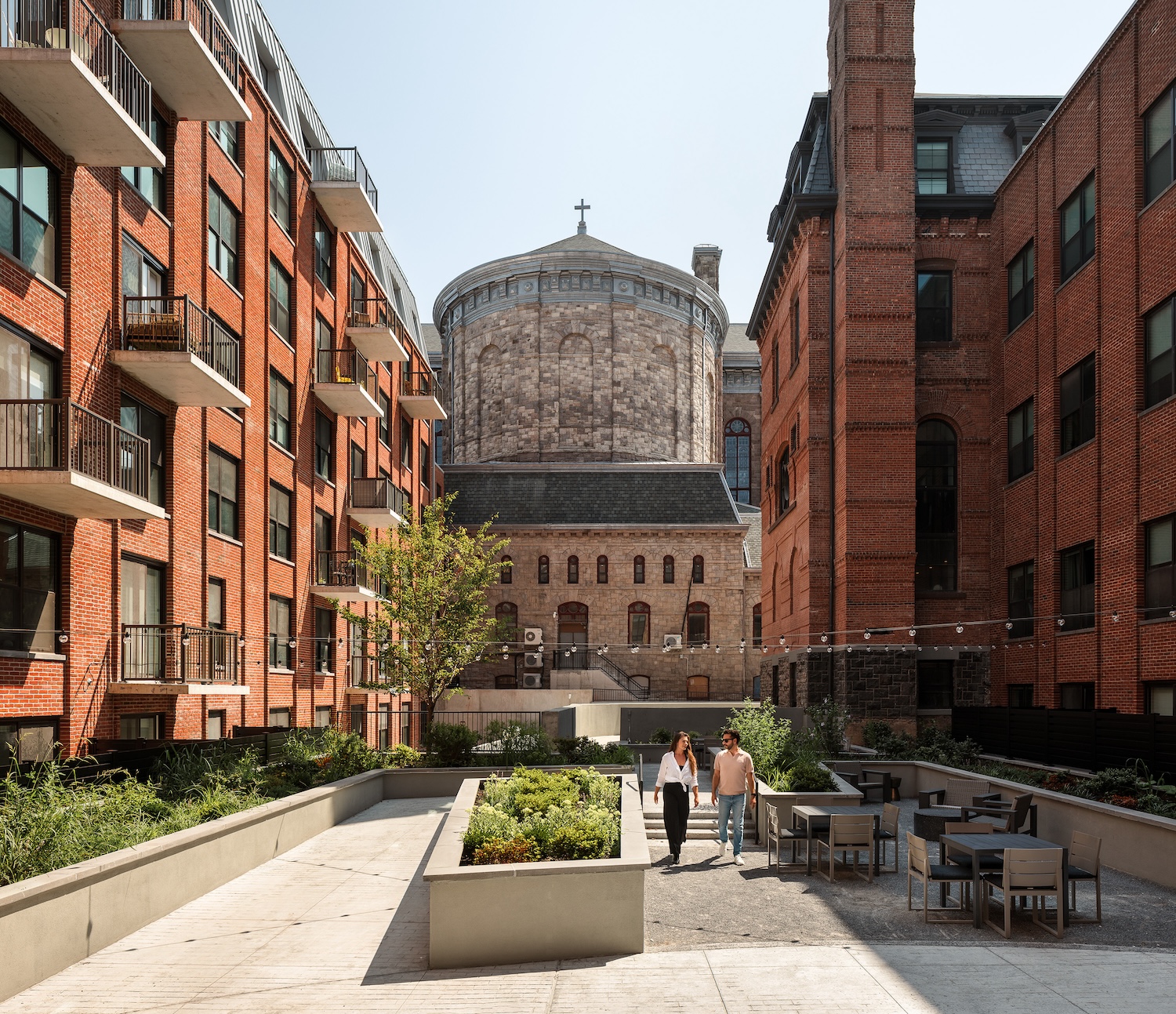
Photo © Mike Van Tassell
The five-story building sits behind St. John the Baptist Roman Catholic Church, which owns the site. Both the school and the church were designed by architect Patrick Keely, himself an Irish immigrant to Brooklyn who would build nearly 600 ecclesiastical structures across North America throughout his career. After St. John’s College moved out, the church was unable to maintain the building. “It looked like a great place to shoot a horror movie,” says Matt Linde, principal and CEO of the Hartby’s real-estate developer People Restoring Communities. “Paint was chipping off the walls. Holes everywhere. Debris all over the floor. Birds flying through it. It was clearly a severely neglected asset.”
The Romanesque Revival church, constructed of large bluestone ashlars, evokes a similar grandiosity and eeriness as the former school building. While it is still in use, years of deferred maintenance have left its rose window and much of the stained glass boarded up with plywood. Hoping to raise funds, in 2017, the congregation and the developer negotiated a 99-year lease. While the agreement grants the right to build on and operate the site, it was important to the church that as much of the original building as possible be maintained. The architects agreed.
.jpg "The Hartby")
Photo © Mike Van Tassell
“We wanted to be good stewards to the community. We didn’t want to put up a steel and glass structure here,” says James Hickerson, the Woods Bagot principal in charge and project architect. But demolishing and erecting a new tower would have been the easier and faster route, and because the structure is not landmarked, it was an option. One of the biggest challenges with the adaptive reuse was complying with zoning codes. To accommodate the parking required for residential zoning, the architects decided to demolish and rebuild the Willoughby side of the u-shaped school building, which allowed for the excavation of a basement garage.
.jpg "The Hartby")
Photo © Mike Van Tassell
Another challenge was the unknown conditions of the dilapidated structure. While the design was finalized in 2018, and construction started prior to the pandemic in 2020, it took nearly six more years to complete the project, mostly because of discoveries made on-site. The foundations turned out to be rubble, requiring permeation grouting, or an injection of concrete to stabilize the areas that had begun to sag.
Not all the on-site discoveries were a headache. “We would find really beautiful brick detailing,” says Hickerson, “so if we could just clean it up and incorporate it, it added more character.” Original features, like an ornate chapel window and the cupola over what was once the primary entrance, were integrated as special moments in penthouses.
Looking for quick answers on architecture and design topics?
Try Ask RECORD, our new smart AI search tool.
Ask RECORD →
.jpg "The Hartby")
A virtually staged unit. Image courtesy The Hartby
-1479-Ret-(HR).jpg "The Hartby")
Photo © Mike Van Tassell
The rebuilt wing along Willoughby, which became the new entrance, was constructed of pre-engineered concrete planks, and it went up quickly compared to the meticulous restoration and repurposing of the rest of the building. The new portions are finished in an ornately detailed red brick, an homage to the original building while remaining identifiably modern. The school’s slate roof is also echoed in the new standing-seam mansard roof over the rebuilt wing.
Bedford-Stuyvesant has repeatedly transformed, and St. John’s College—now the Hartby—is a part of that ongoing story. Starting in the 1930s, the neighborhood became predominantly Black, eventually adopting the nickname “Brooklyn’s Little Harlem.” While every effort has been made to be respectful of the site’s history, the project sits uneasily within debates about the urgent need for housing and concerns over displacement, as “transplants” are defining a new chapter of the neighborhood’s story.
While a portion of the Hartby’s rentals is below market rate, the majority is priced between approximately $3,000 and $6,000 per month, well beyond reach for longtime Bedford-Stuyvesant residents. Yet the alternatives—continued decay or wholesale demolition—would have erased the building, its history, and connection to the community. And how will the tradeoffs be measured if the redevelopment allows St. John the Baptist Church to finally restore its boarded-up rose window and make other long-overdue repairs? With this adaptive reuse, architecture finds itself again on both sides of the double-edged sword of gentrification.
Looking for a reprint of this article?
From high-res PDFs to custom plaques, order your copy today!